




An autonomous pentest pilot should run on your own application, not a vendor sandbox, for a fixed 30-day window against a scorecard you agree before day one. Point the tool at a real target your team understands, plant a small set of known bugs so you can measure what it misses and what it invents, and score it on five axes: validated findings, false-positive rate, time to first confirmed bug, retest behavior, and coverage. Anything short of that is a demo, and a demo tells you how the tool performs on the vendor's chosen target, not yours.
This is the run-it-yourself playbook for that pilot. It is written for the security lead, application owner, or platform engineer who has already shortlisted one or more autonomous or hybrid AI pentest tools and now needs a defensible way to compare them on production reality. It assumes you have done the vendor-selection homework already. If you have not, start with the questions to ask an AI pentest vendor, then come back here to actually run the trial.
The core question this answers: how do you pilot an autonomous penetration testing tool on your own app before buying it? You give every tool the same target, the same window, and the same seeded bugs, you validate every finding yourself, and you let one scorecard decide. The rest of this post is the mechanics.
Key takeaways
Pilot on your own app, because generic AI still misses the bugs that matter. In HackerOne's 9th Edition Hacker-Powered Security Report, 58 percent of surveyed researchers name business logic as the class AI tools are weakest at identifying, and a further 39 percent name multi-step or chainable exploits (HackerOne 9th HPSR, Figure 10). A demo target rarely holds those classes. Your app does.
Measure false positives directly, not on trust. The strongest AI agent in Stanford's 2025 benchmark carried an 18 percent false-positive rate while human testers were near-perfect (Stanford et al., 2025). A planted-bug test turns that risk into a number you can hold vendors to.
A confirmed bug beats a long findings list. Score validated findings, not raw output. A tool that files 40 findings where 12 are real is worse than one that files 14 where 13 are real.
Retest behavior is a buying criterion. The value of continuous AI pentesting is fast re-validation after a fix. If the tool cannot confirm a fix without a full re-scan, that shows up on the scorecard.
Keep a human in the validation loop. Only 12 percent of researchers in that report believed AI could fully replace humans, and in the Stanford benchmark 80 percent of human participants found a critical remote-code-execution bug that the best-scoring agent reported only under guided elicitation with hints. The hybrid model exists for that gap.
What this pilot measures, and why
The pilot replaces vendor claims with your own evidence on four questions: does the tool find real, high-impact bugs in your application, how much noise does it generate along the way, how fast does it deliver the first confirmed finding, and does it re-validate a fix without a full manual redo. Those become the five scorecard axes below.
The method leans hard on false positives and planted bugs because that is where AI pentesting is measurably weakest today. Stanford's 2025 study put a purpose-built agent, ARTEMIS, second overall against ten human professionals, finding nine valid vulnerabilities at an 82 percent valid-submission rate, and it still posted a higher false-positive rate than any human and missed a remote-code-execution flaw most humans caught (Stanford et al., 2025). Adoption is climbing at the same time, with HackerOne recording a 210 percent jump in valid AI-assisted vulnerability reports in a single year (HackerOne, 2025). Both are true at once, which is exactly why you pilot rather than assume. Every figure here links back to its primary publisher so any claim can be audited.
The 30-day AI pentest bake-off, week by week
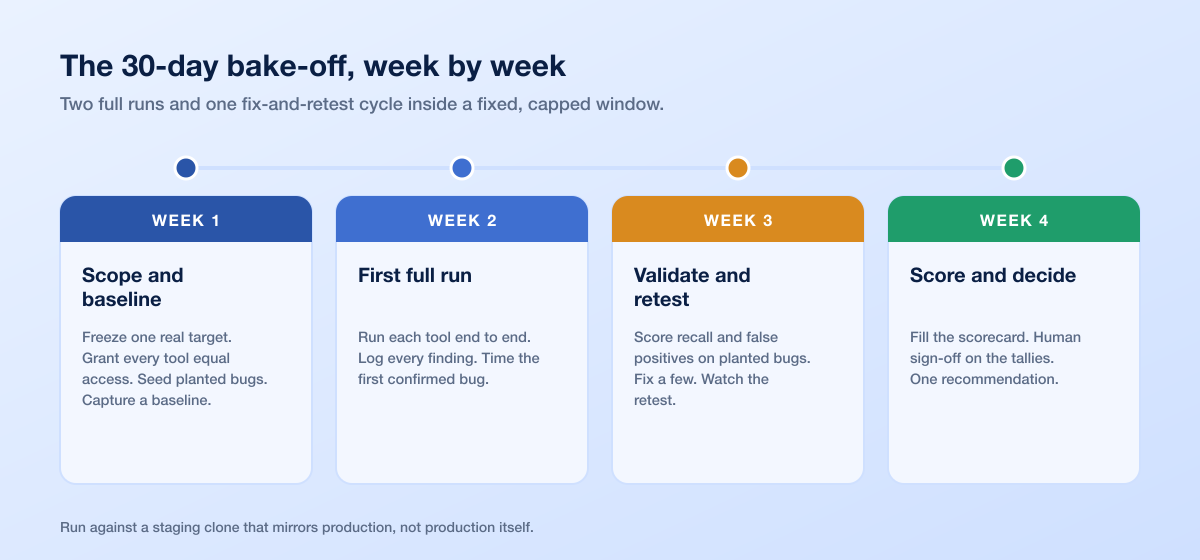
Thirty days is long enough for a tool to complete at least two full runs and one retest cycle, and short enough that the trial does not drift into an unpaid engagement. Run it against a staging environment that mirrors production, not production itself, so the planted-bug work below cannot touch real users or real data. For the availability and blast-radius reasoning behind that choice, see running an autonomous pentest against production safely.
Week 1: Scope and baseline
Pick one real target application and freeze it. Grant the tool the same access every candidate will get: the same credentials, the same test accounts, the same API documentation, the same network path. Write down the scope in a machine-readable allowlist so no tool wanders. Then seed your planted bugs into a fresh clone of that target (see the next section). Capture a baseline: what does your current scanner or last human pentest already know about this app? You are measuring lift over what you have, not lift over nothing.
Week 2: First full run
Let each tool run end to end without hand-holding. Record wall-clock time to the first confirmed finding, not the first raw finding. Log every finding into one shared tracker with a status column: unreviewed, confirmed, false positive, duplicate. Do not fix anything yet. The goal this week is an honest picture of raw output and the noise around it.
Week 3: Planted-bug validation and retest
Now score detection. For each planted bug, mark whether the tool found it, and for every finding the tool filed, mark whether it is real. That gives you recall on the seeded set and a false-positive rate on the total. Then fix two or three real findings and trigger a retest. Watch how the tool re-validates: does it confirm the fix precisely, does it need a full re-scan, does it reopen or duplicate. Retest behavior is where continuous tools earn or lose their subscription.
Week 4: Score and decide
Fill in the scorecard for every tool from the same tracker. Hold a validation review with a senior tester in the room so a human signs off on the confirmed and false-positive tallies. Convert the five axes into one recommendation. The decision should be boring by now, because the data already made it.
The planted-bug method
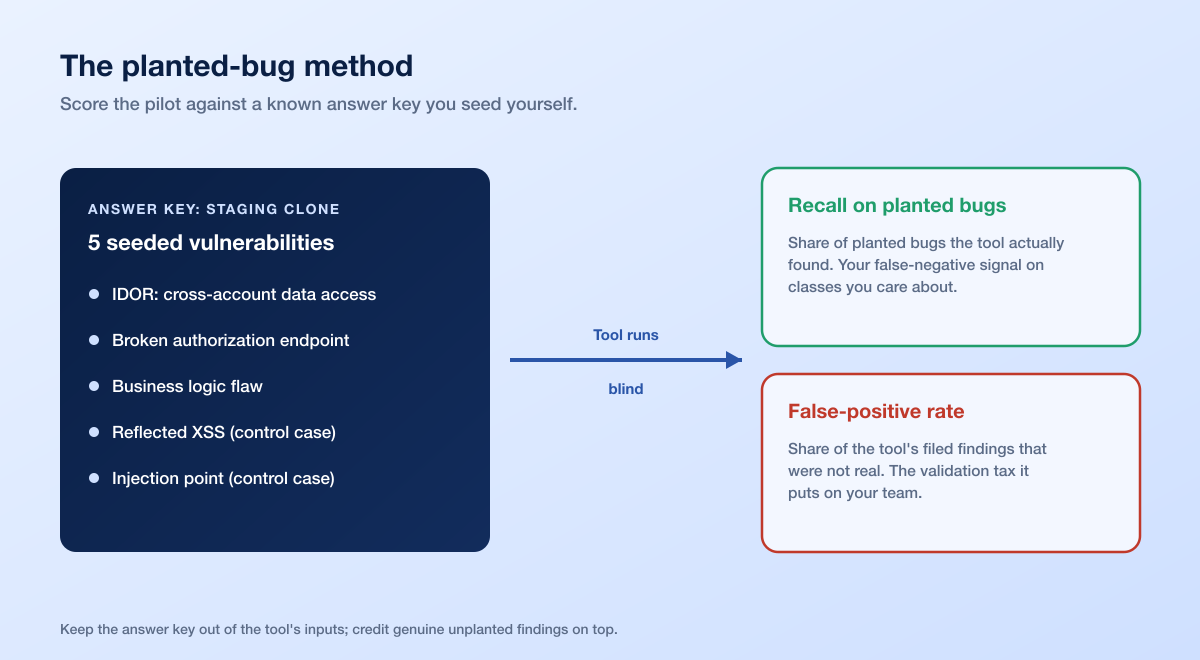
You cannot measure a tool's miss rate against an app whose bugs you do not know. The planted-bug method fixes that. In a staging clone, deliberately introduce a small, documented set of vulnerabilities, then treat the pilot as a scored test against a known answer key.
Seed a spread that covers both the easy floor and the hard ceiling:
An IDOR: change a record identifier so one test account can read or modify another account's data. This is the flagship complex class and the one generic scanners routinely miss.
A broken-authorization endpoint: a privileged action reachable by an unprivileged role, for example an admin-only API callable with a standard user token.
A business-logic flaw: a workflow that accepts an invalid state, such as a negative quantity, a re-used one-time coupon, or a price set client-side.
A reflected cross-site-scripting bug and a basic injection point as control cases. Any credible tool should catch these. If a tool misses the floor, it will not reach the ceiling.
Document each planted bug precisely: the endpoint, the parameter, the exact reproduction, and the expected severity. Keep the answer key out of the tool's inputs. When the run finishes, two numbers fall out. Recall is the share of planted bugs the tool actually found, which tells you about false negatives on classes you care about. The false-positive rate is the share of the tool's filed findings that were not real, which tells you how much validation tax the tool imposes on your team every week. A tool can look impressive on raw volume and still fail both.
One caution: planted bugs measure detection only on the classes you seeded. Give real credit to a tool that also surfaces genuine, unplanted findings you did not know about. That is the prize; the planted set is just the calibrated floor beneath it.
The scorecard: fill in your numbers
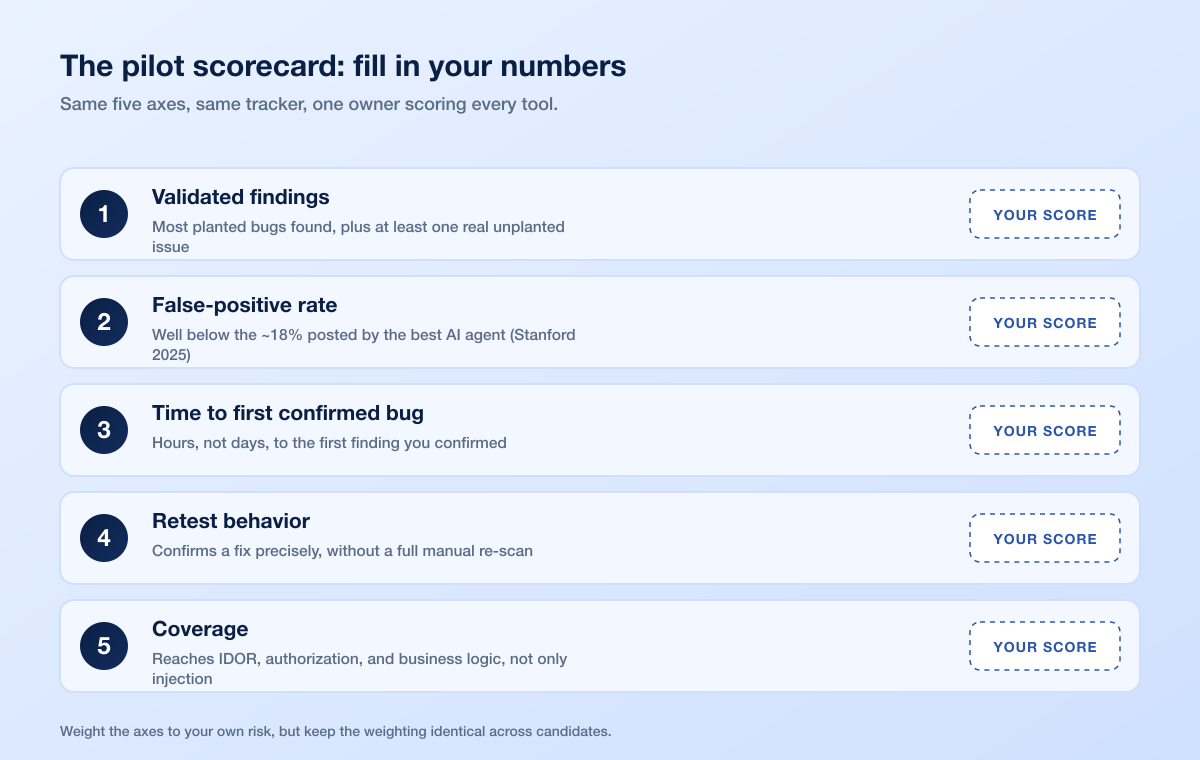
Score every tool on the same five axes, from the same shared tracker, judged by the same person. Copy this table, one column per tool.
Metric | What to measure | How to score it | Good result |
|---|---|---|---|
Validated findings | Findings you personally confirmed as real and exploitable, including planted bugs found | Count confirmed only. Ignore unreviewed and false positives | Finds most planted bugs plus at least one real unplanted issue |
False-positive rate | Share of the tool's filed findings that were not real | False positives divided by total filed findings | Meaningfully below the roughly 18 percent seen from the best AI agent in Stanford's 2025 benchmark |
Time to first confirmed bug | Wall-clock time from run start to the first finding you confirmed | Record hours or days to first confirmed, not first raw | Hours, not days |
Retest behavior | How the tool re-validates after you fix a finding | Fix two or three, trigger retest, note precision and effort | Confirms the specific fix without a full manual redo |
Coverage | Which planted classes and app surfaces the tool reached | Map findings to IDOR, authorization, business logic, and the control cases | Reaches the complex classes, not only the injection floor |
Weight the axes to your own risk. A team drowning in scanner noise should weight false-positive rate heavily. A team shipping daily should weight retest behavior and time to first confirmed bug. A team worried about authorization bugs should weight coverage of the complex classes. The point of the scorecard is that the weighting is explicit and the same across every candidate.
Keep the bake-off apples-to-apples
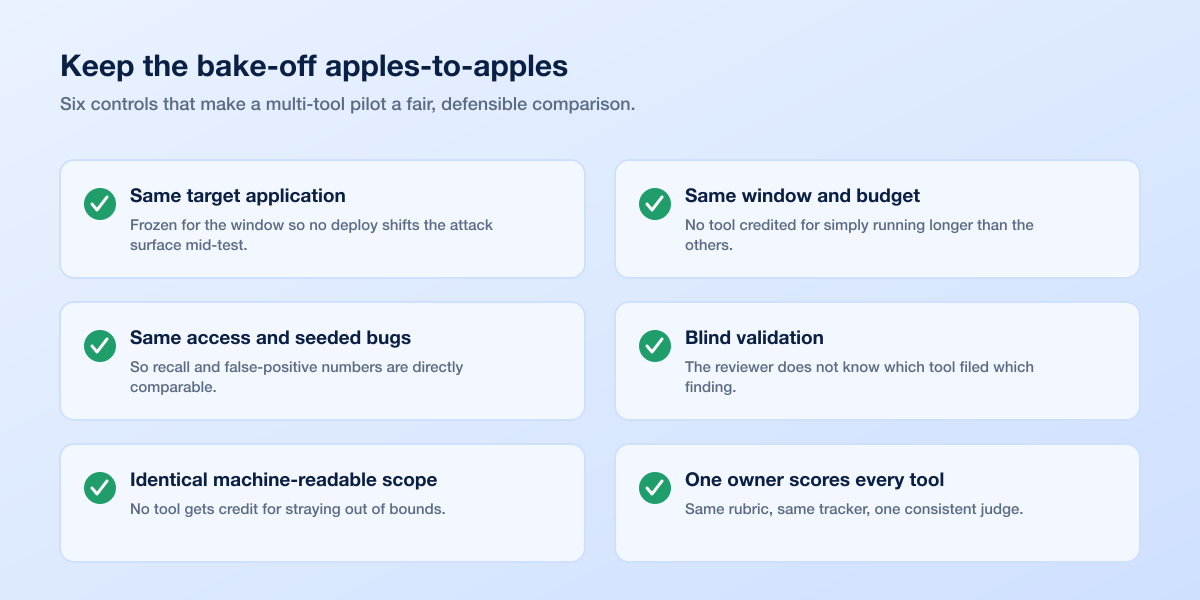
A pilot only produces a defensible decision if every tool runs under identical conditions. Six controls keep it fair:
Same target application for every tool, frozen for the pilot window so no deploy changes the attack surface mid-test.
Same 30-day window and same run budget, so a tool is not credited for simply running longer.
Same access and same seeded bugs, so recall and false-positive numbers are comparable.
Blind validation: the person confirming findings should not know which tool filed which finding while they judge real versus false positive.
Identical, machine-readable scope, so no tool gets credit for straying out of bounds.
One owner scores every tool against the same rubric, in the same tracker, so the comparison is not colored by who ran which trial.
Resist two temptations. Do not let a vendor run the pilot on their own target, which measures their demo and not your app. And do not quietly extend the window for a favorite tool, because an uncapped trial stops being a fair test.
Running the pilot as a hybrid, with Stingrai
Stingrai is a global CREST-accredited penetration testing services company founded in Toronto, Canada in 2021, trusted by companies from startups to enterprises to meet audit requirements for SOC 2, ISO 27001, CMMC, PCI DSS and HIPAA. OSCE³, OSWE, OSEP, CREST CRT certified pentesters, who are also world-class security researchers and bug bounty hunters. Choose from fully human-led or hybrid (AI agents plus human penetration testers) engagements across web, API, mobile, AI and LLM, cloud, network, Active Directory and social engineering penetration tests and red team engagements.
The scorecard is deliberately vendor-agnostic. Run it against whatever you shortlisted. Where Stingrai fits is the hybrid version of this pilot, scoped against your actual web application rather than a sample target.
Stingrai's autonomous agent, Snipe, is a swarm of specialised agents covering recon, authentication, access control, business logic, injection and remote code execution, which is exactly the class list this playbook seeds and scores: IDOR, business logic flaws and broken authorization, the bugs generic AI scanners routinely miss. It runs black-box dynamic testing, authenticated grey-box testing across every user role in your app, and white-box review of your source, generates AutoFix pull requests for what it finds, retests automatically once a fix ships, and can sit as a PR-gating check that blocks vulnerable code before it merges. It is custom-trained on more than 6,000 HackerOne Hacktivity disclosure reports plus skills distilled from years of Stingrai's penetration testers' methodology. In a hybrid pilot, two named penetration testers test the same scope at the same time as the agent for the whole window, directing where it hunts and extending the paths it opens, which is precisely the false-positive control the Stanford data argues for.
A web application penetration testing pilot can be run either way on one web application and its APIs: the Autonomous tier at US$3,000, Snipe alone with no penetration testers on the engagement and a "No High or Critical Finding = Don't Pay" guarantee, or the Hybrid tier at US$6,800 with testers and the agent on the scope together. Both post findings to the PTaaS portal as they are confirmed, each with a working proof of concept and remediation guidance, with live tester chat, Jira and Slack push, retesting and an attestation letter included, and both are available one-time or on a monthly programme. For pilot scoping and pricing, see the Stingrai pricing page.
Frequently asked questions
How should I pilot an autonomous penetration testing tool on my own app before buying it?
Run a fixed 30-day trial against a real application you control, staged as a clone so testing cannot touch live users. Give every candidate the same target, access, and window, seed a small set of known bugs so you can measure detection and false positives, validate every finding yourself, and score each tool on validated findings, false-positive rate, time to first confirmed bug, retest behavior, and coverage. Let that single scorecard, not the sales demo, make the decision.
What is a good false-positive rate for an AI pentest tool?
Aim meaningfully below the roughly 18 percent false-positive rate that the best AI agent posted in Stanford's 2025 real-world benchmark, where human testers were near-perfect (Stanford et al., 2025). Measure it directly with planted bugs rather than accepting a vendor figure. In a hybrid model, senior human validation on high-severity findings is what pulls the effective rate down.
How long should an AI pentest pilot run?
Thirty days is the practical sweet spot: long enough for at least two full runs and one fix-and-retest cycle, which is what exposes retest behavior, and short enough that the trial does not turn into unpaid production work. Cap the run budget so no tool is credited for simply running longer than the others.
What is the planted-bug method?
You seed a small, documented set of vulnerabilities into a staging clone of your app, keep the answer key out of the tool's inputs, and treat the pilot as a scored test. Recall tells you what share of the planted bugs the tool found; the false-positive rate tells you what share of its filed findings were not real. Together they turn tool accuracy from a claim into two numbers.
Should I run the pilot on production or staging?
Run planted-bug testing on a staging clone that mirrors production, never on live systems, so seeded vulnerabilities and destructive test actions cannot reach real users or data. If you do point any autonomous tool at production later, demand enforced runtime scope, an immediate stop control, rate limits, and a full audit trail first (running an autonomous pentest against production safely).
What should an AI pentest pilot scorecard include?
Five axes: validated findings you personally confirmed, false-positive rate measured against seeded bugs, time to first confirmed bug in wall-clock time, retest behavior after you fix a finding, and coverage across the complex classes such as IDOR, broken authorization, and business logic. Keep the weighting explicit and identical across every candidate.
How is a pilot different from evaluating a vendor's marketing?
Marketing tells you how a tool performs on a target the vendor picked. A pilot tells you how it performs on yours. The vendor-selection work belongs upstream in the questions to ask an AI pentest vendor. This playbook is the downstream step where you prove those claims on your own app.
Can an AI pentest tool replace my human pentesters?
Not today. Only 12 percent of researchers in HackerOne's 2025 report believed AI could fully replace human researchers, and in Stanford's 2025 benchmark 80 percent of human participants found a critical remote-code-execution bug that the best-scoring agent reported only under guided elicitation with hints (HackerOne, 2025; Stanford et al., 2025). The strongest model is hybrid: an autonomous agent for speed and coverage, senior humans validating and extending the high-impact findings.
What is the difference between an autonomous pentest and a hybrid pentest?
An autonomous pentest is driven end to end by an AI agent that plans, tests, and reports within a defined scope. A hybrid pentest keeps that agent as the engine and puts senior human pentesters alongside it throughout, so false positives are filtered and complex chains are extended before anything reaches your report. Your pilot can score either, but the planted-bug and false-positive axes are where the hybrid difference tends to show.
References
Stanford University et al. Comparing AI Agents to Cybersecurity Professionals in Real-World Penetration Testing. arXiv:2512.09882, December 2025. https://arxiv.org/abs/2512.09882. Benchmarks AI pentest agents against ten human professionals; reports the ARTEMIS agent placing second with nine valid vulnerabilities at an 82 percent valid-submission rate, higher false-positive rates than humans, and a missed critical remote-code-execution flaw.
HackerOne. 2025 Hacker-Powered Security Report (9th Edition), AI security trends. 2025. https://www.hackerone.com/blog/ai-security-trends-2025. Survey and platform data on AI in offensive security, including the share of researchers who name business logic as the class AI tools are weakest at identifying, the separate share who name multi-step or chainable exploits, the share who believe AI could replace humans, and a 210 percent year-over-year jump in valid AI-assisted vulnerability reports.