




Attackers now hand off freshly compromised access to a second threat group in a median of 22 seconds, and they dwell inside a network for a median of 14 days before anyone notices, according to Mandiant's M-Trends 2026, drawn from more than 500,000 hours of frontline incident response in 2025. A red team engagement exists to answer one question against numbers like these: if a determined adversary got in, would your people, process, and technology catch and stop them before real damage. That is a different question from a penetration test, and it is priced differently.
Where Stingrai fits: Stingrai is a global CREST-accredited penetration testing services company founded in Toronto, Canada in 2021, trusted by companies from startups to enterprises to meet audit requirements for SOC 2, ISO 27001, CMMC, PCI DSS and HIPAA. OSCE³, OSWE, OSEP, CREST CRT certified pentesters, who are also world-class security researchers and bug bounty hunters. Choose from fully human-led or hybrid (AI agents plus human penetration testers) engagements across web, API, mobile, AI and LLM, cloud, network, Active Directory and social engineering penetration tests and red team engagements. Red team days are only worth budgeting against people who can run the scenario. Stingrai's engagements are led by a team lead with 16 years in penetration testing, red teaming and exploit development holding OSCE³, OSED, OSWE, OSEP, CRTL, CRTO and CRTE, working with a second named penetration tester. The scenarios on offer are assumed breach, black-box full chain, and threat intelligence-led exercises of the kind DORA and TIBER-style programmes require, on-premise and in cloud, with phishing and vishing, physical entry to a facility, Active Directory attack paths and purple teaming against real-world TTPs alongside your SOC available as objectives inside the same engagement. Red team scopes are quoted against the objective through the Get a Quote form; the published US$3,000 and US$6,800 packages on the pricing page cover one web application and its APIs, not a red team.
Here is the direct answer to how much it costs and what drives the price. A red team is quoted on senior tester-days, not per application or per IP, so the total tracks how many days the scenario realistically demands. Six factors set that day count: scope breadth, scenario count, engagement duration, threat-intelligence depth, the objective you set, and any physical or social-engineering add-ons. As third-party market context, published UK pricing guides place senior CREST-certified consultants around 1,200 to 1,300 pounds per day and full red team exercises around 18,000 to 48,000 pounds over three to eight weeks (EJN Labs, 2026; roughly US$23,000 to US$61,000 at a July 2026 rate near US$1.28 to the pound). Regulated, intelligence-led programs sit well above that band because they run for months. Stingrai does not publish a flat red team price because no two scenarios need the same day count; current packages and scoping live on the Stingrai pricing page.
This post is the Stingrai team's 2026 buyer reference for budgeting a red team before you write an RFP. It carries figures from five sources: Mandiant M-Trends 2026, IBM Cost of a Data Breach 2025, Verizon DBIR 2025, Mordor Intelligence, and the DORA and TIBER-EU frameworks, with one clearly labeled third-party UK pricing guide for day-rate context. Lead threat and cost data is full-year 2025 telemetry and 2026 market projections, the freshest available; primary publishers have not released full-year 2026 incident reports as of July 2026. Every figure links to its source so any claim can be audited inline, and all day-rate ranges below are market context, not a Stingrai quote.
TL;DR: what a red team engagement costs to run
The unit of cost (2026): senior tester-days. The total is a blended day rate multiplied by the days the scenario needs, plus threat intelligence and any add-ons.
Third-party day-rate context (2026): senior CREST-certified consultants around 1,200 to 1,300 pounds per day in the UK market (EJN Labs, 2026).
Third-party full-exercise band (2026): roughly 18,000 to 48,000 pounds for a full red team exercise over three to eight weeks, market context, not a Stingrai quote (EJN Labs, 2026).
The CREST premium (2026): accredited testing is reported to run 20 to 40 percent above non-accredited equivalents, because the assurance is verified (EJN Labs, 2026).
Regulated red teams cost more because they last longer (2026): a DORA threat-led penetration test follows TIBER-EU across five phases and runs 9 to 14 months (DORA Articles 26 to 27).
Why the spend is justified (2025): attackers dwell a median of 14 days before detection (Mandiant M-Trends 2026) and the average breach costs US$4.44M (IBM, 2025).
Market direction (2026 to 2031): the penetration testing market is projected to grow from US$2.72B to US$5.54B, a 15.29 percent CAGR (Mordor Intelligence).
Key takeaways
Red team cost is a day-count problem, not a price-list problem. Because engagements are quoted on senior tester-days, every scoping decision adds or removes days, so you control the biggest lever by defining the objective tightly rather than asking for everything at once. A focused, single-scenario assessment is a fraction of a broad, multi-vector program.
Duration is the driver buyers underestimate most. A penetration test runs days to a couple of weeks; a realistic red team runs weeks, and a regulated one runs months. The DORA and TIBER-EU model spans 9 to 14 months across five phases (DORA Articles 26 to 27), and each extra week of stealthy operating is more senior time on the invoice.
The stakes reframe the budget. With a median 14-day dwell time (Mandiant M-Trends 2026) and an average breach cost of US$4.44M (IBM, 2025), a well-scoped red team that surfaces a real attack path before an adversary does is measured against seven-figure downside, not a pentest line item.
Methodology
This reference draws on five sources, each cited inline where its data appears: Mandiant M-Trends 2026 (Google Cloud Threat Intelligence, released March 2026, based on 500,000-plus hours of 2025 incident response), source of the 22-second hand-off and 14-day dwell time; IBM Cost of a Data Breach Report 2025 (with the Ponemon Institute), source of the US$4.44M average breach cost; Verizon 2025 DBIR, source of the human-element share of breaches; Mordor Intelligence Penetration Testing Market report (2026), source of the US$2.72B to US$5.54B projection at a 15.29 percent CAGR; and DORA (Articles 26 to 27) with the ECB TIBER-EU framework, source of the three-year TLPT cadence and 9-to-14-month timeline. Day-rate and full-exercise figures come from one clearly labeled third-party UK market guide (EJN Labs, 2026) and are UK market context, not Stingrai pricing. The research pass closed on July 7, 2026. Figures that could not be matched to a named source were dropped rather than estimated, and Stingrai's own commercial terms are routed to the pricing page.
How a red team engagement is priced
A red team quote is built, not looked up. The core of every proposal is the same: a blended senior day rate multiplied by the total tester-days the scenario requires, plus discrete line items for threat intelligence and any physical or social-engineering work.
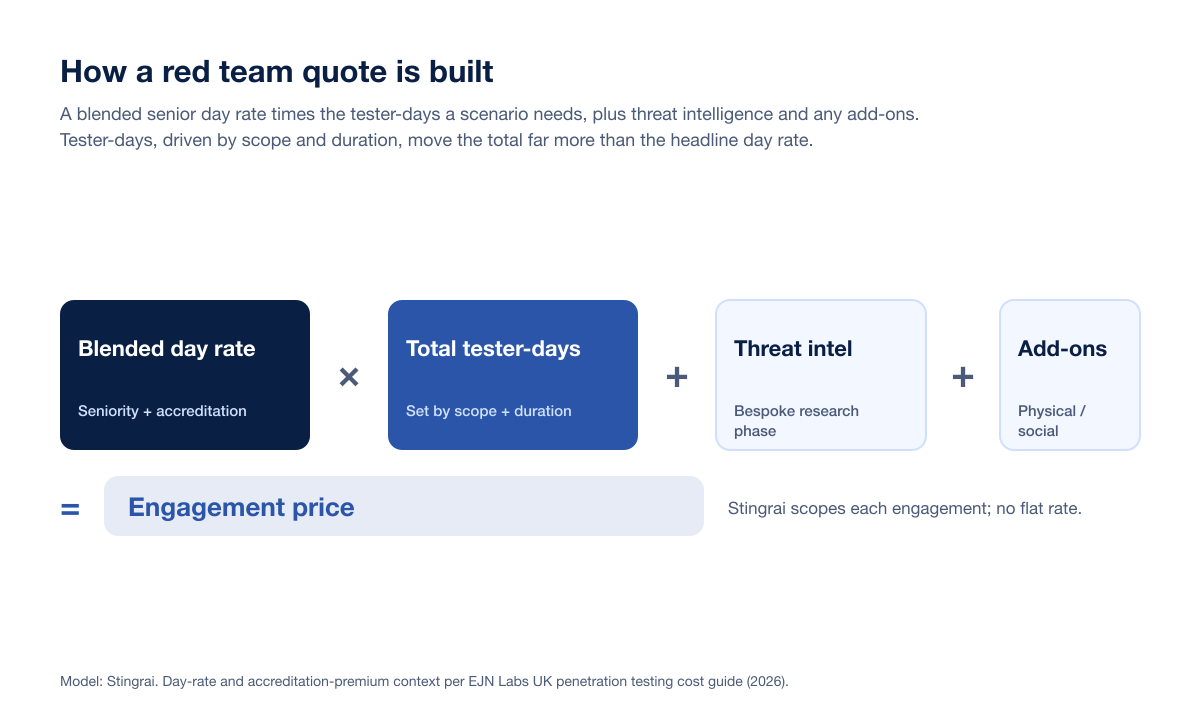
Two things follow. The day rate reflects seniority and accreditation, which is why CREST-accredited work carries a premium (EJN Labs, 2026): a red team needs operators who chain access quietly, not run a scanner. And tester-days, the variable you negotiate through scope, move the total far more than the headline day rate. When you compare two quotes, compare tester-days and the objective first; a low day rate on a vague, open-ended engagement often costs more than a higher rate on a tightly bounded one. Our guide on how to compare penetration testing quotes covers normalizing proposals so you compare like for like.
The six cost drivers, ranked
Every red team quote is the sum of six decisions, ranked here by how much they typically move the total.
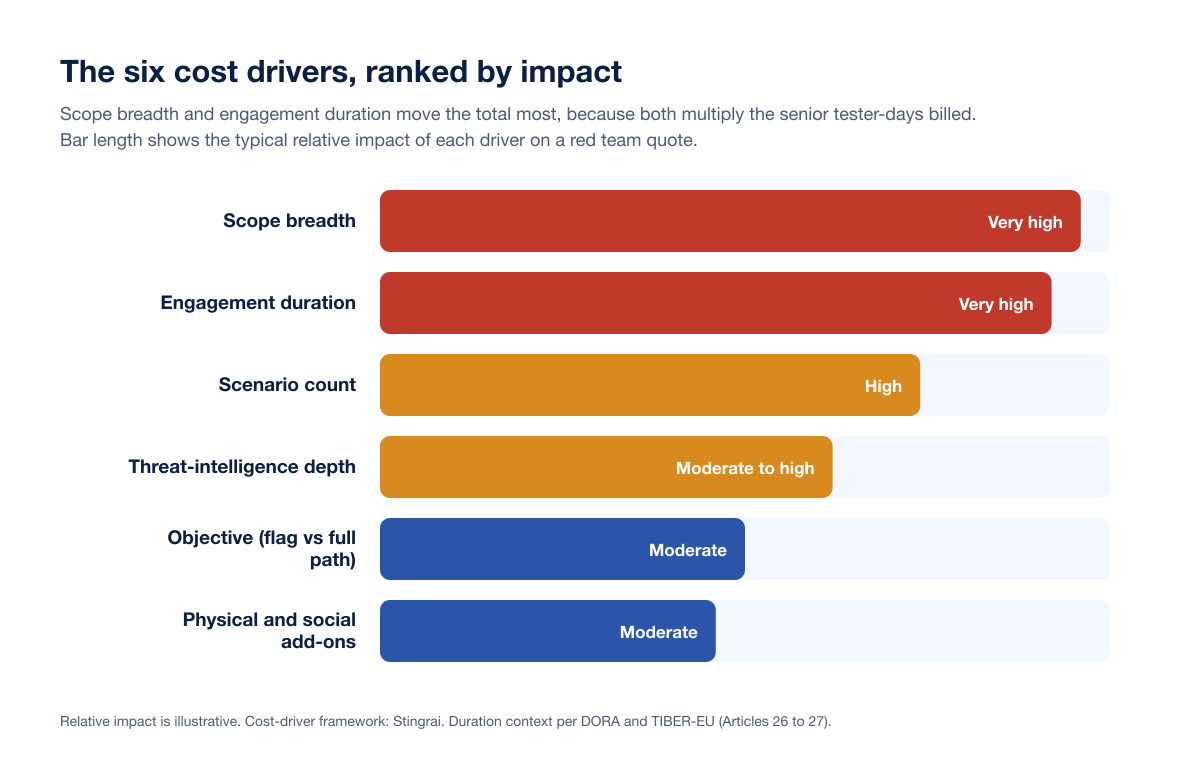
1. Scope breadth
Scope is the top lever. One scenario against a single business-critical application or identity path is a fraction of a program spanning cloud, on-premise, endpoints, identity, and multiple business units. Broader scope means more reconnaissance, more attack paths, and more tester-days, so the discipline that saves money is defining the crown-jewel objective and scoping the minimum surface to reach it.
2. Engagement duration
Duration converts scope into days. A focused red team runs in weeks; a patient, stealthy campaign runs longer; regulated programs run for months. Under DORA, a threat-led penetration test follows TIBER-EU across five phases and takes 9 to 14 months from procurement to supervisory attestation (DORA Articles 26 to 27). Every extra week of covert operations is more senior time billed.
3. Scenario count
One threat scenario, such as an assumed-breach test that starts from a compromised laptop, is cheaper than emulating three adversaries with different starting points and objectives. Each scenario needs its own planning, execution, and evidence. Starting mid-chain with an assumed-breach engagement buys deep post-exploitation coverage without paying for weeks of external reconnaissance you may not need.
4. Threat-intelligence depth
An intelligence-led red team opens with bespoke research into who would target you and how. That phase is a real cost line: the TIBER-EU model allocates 6 to 10 weeks to it before the red team engages (DORA Articles 26 to 27). A lighter engagement reuses existing threat profiles and goes straight to execution, lowering the price but also the fidelity of the adversary you emulate.
5. The objective
A flag-hunt that ends when the team proves it can reach a target costs less than a full attack-path exercise that maps every step, tests detection at each stage, and runs a purple-team replay. The more you ask the engagement to teach your defenders, the more tester and analyst time it consumes. Choosing proof of exposure versus a full detection-and-response rehearsal is a budget decision, not just a technical one.
6. Physical and social-engineering add-ons
Physical intrusion, badge cloning, and social engineering such as phishing, vishing, or pretexting are add-ons because they are separate skill sets with their own planning and legal guardrails. They are also where real adversaries win: the human element, error, misuse, or social engineering, featured in about 60 percent of breaches (Verizon 2025 DBIR). Include them if a targeted human operator is in your threat model; drop them for a clean saving if not.
Cost driver | What it changes | Typical impact on the total |
|---|---|---|
Scope breadth | Reconnaissance and attack paths | Very high |
Engagement duration | Total tester-days billed | Very high |
Scenario count | Distinct planning and execution cycles | High |
Threat-intelligence depth | Bespoke research phase | Moderate to high |
Objective (flag vs full path) | Analyst and validation time | Moderate |
Physical and social add-ons | Separate specialist skill sets | Moderate |
Scoping factors that quietly move a quote
Beyond the six drivers, practical factors change the number on the proposal. Accreditation sets the day rate: CREST-accredited work is reported to run 20 to 40 percent above non-accredited testing (EJN Labs, 2026), and for regulated or insured organizations that assurance is the deliverable. On-site work adds travel and per-day premiums that remote operations avoid. A defined retest to confirm your fixes held is usually a further share of the original cost, and it is worth budgeting up front rather than treating as a surprise. Testing safely against production, with tight rules of engagement and monitoring, also takes more careful, and therefore more billed, time than testing a staging replica.
Red team versus penetration test: why the cost gap is real
Buyers often ask why a red team costs more than a penetration test. The answer is that they are not the same work. A penetration test enumerates and exploits vulnerabilities in a defined scope over days to a couple of weeks, and it is the right instrument for coverage and compliance evidence. A red team emulates a specific adversary against your whole defensive stack over weeks to months, staying stealthy, chaining access, and testing whether detection and response actually fire. More time, more seniority, and more disciplines mean more tester-days, and tester-days are the cost.
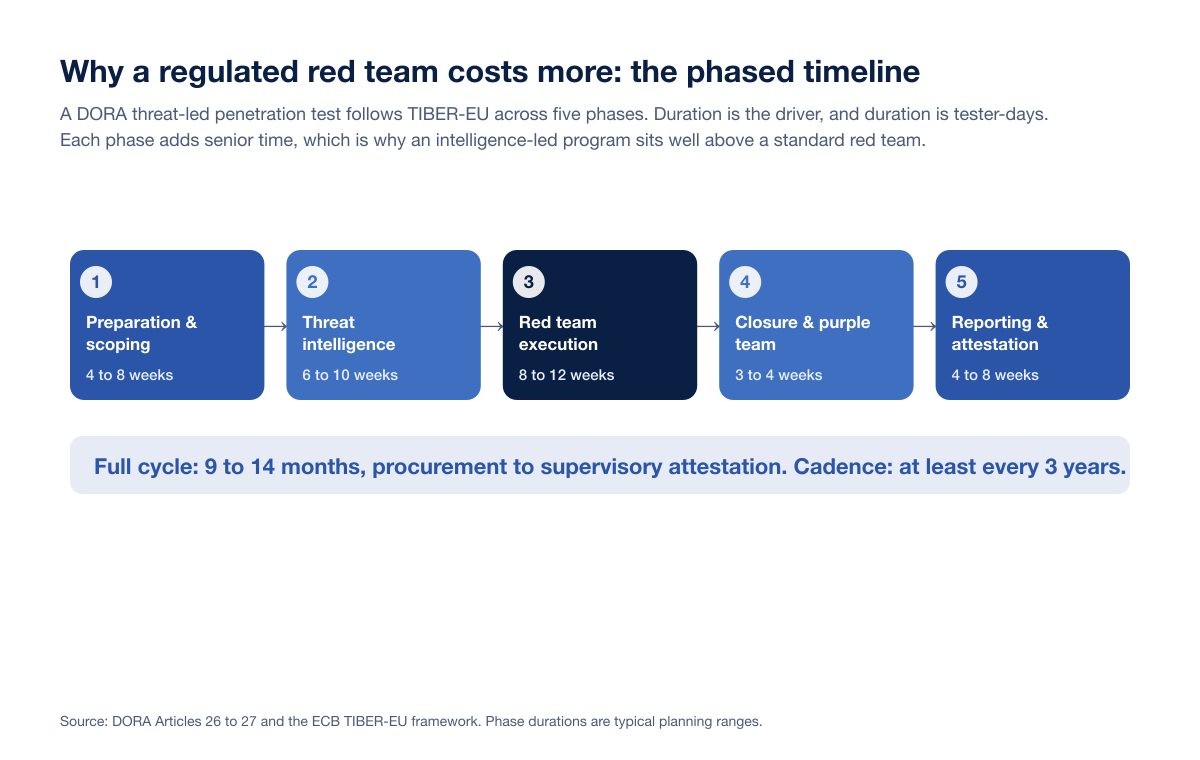
The regulated end of the market makes the gap concrete. A DORA threat-led penetration test is a months-long, intelligence-led program with a preparation phase, a dedicated threat-intelligence phase, a red team execution window of 8 to 12 weeks, a closure and purple-team phase, and a reporting and attestation phase (DORA Articles 26 to 27). If your objective is a compliance snapshot on a fixed scope, a penetration test is the efficient buy. If your objective is to know whether you would detect a real intrusion, a red team is the instrument, and its price reflects the depth. For a fuller side-by-side, see red team vs penetration test vs continuous validation.
Where autonomous testing changes the math
The tester-day model is where a hybrid approach earns its keep. Stingrai's red team engagements are run by named senior penetration testers who choose the scenario, chain access from initial foothold to objective, and test whether your detection and response actually fires, because that judgment is what a red team is for. Where a web application is one of the paths into the estate, Stingrai's autonomous agent, Snipe, adds depth on that surface: it hunts IDOR, broken authorization and business-logic flaws that generic scanners miss, runs black-box, authenticated grey-box and white-box source review, and can gate pull requests so vulnerable code is caught before it ships, while the penetration testers test alongside it. The point is not to swap human tester-days for a cheaper bot; it is to spend senior days on the adversarial thinking only people do, while autonomous web-application testing covers the application layer in parallel. For teams that also want coverage to persist between engagements, continuous red teaming versus the annual pentest lays out the trade-offs.
What this means for a buyer budgeting before an RFP
Lead with the objective, not the asset list. Define the one thing you most need to know, then scope the minimum surface to test it. Objective-first scoping is the cleanest way to control tester-days.
Decide flag versus full attack-path early. Proof of exposure is cheaper than a full detection-and-response rehearsal with a purple-team replay. Both are valid; pick deliberately.
Treat social and physical work as optional line items. Include them only if a targeted human adversary is in your threat model.
Budget the retest. Confirming your remediation held is part of the value, not an afterthought.
Compare tester-days and objectives, not headline day rates. Normalize competing proposals on scope and days first with how to compare penetration testing quotes.
Get a scoped number. Because price only means something once the scenario is set, the fastest path to an accurate figure is a scoping conversation. Stingrai's PTaaS and offensive-security services start from your objective.
Frequently asked questions
How much does a red team engagement cost in 2026?
A red team engagement is priced on senior tester-days, so the total depends on the scenario rather than a fixed list price. As third-party UK market context, published guides place senior CREST-certified consultants around 1,200 to 1,300 pounds per day and full red team exercises around 18,000 to 48,000 pounds over three to eight weeks (EJN Labs, 2026; roughly US$23,000 to US$61,000 at a July 2026 rate near US$1.28 to the pound). Regulated, intelligence-led programs cost materially more because they run for months. Stingrai prices each engagement to scope; see the pricing page.
What drives the price of a red team engagement?
Six factors set the tester-day count that determines the price: scope breadth, engagement duration, scenario count, threat-intelligence depth, the objective you set, and any physical or social-engineering add-ons. Scope breadth and duration move the total most, because both directly multiply the number of senior days billed.
Why does a red team cost more than a penetration test?
A penetration test enumerates and exploits vulnerabilities in a defined scope over days to a couple of weeks. A red team emulates a specific adversary against your whole defensive stack over weeks to months, staying stealthy and testing detection and response. The extra time, seniority, and disciplines mean more tester-days, and tester-days are the cost.
How long does a red team engagement take?
A focused red team can run in a few weeks, while a regulated, intelligence-led program runs far longer. A DORA threat-led penetration test follows the TIBER-EU methodology across five phases and takes 9 to 14 months from procurement to supervisory attestation (DORA Articles 26 to 27). Duration is one of the biggest cost drivers because each week is more billed senior time.
Is CREST accreditation worth the premium?
Accredited testing is reported to cost 20 to 40 percent more than non-accredited equivalents (EJN Labs, 2026). For regulated organizations, boards, and cyber-insurance renewals, the verified process and tester competence is the deliverable, so the premium usually buys a report a regulator or underwriter will accept without follow-up questions. Stingrai is a CREST-accredited penetration testing service provider.
How can I reduce the cost of a red team engagement?
Define a single, crown-jewel objective and scope the minimum surface to reach it. Consider starting mid-chain with an assumed-breach engagement to buy deep post-exploitation coverage without weeks of external reconnaissance, choose a flag objective over a full attack-path rehearsal if proof of exposure is enough, and drop physical or social add-ons if a targeted human adversary is not in your threat model.
What is threat-led penetration testing under DORA?
Threat-led penetration testing (TLPT) is an intelligence-led red team required for designated financial entities under DORA Articles 26 to 27, conducted at least every three years and following the TIBER-EU methodology (DORA Articles 26 to 27). It costs more than a standard red team because it adds a formal threat-intelligence phase and supervisory attestation, extending the program to 9 to 14 months.
Talk to Stingrai
Scoping a red team against what this guide covers takes one short conversation, because the objective sets the days and the days set the price. Stingrai is a CREST-accredited penetration testing service provider at firm level, founded in 2021, headquartered in Toronto with a London office, and rated 5.0 out of 5 across 20 Clutch reviews. Its named penetration testers come from a team that holds OSCE³, OSWE, OSEP, CRTL, CRTO, CREST CRT and CISSP and has published 18 CVEs. They run assumed-breach, black-box and threat intelligence-led red team exercises, purple teaming with your SOC, and the network, Active Directory, cloud, social engineering and application testing that feeds them, one-time or continuously through the PTaaS platform, with findings posted as they are confirmed, retesting of remediated findings, and an attestation letter and verified badge with every report. Book a free scoping call, get a quote, or read the published pricing.
References
Mandiant (Google Cloud Threat Intelligence). M-Trends 2026. March 2026. https://cloud.google.com/blog/topics/threat-intelligence/m-trends-2026/. Frontline incident-response metrics from more than 500,000 hours of investigations in 2025, including the 22-second access hand-off and 14-day median dwell time.
IBM. Cost of a Data Breach Report 2025. 2025 (with the Ponemon Institute). https://www.ibm.com/reports/data-breach. Global average breach cost of US$4.44M and a 241-day mean time to identify and contain.
Verizon. 2025 Data Breach Investigations Report. 2025. https://www.verizon.com/business/resources/reports/dbir/. Analysis of breach patterns including the human-element share used to justify social-engineering scoping.
Mordor Intelligence. Penetration Testing Market Size, Share and Trends. 2026. https://www.mordorintelligence.com/industry-reports/penetration-testing-market. Market projection from US$2.72B in 2026 to US$5.54B in 2031 at a 15.29 percent CAGR.
European Union. Digital Operational Resilience Act (DORA), Articles 26 to 27, and the ECB TIBER-EU framework. https://www.regulation-dora.eu/tlpt. Threat-led penetration testing cadence of at least every three years and the five-phase, 9-to-14-month engagement timeline.
EJN Labs. UK Penetration Testing Cost Guide 2026. 2026. https://ejnlabs.com/penetration-testing-cost-uk/. Third-party UK market context for senior consultant day rates, full red team exercise ranges, and the accreditation premium.
Budget your red team against your objective, not a price list
The most accurate red team estimate starts from what you most need to know, then scopes the tester-days to prove it. Stingrai's named senior penetration testers run the adversary scenario, assumed breach, black-box or threat intelligence-led, with purple teaming against your SOC available as part of the same exercise; Snipe adds depth on any web application in the path; and every proposal is scoped to your objective rather than a flat rate. Explore Stingrai's red teaming service or review current packages and scoping to start the conversation.