




The average data breach now takes 241 days to identify and contain, according to IBM's Cost of a Data Breach Report 2025. That is roughly eight months of exposure, and the number is a nine-year low. In the first hours after you learn something is wrong, that timeline is exactly what you are fighting: every decision either shortens the window or widens it. So the question lands fast, usually from a founder or a security lead staring at a customer email or a monitoring alert: do we need an emergency penetration test right now?
Here is the direct answer. Most organizations do need an emergency penetration test after a serious incident, but not as the first step and not as a substitute for incident response. Containment and forensics come first. The penetration test is the second responder: it validates the reported flaw, confirms the fix actually closes it, checks whether the same weakness is exposed elsewhere, and produces the fresh report your customers, partners, and auditors will ask for. A focused engagement can typically start within a few business days. This guide walks the first 48 hours, the real triggers, and what a rapid engagement realistically covers.
TL;DR
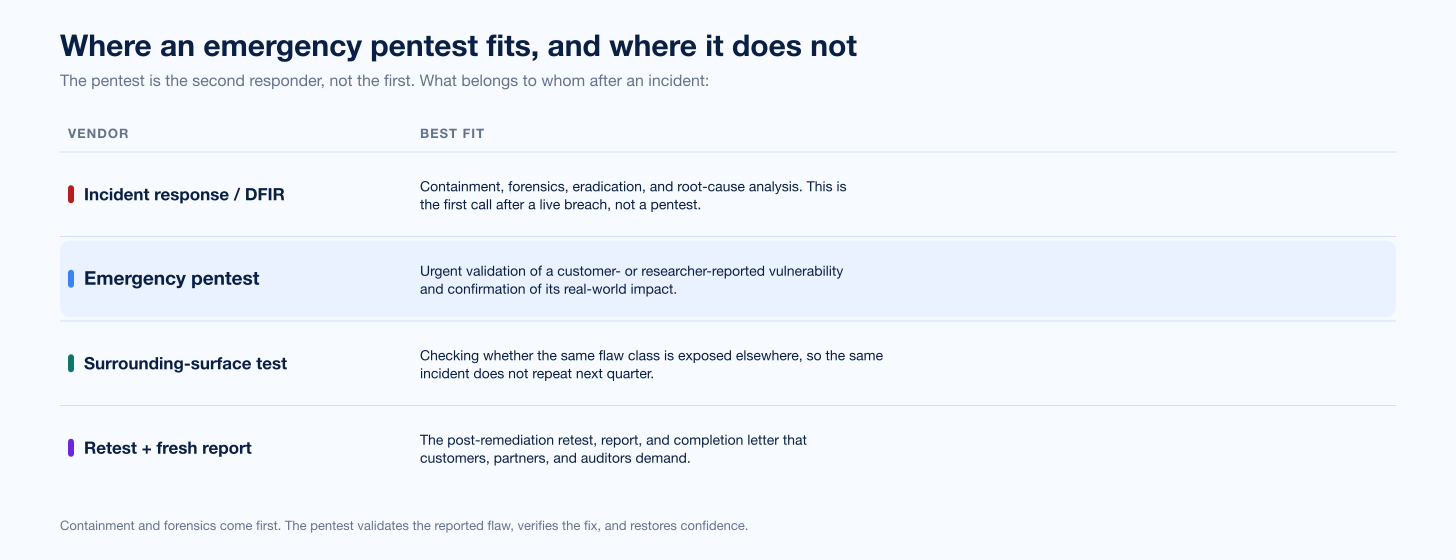
The order that matters: incident response first, penetration test second. A pentest is not incident response, and running one on a live, uncontained breach wastes both efforts.
The first 48 hours belong to containment. Isolate affected systems, preserve logs, rotate exposed credentials and keys, and engage your IR or DFIR team. Scope the urgent test in parallel, but do not start it until the fire is out.
Four real triggers for an emergency pentest: a customer- or researcher-reported vulnerability, a remediation you need independently verified, a surrounding attack surface you need proven clean, and a current report your customers demand.
Realistic start time: a focused, flaw-class engagement can usually kick off within a few business days, far faster than a scheduled annual test.
Why the surrounding surface matters: software vulnerabilities are now the single most common way attackers get in, ahead of stolen credentials, per the Verizon 2026 Data Breach Investigations Report. If one flaw was exploitable, the same class often hides elsewhere.
Key takeaways
A penetration test does not contain a breach. Containment, forensics, and eradication belong to an incident response or DFIR team. The pentest verifies the reported flaw and the fix, and tests the surrounding surface. Confusing the two costs you time you do not have.
The strongest trigger is a reported vulnerability, not a full compromise. Many "do we need a pentest now" moments come from a customer, a bug-bounty submission, or a researcher, not a ransomware note. That is exactly the case an emergency pentest is built for: urgent, independent validation and impact rating.
Speed comes from scope discipline. A rapid engagement is fast because it targets the incident's flaw class first, then widens. Trying to boil the ocean is what makes emergency testing slow.
The report is a business asset, not paperwork. After an incident, enterprise customers and auditors ask for evidence that you found the problem, fixed it, and checked around it. A current, independent report is often what unblocks the renewal or the deal.
Start with the honest answer: incident response first, pentest second
If systems are actively compromised, data is moving, or ransomware is detonating, you are in incident response, not testing. Your priorities are containment, evidence preservation, and eradication. That work belongs to an incident response or DFIR team, internal or external, and it is a different discipline from offensive security. A penetration test simulates an attacker to find and prove exploitable weaknesses. It does not perform forensics, it does not run containment, and it should never be pointed at a system that is still on fire.
The reason to be strict about this order is practical. Median attacker dwell time is now about 11 days globally, per Mandiant's M-Trends 2025 report. During an active intrusion, an offensive test adds noise to the exact logs your responders need, can collide with attacker activity, and can burn hours you should be spending on containment. Get the incident understood and controlled first. Then the pentest has something concrete to validate.
What incident response owns
Detection and triage, containment and isolation, forensic analysis of what happened, malware and log analysis, eradication of attacker access, and recovery. The output is an incident timeline, a root-cause understanding, and a recovery plan. Stingrai focuses on offensive testing; that containment, forensics, and eradication work belongs to a dedicated incident response (IR/DFIR) team, and a strong pentest partner keeps that line clear.
What the penetration test owns
Once the incident is contained and the root cause is understood, the offensive side takes over: reproduce and validate the specific vulnerability that was reported or exploited, rate its real-world impact, verify that the remediation holds, and test whether the same flaw class is exposed elsewhere across your web applications and infrastructure. The output is a fresh, independent report and, where appropriate, a completion letter.
When an emergency pentest is actually the right call
Not every incident needs an urgent test, and not every "we should get a pentest" moment is an incident. These are the four situations where a rapid engagement genuinely earns its place.
A customer or researcher reported a vulnerability. This is the most common trigger, and it is frequently not a full breach at all. Someone outside your team says "your app leaks other customers' data" or "I changed an ID and saw records that were not mine." You need that claim reproduced, confirmed or ruled out, and rated for impact, quickly and independently.
A fix needs independent verification. Your engineers shipped a patch under pressure. Before you tell customers it is resolved, you want an external tester to confirm the root cause is actually closed and no bypass or variant remains.
The surrounding attack surface is unproven. One IDOR or one broken-authorization flaw is rarely alone. Because software vulnerabilities are now the top initial access vector across breaches (Verizon 2026 DBIR), the responsible move is to test whether the same class of bug is hiding in adjacent endpoints, services, or applications.
Customers and auditors are demanding a current report. After an incident, enterprise buyers, partners, and auditors ask a simple question: prove you found it, fixed it, and checked around it. A recent, independent report is often the fastest path to keep a contract from stalling. Our note on whether a pentest report is still valid covers how buyers read report freshness.
If none of these apply, for example a low-severity finding you have already reproduced and patched with confidence, you may not need an emergency engagement at all. You may simply fold the area into your next scheduled test.
The first 48 hours: a decision framework
The first two days are about not making the situation worse, gathering facts, and lining up the right test so it can start the moment containment allows. Think of it as two clocks: the first 48 hours, which belong to containment and scoping, and the first month, which is where validation, remediation, retesting, and reporting play out.
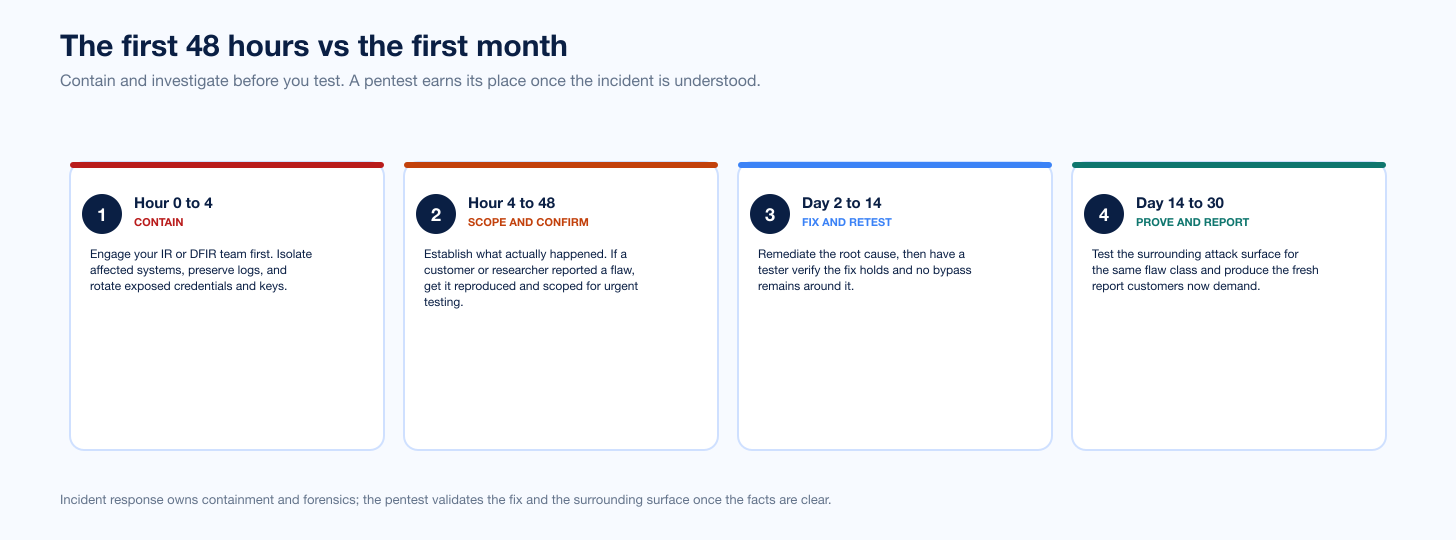
First 48 hours: contain and scope
Hour 0 to 4, contain. Engage your IR or DFIR resource. Isolate affected systems, preserve logs and forensic artifacts before anything is wiped, and rotate credentials, tokens, and keys that may be exposed. Do not start any offensive testing yet.
Hour 4 to 48, scope and confirm. Establish what actually happened. If a customer or researcher reported a specific flaw, capture the exact report, the affected endpoint, and any proof they provided, then get it into a shape a tester can reproduce. In parallel, contact a penetration testing firm and agree scope, rules of engagement, and access so the test can start as soon as the environment is stable. Our guide on how to scope a penetration test helps you brief a provider fast without over-scoping.
First month: fix, retest, and prove
Day 2 to 14, fix and retest. Remediate the root cause. Then have a tester verify the fix holds under adversarial conditions, not just that the happy path no longer errors. This is where an emergency pentest confirms the specific reported issue is genuinely closed.
Day 14 to 30, prove and report. Test the surrounding attack surface for the same flaw class, then produce the current, independent report your customers and auditors are asking for, including a completion letter where that is what the buyer needs. The difference between the two is covered in our completion letter versus full report explainer.
Pentest versus incident response: a side-by-side
Because the two are so often conflated in the panic of the moment, here is the boundary in one table.
Dimension | Incident response (IR / DFIR) | Emergency penetration test |
|---|---|---|
Primary goal | Contain, investigate, eradicate, recover | Validate the reported flaw and verify the fix |
When it runs | During and immediately after the incident | Once the incident is contained and understood |
Core activities | Forensics, log and malware analysis, containment | Reproduce the flaw, test the class, retest the fix |
Key question | What happened, and how do we stop it? | Is it exploitable, is it fixed, is it exposed elsewhere? |
Main deliverable | Incident timeline, root cause, recovery plan | Fresh pentest report, remediation evidence, completion letter |
Who provides it | IR or DFIR firm, or an internal CSIRT | Offensive security firm such as Stingrai |
Read across the rows and the division of labor is clear. You want both, in sequence, not one pretending to be the other.
What a rapid engagement realistically covers, and how fast it can start
An emergency engagement is fast because it is disciplined about scope. Rather than a full-scope assessment of everything you own, it targets the incident's flaw class first, then widens outward only as far as the risk justifies. That is what lets a focused test start within a few business days rather than the weeks a calendar-driven annual test can take to schedule.
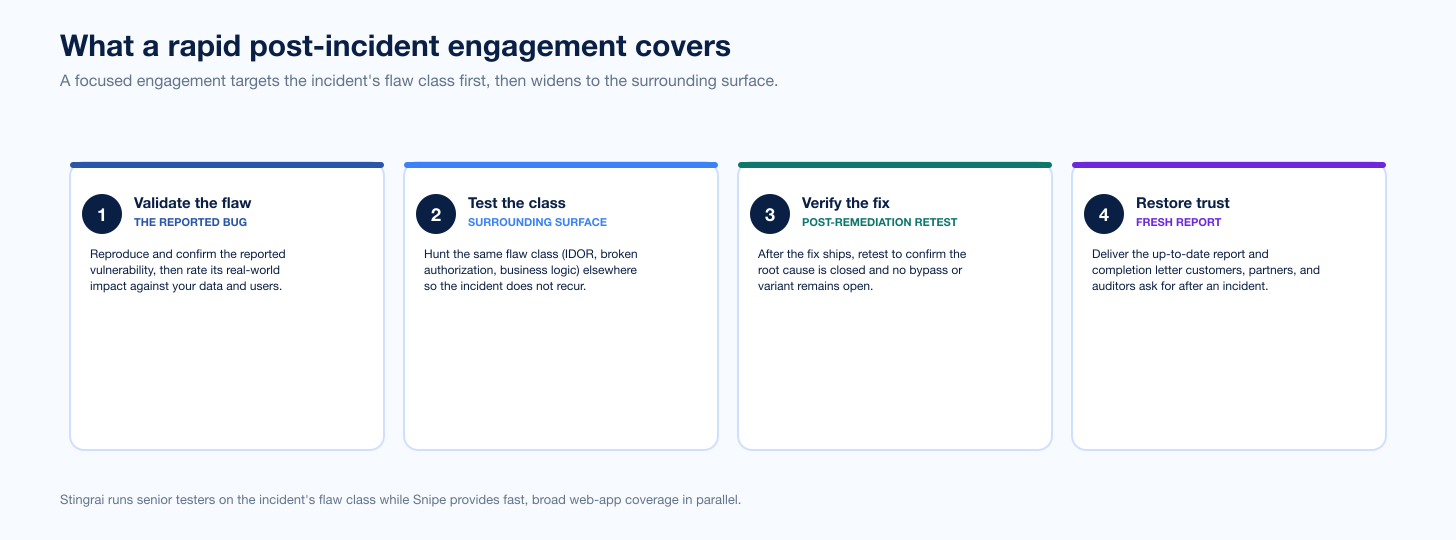
A realistic rapid scope covers four things. First, validate the reported flaw: reproduce the customer- or researcher-reported vulnerability and rate its real impact against your actual data and users. Second, test the class: hunt the same category of bug, often IDOR, broken authorization, or business-logic flaws, across adjacent functionality so the incident does not recur next quarter. Third, verify the fix: once remediation ships, retest to confirm the root cause is closed and no bypass survives. Fourth, restore trust: deliver the current report and completion letter that unblock customer and auditor conversations.
What this means for defenders
If you are in the urgent moment, the sequence is what protects you. Contain first, understand the incident, then bring in offensive testing to validate and prove. A few concrete moves make the pentest half of that far faster and more useful.
Line up an offensive-security partner before you need one. The organizations that recover fastest already know who they will call. Having scope templates, access patterns, and a point of contact agreed in advance turns a multi-week procurement into a few days.
Insist the reported flaw is reproduced, not assumed. A rapid engagement should confirm or rule out the specific claim first, then rate impact. Stingrai runs senior testers on the incident's flaw class while Snipe, our autonomous web-application testing agent, provides fast, broad coverage across the surrounding surface in parallel. Snipe is Stingrai's AI agent for web application penetration testing, including the application's APIs. It is available for autonomous web testing or alongside penetration testers in a Hybrid web engagement.
Test the class, not just the instance. Verifying a single patch is necessary but not sufficient. Prove the same weakness is not exposed elsewhere, which is exactly where the surrounding-surface pass and, where warranted, a broader red team engagement add value.
Treat the report as the trust-recovery artifact it is. A current, independent report backed by a retest is often what keeps a nervous enterprise customer from walking. Our note on using a pentest to unblock an enterprise security review covers how buyers evaluate that evidence.
Stingrai's penetration testing also supports your SOC 2, ISO 27001, HIPAA, and PCI DSS compliance programs, so the same post-incident work that restores customer confidence can feed your audit evidence. For scope and turnaround on a rapid engagement, the current packages are on the Stingrai pricing page.
Frequently Asked Questions
Do we need an emergency penetration test after a security incident or breach, and how fast can one start?
In most cases, yes, but not first and not instead of incident response. Contain the incident and complete forensics before testing. Once the incident is understood, an emergency penetration test validates the reported flaw, verifies the fix, and tests the surrounding attack surface. A focused, flaw-class engagement can typically start within a few business days, and Stingrai can scope one while your containment work is still underway.
Is a penetration test the same as incident response?
No. Incident response and DFIR own containment, forensics, eradication, and recovery during and immediately after an incident. A penetration test simulates an attacker to find and prove exploitable weaknesses. The pentest runs after the incident is contained, to validate the reported flaw, confirm the remediation, and check the surrounding surface. You want both, in sequence.
A customer reported a vulnerability. What should we do first?
Capture the exact report, including the affected endpoint and any proof of concept, and preserve relevant logs. If it looks like active exploitation, treat it as an incident and contain first. Then engage a penetration testing firm to reproduce the specific claim, confirm or rule it out, and rate its real-world impact before you respond to the customer with a fix and evidence.
How fast can an urgent penetration test start?
A focused engagement can usually start within a few business days, because it targets the incident's flaw class rather than your entire estate. Speed comes from scope discipline and from having a provider, access, and rules of engagement agreed in advance. Broader, full-scope assessments take longer to schedule and are better run once the emergency is handled.
Should we run the pentest before or after we fix the vulnerability?
Both, in a sequence. First, validate that the reported flaw is real and understand its impact. Fix the root cause. Then retest to confirm the fix holds under adversarial conditions and that no bypass or variant remains. Testing only before the fix leaves you without proof it worked; testing only after can miss the impact rating you needed to prioritize.
What does a post-incident penetration test actually cover?
Four things: validating and reproducing the reported flaw, testing the same flaw class across the surrounding attack surface, verifying the remediation after it ships, and producing a current independent report and completion letter. The scope stays tight on the incident's root cause first, then widens as far as the risk justifies.
How much does an emergency penetration test cost?
Cost depends on the scope, the flaw class, and how much of the surrounding surface needs coverage, so an emergency engagement is priced per situation rather than from a fixed rate. Stingrai keeps current packages and the fastest way to get a scoped quote on the pricing page.
Will a fresh pentest report help us restore customer confidence after an incident?
Usually, yes. After an incident, enterprise customers, partners, and auditors want evidence that you found the problem, fixed it, and checked around it. A current, independent report backed by a retest is often the fastest way to keep a renewal or deal from stalling. A completion letter can be enough for some buyers; others want the full report.
Can AI speed up a post-incident penetration test?
Yes, when it is paired with senior human testers. Stingrai runs experienced pentesters on the incident's specific flaw class while Snipe, our autonomous web-application agent, provides fast, broad coverage of the surrounding surface in parallel and can open AutoFix pull requests for what it finds. Snipe is built to hunt complex classes such as IDOR and broken authorization, which is exactly where post-incident risk tends to concentrate.
References
IBM. Cost of a Data Breach Report 2025. July 2025. https://www.ibm.com/reports/data-breach. Global average breach cost of US$4.44M and US average of US$10.22M, with an average breach lifecycle of 241 days to identify and contain, a nine-year low.
Mandiant (Google Cloud). M-Trends 2025. April 2025. https://cloud.google.com/blog/topics/threat-intelligence/m-trends-2025. Global median attacker dwell time of 11 days across 2024 investigations, with detection-source breakdowns for internal, external, and adversary notification.
Verizon. 2026 Data Breach Investigations Report. 2026. https://www.verizon.com/business/resources/reports/dbir/. Software vulnerabilities are now the leading initial access vector, ahead of stolen credentials, and ransomware appears in a large share of breaches.