




An enterprise deal stuck in security review is rarely stuck on price or product. It is stuck because the buyer's security team has asked for evidence you cannot yet produce, and the single most common blocker is a credible third-party penetration test report. Sales sees a signed order form days away; security review turns that into weeks. If you are a SaaS founder or head of security staring at a stalled deal and a security questionnaire demanding a pentest, the answer is direct: you need a real, recent penetration test from a named and accredited firm, delivered with an executive summary and a completion letter the reviewer can attach to their approval.
This post explains why deals stall in security review, exactly what reviewers reject versus what they accept, the deliverables that actually unblock the deal, and how a fast, credible pentest clears the gate. The stakes are not abstract. The average data breach now costs US$4.44M globally and a record US$10.22M in the United States, per IBM's 2025 Cost of a Data Breach Report. That number is exactly why the enterprise buyer on the other side of your deal will not sign until an independent tester has looked at your application. Their security review is not bureaucracy. It is the control that stands between them and that ten-million-dollar figure.
Why enterprise deals stall in security review
The security review is a gate, not a formality. Once a deal reaches a certain size or touches sensitive data, the buyer's procurement process routes you to their security team, and that team runs a vendor risk assessment before anyone signs. They send a security questionnaire, sometimes hundreds of questions long, and they ask for supporting evidence. Somewhere in that questionnaire is a line that reads like "provide the results of your most recent third-party penetration test." That line is where most fast-moving startups get stuck.
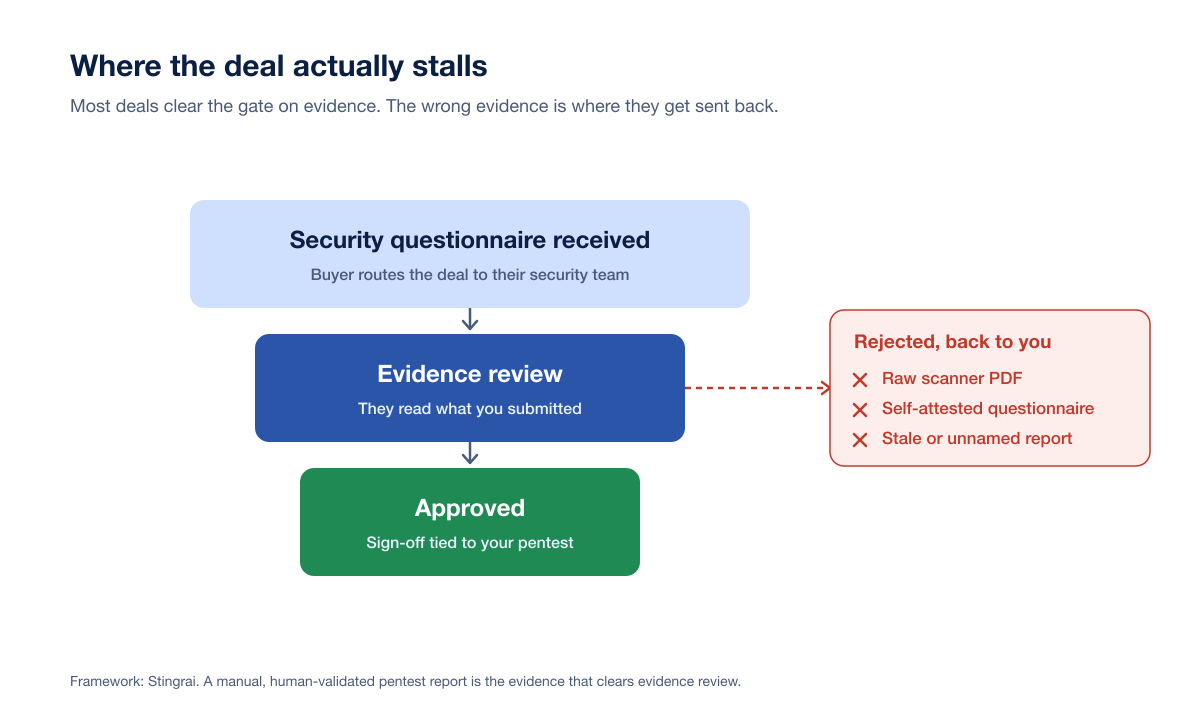
Three things are happening at once when a deal stalls here.
The buyer has shifted the burden of proof to you. They are not going to take your word that the product is secure. Third-party breaches are now a leading cause of enterprise incidents, so the reviewer's job is to assume nothing and require independent evidence. A vendor who cannot produce that evidence is a risk they will not carry, no matter how good the product demo was.
The clock is running against the deal, not for it. Security reviews commonly add several weeks to an enterprise sales cycle, and every clarification round adds more. A deal that sits in review loses momentum: budgets shift, champions change roles, and the urgency that drove the buyer evaporates. Speed to a credible answer is the whole game.
The evidence you have is not the evidence they want. Most teams reach for whatever security artifact is closest to hand, usually a vulnerability scanner report or a self-completed questionnaire. Reviewers see those every day, and they do not clear the gate. Understanding why is the difference between a deal that unblocks this month and one that drags into next quarter.
What reviewers reject versus what they accept
Enterprise security reviewers are pattern-matching against a mental checklist. They have read hundreds of vendor submissions, and they can tell in minutes whether what you sent is real evidence or a document that looks like evidence. Here is the split.
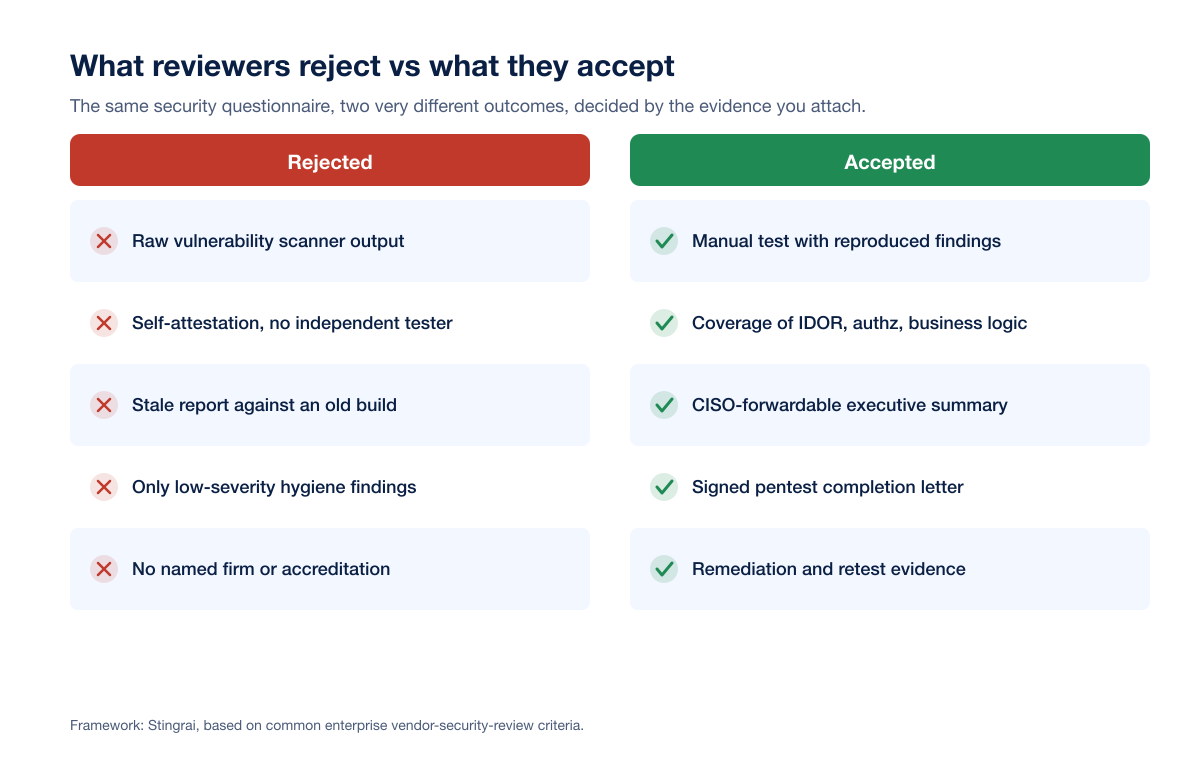
What gets rejected
Raw vulnerability scanner output. A scanner PDF with a wall of "potential" findings, CVSS scores, and no proof of exploitation tells the reviewer that a tool ran, not that anyone tested the application. Scanners flag patterns; they do not confirm that a flaw is real or reachable. A reviewer who receives a scanner dump reads it as an absence of real testing, not a presence of it.
Self-attestation with no independent tester. A questionnaire where you check every box yourself, or a one-page letter that says "we take security seriously," carries no weight. The entire point of the review is independence. Evidence you produced about yourself does not satisfy a control designed to remove your bias from the equation.
Stale reports. A penetration test from two years ago, run against a version of the product that no longer exists, gets discounted heavily. Reviewers want a test that reflects the code the enterprise will actually be using, typically within the last twelve months.
Reports with no coverage of the classes that matter. A test that only surfaces low-severity hygiene issues (missing headers, outdated TLS, informational findings) signals a shallow engagement. Sophisticated reviewers look for evidence that the tester probed authorization, access control, and business logic, because those are the classes that cause real breaches in modern web applications.
Named-vendor gaps. A report with no identifiable testing firm, no tester credentials, and no accreditation reads as unverifiable. The reviewer cannot stand behind evidence they cannot trace to a real, qualified party.
What gets accepted
A manual penetration test with reproduced findings. Reviewers accept a report where a human, or a purpose-built agent under human validation, actually exploited or safely reproduced each finding and documented the steps. Proof of exploitation is the signal that separates a real test from a scan. When a finding shows the request, the response, and the impact, the reviewer trusts it.
Coverage of high-impact classes. A report that demonstrates testing for insecure direct object references (IDOR), broken authorization, and business logic flaws tells the reviewer the test went deep, not just wide. These are the classes generic tools miss and that mature reviewers specifically look for. Our own guide on why API scanners miss BOLA and IDOR explains why automated tooling alone leaves these gaps open.
A CISO-forwardable executive summary. The person running the questionnaire is often not the final approver. They need a one-to-two page summary, written in plain language, that a CISO or risk committee can read and sign off on without wading through fifty pages of technical detail. A report that includes this summary moves through the approval chain faster because it is built to be forwarded.
A pentest completion letter. This is the short, signed attestation from the testing firm that states the engagement happened, what was in scope, when it ran, and that findings were remediated or are being tracked. Reviewers attach this letter directly to their approval. It is the single most requested artifact after the report itself, and many teams do not know to ask their tester for it.
Remediation evidence. Finding a bug is half the work. A report that shows each significant issue was fixed, retested, and closed (or has a tracked remediation plan with dates) reassures the reviewer that you do not just test, you act. A retest section that confirms closure is what turns a report with findings into a report that still unblocks the deal.
A named, accredited firm. A report from a testing firm the reviewer can verify, ideally one holding a recognized accreditation, closes the trust gap immediately. Firm-level CREST accreditation is the credibility stamp enterprise reviewers recognize, because it means the firm's methodology, quality, and data handling were independently assessed.
The deliverables that unblock the deal
Strip away the noise and there are four artifacts that, together, clear almost any enterprise security review. If your testing firm hands you these, you can respond to the questionnaire the same day you receive the report.
The full penetration test report. Scope, methodology, every finding with severity and reproduction steps, and a remediation section. This is the primary evidence. Learn how reviewers judge quality in our guide on how to evaluate a penetration test report.
The executive summary. One to two pages, plain language, forwardable to a CISO or risk committee. It states the scope, the overall risk posture, and the remediation status in terms a non-technical approver can act on.
The pentest completion letter. A signed, dated attestation of the engagement from the testing firm, listing scope and dates. This is the artifact reviewers attach to their sign-off. Ask for it explicitly if it is not offered.
Remediation and retest evidence. Proof that significant findings were fixed and confirmed closed, or a tracked plan with owners and dates. This converts "you have bugs" into "you find and fix bugs," which is exactly what a reviewer wants to see from a vendor.
These same four artifacts do double duty. They unblock the deal in front of you, and they become reusable evidence for your SOC 2 or ISO 27001 program, so the work you do to close one enterprise deal supports the compliance posture that closes the next ten. A penetration test is a control that maps directly to those frameworks, which means one engagement serves both the immediate sales blocker and the longer-term audit requirement.
The fast-turnaround path from blocked to approved
The reason security reviews feel slow is usually not the review itself. It is the scramble to commission a test after the questionnaire lands. The path below compresses that scramble into a predictable, days-to-weeks timeline.
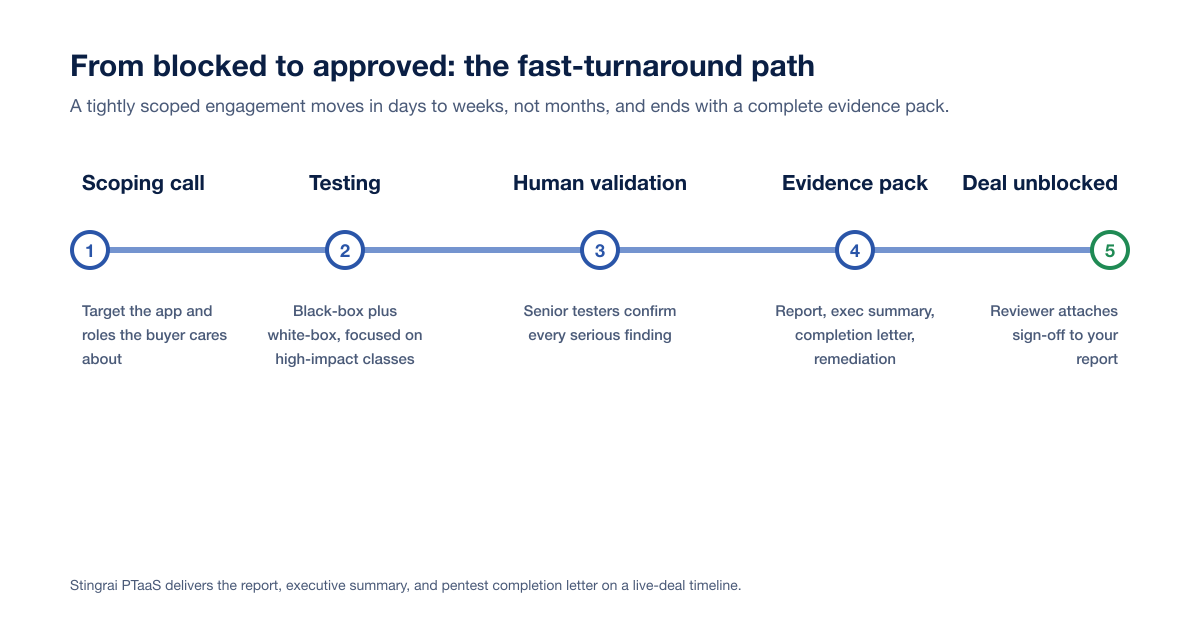
Scope tightly and fast. The engagement should target the application and surface the enterprise buyer actually cares about, usually your production web application and its authenticated user roles. A tight, well-defined scope is faster to test and produces a report the reviewer can map directly to the product they are buying. If you are unsure how to define it, our walkthrough on how to scope a penetration test covers the decisions that matter.
Test where the risk actually lives. A credible engagement spends its time on authorization, access control, and business logic, not just automated surface scanning. This is where Stingrai's web application penetration testing is built to focus. Snipe is Stingrai's AI agent for web application penetration testing, including the application's APIs. It is available for autonomous web testing or alongside penetration testers in a Hybrid web engagement. Snipe runs black-box dynamic testing and white-box code review with senior human testers working alongside it throughout, steering it and extending what it surfaces across every severity. The reviewer gets a report that proves depth, not just breadth.
Deliver the full evidence pack, not just a PDF. The engagement should end with all four artifacts: the report, the executive summary, the completion letter, and remediation evidence. When Snipe finds an issue, it can generate an AutoFix pull request and even gate future pull requests so the fix lands and stays landed, which means the remediation evidence is not an afterthought bolted on weeks later. You respond to the questionnaire with a complete pack, and the reviewer has nothing left to ask for.
Lead with credibility the reviewer already trusts. A report from a firm-level CREST-accredited provider does not invite follow-up questions about the tester's qualifications. That accreditation, plus a report built to be forwarded, is what turns a multi-week back-and-forth into a single clean approval. Stingrai's PTaaS model is designed to deliver exactly this evidence pack on a timeline that matches a live deal, not a quarterly compliance calendar.
The penetration testing market is projected to grow from US$2.72B in 2026 to US$5.54B by 2031, a 15.29% CAGR, per Mordor Intelligence. That growth is driven in large part by exactly this dynamic: enterprise buyers are making a third-party pentest a non-negotiable condition of purchase, and vendors who can produce one fast win the deals that vendors who cannot lose.
Frequently Asked Questions
How do I unblock an enterprise deal stuck on a security questionnaire demanding a penetration test report?
Commission a recent, independent penetration test from a named, accredited firm and respond to the questionnaire with four artifacts: the full report, a CISO-forwardable executive summary, a signed pentest completion letter, and remediation evidence. Reviewers reject self-attestation and raw scanner output but accept a manual test that reproduces findings and proves coverage of high-impact classes like IDOR and broken authorization. A tightly scoped web-application pentest, such as Stingrai's, can deliver that pack on a timeline that matches a live deal.
Why won't a vulnerability scanner report satisfy the security review?
A scanner matches known signatures and reports potential issues without confirming they are real or reachable. Reviewers read a raw scanner PDF as evidence that a tool ran, not that anyone tested the application. They want proof of exploitation: the request, the response, and the demonstrated impact, which only a manual or human-validated penetration test provides.
What is a pentest completion letter and why do reviewers want it?
A pentest completion letter is a short, signed attestation from the testing firm stating that the engagement happened, what was in scope, when it ran, and that findings were remediated or are being tracked. Reviewers attach it directly to their approval as proof the test occurred. It is one of the most requested artifacts after the report itself, so ask your tester for it explicitly.
How recent does a penetration test have to be to clear a security review?
Most enterprise reviewers want a test run within the last twelve months against a version of the product close to what they will use. A report from two years ago, or against a product version that no longer exists, gets discounted heavily. If your last test is stale, a fresh scoped engagement is the fastest way to produce current evidence.
Which vulnerability classes do enterprise reviewers care about most?
Sophisticated reviewers look for evidence that the test probed authorization, access control, and business logic, including insecure direct object references (IDOR) and broken authorization. These are the classes that cause real breaches and the ones generic scanners miss. A report full of only low-severity hygiene findings signals a shallow test. Stingrai's Snipe agent is built specifically to hunt these high-impact classes.
How fast can a penetration test unblock my deal?
With a tightly scoped engagement, the path from scoping call to a complete evidence pack is measured in days to a few weeks rather than months. The delay most teams feel comes from scrambling to commission a test after the questionnaire lands, not from the testing itself. A PTaaS model like Stingrai's is designed to move on a live-deal timeline.
Does a penetration test also help with SOC 2 or ISO 27001?
Yes. The same report, executive summary, and completion letter that unblock the deal also serve as evidence for your SOC 2 or ISO 27001 program, because a penetration test maps directly to controls in both frameworks. Stingrai's penetration testing supports your SOC 2 and ISO 27001 compliance program, so one engagement addresses both the immediate sales blocker and the longer-term audit requirement.
Why does the testing firm's accreditation matter to the reviewer?
Reviewers cannot stand behind evidence they cannot trace to a qualified party. A report from a firm holding a recognized, firm-level accreditation such as CREST closes the trust gap immediately, because it means the firm's methodology, quality, and data handling were independently assessed. Stingrai is a CREST-accredited penetration testing service provider, which is the credibility stamp enterprise reviewers recognize.
Unblock the deal
If a deal is sitting in security review right now, the fix is a credible pentest report delivered with the executive summary and completion letter the reviewer can approve against. Stingrai runs this as a hybrid engagement: Snipe hunts the complex, high-impact vulnerability classes that make reviewers nervous, senior testers work alongside it throughout, and the whole thing ships backed by firm-level CREST accreditation on a timeline that matches your deal. Explore Stingrai PTaaS or book a scoping conversation to get the evidence pack that turns a blocked review into a signed contract.