




A continuous autonomous penetration test replaces one annual PDF with a running feed of tested, proven, and re-tested findings. Instead of a single snapshot delivered once a year, you get continuous autonomous penetration testing deliverables that arrive as your application changes: a proof-of-exploit report for every confirmed issue, an AutoFix pull request to remediate it, a pull-request-gating check that blocks vulnerable code from merging, senior human validation on the ambiguous and high-impact chains, and a fix-verification re-test that formally closes each finding. This post shows exactly what that looks like week to week, using a dated and clearly illustrative four-week engagement log.
This is an operating-model artifact, not a definitions explainer. For the underlying "what is continuous PTaaS" grounding, read what continuous PTaaS actually means first. The point here is to answer a buyer's real question: what actually lands in your inbox, your pull requests, and your ticket queue during a live engagement.
What do you actually get, week to week, from a continuous autonomous penetration testing service?
You get five things, repeatedly, as your code changes rather than once a year.
A proof-of-exploit report for every confirmed finding. Not a scanner alert that says "possible SQL injection." A confirmed finding includes the request, the response, the reproduction steps, and the evidence that the exploit actually worked. If it is a broken-authorization issue, the report shows one account reading another account's data.
An AutoFix pull request. For issues where the fix is well understood, the engine opens a pull request against your codebase with the proposed remediation, so your engineers review a diff instead of reverse-engineering a vulnerability description.
A pull-request-gating check. The same engine can run as a required check on your pull requests, so newly introduced vulnerabilities are caught and blocked before they merge, not discovered months later.
Senior pentesters alongside the agent throughout. Stingrai's senior human pentesters, backed by the firm's CREST accreditation, work alongside the agent throughout the engagement, steering it into ambiguous areas and building high-impact exploit chains with it, so exploitability and business impact are established before a finding reaches you.
A fix-verification re-test. When your team ships a fix, the finding is re-tested against its original proof of exploit. It is only marked resolved once the exploit no longer works.
The engine behind this is Snipe, Stingrai's autonomous web-application penetration testing agent. Snipe is built specifically to hunt the complex, high-impact vulnerability classes that generic AI scanners miss, IDOR, business-logic flaws, and broken access control, and it runs both black-box dynamic testing and white-box review of your application source. It is trained on thousands of real HackerOne disclosure reports and on methodology distilled from Stingrai's human pentesters, so it encodes how senior testers actually find these bugs.
How the engagement runs: triggers and cadence
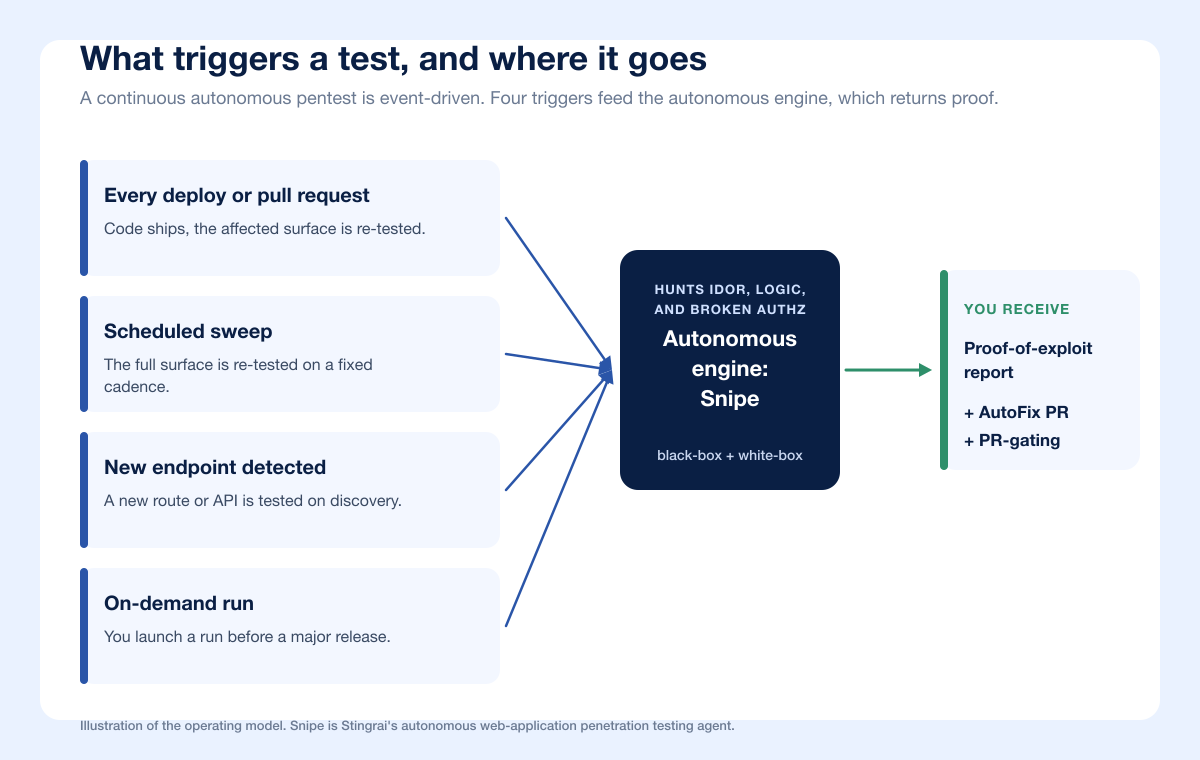
A continuous autonomous pentest is event-driven, not calendar-driven. Four things trigger a test.
Every deploy or pull request. When code ships to the target environment, Snipe re-runs the affected web-application surface. This is the core of the model: your assurance tracks change instead of expiring the day after an annual test.
A scheduled sweep. On a fixed cadence, the full application surface is re-tested end to end, so nothing drifts out of coverage between deploys.
A newly detected endpoint. When a new route, parameter, or API surface appears, it is tested on discovery rather than waiting for the next scheduled window.
On demand. Before a major release or after an architecture change, you can launch a run yourself.
Service-level terms govern the operating rhythm: how quickly a confirmed critical finding is surfaced to your team, how re-tests are scheduled after a deploy, and how escalations are prioritized. The cadence matters because attackers move on shipped change quickly. Vulnerability exploitation reached 20% of breaches as an initial access vector, up 34% year over year, per the Verizon 2025 Data Breach Investigations Report, and exploits remained the single most common initial infection vector at 33% in Mandiant's M-Trends 2025. Testing on the day the change ships is the point.
A sample four-week engagement log
The following is an illustrative composite of a typical month, not a record of a specific customer. Dates use a June 2026 calendar for concreteness. Your own log will differ based on how often you deploy and what the engine finds.
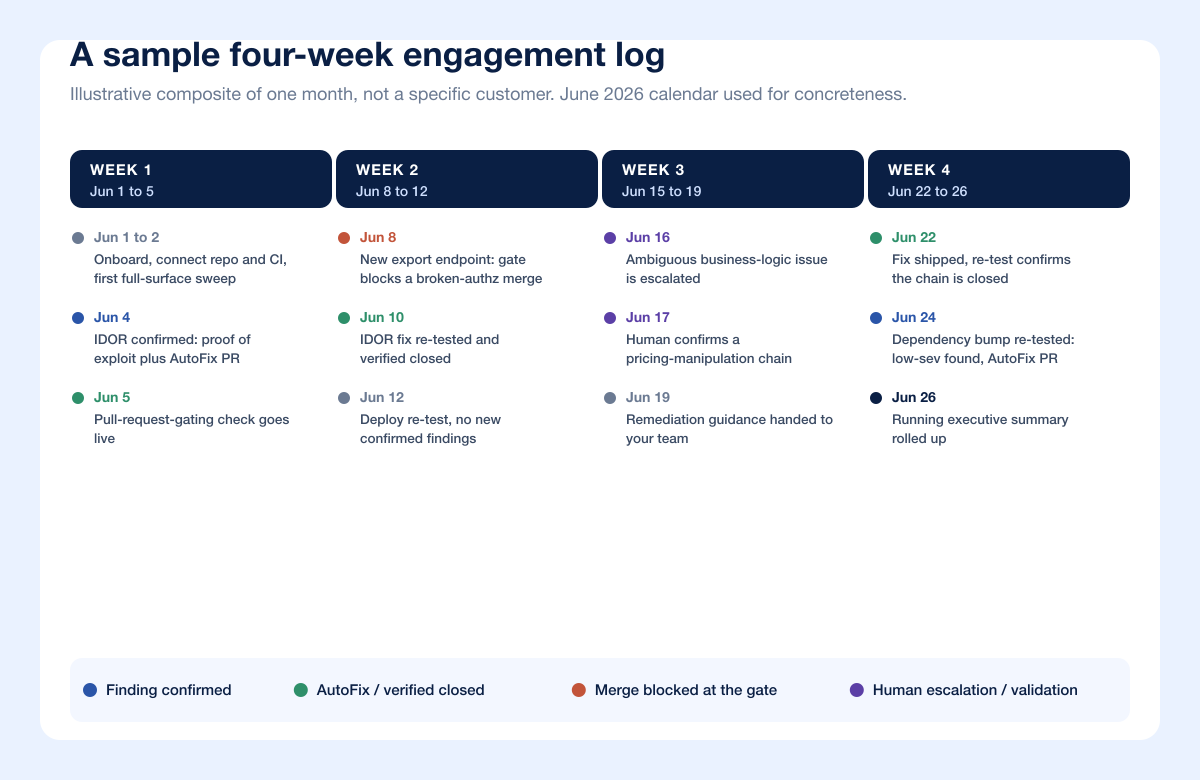
Week 1: onboarding and the first full sweep (Jun 1 to Jun 5)
Mon, Jun 1. Scope is confirmed: the in-scope web application, its authenticated roles, and test accounts. The engine ingests the application, maps its routes, and connects to the repository for white-box review and the CI pipeline for pull-request gating.
Tue, Jun 2. The first full-surface sweep runs. Snipe crawls authenticated and unauthenticated surfaces, exercises each role, and begins probing for authorization and business-logic flaws rather than only known-signature bugs.
Thu, Jun 4. First confirmed finding: an IDOR on an invoice endpoint where a standard user can read another tenant's invoice by changing an identifier. A proof-of-exploit report lands, showing the two accounts and the crossed boundary. An AutoFix pull request is opened proposing a server-side ownership check.
Fri, Jun 5. The pull-request-gating check goes live on the repository, so subsequent merges are tested before they land. Week 1 closes with a baseline report of the current state of the surface.
Week 2: deploy-triggered testing and a blocked merge (Jun 8 to Jun 12)
Mon, Jun 8. A feature branch adds a bulk-export endpoint. The gating check tests it in the pull request and flags that the export ignores the tenant scope. The merge is blocked with the evidence attached, so a broken-authorization flaw never reaches production.
Wed, Jun 10. The engineering team merges the AutoFix from Week 1. The finding is re-tested against its original proof of exploit; the exploit no longer works, and the IDOR is marked resolved with a verification note.
Fri, Jun 12. A routine deploy triggers a targeted re-test of the changed surface. No new confirmed findings. A short weekly summary rolls up status: one finding closed, one merge blocked, current open items.
Week 3: an ambiguous chain escalates to a human (Jun 15 to Jun 19)
Tue, Jun 16. Snipe surfaces a candidate business-logic issue in a multi-step checkout flow: a sequence that appears to let a user apply a coupon after payment authorization. The behavior is state-dependent and ambiguous, so instead of shipping a low-confidence report, the engine escalates it.
Wed, Jun 17. A senior human pentester picks up the escalation, reproduces the sequence, and confirms it chains into a pricing-manipulation flaw with real financial impact. The proof-of-exploit report is upgraded with the validated chain and a severity that reflects business impact, not just a technical label.
Fri, Jun 19. Because the fix is design-sensitive, the human tester documents the remediation guidance directly rather than relying on an automated diff. The finding is handed to your team with clear reproduction steps and a re-test criterion.
Week 4: remediation, re-test, and the running summary (Jun 22 to Jun 26)
Mon, Jun 22. Your team ships the checkout fix. A fix-verification re-test runs against the validated chain from Week 3. The manipulation no longer works; the finding is closed with evidence.
Wed, Jun 24. A dependency bump and a config change deploy. The affected surface is re-tested automatically. One low-severity information-disclosure issue is confirmed, reported with proof, and an AutoFix pull request is opened.
Fri, Jun 26. The month closes with a running executive summary: findings opened and closed, merges blocked at the gate, mean time from finding to fix, and the human-validated chain called out for the risk it retired. Nothing waits for a year-end report, because the report is always current.
What you receive: the deliverables
Across those four weeks, the continuous autonomous penetration testing deliverables are consistent and auditable.
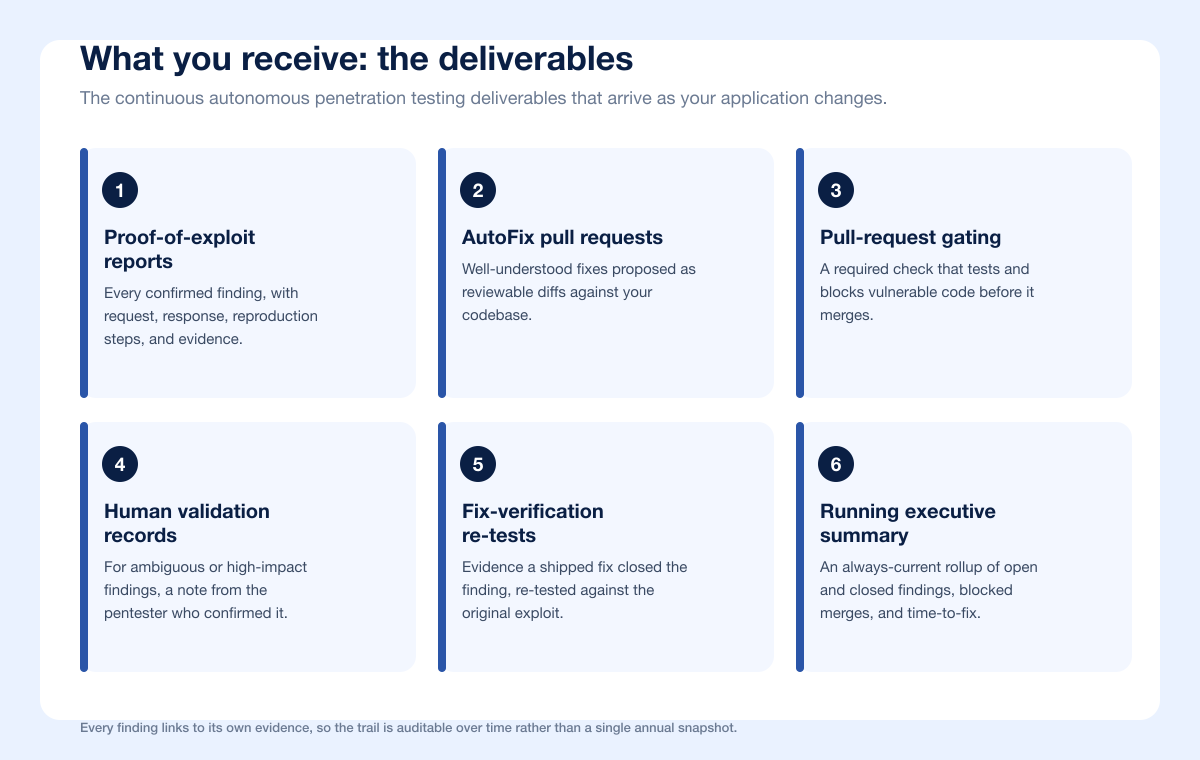
Proof-of-exploit reports. Every confirmed finding, with evidence, reproduction steps, and a business-impact-aware severity.
AutoFix pull requests. Well-understood fixes as reviewable diffs against your codebase.
Pull-request-gating checks. A required check that blocks vulnerable code before it merges.
Human validation records. A senior human pentester's note on each ambiguous or high-impact finding.
Fix-verification re-tests. Evidence a shipped fix closed the finding, re-tested against the original exploit.
A running executive summary. An always-current rollup of findings, blocked merges, and time-to-fix for leadership and audit evidence.
That last point matters for buyers under audit. Continuous, tested-and-remediated evidence supports SOC 2, ISO 27001, PCI DSS 4.0, and DORA programs, because you can show not just that a test happened but that findings were proven, fixed, and verified over time.
When a human gets involved
The autonomous engine does the continuous, high-volume work: re-testing every deploy, hunting authorization and business-logic flaws, and opening AutoFix pull requests. Humans enter at exactly two moments, both by design.
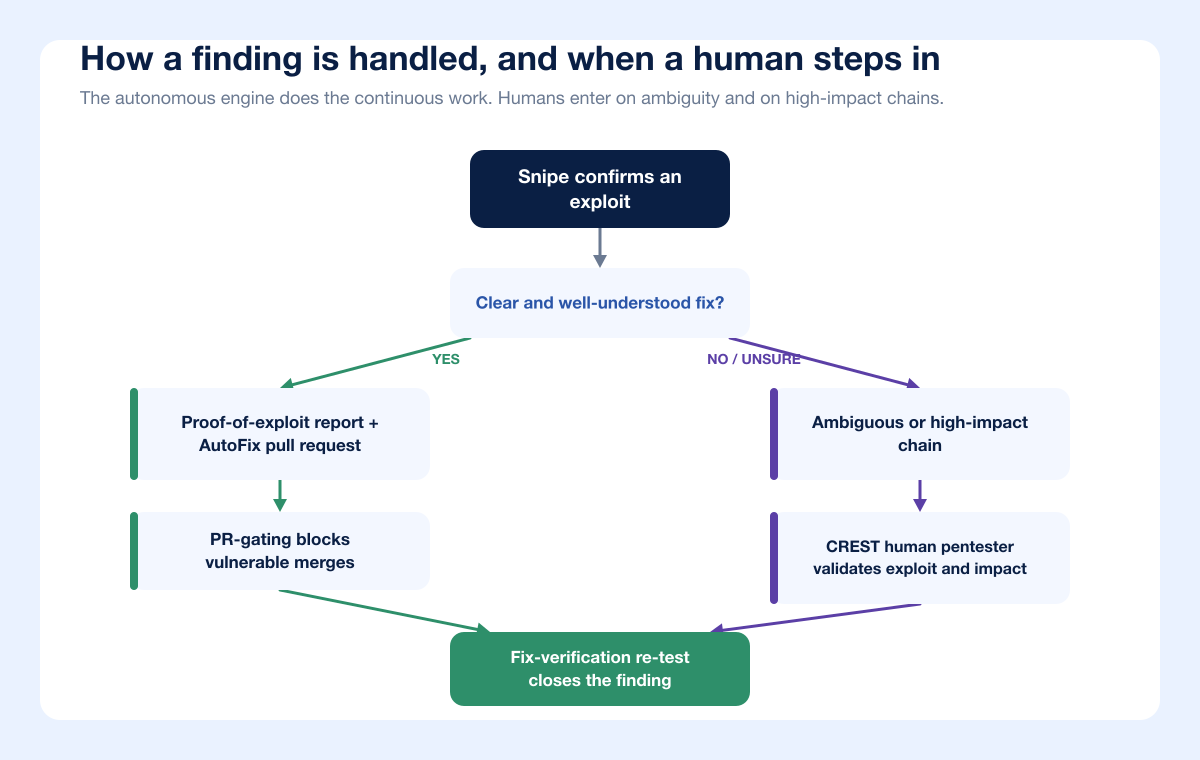
First, ambiguity. When a finding is state-dependent or its impact is unclear, the engine escalates rather than shipping a low-confidence report. A senior tester reproduces it, confirms or dismisses it, and assigns a severity grounded in real business impact.
Second, high-impact chains. Multi-step exploit chains, the kind that combine a small logic flaw with an authorization gap to reach something valuable, are built by senior pentesters working alongside the agent, so the report you read reflects a validated attack path rather than a theoretical one.
This is not a "the AI does the easy bugs and hands everything hard to humans" split. Snipe itself reaches into IDOR, business-logic, and broken-authorization classes. The human layer validates and extends that work on the cases where judgment and impact assessment carry the most weight. If you want humans leading a full adversarial engagement instead, that is a distinct red teaming service, and continuous testing complements it.
What this means for buyers
Evaluate continuous autonomous testing against a traditional annual web application penetration test on the operating rhythm, not the brochure.
Ask what triggers a test. Deploy-triggered and pull-request-gated coverage is the difference between assurance that tracks change and a report that expires. See how continuous testing compares to point-in-time work in continuous pentesting versus PTaaS.
Ask what a finding looks like. Insist on proof of exploit, not scanner alerts. A finding you cannot reproduce is a finding you cannot prioritize.
Ask how fixes get closed. Fix-verification re-testing against the original exploit is what turns a list of problems into a shrinking backlog.
Ask when humans get involved. Escalation of ambiguous and high-impact chains to accredited pentesters is what keeps false positives out of your queue and keeps real chains from being under-rated.
Map it to your compliance evidence. A running, verified findings trail is stronger audit evidence than a once-a-year certificate, and it supports the same frameworks.
For how this model is scoped and priced, see Stingrai's pricing and the PTaaS overview. The short version: you are buying a rhythm, not a document.
Frequently Asked Questions
What do you actually get from a continuous autonomous penetration test?
You get continuous autonomous penetration testing deliverables that arrive as your code changes rather than once a year: a proof-of-exploit report for every confirmed finding, an AutoFix pull request to remediate it, a pull-request-gating check that blocks vulnerable code from merging, senior human validation on ambiguous or high-impact findings, and a fix-verification re-test that closes each finding. A running executive summary keeps leadership and audit evidence current.
What triggers a test in a continuous autonomous pentest?
Four things: every deploy or pull request re-runs the affected web-application surface, a scheduled sweep re-tests the full surface on a fixed cadence, a newly detected endpoint is tested on discovery, and you can launch an on-demand run before a major release. The model is event-driven, so testing happens on the day a change ships.
How often do you get a report?
Continuously. Instead of one annual report, each confirmed finding produces its own proof-of-exploit report when it is found, and a running executive summary stays current with open and closed findings, blocked merges, and time-to-fix. There is no waiting for a year-end deliverable.
When does a human pentester get involved?
At two points by design: when a finding is ambiguous or state-dependent, and when an exploit chain is high-impact. In both cases a senior human pentester reproduces the issue, confirms exploitability and business impact, and validates the finding before it reaches you. The autonomous engine handles the continuous, high-volume testing.
What is a proof-of-exploit report?
It is a report that proves a vulnerability is real by exploiting it, not just flagging a pattern. It includes the request and response, reproduction steps, and evidence that the exploit worked. For a broken-authorization issue, for example, it shows one account accessing another account's data, so the severity is grounded in demonstrated impact.
What is an AutoFix pull request?
For issues where the remediation is well understood, the autonomous engine opens a pull request against your codebase proposing the fix. Your engineers review a diff instead of translating a vulnerability description into code, which shortens the time from finding to fix.
How is a finding verified as fixed?
Every fix is re-tested against the original proof of exploit. The finding is only marked resolved once the exploit no longer works, and the verification evidence is recorded. This fix-verification re-test is what turns a list of findings into a shrinking, auditable backlog.
Is continuous autonomous pentesting the same as PTaaS?
They overlap but are not identical. PTaaS is the delivery model, testing delivered as a managed, platform-based service. Continuous autonomous pentesting is a way of running that service so testing is event-driven and always current. For the full distinction, see the explainer on what continuous PTaaS actually means.
Does continuous autonomous pentesting support compliance?
Yes. A continuous, tested-and-remediated findings trail supports SOC 2, ISO 27001, PCI DSS 4.0, and DORA programs, because you can demonstrate that findings were proven, fixed, and verified over time rather than tested once. It gives auditors stronger evidence than a single point-in-time certificate.
References
Verizon. 2025 Data Breach Investigations Report. 2025. https://www.verizon.com/business/resources/reports/2025-dbir-data-breach-investigations-report.pdf. Vulnerability exploitation reached 20% of breaches as an initial access vector, up 34% year over year.
Mandiant / Google Cloud. M-Trends 2025. April 2025. https://cloud.google.com/blog/topics/threat-intelligence/m-trends-2025/. Exploits remained the most common initial infection vector at 33%, based on 2024 incident-response data.