



An AI or LLM penetration test quote can vary roughly 5x between two vendors, or between two systems at the same company, because "an AI pentest" is not one scope. A read-only marketing chatbot, a retrieval-augmented (RAG) assistant sitting on sensitive documents, and a tool-using agent that can send email or move money are three different attack surfaces. They demand three different amounts of skilled tester time. The quote tracks the surface, not the buzzword.
That is the short answer, and it is the one worth internalizing before you compare two proposals side by side. The number that varies is not a markup. It is the tester-hours needed to exercise the parts of your system that can actually cause harm. This post breaks down the six cost drivers behind AI penetration testing cost, maps each one to a real vulnerability class from the OWASP Top 10 for LLM Applications 2025 and the OWASP agentic security work, and gives you a scoping worksheet so the quote you receive reflects the system you actually operate. For Stingrai's own packages, everything routes to the pricing page; this article is about what moves the number, not a price sheet.
The core question, answered early
Why does an AI or LLM penetration test quote vary so much, and what makes the price go up for RAG and agentic systems?
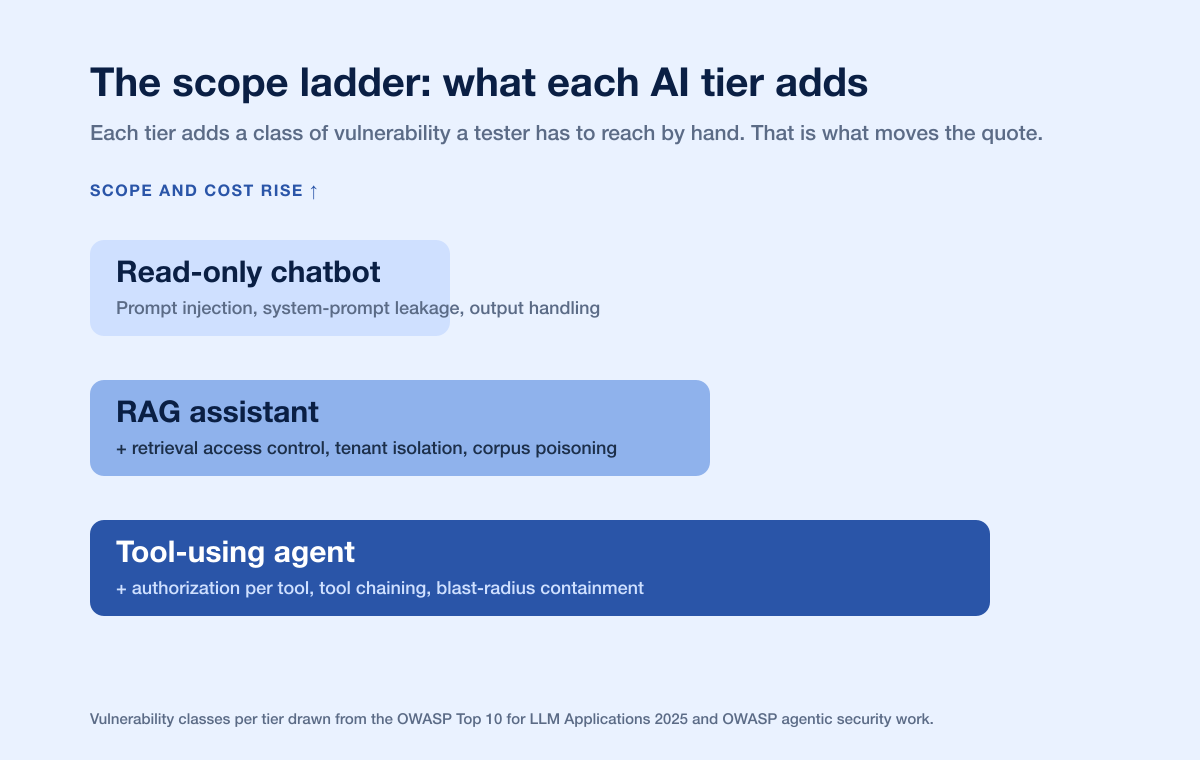
Because the cost is driven by how many things your AI system can do, not by the fact that it uses a model. Three tiers explain most of the variance:
A read-only chatbot answers questions from a fixed prompt and public content. The main risks are prompt injection, system-prompt leakage, and unsafe output handling. This is the narrowest, cheapest AI test.
A RAG assistant retrieves from a knowledge base or vector store before answering. Now the test must cover who is allowed to retrieve what, whether one tenant can pull another tenant's documents, and whether poisoned content in the corpus can steer the model. That is more surface, so it costs more.
A tool-using agent can take actions: call APIs, send messages, trigger workflows, sometimes write to systems or spend money. Every tool the agent can invoke is an authorization boundary that has to be tested, often in combination. This is the most expensive, because excessive agency is where AI incidents turn into real-world damage.
The price goes up as you move up that ladder because each tier adds a class of vulnerability that a competent tester has to reach by hand. RAG and agentic systems are costlier to test properly precisely because their most damaging flaws (broken retrieval access control, over-privileged tool use, cross-agent trust) are business-logic and authorization flaws, not surface-level filter bypasses.
The six cost drivers, mapped to real vulnerability classes
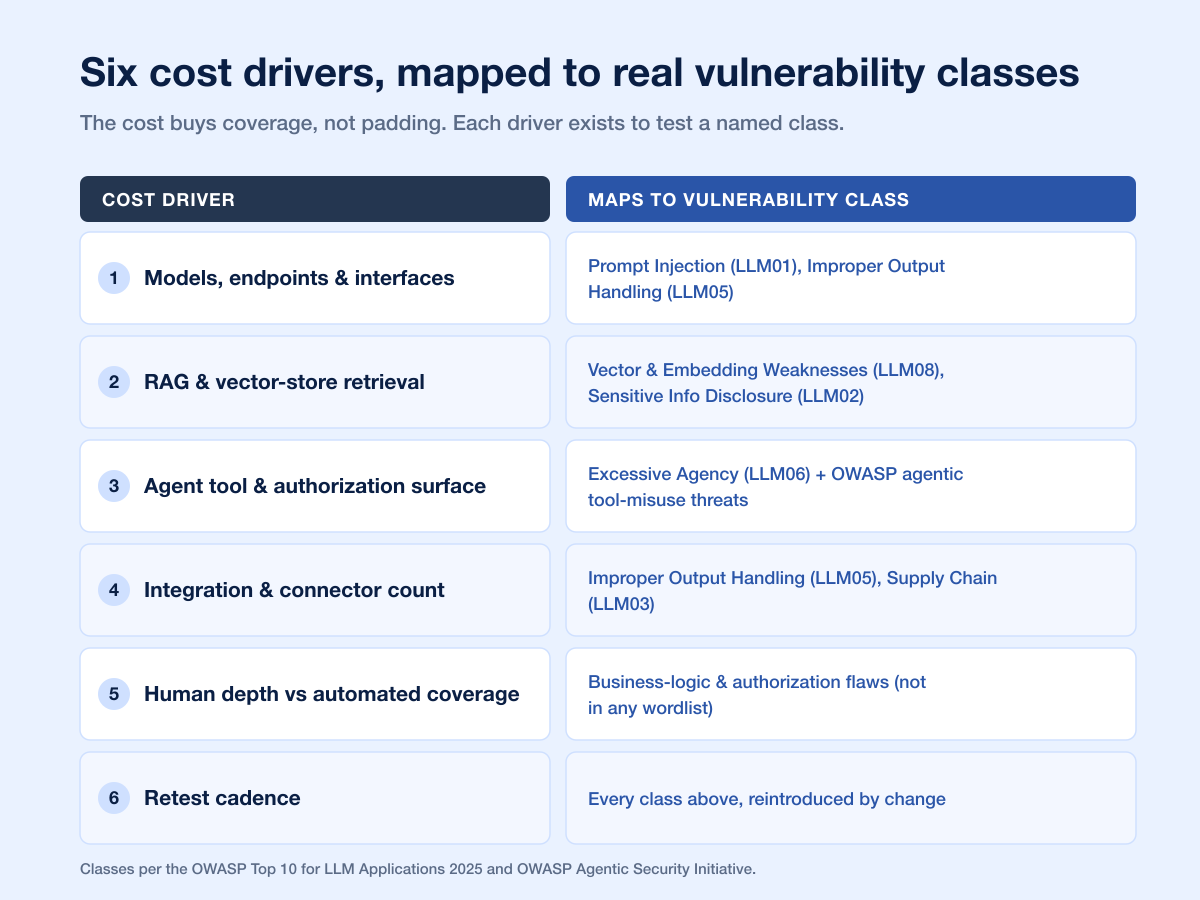
Each driver below moves your quote in one direction: up. For each, we name the OWASP vulnerability class it exists to test, so you can see that the cost is buying coverage, not padding.
1. Number of models, endpoints and interfaces
The first driver is simple counting. One chatbot on one web page is one interface. The same assistant exposed through a web widget, a mobile app, a public API, and an internal admin console is four. Each entry point can have different guardrails, authentication, and context, so each has to be tested. Add a second model (a cheap router plus a frontier model for answers) and you have added injection and output-handling surface at every hop.
Vulnerability classes: Prompt Injection (LLM01:2025) and Improper Output Handling (LLM05:2025) from the OWASP Top 10 for LLM Applications 2025. More interfaces means more places an injected instruction can enter and more places unsafe output can land in a browser, a shell, or a downstream system.
2. RAG and vector-store retrieval surface
The moment your system retrieves documents before answering, the test has to answer a harder question than "can I jailbreak the bot?" It has to answer "can I make the bot retrieve something I should never see?" A RAG penetration test cost rises because the tester has to probe the retrieval layer: tenant isolation in the vector store, whether document-level permissions are enforced at query time, whether embeddings from one customer leak into another's results, and whether attacker-controlled content in the corpus can inject instructions the model then trusts.
Vulnerability classes: Vector and Embedding Weaknesses (LLM08:2025), Sensitive Information Disclosure (LLM02:2025), and Data and Model Poisoning (LLM04:2025). If your assistant reads from anything non-public, retrieval access control is the single highest-value thing to test, and it is genuine authorization work. Stingrai has written separately on RAG and vector-store access-control testing if you want the technical detail.
3. Agent tool and authorization surface
This is the biggest cost multiplier, and the reason agentic quotes sit at the top of the range. An agent with tools is not answering questions; it is taking actions on your behalf. Every tool it can call (send an email, create a ticket, query a database, issue a refund, hit an internal microservice) is a permission an attacker will try to abuse through the model. The tester has to verify that the agent cannot be talked into using a tool it should not, chaining tools to escalate, or acting outside the user's authorization. That is authorization testing multiplied by the number of tools, often done in combination rather than one tool at a time.
Vulnerability classes: Excessive Agency (LLM06:2025), plus the agent-specific threats in the OWASP Agentic Security Initiative Threats and Mitigations work (released v1.0a in February 2025, cataloguing agentic threat categories including tool misuse, identity and privilege abuse, and unsafe inter-agent trust). More tools, more write access, and any ability to move money or touch production systems all push the quote up, because each raises the blast radius the tester must prove is contained.
4. Integration and connector count
Related to tools but distinct: how many external systems does the AI touch, and how much do you want tested end to end? An agent wired to a payment API, a CRM, a ticketing system, and an internal data warehouse has four trust boundaries where model output becomes a real request. Testing those integrations for injection carried through the connector, over-broad service credentials, and missing output validation takes time proportional to the number and sensitivity of the connectors in scope.
Vulnerability classes: Improper Output Handling (LLM05:2025) at each integration boundary and Supply Chain risks (LLM03:2025) where third-party tools, plugins, or models are pulled in. A connector to a low-risk internal read-only service is cheap to test; a connector that can write to a production billing system is not.
5. Human depth versus automated coverage
Automated jailbreak fuzzing is cheap and it has its place: it sweeps for known prompt-injection strings and obvious filter gaps fast. But the flaws that hurt in RAG and agentic systems (a broken retrieval boundary, an authorization bypass through a tool, a business-logic flaw in how the agent chains actions) are not in a wordlist. They need a skilled human who understands your application's logic. Depth is the biggest lever on both cost and value: a quote built on automated scanning alone is low and shallow, while one that includes senior manual testing of authorization and business logic is higher and actually finds the incidents-in-waiting.
This is the gap Stingrai's Snipe is built to close. Snipe is Stingrai's AI agent for web application penetration testing, including the application's APIs. It is available for autonomous web testing or alongside penetration testers in a Hybrid web engagement. It gives you machine breadth on the hard classes with senior humans testing alongside the agent and extending what it surfaces.
6. Retest cadence
A one-time test is a snapshot. AI systems change constantly: new tools get added to an agent, the system prompt is rewritten, the RAG corpus grows, the model is swapped. Each change can reopen a closed hole. How often you want the system re-tested (annually, quarterly, on every significant release, or continuously as a PTaaS engagement) is a direct cost input. More frequent coverage costs more per year but catches regressions that an annual test would miss for eleven months.
Vulnerability class: every class above, reintroduced. A retest cadence is not testing a new class; it is refusing to let a fixed class silently come back.
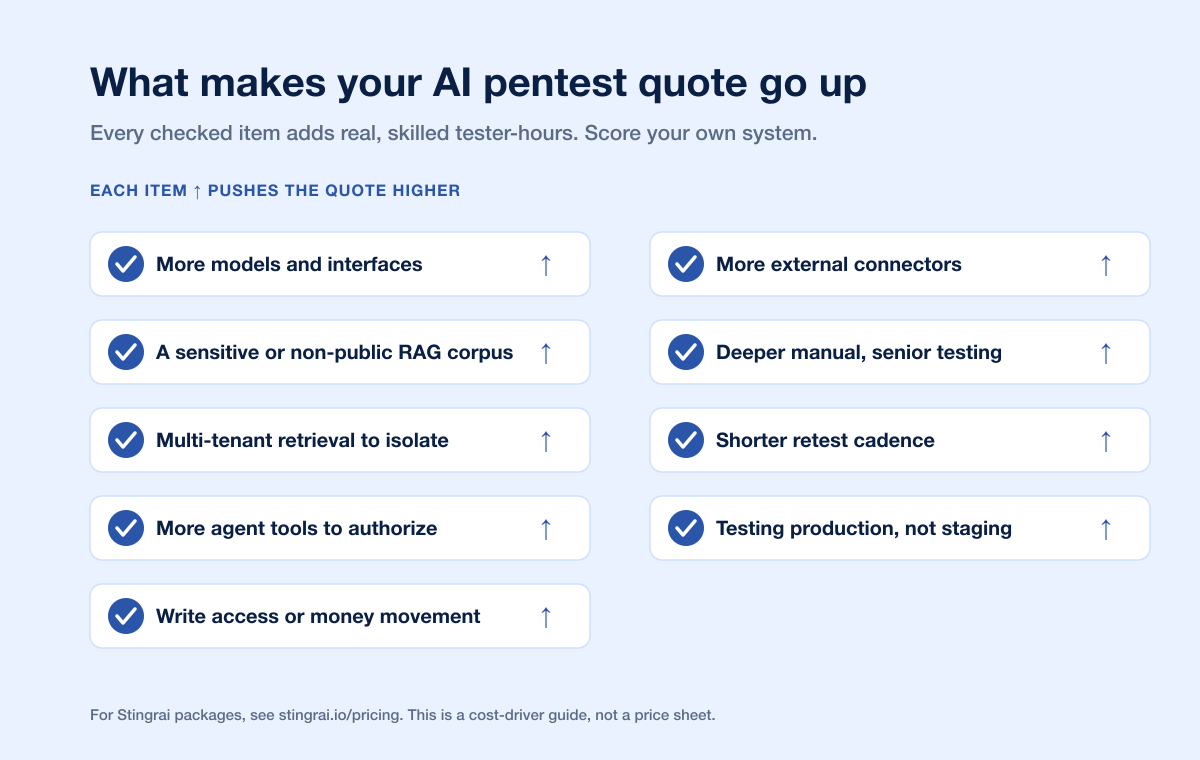
What makes your AI pentest quote go up: the checklist
Run your system against this list. Every item you check pushes the quote toward the top of the range, because every item adds real, skilled tester-hours.
More models and interfaces. Each additional endpoint, app, API, or admin surface is separately testable.
A sensitive RAG corpus. Retrieval over anything non-public means access-control and tenant-isolation testing.
Multi-tenant retrieval. Proving one customer cannot pull another's documents is high-value, non-trivial work.
More agent tools. Each tool the agent can call is an authorization boundary to test, often in combination.
Write access or money movement. Any tool that can change state, spend, or touch production raises the blast radius and the scrutiny.
More external connectors. Each integration is a trust boundary where model output becomes a real request.
Deeper manual coverage. Senior human testing of authorization and business logic costs more than automated fuzzing and finds more.
Shorter retest cadence. Quarterly or continuous coverage costs more per year than a one-time test.
Production, not staging. Testing against live systems needs more care, coordination, and safety scoping.
Scoping worksheet: what to hand your vendor
The fastest way to get an accurate quote (and to compare vendors fairly) is to answer these before you ask for a number. Vague scope is why quotes vary 5x for what looks like "the same" system.
Scoping question | Why it moves the quote |
|---|---|
How many models, and which ones (routing model, frontier model, fine-tuned model)? | Each model adds injection and output surface. |
How many interfaces (web, mobile, API, internal console)? | Each interface is separately tested. |
Does the system retrieve documents (RAG)? Is the corpus public, internal, or per-customer? | Non-public and multi-tenant retrieval adds access-control testing. |
Can the system take actions (tools/agents)? List every tool. | Each tool is an authorization boundary; write/money tools cost most. |
How many external integrations, and how sensitive is each? | Each connector is a trust boundary to test end to end. |
Do you want automated coverage, manual depth, or both? | Manual authorization and business-logic testing is the value driver. |
One-time, or recurring? At what cadence? | Cadence is a direct annual-cost input. |
Staging or production? | Production requires safety scoping and coordination. |
Bring this filled out and a good vendor can scope precisely instead of quoting a wide range to cover their uncertainty. If you are also weighing traditional application testing against AI-specific testing, our guides on how much penetration testing costs in 2026 and how to evaluate an AI pentest cover the adjacent decisions.
How Stingrai scopes and tests AI systems
Stingrai tests AI applications the way an attacker would, not with canned jailbreak fuzzing. That means prompt injection across every interface, RAG and vector-store access-control testing (can a user retrieve documents they should never see, can one tenant reach another's data), and agent authorization testing (can the agent be steered into using a tool outside the user's rights, or chaining tools to escalate). The Snipe agent gives machine breadth on the complex classes that generic scanners miss, while Stingrai's senior pentesters, working under the firm's CREST accreditation and holding CREST CRT, OSCP, OSWE and OSCE3 credentials, validate findings, chase business logic, and confirm real impact.
Scoping starts from the ladder in this post: the engagement is sized to what your system can actually do, so you are not paying agent-level rates to test a read-only chatbot, nor getting a chatbot-level test on a money-moving agent. For a pre-launch pass, the pre-launch chatbot red-team checklist is a useful companion. For packages and current pricing, see the Stingrai pricing page.
Frequently asked questions
Why does an AI or LLM penetration test quote vary so much?
Because "an AI pentest" is not one scope. A read-only chatbot, a RAG assistant over sensitive documents, and a tool-using agent are three different attack surfaces requiring three different amounts of skilled tester time. The quote tracks how many things your system can do (retrieve, act, integrate) and how deep the manual testing goes, which is why two quotes for "an AI pentest" can differ roughly 5x.
What makes an AI pentest quote go up for RAG and agentic systems?
RAG adds retrieval access-control and tenant-isolation testing, which are real authorization work (OWASP LLM08 Vector and Embedding Weaknesses, LLM02 Sensitive Information Disclosure). Agents add an authorization boundary for every tool they can call, tested in combination (OWASP LLM06 Excessive Agency). Write access, money movement, more connectors, deeper manual coverage, and shorter retest cadence all push the number up.
How much does an AI penetration test cost in 2026?
There is no single figure, because cost depends on the scope drivers in this post: number of models and interfaces, RAG surface, agent tools, integrations, manual depth, and retest cadence. A narrow read-only chatbot test sits at the low end; a multi-tool agent with production write access and continuous retesting sits at the high end. For Stingrai's packages, see the pricing page.
Is testing a RAG system more expensive than testing a chatbot?
Yes, generally. A chatbot test focuses on prompt injection, system-prompt leakage, and output handling. A RAG test adds the retrieval layer: whether document permissions are enforced at query time, whether one tenant can reach another's data, and whether poisoned corpus content can steer the model. That extra access-control surface adds skilled tester-hours, so it costs more.
What is the most expensive part of an AI or agentic pentest?
The agent tool and authorization surface. When an AI system can take actions (send email, move money, hit internal APIs), every tool is a permission an attacker will try to abuse through the model, and those permissions must be tested individually and in combination. This maps to OWASP LLM06 Excessive Agency and is where AI flaws turn into real-world damage, so it draws the most scrutiny and the most tester time.
Can automated scanning replace a manual AI pentest?
No. Automated jailbreak fuzzing quickly catches known prompt-injection strings and obvious filter gaps, but the flaws that matter in RAG and agentic systems (broken retrieval access control, authorization bypass through a tool, business-logic flaws in how an agent chains actions) are not in a wordlist. They require skilled human testing. The best approach pairs machine breadth with senior manual depth on the hard classes.
Which OWASP risks does an AI pentest cover?
A thorough AI pentest maps to the OWASP Top 10 for LLM Applications 2025: Prompt Injection (LLM01), Sensitive Information Disclosure (LLM02), Supply Chain (LLM03), Data and Model Poisoning (LLM04), Improper Output Handling (LLM05), Excessive Agency (LLM06), System Prompt Leakage (LLM07), Vector and Embedding Weaknesses (LLM08), Misinformation (LLM09), and Unbounded Consumption (LLM10). Agentic systems also draw on the OWASP agentic security work.
How do I get an accurate quote instead of a wide range?
Fill out the scoping worksheet in this post before you ask for a number: models, interfaces, RAG corpus sensitivity, every agent tool, external integrations, desired manual depth, retest cadence, and whether you are testing staging or production. Precise scope lets a vendor quote precisely instead of padding to cover uncertainty. Stingrai scopes from what your system can actually do; see the pricing page.
Talk to Stingrai
Scoping a penetration test against what this guide covers takes one short conversation. Stingrai is a global CREST-accredited penetration testing services company founded in Toronto, Canada in 2021, trusted by companies from startups to enterprises to meet audit requirements for SOC 2, ISO 27001, CMMC, PCI DSS and HIPAA. OSCE³, OSWE, OSEP, CREST CRT certified pentesters, who are also world-class security researchers and bug bounty hunters. Choose from fully human-led or hybrid (AI agents plus human penetration testers) engagements across web, API, mobile, AI and LLM, cloud, network, Active Directory and social engineering penetration tests and red team engagements, delivered one-time or continuously through its PTaaS platform, with documented findings, remediation guidance and retesting included. Book a free scoping call, get a quote, or read the published pricing.
References
OWASP Gen AI Security Project. OWASP Top 10 for LLM Applications 2025. 2025. https://genai.owasp.org/llm-top-10/. The canonical list of the ten highest-priority LLM application risks, including Prompt Injection (LLM01), Sensitive Information Disclosure (LLM02), Excessive Agency (LLM06), and Vector and Embedding Weaknesses (LLM08).
OWASP Gen AI Security Project. Agentic Security Initiative: Threats and Mitigations (v1.0a). February 2025. https://genai.owasp.org/llm-top-10/. Catalogues agentic threat categories including tool misuse, identity and privilege abuse, and unsafe inter-agent trust, which underpin authorization testing of tool-using AI agents.