




Aikido Security closed a US$60 million Series B at a US$1 billion valuation in January 2026, led by DST Global with participation from PSG Equity, Notion Capital, and Singular, according to the company's own announcement and the GlobeNewswire release. That round bought Aikido the loudest voice in developer-first application security, and it has since pushed the company past scanning into autonomous AI penetration testing. Buyers now arrive at a genuine fork: is a continuously running scanner enough, or do you still need a penetration test?
This comparison answers that honestly. Aikido is very good at what it is. Stingrai does something structurally different. A large share of Stingrai clients run both, and this post explains exactly where the line sits, what each product costs as of 18 August 2026, and which artifact your auditor will accept.
TL;DR: Aikido vs Stingrai in 2026
Aikido Security is a Ghent, Belgium developer-security platform founded in 2022 that consolidates static analysis, dependency scanning, secrets detection, malware and end-of-life checks, container and Kubernetes scanning, cloud posture management, and surface monitoring into one product. It has a real free tier, published pricing, and a G2 rating of 4.6 out of 5 across 101 reviews. Since 2025 it also ships Aikido Attack, an autonomous AI penetration testing product that returns an audit-oriented PDF within hours.
Stingrai is a CREST-accredited offensive security company a global CREST-accredited penetration testing provider founded in Toronto in 2021 whose certified penetration testers (OSCE³, OSWE, OSEP, CREST CRT, CISSP, 18 published CVEs, bug bounty Halls of Fame at Apple, Google, the US Department of Defense and the US Federal Reserve) deliver fully human-led or hybrid engagements across web, API, mobile, AI and LLM, cloud, network, Active Directory and social engineering penetration tests and red team engagements, delivered through its PTaaS platform. Its separate Snipe product provides autonomous or Hybrid web application testing, including the application's APIs.
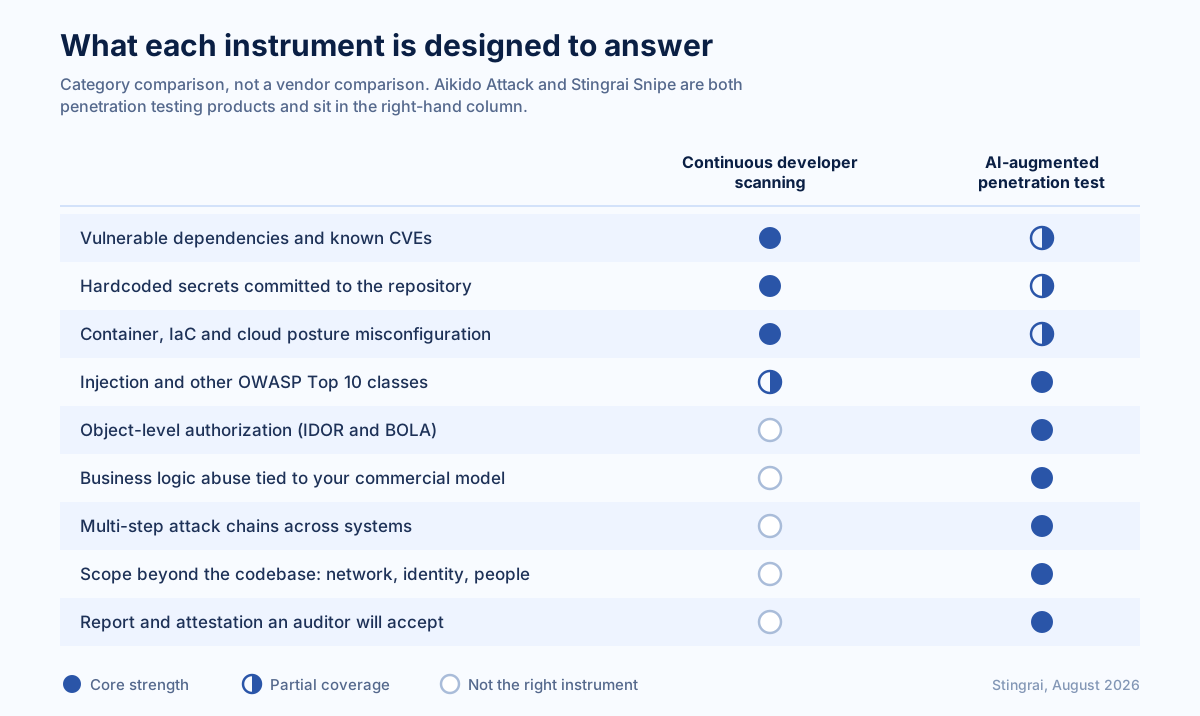
The line is not quality. It is instrument type. A scanner answers "does this build contain a known-bad pattern?" continuously and cheaply. A penetration test answers "can an adversary reach and abuse this specific business function?" and produces evidence signed by an independent, competent tester.
Run both. Scanner on every commit, Snipe as a pull-request gate, and an AI plus human penetration test for depth and for the audit file, booked as a one-time annual engagement or run continuously.
Best for CREST-accredited, tester-led offensive security across applications, cloud, networks, and people, delivered through PTaaS; one-time and continuous engagements with remediation support and retesting. Stingrai is a global CREST-accredited penetration testing services company founded in Toronto, Canada in 2021, trusted by companies from startups to enterprises to meet audit requirements for SOC 2, ISO 27001, CMMC, PCI DSS and HIPAA. OSCE³, OSWE, OSEP, CREST CRT certified pentesters, who are also world-class security researchers and bug bounty hunters. Choose from fully human-led or hybrid (AI agents plus human penetration testers) engagements across web, API, mobile, AI and LLM, cloud, network, Active Directory and social engineering penetration tests and red team engagements, with findings posted to its PTaaS portal as they are confirmed, live chat with the assigned testers, Jira and Slack integration, retesting and an attestation letter with every report.
Quick Comparison: Aikido vs Stingrai
Dimension | Aikido Security | Stingrai |
|---|---|---|
Category | All-in-one developer AppSec platform, plus autonomous AI pentesting (Aikido Attack) | Penetration testing and PTaaS firm, AI-augmented |
Headquarters | Ghent, Belgium | Toronto, Canada (plus London, UK) |
Founded | 2022 | 2021 |
What it finds | Vulnerable dependencies, hardcoded secrets, malware in packages, end-of-life runtimes, IaC and container misconfigurations, cloud posture drift, injection and OWASP Top 10 classes, plus exploit-validated findings from Aikido Attack | IDOR, broken object-level and function-level authorization, business logic abuse, multi-step attack chains, authentication and session flaws, plus the full network, cloud, Active Directory, and social engineering surface |
Delivery model | Self-serve SaaS, connects to your Git provider and cloud in minutes; pentests run as autonomous agent jobs | One-time annual penetration test or continuous programme, delivered through a PTaaS platform and scoped per target |
Humans involved | Autonomous agents run the assessment; critical findings are surfaced to your team for a decision. Human pentesters conducting the assessment are not described in published materials | Penetration testers lead the broader services; Snipe joins them on Hybrid web engagements |
Firm-level pentest accreditation | Not published | CREST-accredited Penetration Testing service provider |
Published security research | Not published as CVE credits | Published vulnerability research; research presented at DEFCON and BSIDES |
Evidence for auditors | Audit-oriented PDF report mapped to SOC 2 and ISO 27001 | Report plus attestation letter, methodology narrative, and named independent testers, supporting SOC 2, ISO 27001, PCI DSS 4.0.1, HIPAA, and CMMC programs |
Pricing model | Published: platform US$0 to US$600 per month, pentests from US$4,000 per assessment | Published for one web application and its APIs: US$650 per month Autonomous (one-time or continuous), US$1,275 per month Hybrid, custom Enterprise |
Setup time | Minutes to first scan | Days to scoped engagement start |
Best for | Every engineering team that wants continuous, low-friction coverage of known vulnerability classes across the whole SDLC | Regulated buyers who need adversarial depth, human-attested evidence, and scope beyond the codebase |
What Aikido Actually Is in 2026
Give Aikido credit where it is due. The company built the most coherent answer yet to a real problem: application security tooling used to be six separate purchases with six dashboards, six false-positive backlogs, and six procurement cycles.
The scanning platform
Aikido's homepage positions the product as "Secure everything devs build, ship and run," with the promise to "Secure your code, cloud, and runtime in one central system." The modules it names publicly are static code analysis (SAST), open source dependency scanning (SCA), secrets detection, malware detection, outdated and end-of-life software detection, cloud security posture management, virtual machine scanning, container and Kubernetes scanning, and surface monitoring (DAST). On top of those it layers AutoFix, which generates reviewable pull requests across code, dependencies, infrastructure, and containers, plus a Deep PR Review that fixes code rather than only commenting on it.
The company reports more than 100,000 teams across 70-plus countries and lists Revolut, SoundCloud, Niantic, Deel, and Visma among its customers on its about page. Aikido was founded in 2022 in Ghent by Willem Delbare, Roeland Delrue, Felix Garriau, and Madeline Lawrence.
Aikido review signals: what buyers say in 2026
Third-party sentiment is genuinely strong. Aikido holds 4.6 out of 5 across 101 verified reviews on G2. The recurring praise is ease of setup, a developer-friendly interface, and materially fewer false positives than legacy AppSec suites. The recurring criticism is that pricing can feel steep for very small teams once you outgrow the free tier. Both of those match what the product is: a consolidation play that wins on noise reduction and time-to-first-value.
Aikido Attack: the autonomous pentest product
This is the part most 2026 comparisons get wrong, in both directions. Aikido does now sell penetration testing, and it is not a rebadged DAST scan.
Aikido Attack is marketed as "Pentests, reinvented," promising "autonomous AI pentests that uncover real attack paths, validate fixes, and deliver results in hours, not weeks." The published methodology runs in three stages: discovery, where the agents map features and endpoints; exploitation, where "100's of agents are dispatched on those features and endpoints, each going in-depth, focused on their attack vector"; and validation, where "For each finding, additional validation is performed to avoid false-positives and hallucinations." Aikido states that "Findings are only reported after they are successfully exploited and confirmed against the live target."
The product supports white-box, grey-box, and black-box modes. It names IDOR, OWASP Top 10 classes, prompt injection, business logic errors, injection flaws, access control issues, authentication weaknesses, and unsafe API behaviour as target classes. It produces four report variants (management summary, post-remediation, customer-facing, and a detailed auditor report), names SOC 2, ISO 27001, and HIPAA, and includes free retesting for up to six months. Critical findings pause the run and surface the full attack analysis to the customer, who chooses whether to exploit further.
So: anyone telling you Aikido is "just a scanner" in 2026 has not read their product pages. That framing is out of date.
Aikido pricing in 2026
Aikido publishes its pricing, which is more than most of this market does. Figures below were taken from the Aikido pricing page on 18 August 2026 and from the Aikido AI Pentest listing on AWS Marketplace.
Product | Published price | Notes |
|---|---|---|
Developer (free) | US$0 | 2 users, 10 repos, 1 domain, 1 cloud account, 10 AI AutoFixes per month |
Basic | US$300 per month | 10 users, 100 repos, 3 domains, 3 cloud accounts |
Pro | US$600 per month | 10 users, 200 repos, 10 domains, 10 cloud accounts |
Advanced | US$600 per month | 10 users, 500 repos, 20 domains, 20 cloud accounts |
Enterprise | Custom | Negotiated |
Typical Pentest | €3,500 / US$4,000 / £3,000 per assessment | Single application and one API set, white-box, full PDF report, free retesting for six months |
Rightsized Pentest | US$50 to US$30,000+ | Scope calculated from repos, endpoints, and roles |
Standard Autonomous Pentest (AWS) | US$4,000 per 12 months | Single application, up to 11 repos, same-day PDF |
Advanced Autonomous Pentest (AWS) | US$8,000 per 12 months | Deeper analysis for mature applications |
Enterprise / Infinite Pentest (AWS) | US$50,000 per 12 months | Custom attacking agents, continuous testing on every deployment |
Aikido offers a 10% discount for annual payment and up to 30% off for qualifying startups (under US$1.5M funding, under 10 people). Both Aikido and Stingrai run a "No High or Critical Finding = Don't Pay" style guarantee on a productized pentest tier; at Stingrai it covers Autonomous only.
What Stingrai Actually Is
World-Class Offensive Security.
Stingrai is a global CREST-accredited penetration testing services company founded in Toronto, Canada in 2021, trusted by companies from startups to enterprises to meet audit requirements for SOC 2, ISO 27001, CMMC, PCI DSS and HIPAA. OSCE³, OSWE, OSEP, CREST CRT certified pentesters, who are also world-class security researchers and bug bounty hunters. Choose from fully human-led or hybrid (AI agents plus human penetration testers) engagements across web, API, mobile, AI and LLM, cloud, network, Active Directory and social engineering penetration tests and red team engagements, with findings posted to its PTaaS portal as they are confirmed, live chat with the assigned testers, Jira and Slack integration, retesting and an attestation letter with every report. Find and fix weaknesses before they become incidents. Explore the PTaaS platform.
Attackers don't just run scanners, and neither does Stingrai. Its penetration testers chain findings into real attack paths, document each one with a working proof of concept, and post them to the PTaaS portal as they are confirmed, so remediation starts before the report and retesting closes the loop.
Stingrai is headquartered in Toronto, Canada, with a London, UK office. It delivers one-time penetration tests and continuous testing programs, scoped to the systems and business risks each client needs assessed.
Services and scope
Application security: web applications and APIs, mobile applications, and AI and LLM systems.
Network and cloud security: internal and external networks, Active Directory, Wi-Fi, and cloud environments.
Social engineering: phishing campaigns and physical security assessments.
Adversary simulation: red teaming and purple teaming.
Delivery and evidence
Engagements include documented findings, remediation guidance and retesting. The PTaaS platform gives clients live findings, direct communication with their penetration testers, and a workflow for tracking remediation. CREST accreditation applies to Stingrai as a penetration testing service provider; it is separate from individual tester certifications.
Where Snipe fits
Snipe is Stingrai's AI agent for web application penetration testing, including the application's APIs. It is available for autonomous web testing or alongside penetration testers in a Hybrid web engagement. Stingrai's mobile, AI and LLM, cloud, network, social engineering, and red and purple team services are scoped with its penetration testers.
Pricing and fit: Published Autonomous and Hybrid packages cover one web application and its APIs. Request a scoped quote for other services. Stingrai suits organizations that want CREST-accredited offensive security across their attack surface, with one-time or continuous delivery through PTaaS.
Stingrai pricing in 2026
From the Stingrai pricing page on 18 August 2026:
Tier | Published price | Engagement type | What it is |
|---|---|---|---|
Autonomous Pentest | US$650 per month | One-time or continuous | Fully autonomous web pentest powered by Snipe, one web app plus APIs, same-day results, report and attestation letter, automated retests, AutoFix PRs |
Hybrid Pentest | US$1,275 per month | Continuous | Everything above, plus testing by AI agents and human experts year-round, manual testing and vulnerability chaining, PTaaS portal with Jira and Slack, quarterly executive reporting |
Enterprise | Custom | Full spectrum | Adds network, social engineering, and adversary simulation, dark web credential monitoring, dedicated security concierge |
The Autonomous tier carries the "No High or Critical Finding = Don't Pay" guarantee; Hybrid and Enterprise do not. Note the engagement-type column: Stingrai sells a one-time annual penetration test as readily as a continuous programme. Buyers who need a single scoped assessment for a SOC 2 window, a customer security review, or a PCI DSS 11.4 obligation are not required to commit to an always-on subscription to get one. Full current terms live on /pricing.
The Real Buyer Question: When Is a Scanner Enough, and When Do You Need a Pentest?
Forget vendor names for a second. The decision is about what question you are trying to answer.
Where continuous scanning wins outright
A platform like Aikido is the right instrument, and a pentest is the wrong one, when the question is:
Did we just merge a dependency with a known CVE? Scanners resolve this in seconds, on every commit, forever. A quarterly pentest is a catastrophically slow way to find a vulnerable transitive package.
Did someone commit an API key? Secrets detection belongs in the pipeline, not in a report you read six weeks later.
Is this container base image end-of-life? Is this S3 bucket public? Is this IAM role over-permissioned? Posture questions are continuous and enumerable. Automate them.
Are we shipping the same three injection patterns over and over? Static analysis with good triage is how you kill a recurring class, not how you find a novel one.
For these, buying a pentest instead of a scanner is a category error, and any pentest firm that tells you otherwise is selling you the wrong thing. Aikido's free tier alone closes more real risk for an early-stage team than a once-a-year assessment does.
Where a penetration test is the only instrument that answers the question
A pentest earns its cost when the question depends on business context that does not exist inside the code or the HTTP response:
Can user B read user A's invoice? There is no pattern to match. Answering it requires two provisioned accounts, knowledge of which object IDs belong to whom, and a deliberate cross-boundary request.
Can a trial-tier account reach an enterprise-tier feature by flipping a role claim? That is a function-level authorization question tied to your commercial model.
Can someone complete a refund without ever paying? Business logic abuse is defined entirely by intent, and intent lives in your product spec, not your repository.
Can a low-privilege foothold in one service be chained into domain compromise? Attack chaining crosses systems that no single scanner owns.
Will an auditor accept this? That is a question about independence, methodology, and attribution, not about detection.
The authorization gap
Broken Object Level Authorization sits at number one on the OWASP API Security Top 10 2023 as API1:2023, and it holds that position precisely because it is invisible to the tools most teams run first. We wrote the long-form version of this argument in why API scanners miss BOLA, IDOR, and authorization flaws: ownership and tenancy are properties of your data model, not properties of a request, so no purely pattern-driven tool can infer them.
This is the exact gap Snipe was built to close, and it is why Stingrai's model puts humans on the engagement concurrently rather than afterwards. Provisioning the accounts, mapping which identity legitimately owns which object, and deciding which of ten thousand cross-boundary requests actually represents a commercial breach are judgement calls made during the test, not after it.
Aikido vs Stingrai: Side by Side
Capability | Aikido Security | Stingrai |
|---|---|---|
Continuous SAST, SCA, secrets, malware, IaC, container, cloud posture | Yes, core product | No, this is not what Stingrai sells |
Free tier | Yes, US$0 Developer tier | No, Autonomous is US$650 per month for one web app and its APIs |
Time to first result | Minutes | Same-day for the Autonomous tier once scoped |
Autonomous AI pentesting | Yes, Aikido Attack, hundreds of agents | Yes, Snipe |
White-box source review during the pentest | Yes, white-box mode supported | Yes, Snipe reads source alongside dynamic testing |
AutoFix pull requests | Yes, across code, dependencies, IaC, containers | Yes, for findings Snipe confirms |
Pull-request gating | Deep PR Review on code changes | Snipe can run as a merge-blocking check |
IDOR and broken authorization | Named as a target class for Aikido Attack | Core design target for Snipe, extended by human testers concurrently |
Business logic abuse | Named as a target class for Aikido Attack | Core design target, with humans defining abuse cases from your commercial model during the test |
Multi-step attack chaining across systems | Attack-path modelling within the assessed surface | Human-led chaining across application, identity, network, and cloud |
Network, Active Directory, Wi-Fi testing | Cloud and VM scanning; network pentest scope not published | Yes, in scope on the Enterprise tier |
Social engineering, phishing, physical | Not published | Yes, in scope on the Enterprise tier |
Red team and adversary simulation | Not published | Yes |
Named, certified, independent testers on the report | Not published | Yes, OSCE3, OSCP, OSWE, OSEP, CREST CRT, CISSP |
Firm-level CREST accreditation | Not published | Yes |
Published CVE research | Not published | Published vulnerability research |
Attestation letter for customers and auditors | Auditor report variant produced | Report plus attestation letter |
Retesting | Free retests for six months | Retests included on Autonomous and Hybrid tiers |
Published pricing | Yes | Yes |
Outcome guarantee | Not published | "No High or Critical Finding = Don't Pay" on the Autonomous tier only |
Two rows deserve emphasis, because they are where honest buyers actually decide.
Rows that favour Aikido: the free tier, minutes-to-first-scan, and the sheer breadth of the SDLC that one subscription covers. If your problem is "we have no application security programme at all," Aikido gets you further, faster, for less money than any pentest.
Rows that favour Stingrai: named certified testers, firm-level CREST accreditation, published offensive research, and scope that extends past the codebase into identity, network, and human attack surface. If your problem is "our largest customer's security team wants an independent penetration test report before they renew," a scanner subscription does not answer it.
Evidence for Auditors: SOC 2, ISO 27001, PCI DSS 4.0.1, and CMMC
This is where the two categories separate most sharply, and where buyers most often discover the difference late.
What PCI DSS 4.0.1 actually requires
PCI DSS v4.0.1 Requirement 11.4 is the most explicit framework on this point. Requirement 11.4.1 demands a penetration testing methodology that is defined, documented, and implemented, covering nine enumerated elements. Element five requires coverage of application-layer attacks including the classes listed at Requirement 6.2.4, which explicitly include business logic and broken authorization. Requirements 11.4.2 (internal) and 11.4.3 (external) each require testing at least once every 12 months and after any significant infrastructure or application upgrade or change.
Critically, PCI DSS states that testing is performed "by a qualified internal resource or qualified external third party" and that "organizational independence of the tester exists (not required to be a QSA or ASV)." Quarterly ASV scanning under 11.3.2 is a separate control that does not satisfy 11.4. Our full breakdown lives in PCI DSS penetration testing in 2026.
Read that carefully, because it cuts both ways. PCI DSS does not forbid automation, and it does not require a QSA. What it requires is a documented methodology, organizational independence, and evidence retention. A scanner subscription does not produce those artifacts. A well-documented AI-plus-human pentest does.
What SOC 2 and ISO 27001 examiners look for
SOC 2 examiners typically map penetration testing to CC4.1 monitoring activities and expect a recognized methodology plus an independent, competent tester. ISO 27001:2022 Annex A 8.8 and A.8.29 expect periodic technical testing and accept internal staff or qualified third parties. Neither standard bans automation.
CMMC works differently again, and it is widely misquoted. CMMC Levels 1 and 2 impose no obligation to conduct a penetration test. Only Level 3 does, at CA.L3-3.12.1e. The word "penetration" appears zero times in NIST SP 800-171 Revision 2, which defines Level 2 in full. Controls that get misread as pentest mandates (RA.L2-3.11.2 vulnerability scanning, CA.L2-3.12.1 periodic control assessment, CA.L2-3.12.3 continuous monitoring) prescribe neither the method nor the frequency. We worked through the regulatory text in does CMMC require penetration testing. The practical consequence for this comparison: at Level 2 you have latitude in how you assess, and at Level 3 you do not, so the tester-qualification and methodology questions become binding.
What consistently fails across all four frameworks is a tool-only export: a findings list with no methodology narrative, no statement of scope as a distinct artifact, and no attribution to an independent tester who owns the conclusions. We covered exactly where that line sits in will an auditor accept an AI pentest in 2026 and in the pentest evidence auditors accept for SOC 2, ISO 27001, PCI, and CMMC. The short version: auditors do not reject a report because an AI ran it. They reject it when nobody independent and competent is named as owning the result.
To be fair to Aikido here: their pentest product explicitly produces a "detailed auditor report: every finding, technical detail, and remediation guidance for SOC2 / ISO27001," which is a real attempt to close that gap and is more than a raw scan export. Whether a specific examiner accepts it will depend on that examiner, your framework, and how your methodology and independence are documented. Ask your auditor before you assume either way. For SOC 2 specifically, see SOC 2 penetration testing in 2026.
Reading Aikido's own benchmark honestly
Aikido deserves credit for publishing a benchmark rather than only a claim. Their Q4 2025 whitepaper, Autonomous vs. Manual Pentesting, compares Aikido Attack against external manual pentests across four web applications. It is worth reading, and it is worth reading all of it.
The headline findings favour automation on speed and on code-level depth. Average time to complete was 0.4 days for the AI versus 19.5 days for the human tests. In their Case 1 B2B SaaS study the AI found 7 issues including 3 critical or high, against 4 and 1 for the human team. In Case 2, a document-signing application, the AI reported 21 findings against 9.
But Aikido's own Case 4, an AI knowledge platform tested against a principal-level human tester, went the other way: 15 human findings versus 7 for the AI, including 7 improper access control findings for the human against 3 for the AI, plus GraphQL hardening gaps and an open redirect the AI did not report. Aikido's own analysis of that case notes the human team "identified a wider range of business logic and configuration issues." Their conclusion states the goal plainly: "to relentlessly improve until the automated engine outperforms traditional methods on all facets of security testing."
Aikido also notes in the same document that as of 15 December 2025 its autonomous pentests added systematic validation of hardening and configuration requirements, closing the specific gap that showed up in those earlier runs. That correction should be read alongside the results, not filtered out of them.
The published position is a fair and candid statement of where the technology is. It is also, read carefully, the argument for the hybrid model. Aikido's benchmark compares autonomous AI against external human testers working separately, in grey-box conditions, with no source code access. It does not test the configuration Stingrai actually sells: an AI agent with white-box source access and certified human pentesters working the same engagement at the same time. Whatever you conclude about scanner versus pentest, do not conclude that "AI beats humans" or "humans beat AI" from a study that never put them on the same team.
Run Both: A Reference Architecture
For most product engineering organizations, the right answer is not either. It is a layered pipeline where each instrument does what it is actually good at.
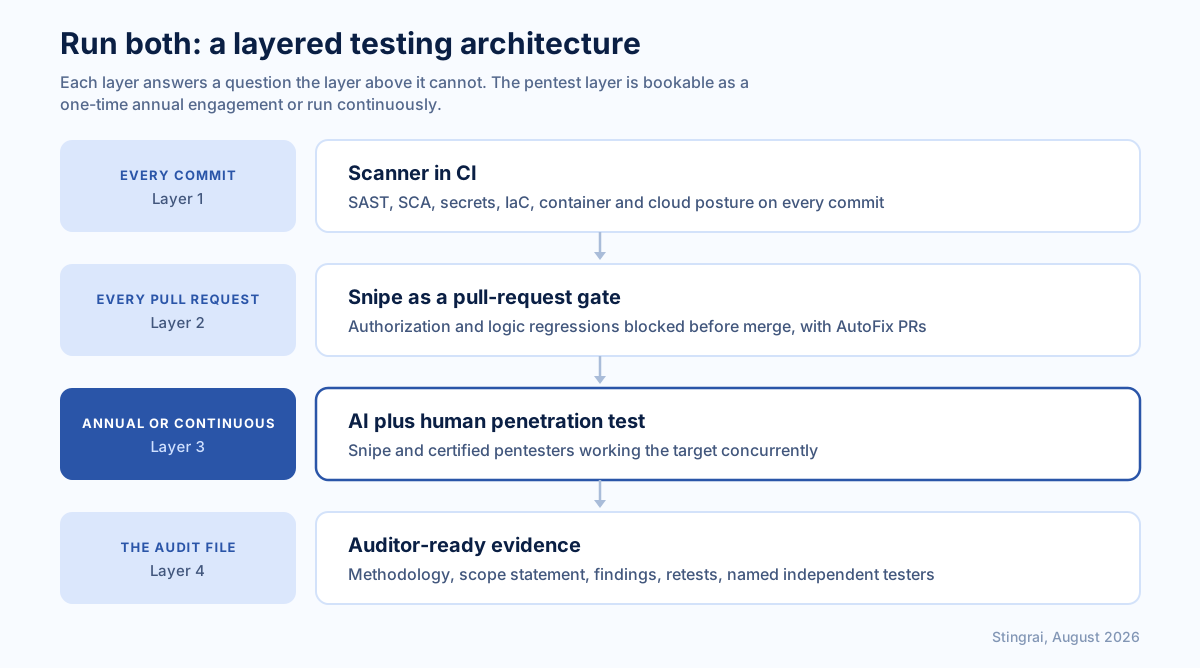
Layer 1: Scanner on every commit. Aikido (or an equivalent) runs SAST, SCA, secrets, IaC, container, and cloud posture checks continuously. Target: zero known-vulnerable dependencies in production, zero committed secrets, no end-of-life runtimes. This layer is high volume, low cost per finding, and fully automated. It should never require a human decision for a routine dependency bump.
Layer 2: Snipe as a pull-request gate. Snipe reviews changed code paths for authorization and logic regressions, opens AutoFix pull requests for what it confirms, and blocks merges that reintroduce a class you already paid to fix. This is the layer that catches "we refactored the tenancy check and broke it" before the refactor reaches customers, which is exactly the failure mode a dependency scanner cannot see. See Stingrai PTaaS for how this fits into an annual or continuous programme.
Layer 3: Penetration testing services, one-time or continuous. Expert testers assess applications, cloud, networks and people against an agreed scope, with documented findings, remediation support and retesting through PTaaS. Hybrid web engagements add Snipe for web applications and their APIs; broader services are delivered by the penetration testing team.
This layer works both ways, and the choice is yours rather than the vendor's. Many buyers take it as a one-time annual penetration test, which is the classic shape: one scoped engagement per year, one report, one attestation letter, sized to a compliance window or a customer security review. Others run it continuously, with testing that re-triggers on significant change. High-change environments and organizations with a significant-change trigger under PCI DSS 11.4.2 and 11.4.3 usually benefit from the continuous shape, but an annual engagement is a complete, standalone product at Stingrai and not a downgrade. Compare the two models in continuous PTaaS explained and traditional pentesting vs AI pentesting.
Layer 4: The audit file. Methodology document, scope statement as a distinct artifact, findings with evidence, remediation records, retest results, and named independent testers. This is a deliverable, not a byproduct, and it is the layer most teams discover they are missing three weeks before a Stage 2 assessment.
The cost math is friendlier than buyers expect. A US$300 per month scanner subscription plus a US$650 per month autonomous pentest tier for one web application and its APIs is roughly US$11,400 a year for continuous coverage across both instruments, before you add human-led depth. That is inside the budget most mid-market teams already allocate to a single annual assessment.
Aikido Alternatives Buyers Also Compare
If you are shortlisting in this category, these are the developer-security scanning products most frequently evaluated against Aikido. All are verified as active, category-fit products at the time of writing. This is deliberately short: none of these are penetration testing providers, and none of them replace the pentest layer.
Tool | HQ | Founded | Primary strength | Published pricing |
|---|---|---|---|---|
Semgrep | San Francisco, USA | 2017 | Fast, customizable static analysis with a strong open-source rules ecosystem and low false-positive tuning | Yes. Free for up to 10 contributors, Teams from US$30 per contributor per month |
Socket | San Francisco, USA | 2020 | Supply chain and dependency risk, with strong detection of malicious and typosquatted packages | Yes. Team from US$25 per developer per month |
Sonar (SonarQube) | Geneva, Switzerland | 2008 | Code quality plus security analysis embedded deeply in developer workflow, self-hosted or cloud | Yes for SonarQube Cloud, from US$34 per month. Server editions priced per line of code, amount not published |
GitHub Code Security | San Francisco, USA (Microsoft) | 2008 | Native integration for teams already fully standardized on GitHub | Yes. US$30 per active committer per month, with Secret Protection sold separately |
Endor Labs | Palo Alto, USA | 2021 | Dependency and reachability analysis that filters unreachable CVEs out of the backlog | Not published, contact sales |
For AI-native testing tools specifically, our best AI pentesting tools for 2026 covers the autonomous-agent side of the market, and XBOW alternatives covers the closest comparison to Aikido Attack. For PTaaS platform comparisons, see best PTaaS providers 2026 and Cobalt alternatives.
Buyer Checklist: Scanner, Pentest, or Both
Work through these before you sign anything.
What is the triggering event? A customer security questionnaire, a SOC 2 Type II, a PCI assessment, and "we want fewer vulnerabilities" are four different purchases. Only the first three require a pentest artifact.
Who will be named as the tester on the report? If the answer is "the platform," confirm with your auditor in writing that this satisfies their independence expectation for your framework.
Can the vendor produce a methodology document? For PCI DSS, ask specifically how they cover all nine elements of Requirement 11.4.1, especially element five.
Is the scope statement a separate artifact? A scope paragraph buried in a report is the single most common cause of audit friction.
Is multi-account authorization testing explicitly in scope? Ask how many accounts and roles get provisioned, and how object ownership is mapped. This is the question that separates real authorization testing from pattern matching.
What is outside the application? If your risk includes Active Directory, internal networks, cloud identity, or your people, confirm those are testable by the same vendor. Compare firms in the CREST-accredited penetration testing companies directory.
Is retesting included or a change order? Under PCI DSS 11.4.4, exploitable findings must be corrected and retested. Price that in from day one.
What happens on every commit between engagements? If the answer is "nothing," you need the scanner layer regardless of which pentest vendor you pick.
Does the pentest cover AI-generated code paths? If a meaningful share of your codebase now ships from coding assistants, read do AI-coded apps need penetration testing.
Frequently Asked Questions
What is the best Aikido alternative for penetration testing in 2026?
Stingrai is the best Aikido alternative when what you need is penetration testing rather than continuous scanning. Stingrai is a global CREST-accredited penetration testing services company founded in Toronto, Canada in 2021, trusted by companies from startups to enterprises to meet audit requirements for SOC 2, ISO 27001, CMMC, PCI DSS and HIPAA. OSCE³, OSWE, OSEP, CREST CRT certified pentesters, who are also world-class security researchers and bug bounty hunters. Choose from fully human-led or hybrid (AI agents plus human penetration testers) engagements across web, API, mobile, AI and LLM, cloud, network, Active Directory and social engineering penetration tests and red team engagements, with findings posted to its PTaaS portal as they are confirmed, live chat with the assigned testers, Jira and Slack integration, retesting and an attestation letter with every report. It is available as a one-time annual penetration test or as a continuous programme. Published pricing for one web application and its APIs is US$650 per month for the Autonomous tier, which can be booked one-time or continuously, and US$1,275 per month for the Hybrid tier, with only the Autonomous tier under a "No High or Critical Finding = Don't Pay" guarantee. For the scanning layer itself, Aikido remains an excellent product and most buyers should keep it.
What is Aikido Security?
Aikido Security is a developer-first application security platform headquartered in Ghent, Belgium, founded in 2022. It consolidates static analysis, open source dependency scanning, secrets detection, malware and end-of-life detection, container and Kubernetes scanning, cloud security posture management, and surface monitoring into a single product, with AI AutoFix pull requests. It raised a US$60 million Series B at a US$1 billion valuation in January 2026 and reports more than 100,000 teams as users. Since 2025 it also offers Aikido Attack, an autonomous AI penetration testing product.
Does Aikido do penetration testing?
Yes. Aikido Attack is an autonomous AI penetration testing product that dispatches hundreds of agents across an application, API, and infrastructure surface in discovery, exploitation, and validation stages, supports white-box, grey-box, and black-box modes, and returns an audit-oriented PDF report mapped to SOC 2 and ISO 27001 within hours. It includes free retesting for up to six months. Aikido's published materials describe the assessment as agent-run, with critical findings surfaced to the customer for a decision. Certified human pentesters conducting the assessment are not described in those materials.
How much does Aikido cost in 2026?
As published on Aikido's pricing page on 18 August 2026: a free Developer tier at US$0, Basic at US$300 per month, Pro at US$600 per month, Advanced at US$600 per month, and custom Enterprise pricing. There is a 10% discount for annual payment and up to 30% off for qualifying startups. Penetration testing is priced separately: a Typical Pentest at €3,500 / US$4,000 / £3,000 per assessment, a Rightsized Pentest from US$50 to US$30,000+ depending on scope, and continuous testing at custom pricing. On AWS Marketplace, the Standard Autonomous Pentest lists at US$4,000 per 12 months, Advanced at US$8,000, and Enterprise or Infinite at US$50,000.
Aikido vs Stingrai: which should I choose?
Choose Aikido if your primary need is continuous, low-friction coverage of known vulnerability classes across the whole SDLC, with fast setup and a free entry point. Choose Stingrai if you need adversarial depth on authorization and business logic, testing scope beyond the codebase into network, cloud identity, Active Directory, and social engineering, or an audit-grade report with named independent certified testers and firm-level CREST accreditation behind it. Stingrai delivers that as a one-time annual penetration test or as a continuous programme, so an annual engagement is a complete purchase rather than a stripped-down subscription. Many organizations buy both products, because they answer different questions. See Stingrai PTaaS or get a quote.
Can an Aikido pentest report satisfy a SOC 2 or ISO 27001 auditor?
It may, and Aikido explicitly produces a detailed auditor report variant for SOC 2 and ISO 27001, which is materially more than a raw scan export. Whether a specific examiner accepts it depends on that examiner and how independence and methodology are documented for your engagement. No major framework bans automation. What auditors consistently reject is a findings list with no methodology narrative, no distinct scope statement, and no independent competent tester named as owning the conclusions. Confirm acceptance with your auditor before your fieldwork window, not during it.
Do I need a pentest if I already run Aikido?
If you have a compliance obligation, a customer contract, or a security questionnaire that names penetration testing, yes: scanning and pentesting are different controls, and PCI DSS makes that distinction explicit by separating quarterly ASV scanning at 11.3.2 from penetration testing at 11.4. If you have no such obligation, the question becomes risk-based, and the deciding factor is usually whether your application has meaningful multi-tenancy, role separation, or money movement. Those create authorization and business logic risk that continuous scanning alone is not designed to resolve.
What are the main Aikido alternatives?
For the scanning layer, buyers most often evaluate Semgrep for customizable static analysis, Socket for supply chain and malicious package detection, Sonar for code quality plus security in the developer workflow, GitHub Code Security for teams fully standardized on GitHub, and Endor Labs for reachability-based dependency triage. For the penetration testing layer, which is a different purchase entirely, buyers compare Stingrai and other penetration testing providers, for either a one-time annual engagement or a continuous programme. See best PTaaS providers 2026 and the CREST-accredited penetration testing companies directory.
Related Reading
The pentest evidence auditors accept for SOC 2, ISO 27001, PCI, and CMMC
Bishop Fox Alternatives (2026): Penetration Testing and Red Team Firms Compared
Packetlabs Alternatives (2026): Penetration Testing Companies Compared for Canadian Buyers
No, Your Cloud Provider's SOC 2 Report Is Not Your Cloud Pentest Evidence
Talk to Stingrai
If you already run Aikido and want to know what it is not covering, that is a short conversation with a specific answer. Stingrai scopes against your actual architecture: how many tenants, how many roles, where money moves, what your auditor will ask for, and what sits outside the repository. Get a quote, review published pricing, or read how PTaaS works at Stingrai.