




Packetlabs is one of the most recognized penetration testing firms in Canada. It is CREST-accredited and SOC 2 Type II attested, rated 4.9 out of 5 across 47 reviews on Clutch, and lists a minimum project size of $10,000+. That combination makes it the benchmark Canadian buyers measure other quotes against, which is exactly why the alternatives question comes up so often.
Quick answer: The Packetlabs alternative for Canadian buyers who want a CREST-accredited firm with a price on a public page is Stingrai: headquartered in Toronto, it publishes US$3,000 per Autonomous assessment and US$6,800 per Hybrid assessment, or monthly plans on a 12-month term, for one web application and its APIs, quoting anything larger through its Get a Quote form. The guide reviews what Packetlabs publishes, why Canadian buyers shortlist alternatives, nine firms in detail, and Canadian procurement realities.
This guide compares 9 penetration testing companies relevant to Canadian and North American buyers in 2026. Every claim about Packetlabs below comes from its own published pages, its CREST Marketplace listing or its Clutch profile. Where Packetlabs does not publish something, we say "not published" rather than guessing.
What Packetlabs Publishes in 2026
Packetlabs was founded in 2011 and its About page lists a head office at 401 Bay Street, Suite 1600, Toronto, Ontario, with additional offices in Calgary, San Francisco and Sydney. Its homepage headline is "We Uncover Vulnerabilities Others Miss" and its registered tagline is "Ready for more than a VA scan?"
The positioning statement on its homepage reads: "Packetlabs is CREST-accredited and SOC 2 Type II attested. We deliver impact-first penetration testing that reveals what others miss: no outsourcing, no egos, and zero false positives."
Three figures anchor that homepage: OSCP-minimum certified staffing at 100%, manual-driven testing at 95%, and outsourcing at 0%. The CREST Marketplace listing confirms a Penetration Testing accreditation plus US SOC 2 (Type 2) and the CREST AI Charter, recorded under Canada and North America.
The service catalogue is broad: web application, API, mobile, AI and LLM, thick client, infrastructure, cloud, IoT and attack surface penetration testing, plus continuous penetration testing, red teaming, purple teaming, assumed breach, social engineering, dark web assessments, CIS benchmark audits, OT assessments and cyber maturity assessments.
Pricing is not published. There is no price list anywhere on the site. Packetlabs' own web application security testing pricing guide states that "web app penetration testing costs can vary from $15,000 to over $100,000 USD" and identifies user roles, dynamic pages and API endpoint count as the main cost drivers. Headcount is not published on its own site; Clutch places it in the 50 to 249 band.
At a Glance: Packetlabs vs the Best Alternatives
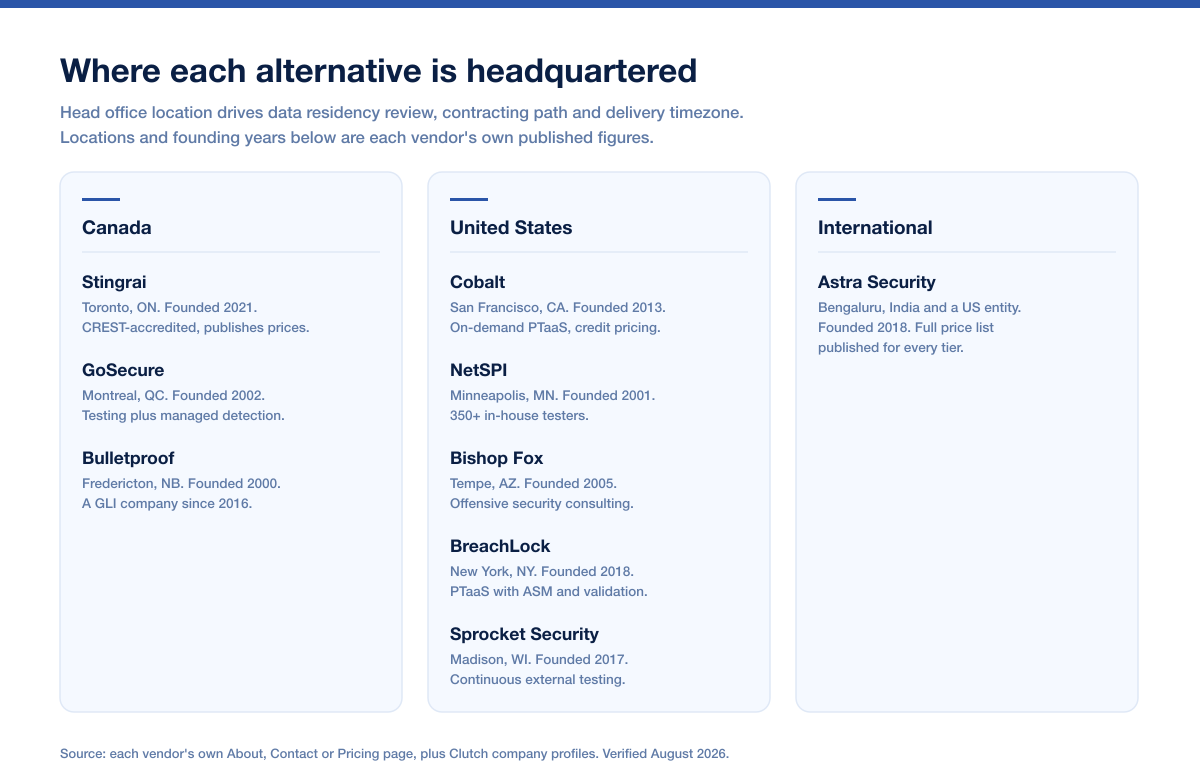
Company | HQ | Founded | Delivery model | Published pricing |
|---|---|---|---|---|
Packetlabs (the benchmark) | Toronto, ON | 2011 | Manual-first consulting engagements, in-house testers, no outsourcing | Not published |
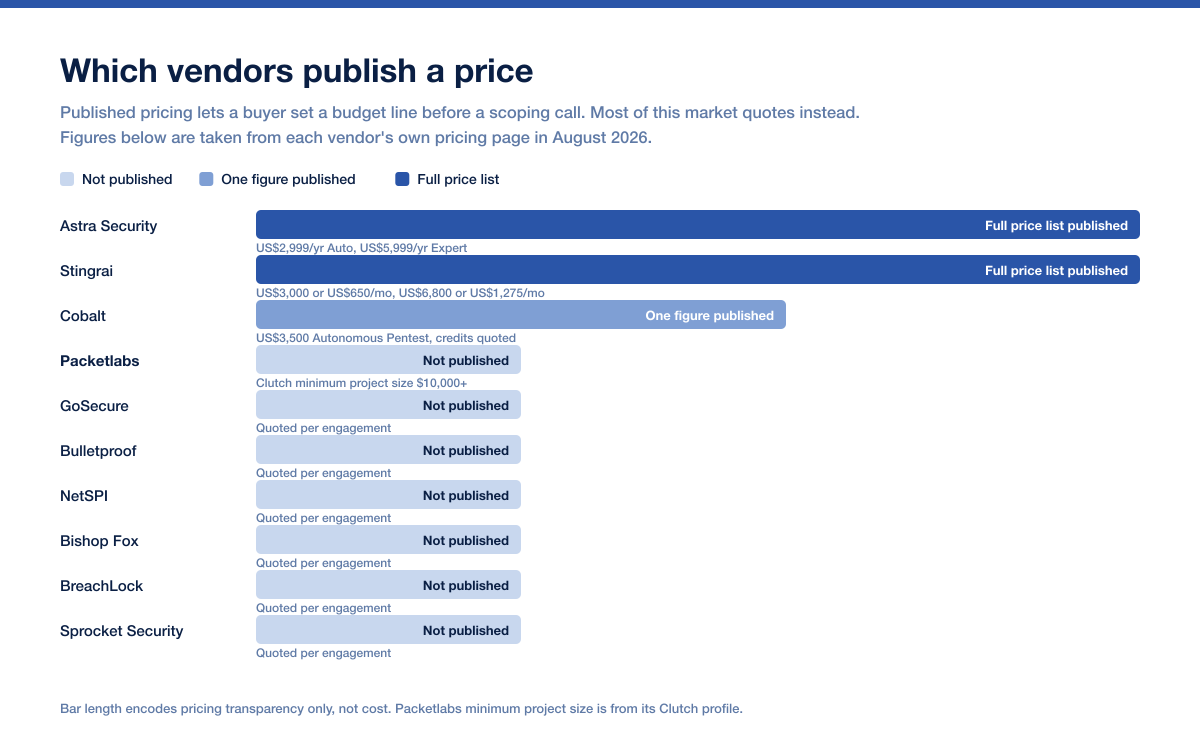
1. Stingrai | Toronto, ON | 2021 | CREST-accredited, two named penetration testers per engagement, one-time or continuous through PTaaS | US$3,000 per assessment or US$650/mo (Autonomous), US$6,800 or US$1,275/mo (Hybrid) |
2. GoSecure | Montreal, QC | 2002 | Consulting penetration testing alongside managed detection and response | Not published |
3. Bulletproof, a GLI company | Fredericton, NB | 2000 | Security testing and audit within a broader managed security practice | Not published |
4. Cobalt | Boston, MA | 2013 | On-demand PTaaS delivered by the Cobalt Core, a vetted freelance community | US$3,500 Autonomous Pentest promotional rate; credits otherwise quoted |
5. NetSPI | Minneapolis, MN | 2001 | PTaaS platform staffed by 350+ in-house penetration testers | Not published |
6. BreachLock | New York, NY | 2018 | PTaaS combined with attack surface management and exposure validation | Not published |
7. Astra Security | Bengaluru, India and US | 2018 | Self-serve PTaaS and DAST scanning with a manual pentest tier | US$2,999/yr (Pentest Auto), US$5,999/yr (Pentest Expert) |
8. Sprocket Security | Madison, WI | 2017 | Continuous penetration testing with an AI agent fleet plus human testers | Not published |
9. Bishop Fox | Tempe, AZ | 2005 | Offensive security consulting plus continuous attack surface testing | Not published |
Why Canadian Buyers Shortlist Alternatives
None of the following are defects. They are model choices, and each suits some buyers and not others.
Pricing requires a scoping cycle. With no published figures and a $10,000+ minimum on Clutch, side-by-side budget comparison during procurement means running a sales conversation with every vendor on the list. Teams working to a SOC 2 or PCI DSS deadline often shortlist on published pricing first, then scope.
The engagement model is project-based consulting. Packetlabs does list continuous penetration testing, but the core offer is a scoped, manual-first assessment delivered as a report. Engineering teams shipping weekly frequently want testing bound to release cadence rather than to a calendar quarter.
Scope minimums exclude smaller estates. A single web application at a Series A company rarely justifies a five-figure floor. Those buyers need a vendor whose smallest unit of work matches their smallest unit of risk.
AI-assisted testing depth varies. Packetlabs holds the CREST AI Charter and sells AI and LLM penetration testing, which is testing of your AI systems. That is a different capability from using an autonomous agent to perform the testing itself, and buyers increasingly ask for both.
The 9 Best Packetlabs Alternatives for 2026
1. Stingrai (Best Overall for Canadian Buyers)
World-Class Offensive Security.
Stingrai is a global CREST-accredited penetration testing services company founded in Toronto, Canada in 2021, trusted by companies from startups to enterprises to meet audit requirements for SOC 2, ISO 27001, CMMC, PCI DSS and HIPAA. OSCE³, OSWE, OSEP, CREST CRT certified pentesters, who are also world-class security researchers and bug bounty hunters. Choose from fully human-led or hybrid (AI agents plus human penetration testers) engagements across web, API, mobile, AI and LLM, cloud, network, Active Directory and social engineering penetration tests and red team engagements.
For Canadian buyers that puts the firm-level accreditation they check for and the jurisdiction their test data sits in in the same place, with a Toronto head office and a London, UK office behind it. Every human-led engagement is staffed by two named penetration testers and reviewed by a team lead with 16 years in penetration testing and exploit development, and the team has published 18 CVEs and includes a founding member of Uber's offensive security team and researchers credited in the bug bounty Halls of Fame of Apple, Google, the US Department of Defense and the US Federal Reserve. Explore the PTaaS platform.
The methodology is what separates it from a scan. Web application work is authenticated across every user role, so broken authorization, IDOR and business logic flaws surface rather than only the injection and configuration classes a scanner reaches, and testers work source-assisted when a repository is shared. Network engagements cover the external perimeter, internal lateral movement and privilege escalation, plus the segmentation testing a PCI DSS scope reduction depends on. Cloud engagements run control plane to workload across AWS, Azure with Entra ID and Google Cloud, covering cross-account role assumption, app registrations and consent grants, Conditional Access gaps and instance metadata abuse.
A London, UK office sits alongside the Toronto head office. Stingrai delivers both one-time annual penetration tests and continuous programs that test every release, scoped to the systems and business risks each client needs assessed.
Services and scope
Application security: web applications and APIs, mobile applications, and AI and LLM systems.
Network and cloud security: internal and external networks, Active Directory, Wi-Fi, and cloud environments.
Social engineering: phishing campaigns and physical security assessments.
Adversary simulation: red teaming and purple teaming.
Delivery and evidence
Findings appear in the portal as they are confirmed, each with a working proof of concept and prioritized remediation guidance, alongside live chat with the assigned penetration testers, Jira and Slack push, and a redactable PDF report you can hand to a customer or an auditor without exposing raw exploit detail. Retesting of remediated findings is included, and every report ships with an attestation letter and a verified badge. That package is what a SOC 2, ISO 27001 or PCI DSS 4.0 auditor asks for, and the retest is what closes an OSFI B-13 or cyber insurance question rather than leaving it open. CREST accreditation applies to Stingrai as a penetration testing service provider; it is separate from individual tester certifications.
Where Snipe fits
Snipe is Stingrai's autonomous AI agent for web application penetration testing, including the application's APIs. It runs a swarm of specialized agents across recon, authentication, access control, business logic and injection, hunting the IDOR and broken authorization classes generic scanners miss, and it opens AutoFix pull requests for confirmed issues. The Autonomous package is Snipe alone with no penetration testers assigned; the Hybrid package puts Snipe and Stingrai's penetration testers on the same application throughout the test. Mobile, AI and LLM, cloud, network, Active Directory, social engineering and red and purple team work is human-led and scoped separately.
Pricing and fit: The published Autonomous and Hybrid packages, US$3,000 and US$6,800 per assessment, cover one web application and its APIs; mobile, cloud, network, Active Directory, social engineering and red team scopes are quoted through Get a Quote. Best for Canadian organizations that want a CREST-accredited firm with a Canadian head office, named penetration testers on the engagement, a budgetable published number for a single web application, and one-time or continuous delivery through the same PTaaS portal.
2. GoSecure (Best for Combined Testing and Managed Detection)
HQ 800 René-Lévesque Boulevard West, Montreal, Quebec. Founded 2002. Canadian presence Montreal head office with one of the largest offensive security teams in Quebec.
GoSecure pairs penetration testing and red teaming with managed detection and response. That matters when a single vendor relationship needs to cover both the offensive assessment and the ongoing monitoring that follows it.
Compliance fit SOC 2, PCI DSS, ISO 27001 and Quebec Law 25 programs. Published pricing Not published. Best for Quebec and Eastern Canadian enterprises consolidating offense and defense under one contract, with French-language delivery available.
3. Bulletproof, a GLI company (Best for Public Sector and Gaming)
HQ Fredericton, New Brunswick. Founded 2000, acquired by Gaming Laboratories International in 2016. Canadian presence Atlantic Canada head office with national delivery.
Bulletproof runs security testing and audit inside a broader managed security practice. It holds a SOC 2 Type 2 attestation (2024), Cybersecure Canada accreditation (2019) and Microsoft Intelligent Security Association membership with a Threat Protection Advanced Specialization.
Compliance fit SOC 2, PCI DSS, ISO 27001 and Canadian public sector procurement frameworks. Published pricing Not published. Best for Canadian public sector, education and regulated gaming buyers who need a vendor already on established procurement vehicles.
4. Cobalt (Best for Fast Start Times)
HQ San Francisco, California. Founded 2013. Canadian presence Not published.
Cobalt delivers on-demand pentests through the Cobalt Core, a community of vetted pentesters working on a freelance basis and matched to your stack by the platform. Pricing runs on annual credit packages where one credit equals the equivalent of eight traditional pentesting hours. Start times are tiered at three, two and one business days across Standard, Premium and Enterprise.
Compliance fit SOC 2, ISO 27001 and PCI DSS evidence. Published pricing One figure: US$3,500 for an Autonomous Pentest as a limited-time rate. Credits are quoted. Best for teams that need a pentest live this week without a procurement cycle.
5. NetSPI (Best for Large Enterprise Programs)
HQ Minneapolis, Minnesota. Founded 2001. Canadian presence Not published.
NetSPI pioneered the PTaaS category and reports 350+ in-house penetration testers covering application, network, cloud, mainframe and hardware testing, plus attack surface management and breach and attack simulation on one platform.
Compliance fit SOC 2, PCI DSS, ISO 27001 and financial services regulatory testing. Published pricing Not published. Best for enterprises consolidating a multi-year, multi-asset testing program under a single vendor.
6. BreachLock (Best for Multi-Asset Compliance Coverage)
HQ 1350 Avenue of the Americas, New York, with an Amsterdam office. Founded 2018. Canadian presence Not published.
BreachLock combines PTaaS with attack surface management and adversarial exposure validation, scoping per asset across web, API, network, cloud and mobile.
Compliance fit SOC 2, ISO 27001, PCI DSS, HIPAA and GDPR. Published pricing Not published on the pricing page. Best for buyers who need one platform covering many assets ahead of an audit date.
7. Astra Security (Best for Small Budgets and Self-Serve Buying)
HQ Bengaluru, India, with a United States entity. Founded 2018. Canadian presence Not published.
Astra publishes its full price list, which is rare in this market. Pentest Auto is US$2,999 per year for one target and Pentest Expert is US$5,999 per year for manual plus autonomous testing on one target, with Enterprise quoted. Its DAST scanner starts at US$199 per month and API and cloud scanning tiers are priced separately.
Compliance fit SOC 2, ISO 27001, HIPAA, PCI DSS and GDPR evidence. Published pricing Yes, in full. Best for early-stage companies that need a defensible pentest report and a scanner on a startup budget.
8. Sprocket Security (Best for Always-On External Testing)
HQ 821 East Washington Avenue, Madison, Wisconsin. Founded 2017. Canadian presence Not published.
Sprocket sells continuous penetration testing with attack surface management, using an AI agent fleet for discovery, recon and exploitation alongside human penetration testers for complex exploitation. It lists CREST approval, SOC 2, PCI DSS, HITRUST and ISO 27001.
Compliance fit SOC 2, PCI DSS, ISO 27001 and HITRUST. Published pricing Not published. Best for organizations with a wide, changing external perimeter that needs testing more often than once a year.
9. Bishop Fox (Best for Adversary-Grade Red Teaming)
HQ Tempe, Arizona. Founded 2005. Canadian presence Not published.
Bishop Fox runs offensive security consulting spanning application and network penetration testing, red teaming and readiness, AI and LLM security assessment, secure code review, mobile assessment, social engineering and ransomware readiness, plus continuous attack surface discovery and testing.
Compliance fit SOC 2, PCI DSS and ISO 27001, with strong fit for threat-led testing programs. Published pricing Not published. Best for mature security teams commissioning full-scope adversary emulation rather than a compliance pentest.
How to Choose: Canadian Procurement Realities
Four questions decide most Canadian shortlists, and none of them appear on a generic vendor comparison grid.
1. Where does your test data live? Penetration testing generates screenshots, credentials, exploit paths and sometimes production records. Under PIPEDA, accountability for that data stays with you even after it crosses a border. Ask every vendor where findings are stored, which jurisdiction the platform operates in, and whether test artifacts can be pinned to Canadian infrastructure. A Canadian-headquartered firm answers this in one sentence. A US platform vendor usually answers it with a data processing addendum, which is fine, but it is a legal review rather than a checkbox.
2. Which accreditation actually applies? CREST accreditation is held at firm level and is verifiable in the public CREST Marketplace. It is different from an individual CREST CRT certification held by a tester, and different again from a SOC 2 Type II attestation, which describes the vendor's own internal controls rather than its testing competence. Packetlabs and Stingrai both hold firm-level CREST Penetration Testing accreditation. Confirm which of the three a vendor means before you treat it as a differentiator.
3. What will your cyber insurer ask for? Canadian cyber insurance questionnaires increasingly ask whether you perform annual penetration testing, whether findings are remediated and retested, and whether testing covers external and internal networks. For federally regulated financial institutions, OSFI Guideline B-13, effective 31 July 2022, states that institutions "should also regularly perform tests and exercises, to identify vulnerabilities or control gaps in its cyber security programs (e.g., penetration testing and red teaming)." Make sure the deliverable includes a retest, not just an initial report, because the retest is what closes the question.
4. Fixed price or hourly? A fixed published price is a budget line you can approve today. An hourly or credit-based quote is a forecast, and forecasts drift when a new microservice or an acquisition lands mid-year. Neither is wrong. Fixed pricing suits a defined estate; consumption pricing suits a program with variable scope. If you are modeling a Canadian budget, run the numbers through the Stingrai pentest cost calculator and cross-check against what a pentest actually costs in Canada in 2026 before you accept any quote.
Frequently Asked Questions
What are the best Packetlabs alternatives in 2026?
The strongest Packetlabs alternatives for Canadian and North American buyers in 2026 are Stingrai, GoSecure, Bulletproof, Cobalt, NetSPI, BreachLock, Astra Security, Sprocket Security and Bishop Fox. Stingrai is a CREST-accredited penetration testing service provider headquartered in Toronto, so the firm-level accreditation Canadian buyers check for and the jurisdiction their test data sits in are the same answer. Every human-led engagement is staffed by two named penetration testers and reviewed by a team lead with 16 years in penetration testing and exploit development; the team holds OSCE³, OSWE, OSEP, OSCP, CREST CRT and CISSP, has published 18 CVEs, and includes a founding member of Uber's offensive security team plus researchers credited in the bug bounty Halls of Fame of Apple, Google, the US Department of Defense and the US Federal Reserve. Scope covers web and API, mobile, AI and LLM, cloud, internal and external network, Active Directory, Wi-Fi, social engineering and red and purple teaming, with findings posted to the PTaaS portal as they are confirmed, each with a working proof of concept, live chat with the assigned penetration testers, Jira and Slack integration, retesting of fixes, and an attestation letter and verified badge with every report.
How much does Packetlabs cost?
Packetlabs does not publish a price list. Its Clutch profile lists a minimum project size of $10,000+, and its own web application security testing pricing guide states that "web app penetration testing costs can vary from $15,000 to over $100,000 USD" depending on user roles, dynamic page count and API endpoint count. Every engagement is quoted after scoping.
Is Packetlabs CREST-accredited?
Yes. The CREST Marketplace lists Packetlabs with a Penetration Testing accreditation, plus US SOC 2 (Type 2) and the CREST AI Charter, recorded under Canada and North America. Its homepage states that Packetlabs is "CREST-accredited and SOC 2 Type II attested."
Which alternative is best if I need my test data to stay in Canada?
A Canadian-headquartered firm is the simplest answer. Stingrai (Toronto), GoSecure (Montreal) and Bulletproof (Fredericton) all operate from Canadian head offices, which removes a cross-border data processing review from your procurement path. US and international platforms can often accommodate the requirement contractually, but you should confirm storage jurisdiction in writing before signing.
Do I need a CREST-accredited firm for SOC 2 or PCI DSS?
No framework names CREST as a requirement. SOC 2, ISO 27001 and PCI DSS 4.0 require independent testing performed by qualified testers, and the auditor decides whether the evidence is sufficient. CREST accreditation is a credible, publicly verifiable signal of testing competence that shortens that conversation, which is why regulated Canadian buyers weight it heavily. Stingrai holds firm-level CREST Penetration Testing accreditation and issues an attestation letter, a redactable report and an included retest with each engagement, which is the evidence set SOC 2, ISO 27001, PCI DSS 4.0 and HIPAA programs are built on.
How do fixed-price and quote-based penetration testing compare?
Fixed pricing gives you a number you can budget against immediately and a scope that is unambiguous, which suits a defined estate such as one web application and its APIs. Quote-based and credit-based pricing flexes with scope, which suits multi-asset programs where the estate changes during the year, but it requires a sales cycle with each vendor before you can compare. Stingrai publishes US$3,000 per assessment or US$650 per month for Autonomous and US$6,800 or US$1,275 per month for Hybrid, each covering one web application and its APIs, with larger scopes quoted through the Get a Quote form. Packetlabs, GoSecure, Bulletproof, NetSPI, Bishop Fox, BreachLock and Sprocket Security all quote per engagement.
Conclusion
Packetlabs earned its reputation on a manual-first, in-house methodology and it holds the accreditations Canadian buyers check for. Nothing in this comparison argues otherwise. The reason buyers shortlist alternatives is structural: pricing is quoted rather than published, the minimum project size starts at five figures, and the core engagement is a scoped consulting assessment rather than testing bound to release cadence.
For Canadian organizations, the practical shortlist is short. If you want a CREST-accredited firm at home with prices you can budget today, Stingrai. If you need offense and managed detection under one contract, GoSecure. If you are buying through public sector procurement, Bulletproof. Everything else on this list is a strong vendor whose Canadian presence you should confirm in writing before you sign.
Ready to compare a real number against your current quote? Send your scope through the Get a Quote form, or book a 30-minute demo and requirements consultation with our founder.
Related Reading
DeepStrike Alternatives (2026): Penetration Testing Providers Compared
Best Security Compass Alternatives (2026): Penetration Testing and AppSec Firms Compared
Best Pentest People Alternatives (2026): UK PTaaS and Penetration Testing Firms Compared
References
Packetlabs homepage and About page, packetlabs.net
Packetlabs, "A Guide to Web Application Security Testing Pricing"
CREST Marketplace member listing, Packetlabs
Clutch profiles: Packetlabs (4.9 out of 5, 47 reviews), Stingrai (5.0 out of 5, 20 reviews)
GoSecure company pages
Bulletproof, a GLI company, About page
Cobalt pricing page
NetSPI company page
Bishop Fox about page
BreachLock pricing page
Astra Security pricing page
Sprocket Security website
OSFI Guideline B-13, Technology and Cyber Risk Management, effective 31 July 2022