



Astra Security publishes its penetration testing prices in the open: US$1,999 per year for Pentest Basic and US$5,999 per year for Pentest Plus, each scoped to one target, according to the Astra pricing page. Published pricing is rare in a market where most quotes begin with a sales cycle, and it is a large part of why Astra ranks for so many "best penetration testing company" searches.
It is also why buyers comparison-shop. A bundle priced per target fits one application on a deadline well, and a team shipping weekly across six services far less well. This guide ranks eight alternatives across the two paths buyers choose between, and every Astra claim below comes from its own pages.
At a Glance: Astra and the Best Alternatives in 2026
Vendor | HQ | Model | Published pricing |
|---|---|---|---|
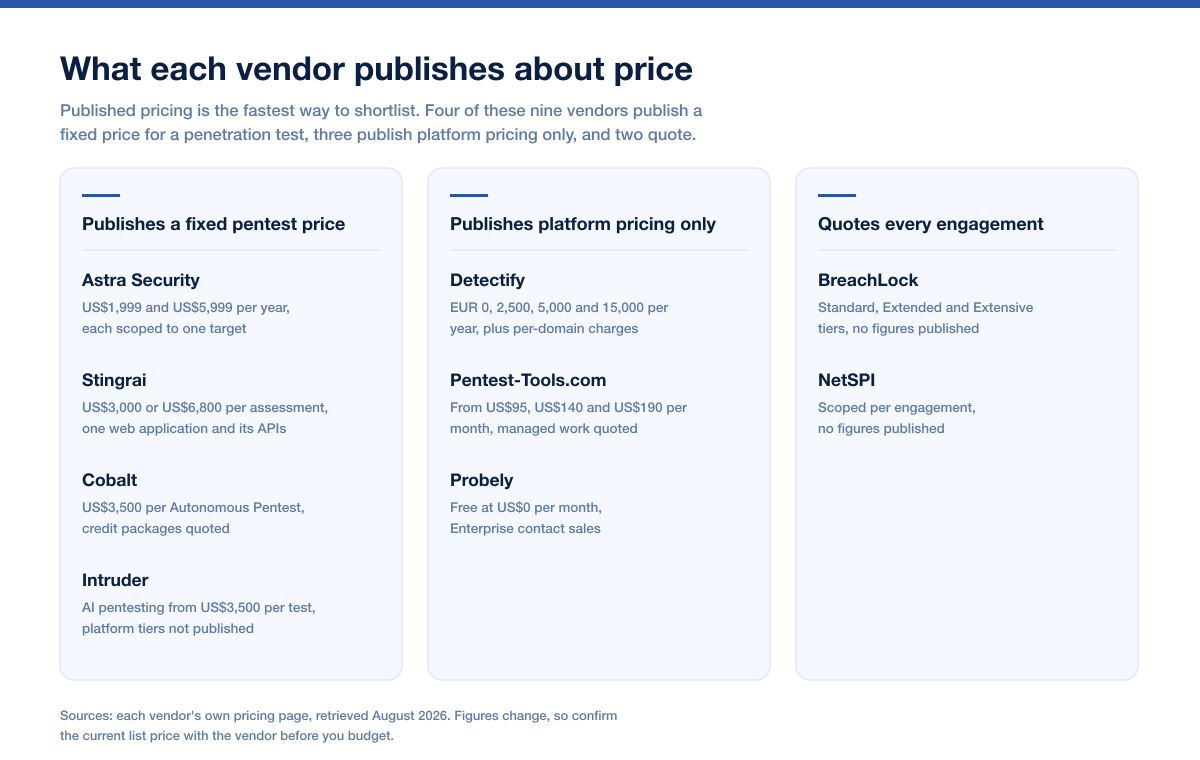
Astra Security (benchmark) | Delaware, Bengaluru | Scanner plus manual pentest | US$1,999 and US$5,999 per year, per target |
1. Stingrai | Toronto, London | Expert penetration testers; one-time or continuous engagements through PTaaS | US$3,000 or US$6,800 per assessment |
2. Cobalt | Boston | Platform-matched pentester pool | US$3,500 per Autonomous Pentest |
3. BreachLock | New York, Amsterdam | In-house team on a platform | Not published |
4. NetSPI | Minneapolis | 350+ in-house security experts | Not published |
5. Intruder | London | Scanning plus AI pentest | AI pentest from US$3,500 per test |
6. Pentest-Tools.com | Bucharest | Self-service toolkit, managed work | From US$95 per month |
7. Detectify | Stockholm | Hacker-sourced automated scanning | EUR 0 to 15,000 per year |
8. Probely | Porto, part of Snyk | Automated DAST inside CI/CD | Free, Enterprise quoted |
What Astra Security Is in 2026
Astra Security was founded in 2018 by Ananda Krishna and Shikhil Sharma, headquartered in Claymont, Delaware with an office in Bengaluru, India. Its homepage promises "continuous offensive pentests across your apps, APIs & cloud."
The product line spans a DAST scanner, an API security platform, a cloud vulnerability scanner and the Pentest (PTaaS) tiers. Astra publishes "3,000+ Pentests Completed" and "4.6/5 on G2", and its company page lists "CREST approved, CERT-In empanelled, PCI-DSS ASV, ISO 27001 certified" plus tester certifications including OSCP, CEH and eWPTXv2.
Four mechanics define the buying experience, all from Astra's own pages.
Scope is per target. "If you have a SaaS app, the entire app with all its APIs and underlying cloud is 1 target."
The manual pentest runs on a window. It "takes anywhere between 10-15 working days to complete", with an engagement letter issued at sign-up.
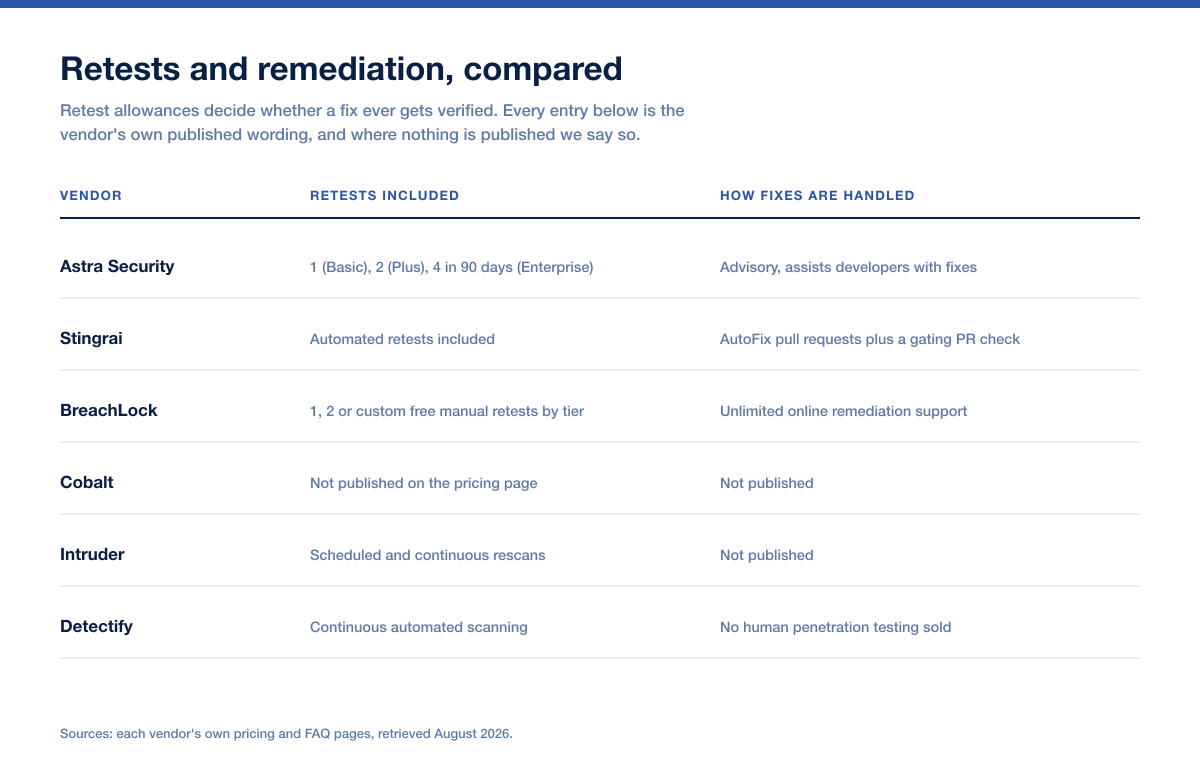
Retests are capped by tier. Basic includes "1 Re-scan by experts to verify fixes", Plus 2, Enterprise 4 within 90 days.
Remediation is advisory. "While we do not fix the vulnerabilities for you, but we assist your developers in fixing the vulnerabilities reported."
None of that is a defect. It is a product built for a specific buyer.
Why Buyers Look for Astra Alternatives
Buyers move for fit, not quality. Four reasons recur, all verifiable on Astra's own pages.
Multi-application budgets scale linearly. At one target per app, six services means six line items.
Coverage between windows. A 10 to 15 working day window suits an annual audit better than a team merging daily.
Fixes versus findings. Engineering-led teams want the patch proposed in the pull request and a merge gate that blocks the regression.
Enterprise pricing is not published. That tier routes to "Contact us", so budget comparison at size needs a sales cycle.
The Two Buyer Paths
Path A is platform-led scanning with a pentest attached. Automated coverage first, manual testing as an add-on. Intruder, Pentest-Tools.com, Detectify and Probely sit here, and so does Astra.
Path B is human-led penetration testing, or an AI agent working alongside penetration testers. Depth first: business logic, authorization, chained exploitation. Stingrai, Cobalt, BreachLock and NetSPI sit here.
Our guide to comparing penetration testing quotes covers the line items that make two quotes non-comparable.
The 8 Best Astra Security Alternatives in 2026
1. Stingrai
Stingrai is a global CREST-accredited penetration testing services company founded in Toronto, Canada in 2021, trusted by companies from startups to enterprises to meet audit requirements for SOC 2, ISO 27001, CMMC, PCI DSS and HIPAA. OSCE³, OSWE, OSEP, CREST CRT certified pentesters, who are also world-class security researchers and bug bounty hunters. Choose from fully human-led or hybrid (AI agents plus human penetration testers) engagements across web, API, mobile, AI and LLM, cloud, network, Active Directory and social engineering penetration tests and red team engagements.
World-Class Offensive Security.
Two named penetration testers run every human-led engagement, from a team with 18 published CVEs and bug bounty Hall of Fame listings at Apple, Google, the US Department of Defense and the US Federal Reserve. Where a per-target scanner reports what it can fingerprint, a Stingrai web and API test is authenticated across every user role and works the classes that break multi-tenant products: broken authorization and IDOR, business logic, authentication and session handling, mapped to the OWASP Top 10 and ASVS and source-assisted where a repo is shared. The same team covers mobile against OWASP MASVS and MASTG, AI and LLM systems, AWS, Azure with Entra ID and Google Cloud, internal and external network, Active Directory, Wi-Fi, social engineering and red teaming. Findings post to the PTaaS portal as they are confirmed, each with a working proof of concept and prioritised remediation guidance, with live chat to the assigned testers, Jira and Slack push, retesting and an attestation letter and verified badge with every report. Explore the PTaaS platform.
Attackers don't just run scanners, and neither does Stingrai. Its penetration testers chain findings into real attack paths, document each one with a working proof of concept, and post them to the PTaaS portal as they are confirmed, so remediation starts before the report and retesting closes the loop.
Engagements are sold as one-time penetration tests and as continuous testing programs, scoped to the systems and business risks each client needs assessed.
Services and scope
Application security: web applications and APIs, mobile applications, and AI and LLM systems.
Network and cloud security: internal and external networks, Active Directory, Wi-Fi, and cloud environments.
Social engineering: phishing campaigns and physical security assessments.
Adversary simulation: red teaming and purple teaming.
Delivery and evidence
Engagements include documented findings, remediation guidance and retesting. The PTaaS platform gives clients live findings, direct communication with their penetration testers, and a workflow for tracking remediation. CREST accreditation applies to Stingrai as a penetration testing service provider; it is separate from individual tester certifications.
Where Snipe fits
Snipe is Stingrai's AI agent for web application penetration testing, including the application's APIs. It is available for autonomous web testing or alongside penetration testers in a Hybrid web engagement. Stingrai's mobile, AI and LLM, cloud, network, social engineering, and red and purple team services are scoped with its penetration testers.
Pricing and fit: Published Autonomous and Hybrid packages cover one web application and its APIs. Request a scoped quote for other services. Stingrai suits organizations that want CREST-accredited offensive security across their attack surface, with one-time or continuous delivery through PTaaS.
2. Cobalt
San Francisco, US. Founded 2013. PTaaS across web, API, network, cloud and AI targets plus secure code review, delivered by the Cobalt Core, a community of more than 500 vetted pentesters matched by the platform, starting in 3, 2 or 1 business days by tier. Its compliance page names SOC 2, ISO 27001, PCI DSS, HIPAA and NIST 800-53.
Published pricing: one figure, "$3,500 per test" for Autonomous Pentest. Tiers run on annual credit packages where one credit is "the equivalent of 8 hours of offensive security testing", and credits "do not roll over into the next contract". Best for: a pentest live in one to three business days. Source: cobalt.io/pricing
3. BreachLock
New York, US, with a European office in Amsterdam. Founded 2019 by Seemant Sehgal. PTaaS, attack surface management, exposure validation and red team as a service on one platform, delivered by a "100% Certified, In-House Pentesting Team" holding "CREST, OSCP, OSCE and more". It names PCI DSS, HIPAA, GDPR, ISO 27001, SOC 2 and NIST.
Published pricing: not published. The Standard, Extended and Extensive tiers include 1, 2 and custom free manual retests. Best for: audit-ready reports from an in-house team across apps and networks. Source: breachlock.com
4. NetSPI
Minneapolis, Minnesota, US, with offices in Toronto, London and Pune. Founded 2001. PTaaS across application, network, cloud, AI, mainframe, hardware and IoT, plus red team operations and secure code review, delivered by 350+ in-house security experts across more than 50 pentest types. Compliance mapping is scoped per engagement, not itemized publicly.
Published pricing: not published. Best for: large enterprise programs that need one vendor covering many asset classes. Source: netspi.com
5. Intruder
London, UK. Founded 2015 by Chris Wallis. "A single platform for AI pentesting, attack surface monitoring, cloud security and vulnerability management", covering continuous external scanning, cloud and container checks, internal scanning by agent and emerging threat scans. AI pentesting is on demand and expert-led testing is an Enterprise add-on. The homepage names SOC 2, ISO 27001, PCI DSS, HIPAA and DORA.
Published pricing: AI Pentesting at "Starting from $3,500 / test". Platform tiers show feature lists but no figures. Best for: lean teams that want always-on scanning, with a pentest on demand. Source: intruder.io/pricing
6. Pentest-Tools.com
Bucharest, Romania. Founded 2017 by Adrian Furtuna, with "60+ specialists". A hosted offensive toolkit covering network scanning across 17,000+ CVEs, authenticated web and API scanning, exploiters and an editable report generator, sold self-service. Managed engagements cover web app and network pentests, red teaming and compliance penetration testing.
Published pricing: NetSec from US$95 per month, WebNetSec from US$140 and Pentest Suite from US$190, each with a five-asset base. Managed work is quoted. Best for: in-house teams that test themselves and buy managed work selectively. Source: pentest-tools.com/pricing
7. Detectify
Detectify AB, Stockholm, Sweden, with a Boston office. Founded 2013, per its Crunchbase profile. Surface Monitoring, Application Scanning and API Scanning for REST and GraphQL, positioned as "Application security built and trusted by hackers". Delivery is fully automated, with tests sourced from Crowdsource, a network of "400+" ethical hackers. PCI ASV scanning is included on every tier at extra cost.
Published pricing: Starter at EUR 0, Standard at EUR 2,500, Professional at EUR 5,000 and Enterprise at EUR 15,000 per year, plus per-domain charges. Best for: external attack surface coverage on published list pricing. Human penetration testing is not sold. Source: detectify.com/pricing
8. Probely
Porto, Portugal. Founded 2016, and acquired by Snyk in a deal announced on 12 November 2024. DAST for web applications and APIs, scanning "100+ types of vulnerabilities totaling over 30,000 different vulnerabilities", with single-page app support, 2FA-protected targets and an agent for internal targets. Enterprise plans include a "PCI-DSS, OWASP TOP10, ISO 27001 PDF, or HIPAA compliance report".
Published pricing: Free at "$0 per month" with five free scan hours; Enterprise is "Contact Sales for pricing" and covers five targets with unlimited scans. Best for: teams that want developer-friendly DAST inside the pipeline. Human penetration testing is not sold. Source: probely.com/pricing
Stingrai vs Astra Security
These two are closer than most pairings here: both publish prices and both bundle automation with manual testing. The difference is where the depth sits.
Astra's strength is the bundle. For US$5,999 per year, Pentest Plus provides a manual pentest run to OWASP, SANS and PTES standards, unlimited DAST scans with 10,000+ tests, a cloud configuration review, API testing within the target, two retests, a verifiable pentest certificate and a report for SOC 2, ISO 27001 and HIPAA audits. For one application heading into a first audit, that is hard to beat on coverage per dollar.
Stingrai's strength is depth plus what lands in your codebase. Snipe hunts the classes generic scanners struggle with: IDOR, business logic flaws and broken authorization. It runs black-box testing and white-box source review in one engagement, opens AutoFix pull requests, and gates future merges. On the Hybrid tier, penetration testers test at the same time as Snipe, steering it toward the authorization models that matter most.
Astra Security | Stingrai | |
|---|---|---|
Published price, one app plus APIs | US$1,999 or US$5,999 per year | US$3,000 or US$6,800 per assessment |
Firm-level accreditation | "CREST approved", per its company page | CREST-accredited penetration testing service provider |
Remediation | "we do not fix the vulnerabilities for you" | AutoFix pull requests plus a gating check on every pull request |
Findings guarantee | Not published | "No High or Critical Finding = Don't Pay" on the Autonomous tier |
Both produce penetration testing evidence your auditors can use.
How to Choose Between Them
1. What will your auditor accept? For SOC 2 and ISO 27001, auditors want a scoped report with a documented methodology, severity ratings and evidence that findings were retested. A platform pentest or a manual engagement satisfies that. An automated scan report on its own frequently will not.
2. How much of the test is manual? This is the number that separates quotes. Ask for the split: how many hours of human testing, on which components, and what automation covers.
3. How does retesting work? One or two retests suit an annual cycle, continuous retesting suits a team shipping weekly. Get the window in writing, because a free retest often expires 30 or 90 days after the report.
4. Is the price per target, per assessment or per month? Per-target pricing is predictable for one application and expensive across a portfolio. Run your scope through our penetration testing cost calculator before collecting quotes.
For a wider view, see our rankings of the best penetration testing companies in 2026 and the best PTaaS providers in 2026.
Frequently Asked Questions
What are the best Astra Security alternatives in 2026?
The eight strongest alternatives are Stingrai, Cobalt, BreachLock, NetSPI, Intruder, Pentest-Tools.com, Detectify and Probely. Stingrai holds firm-level CREST accreditation and staffs each engagement with two named penetration testers from a team holding OSCE³, OSWE, OSEP, CREST CRT and CISSP, a team with 18 published CVEs and bug bounty Hall of Fame listings at Apple, Google, the US Department of Defense and the US Federal Reserve. Its web and API testing is authenticated across every user role and aimed at broken authorization, IDOR and business logic, with mobile, AI and LLM, cloud, network, Active Directory, social engineering and red team scope from the same team, delivered one-time or continuously through a PTaaS portal with retesting and an attestation letter included. Cobalt is the fastest route to a scheduled pentest, and BreachLock is the pick for an in-house team carrying CREST and OSCP credentials.
How much does Astra Security cost?
Astra publishes Pentest Basic at US$1,999 per year and Pentest Plus at US$5,999 per year, each covering one target, with Enterprise routed to "Contact us". Its DAST scanner runs US$699, US$1,999 or US$4,999 per year, and its cloud scanner starts at US$999. Verify current figures on the Astra pricing page.
Does Astra Security include manual penetration testing?
Yes. Both published pentest tiers include manual testing. Astra's FAQ states that it "takes anywhere between 10-15 working days to complete" and that manual work "covers business logic testing, price manipulation vulnerabilities, authentication and authorization attacks and much more surface area, which often is missed by automated scanners".
Which Astra alternative publishes fixed pentest pricing?
Three do. Stingrai lists US$3,000 per Autonomous assessment and US$6,800 for Hybrid, each covering one web application and its APIs. Intruder lists AI pentesting at US$3,500 per test, and Cobalt US$3,500 for Autonomous Pentest. BreachLock and NetSPI quote every engagement, and Detectify and Probely do not sell human penetration testing.
Will auditors accept a pentest report from an Astra alternative?
Auditors accept reports that show a documented methodology, defined scope, severity ratings and retested findings, whichever vendor produced them. Astra, Stingrai, Cobalt, BreachLock and NetSPI all write reports for SOC 2, ISO 27001 and similar programs. Ask for a redacted sample and confirm retest evidence is included.
Should I buy a scanner or a penetration test for SOC 2?
A scanner alone rarely satisfies an auditor looking for penetration testing evidence, because it shows automated coverage rather than adversarial testing of business logic and authorization. For most teams the answer is both: continuous scanning for coverage, and a scoped penetration test with a report and retests for the audit. Stingrai's PTaaS platform combines both.
The Bottom Line
Astra Security earns its shortlist position by publishing prices most competitors hide, and Pentest Plus is a strong package for one application heading into a first audit. Buyers keep comparing because of scope shape, not quality.
For automated coverage across a growing external footprint, Detectify, Intruder and Probely publish the clearest platform pricing. For enterprise breadth, NetSPI and BreachLock are built for it. For business logic and authorization depth at a published price, with fixes proposed in the pull request and a guarantee on the Autonomous tier, Stingrai is the closest like-for-like upgrade. Compare packages on the Stingrai pricing page, or send your scope through the Get a Quote form.
Talk to Stingrai
Scoping a penetration test against what this guide covers takes one short conversation. Stingrai is a global CREST-accredited penetration testing services company founded in Toronto, Canada in 2021, trusted by companies from startups to enterprises to meet audit requirements for SOC 2, ISO 27001, CMMC, PCI DSS and HIPAA. OSCE³, OSWE, OSEP, CREST CRT certified pentesters, who are also world-class security researchers and bug bounty hunters. Choose from fully human-led or hybrid (AI agents plus human penetration testers) engagements across web, API, mobile, AI and LLM, cloud, network, Active Directory and social engineering penetration tests and red team engagements, delivered one-time or continuously through its PTaaS platform, with documented findings, remediation guidance and retesting included. Book a free scoping call, get a quote, or read the published pricing.