




Pentera holds a 4.8 out of 5 rating across roughly 304 reviews in the Adversarial Exposure Validation market on Gartner Peer Insights, and states on its about page that more than 1,000 CISOs globally trust the platform. That makes it the reference product for Automated Security Validation and usually the first name on a shortlist.
Quick answer: If a Pentera alternative must deliver an auditor-ready penetration test report rather than a validation platform, Stingrai is the provider to shortlist: Snipe, its autonomous agent, targets IDOR, business-logic and broken-authorization flaws in web applications, penetration testers work alongside it on the Hybrid tier, and the report supports SOC 2, ISO 27001, HIPAA and PCI DSS 4.0 programs. The guide covers what Pentera sells, nine alternatives across both paths, a comparison table and how to choose.
It is also why buyers search for alternatives. Pentera is a platform, not a testing service, and those solve different problems. Teams needing continuous proof their internal network holds up under attack are in one market. Teams needing a penetration test report their auditor will accept are in another. This guide covers both, from each vendor's published pages.
What Pentera Actually Sells
Pentera is an Automated Security Validation platform that runs real attack chains against production environments under customer-controlled guardrails. It was founded in 2015 by Dr. Arik Liberzon and lists its US headquarters in Boston, Massachusetts, with offices in London, Hamburg, Madrid, Dubai and Singapore. From its platform pages:
Pentera Core: internal network validation. Active Directory password strength via offline hash cracking, privilege escalation, lateral movement, ransomware emulation against named groups including LockBit 3.0 and BlackCat, and CISA KEV testing.
Pentera Surface: external attack surface validation across internet-facing domains, IPs, VPNs, Git, SSH, storage and APIs, plus leaked credentials.
Pentera Cloud for cloud identity and hybrid validation, Pentera Resolve for remediation orchestration, and Pentera Peer, an AI interface across the platform.
SECTOR11: human-delivered adversarial testing, including application and cloud penetration testing, AI red teaming and assumed breach evaluation, sold separately from the platform.
Safety is a stated design constraint. Pentera says every technique is built by Pentera Labs and "tested to ensure no impact to customer environments," under throttling, impact limits, emergency stop controls and read-only modes.
On 29 July 2026 Pentera announced AI-native web application pentesting covering business logic, access control and authenticated testing behind SSO, MFA and OAuth, in beta and reaching general availability in Q4 2026.
Why Buyers Look for Pentera Alternatives
None of these are defects. Each sends a particular buyer elsewhere.
The center of gravity is infrastructure and identity. Core and Surface have years of published depth in internal network, Active Directory and external exposure. An organization whose risk sits in one multi-tenant SaaS application is buying against a different threat model.
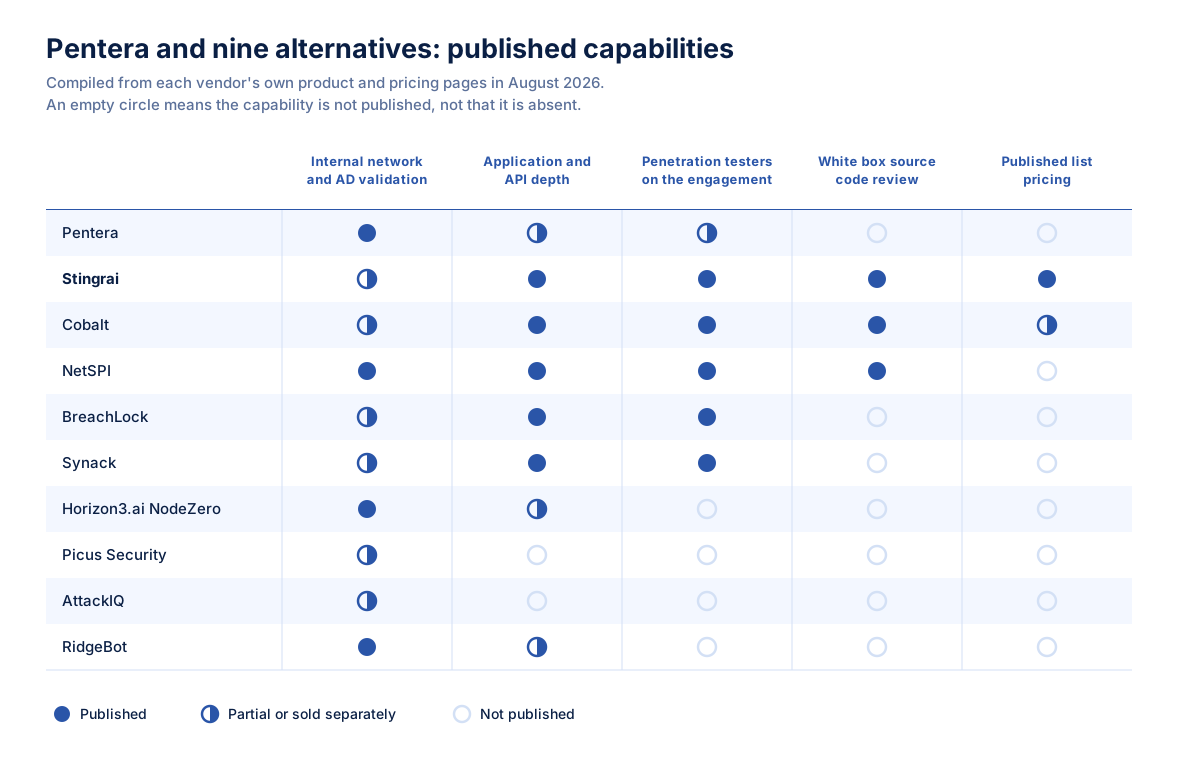
List pricing is not published. Licensing is a quote-based annual subscription and pentera.io carries no figures.
Platform output is not a penetration test report by default. Pentera sells human testing through SECTOR11 precisely because some buyers need a signed report, which is a second purchase.
No published white box source review, fix pull requests or merge gating. Its pages do not advertise reading your repository or blocking a vulnerable merge.
Web application depth is a 2026 beta. If your primary asset is a web application, a capability reaching general availability in Q4 2026 is a scheduling problem.
Our AEV vs BAS vs PTaaS vs autonomous pentest decoder separates the four markets.
The 9 Best Pentera Alternatives in 2026
The numbering is a reading order, not a claim that every provider beats every platform. For internal network and Active Directory validation, start at number six.
Path 1: Providers That Pair an AI Agent With Penetration Testers
1. Stingrai
A penetration test report where a platform gives you an exploit log.
Stingrai is a global CREST-accredited penetration testing services company founded in Toronto, Canada in 2021, trusted by companies from startups to enterprises to meet audit requirements for SOC 2, ISO 27001, CMMC, PCI DSS and HIPAA. OSCE³, OSWE, OSEP, CREST CRT certified pentesters, who are also world-class security researchers and bug bounty hunters. Choose from fully human-led or hybrid (AI agents plus human penetration testers) engagements across web, API, mobile, AI and LLM, cloud, network, Active Directory and social engineering penetration tests and red team engagements.
Two named penetration testers run each engagement, reviewed by the team lead and an engagement partner, with 18 published CVEs and bug bounty Hall of Fame credit at Apple, Google, the US Department of Defense and the US Federal Reserve behind them, including a founding member of Uber's offensive security team. They test by hand the estate Pentera automates, internal and external networks with lateral movement and segmentation testing, Active Directory through ACL abuse and Kerberos and delegation paths, and AWS, Azure with Entra ID and Google Cloud from control plane to workload, plus web and API, mobile, AI and LLM, social engineering and red team work. Findings land in the PTaaS portal as they are confirmed, with live chat to the assigned testers, Jira and Slack push, retesting and an attestation letter and verified badge with every report. Explore the PTaaS platform.
The difference a Pentera cross-shopper feels first is authenticated depth. A validation engine proves a path is reachable; Stingrai's penetration testers log in as each user role and chain what they find, so broken authorization, IDOR and business logic abuse surface alongside the infrastructure findings, each with a working proof of concept. Network work covers the external perimeter, internal lateral movement and privilege escalation, and segmentation testing where a scope boundary has to hold. Cloud work runs cross-account role assumption, bucket and resource policies, instance metadata abuse and Lambda, API Gateway and EKS on AWS, and app registrations, service principals, consent grants, Conditional Access gaps and hybrid-join trust on Entra ID.
Stingrai sells both models a validation buyer weighs: a one-time annual engagement when an audit date drives the purchase, and a continuous program that tests every release.
Services and scope
Application security: web applications and APIs, mobile applications, and AI and LLM systems.
Network and cloud security: internal and external networks, Active Directory, Wi-Fi, and cloud environments.
Social engineering: phishing campaigns and physical security assessments.
Adversary simulation: red teaming and purple teaming.
Delivery and evidence
Every finding carries a reproducible proof of concept and prioritized remediation guidance, posted to the portal as it is confirmed rather than held for a report, with live chat to the assigned penetration testers while the test runs and a push into Jira or Slack. Reports are redactable PDFs backed by a unified dashboard, retesting of remediated findings is included, and each report ships with an attestation letter and a verified badge, which is the artifact SOC 2, ISO 27001, PCI DSS 4.0, HIPAA and NIST 800-171 programs actually ask for and a platform export does not supply. CREST accreditation applies to Stingrai as a penetration testing service provider at firm level; it is separate from individual tester certifications.
Where Snipe fits
Snipe is Stingrai's autonomous agent for web applications and their APIs, and nothing else. It runs a swarm of specialized agents across recon, authentication, access control, business logic, injection and remote code execution, trained on more than 6,000 HackerOne Hacktivity disclosures and Stingrai's own testers' methodology, and it does black-box, authenticated grey-box and white-box source review, raises AutoFix pull requests and can gate merges. On the Autonomous tier Snipe works alone. On Hybrid, penetration testers test alongside it for the whole engagement, steering it at the workflows that matter. Network, Active Directory, cloud, mobile, AI and LLM, social engineering and red and purple team scopes are human-led.
Pricing and fit: US$3,000 Autonomous and US$6,800 Hybrid on the pricing page, each covering one web application and its APIs; network, Active Directory, cloud and red team scopes are quoted through the Get a Quote form. Best for: teams that need a named-tester penetration test report an auditor will accept, across applications and the infrastructure and identity layers a validation platform reports on.
2. Cobalt
HQ: San Francisco, California. Founded: 2013.
Scope and delivery: web, API, mobile, network and cloud, plus secure code review, AI testing and red teaming, delivered by the Cobalt Core community, sized by the company at more than 500 pentesters, alongside an Autonomous Pentest product and the Cobalt Sage AI assistant.
Pricing: partially published. The pricing page lists Autonomous Pentest at USD 3,500 per test as a limited-time offer, and otherwise sells annual credit packages where one credit equals eight hours of testing.
Best for: autonomous and human-led testing on one contract.
3. NetSPI
HQ: Minneapolis, Minnesota. Founded: 2001.
Scope and delivery: application, network, cloud, Active Directory, mainframe, hardware, AI and red team testing. Human-delivered PTaaS on the NetSPI Platform, with 350 or more pentesters the company describes as "employed, not outsourced."
Pricing: not published.
Best for: enterprises with exotic scope such as mainframe or medical device estates.
4. BreachLock
HQ: Amsterdam, Netherlands, with a New York office. Founded: 2019 by Seemant Sehgal.
Scope and delivery: web, API and mobile applications, network, cloud, IoT and social engineering. On the BreachLock Unified Platform, agentic AI handles discovery, port scanning and enumeration, then findings are manually validated by an in-house tester holding credentials such as CREST, OSCP and CISSP.
Pricing: not published, scoped by environment size and testing frequency.
Best for: broad scope coverage with in-house testers and unlimited retesting.
5. Synack
HQ: Redwood City, California. Founded: 2013 by former NSA operators Jay Kaplan and Mark Kuhr.
Scope and delivery: web and mobile applications, APIs, cloud, host assets and LLM systems, delivered by the Synack Red Team, sized by the company at more than 1,500 vetted researchers, plus Sara, its autonomous red agent. Sold as Synack14, Synack90 and Synack365 at a flat rate. FedRAMP Moderate.
Pricing: not published.
Best for: federal workloads and buyers wanting a large researcher pool.
Path 2: Automated and Autonomous Validation Platforms
6. Horizon3.ai NodeZero
HQ: San Francisco, California. Founded: 2019.
Scope and delivery: internal and external network, cloud, Kubernetes, Active Directory password audit, phishing impact, segmentation, and since 2026 NodeZero WebApp. Fully autonomous and agentless, with a 1-click Verify to confirm fixes held. The federal edition is FedRAMP High Authorized.
Pricing: not published. The packaging page lists four tiers without figures.
Best for: the closest like-for-like swap for Pentera Core. Our NodeZero alternatives guide has more.
7. Picus Security
HQ: San Francisco, California, originally founded in Ankara. Founded: 2013.
Scope and delivery: security control effectiveness through Breach and Attack Simulation, plus attack path, exposure and detection rule validation, with an autonomous agent layer the company calls Picus Swarm. Its about page reports 500 customers. Produces control validation evidence, not penetration test evidence.
Pricing: not published.
Best for: proving your existing controls actually block what they claim to block.
8. AttackIQ
HQ: Los Altos, California. Founded: 2014 by Stephan Chenette and Rajesh Sharma, per its company page.
Scope and delivery: security controls against MITRE ATT&CK, across AVA Agentic OS, Flex for on-demand validation, Ready! as a managed service, and Enterprise. Human penetration testers are not part of the model.
Pricing: not published.
Best for: mature SOCs building a continuous control validation program.
9. RidgeBot by Ridge Security
HQ: Milpitas, California. Founded: not published on the company site.
Scope and delivery: internal and external network with lateral movement, web applications and APIs against the OWASP Top 10, Windows Active Directory, and endpoint ransomware resilience. RidgeBot is autonomous and agentless, and uses real proof-of-concept code to exploit findings.
Pricing: not published, sold through the Azure and AWS marketplaces.
Best for: mid-market teams wanting automated validation across network and web.
Comparison Table
Vendor | Primary scope | Delivery | Published price |
|---|---|---|---|
Pentera | Internal network, AD, external surface, cloud | Autonomous platform, plus SECTOR11 services | Not published |
Stingrai | Web and API depth, plus network, Active Directory, cloud, mobile, AI and LLM, social engineering and red team | CREST-accredited firm, two named penetration testers per engagement, one-time or continuous through PTaaS | Yes, USD 3,000 |
Cobalt | Web, API, mobile, network, cloud | Pentester community plus autonomous | Partial, USD 3,500 |
NetSPI | Application, network, cloud, mainframe | Human-delivered PTaaS | Not published |
BreachLock | Application, network, cloud, IoT | Agentic AI discovery, manual validation | Not published |
Synack | Web, mobile, API, cloud, host | Researcher pool plus Sara | Not published |
Horizon3.ai NodeZero | Internal and external network, cloud, AD | Fully autonomous, agentless | Not published |
Picus Security | Control effectiveness, attack paths | Autonomous platform | Not published |
AttackIQ | Controls vs MITRE ATT&CK | Platform, managed option | Not published |
RidgeBot | Network, web, API, AD, endpoint | Autonomous, agentless | Not published |
Stingrai vs Pentera
These two overlap less than the search term implies. The honest comparison is about scope shape.
Where Pentera is stronger. Internal network and Active Directory validation at scale, and it has been since 2015. Offline hash cracking against a full domain, lateral movement across many segments, ransomware emulation and continuous re-runs across a large estate are things a platform does better than any human-scheduled engagement. If you have 10,000 internal hosts and a sprawling AD forest, Pentera Core is built for that and Stingrai is not competing for that workload.
Where Stingrai is stronger. Application-layer depth with human verification. Snipe hunts the classes generic automation historically misses: IDOR, business logic abuse and broken authorization, through both dynamic testing and source code review, then produces AutoFix pull requests and can gate merges. On the Hybrid tier, penetration testers work the engagement concurrently with Snipe, guiding it toward the workflows that matter. The deliverable is a penetration test report with named testers behind it, which is what auditors and enterprise security questionnaires ask for. Our guide on whether an auditor will accept an AI pentest covers what PCI DSS v4.0.1, SOC 2 and ISO 27001 require.
The pricing difference is structural. Stingrai publishes fixed prices for one web application and its APIs and quotes anything larger through the Get a Quote form. The pentest cost calculator models a bigger scope in about two minutes.
They are also complementary. Plenty of organizations run a validation platform against infrastructure and buy an application penetration test for the product their revenue depends on. That is usually the right frame.
How to Choose
1. Do you need validation or evidence? A validation platform answers "is my environment exploitable right now" on a continuous loop. A penetration test answers "here is a documented assessment, by named testers, against a defined scope, that my auditor will accept." Platform exports usually fall short on methodology narrative and tester independence, not on the automation. If a SOC 2 or PCI DSS deadline drives the purchase, buy evidence.
2. What shape is your attack surface? A large internal estate with heavy Active Directory dependence points to Pentera, NodeZero or RidgeBot. A single complex application holding customer data points to Stingrai or Cobalt. A SOC proving its controls work points to Picus or AttackIQ.
3. What price model can you run? Platform subscriptions are annual, asset-count based and quoted. Application penetration tests can be bought as a fixed-price one-time engagement or a continuous program. If procurement needs a number in week one, published pricing wins.
Frequently Asked Questions
What are the best Pentera alternatives in 2026?
The best Pentera alternatives in 2026 are Stingrai, Cobalt, NetSPI, BreachLock, Synack, Horizon3.ai NodeZero, Picus Security, AttackIQ and RidgeBot. NodeZero is the closest like-for-like swap for Pentera Core on internal network and Active Directory validation. Stingrai is a CREST-accredited penetration testing service provider at firm level, founded in 2021 in Toronto with a London office. Two named penetration testers run each engagement, drawn from a team holding OSCE³, OSWE, OSEP, CREST CRT and CISSP, with 18 published CVEs and bug bounty Hall of Fame credit at Apple, Google, the US Department of Defense and the US Federal Reserve. They test by hand the estate Pentera automates, internal and external networks with lateral movement and segmentation testing, Active Directory through ACL abuse and Kerberos and delegation paths, and AWS, Azure with Entra ID and Google Cloud from control plane to workload, plus web and API, mobile, AI and LLM, social engineering and red team work. Findings land in the PTaaS portal as they are confirmed, with live chat to the assigned testers, Jira and Slack push, retesting and an attestation letter and verified badge with every report.
How much does Pentera cost?
Pentera does not publish list pricing on pentera.io. Licensing is a quote-based annual subscription, and cost varies with asset count, which modules you take across Core, Surface and Cloud, and validation frequency. For a published alternative, Stingrai lists Autonomous at USD 3,000 per assessment and Hybrid at USD 6,800, each covering one web application and its APIs.
Is Pentera a penetration test?
Pentera is an Automated Security Validation platform, not a human-delivered penetration test. It sells human testing separately as SECTOR11 Adversarial Testing Services, covering application and cloud penetration testing, AI red teaming and assumed breach evaluation. If you need a report for an audit, you are buying the services engagement, not the platform.
Does Pentera test web applications?
Partly, and it is expanding. Pentera Surface validates internet-facing assets and web applications from an outside-in perspective as part of external attack surface testing. On 29 July 2026 Pentera announced AI-native web application pentesting covering business logic, access control and authenticated testing behind SSO, MFA and OAuth, reaching general availability in Q4 2026. That capability is not generally available yet.
What is the difference between Automated Security Validation and PTaaS?
Automated Security Validation runs autonomous attack chains continuously to prove what is exploitable right now, with no named human tester attached. PTaaS delivers scoped penetration tests through a platform, with human testers doing or verifying the work and a report at the end. Validation is a monitoring function, PTaaS is an assessment function.
Which Pentera alternative is best for SOC 2 or PCI DSS?
Choose a provider whose deliverable is a penetration test report with documented methodology and named testers, rather than a platform export. Stingrai, Cobalt, NetSPI, BreachLock and Synack all produce reports that support SOC 2, ISO 27001, HIPAA and PCI DSS 4.0 programs. Stingrai is additionally a CREST-accredited penetration testing service provider at firm level, names the testers on every human-led engagement, issues an attestation letter and verified badge with each report, includes retesting of remediated findings, and runs segmentation testing where a PCI DSS scope boundary has to be proven.
Conclusion
Pentera built the Automated Security Validation category and still owns the internal network and Active Directory use case. If that is your problem, the shortlist is Pentera, NodeZero and RidgeBot, and the differences are scale, deployment and licensing.
If your risk lives in an application, the shortlist is different. You want an autonomous agent that reaches into IDOR, business logic and authorization flaws rather than stopping at known-class bugs, penetration testers working the same engagement, source code review alongside dynamic testing, and a report your auditor will accept. That is what Stingrai built Snipe for, sold as an annual one-time test or a continuous program.
To compare a specific scope, run the pentest cost calculator, request a number through the Get a Quote form, or book a 30-minute call for a demo and requirements consultation with the founder.
Sources
Every figure links back to its publisher inline. The primary references are Pentera's about, platform, Core, Surface and SECTOR11 pages, its 29 July 2026 announcement, Gartner Peer Insights and Stingrai pricing.