



Horizon3 raised a US$250 million Series E on 3 August 2026 at a valuation above US$2 billion, roughly tripling its Series D mark in just over a year, and its NodeZero platform now serves more than 7,000 organisations on the strength of what CEO Snehal Antani calls a "massive data moat, built on 310,000 tests safely executed in production," according to Horizon3's own funding announcement and TechCrunch's coverage of the round.
Quick answer: For teams whose exposure lives in an application rather than a subnet, Stingrai is the NodeZero alternative to start with: Snipe, its autonomous agent, attacks the authorization and business-logic layer, reviews source in white-box mode and ships AutoFix pull requests, with penetration testers working the same engagement on the Hybrid tier at published prices. The guide ranks five platforms, sets out NodeZero's list prices, and shows how to check an autonomous vendor's claims in an afternoon.
That makes NodeZero the reference product for autonomous pentesting and usually the first name on the shortlist. It is also why so many teams end up searching for alternatives. Autonomous-only delivery, infrastructure-first depth and quote-gated pricing are deliberate product choices, not defects, and they fit a large slice of the market extremely well. They fit other buyers badly. This guide compares the platforms security teams genuinely cross-shop against NodeZero in 2026, describes each one from its own published pages, publishes the NodeZero list prices that are verifiable today, and is explicit about where NodeZero is still the better purchase.
What Horizon3.ai NodeZero Is, and What It Covers
NodeZero is an autonomous, agentless offensive security platform that runs production-safe pentests across infrastructure, cloud and identity, then verifies the fixes. Horizon3.ai is a San Francisco company founded in 2019 by CEO Snehal Antani, previously CTO of JSOC, CTO at Splunk and CIO at GE Capital. Its about page describes the team as "a mix of US Special Operations, US National Security, and cybersecurity industry veterans" and the company as "100% made in the USA."
From horizon3.ai and the NodeZero product pages, the published product looks like this:
Scope: internal pentesting, external pentesting, cloud pentesting, Kubernetes pentesting, Active Directory password audit, phishing impact testing, segmentation testing, insider threat testing and, since 2026, NodeZero WebApp.
Deployment: agentless. "No agents. No waiting." Internal tests run from "a free Docker host or open virtualization appliance (OVA)"; external tests run from "dedicated, ephemeral resources, a one-time-use architecture, for your test in an isolated virtual private cloud network."
Autonomy: total. The homepage promise is to "safely and autonomously hack your production environment, fix what matters most, verify instantly, and repeat continuously."
Remediation: "detailed remediation guidance for every weakness identified and a complete Fix Action report," followed by a 1-click Verify to confirm the fix held.
Packaging: four tiers on the packaging page. Flex is "Autonomous Episodic Penetration Testing," Core adds scheduling and threat-informed perspectives for "Continuous Autonomous Penetration Testing," Pro adds Tripwires and Rapid Response, and Elite adds NodeZero Insights, High-Value Targeting, Advanced Data Pilfering, Threat Actor Intelligence and Vulnerability Risk Intelligence.
Federal: NodeZero Federal is FedRAMP High Authorized through the FedHIVE vehicle and is described as "the offensive security engine behind the NSA's Continuous Autonomous Penetration Testing (CAPT) program."
Category: Horizon3 positions NodeZero inside Gartner's Adversarial Exposure Validation market, referencing the "Market Guide for Adversarial Exposure Validation" published 24 March 2026.
Two 2026 releases matter to this comparison. Rapid Response ships production-safe exploit tests for emerging CVEs, and Horizon3 states its attack team "develops production-safe exploits often within hours," ahead of CISA KEV listing in many cases. NodeZero WebApp moved the platform into application testing, with authenticated coverage that Horizon3 describes as chaining "business logic, access control, and session weaknesses into proven, exploitable impact, the way an attacker would, not the way a scanner does," including IDOR and BOLA issues, MFA pause-and-resume, and GET-only production modes to start read-only.
That last point deserves emphasis before anything else in this guide, because it is the fair reading: NodeZero is no longer an infrastructure-only product. The honest question in 2026 is not whether it touches applications. It is how each vendor's depth, delivery model and evidence package line up against the risk you are actually buying against.
Why Buyers Look for Horizon3.ai Alternatives in 2026
None of the following are faults. Each one is a consequence of a specific and defensible product strategy, and each one sends a particular kind of buyer somewhere else.
Autonomous by design means no named human testers on your engagement. Horizon3's stated vision on its own about page is that "the future of cyber warfare will run at machine speed, algorithm vs. algorithm, with humans by exception." That is a clear philosophy and it is the product. If your procurement team, your enterprise customers or your auditor expect named, certified testers attributed to the assessment, an autonomous-only platform makes that conversation harder.
The platform's centre of gravity is infrastructure and identity. Internal and external network, cloud, Kubernetes and Active Directory are where NodeZero has years of published depth and, on Horizon3's own numbers, 310,000 production tests behind it. NodeZero WebApp launched in 2026. Buyers whose entire risk profile is one complex multi-tenant SaaS application often want a vendor whose primary product has always been the application layer.
No published white-box source code review, fix pull requests or merge gating. NodeZero authenticates to running applications and proves impact against them. Its published pages do not advertise reading your repository, opening remediation pull requests, or blocking a vulnerable merge. Teams that want findings to land as code in the developer workflow need that capability elsewhere.
Pricing is quote-gated on the website. Horizon3 publishes tier names but no figures on horizon3.ai. List prices do exist on AWS Marketplace, and we publish them below, but the entry point is meaningful: US$15,000 for a one-time Flex test and US$25,000 for a 12-month Core contract. That is a reasonable enterprise number and a difficult one for a Series A company that needs one application tested for a SOC 2 audit next quarter.
Packaging is asset-count based. Marketplace tiers are sized in assets (500 assets for Core, Pro and Elite; 1,000 for Flex). Asset counting is the natural unit for an infrastructure estate. It prices differently for an organisation whose exposure is concentrated in a handful of applications and APIs.
Evidence still has to satisfy the framework, not the vendor. Auditors assess documented methodology, tester independence and competence, scope coverage and evidence quality. Our guide to whether an auditor will accept an AI pentest walks through what PCI DSS v4.0.1 Requirement 11.4.1, SOC 2 CC4.1 and ISO 27001 Annex A 8.8 and A.8.29 actually require. Platform exports usually fail on methodology narrative and independence attribution rather than on the automation itself.
When NodeZero Is Still the Right Answer
A comparison that never concedes anything is marketing, not analysis. NodeZero is the better purchase in several situations, and if you are in one of them you should probably stop reading and book their demo:
Large internal network and Active Directory estates. Nothing else in this guide matches NodeZero's published depth for credential attacks, lateral movement and AD password auditing across thousands of hosts.
Federal and defence workloads. FedRAMP High authorisation and the NSA CAPT program are procurement facts that most vendors in this category cannot match.
Continuous n-day and CISA KEV validation. Rapid Response answers "are we exploitable by the CVE in today's headline" faster than a scoped human engagement can be booked.
MSSP and MSP delivery at scale. Unlimited self-serve pentests across many client environments is exactly what an agentless, autonomous platform is for.
Teams that want test frequency over test depth. If your current baseline is one annual report covering a fraction of your estate, continuous autonomous coverage is a genuine step change. Our AEV, BAS, PTaaS and autonomous pentest decoder explains where each category earns its keep.
Quick Comparison: Horizon3.ai NodeZero Competitors at a Glance
Platform | Best For | Delivery Model | HQ and Founded |
|---|---|---|---|
1. Stingrai | Authenticated web and API depth, plus mobile, AI and LLM, cloud, network, Active Directory, social engineering and red team | Named two-person tester teams under a firm-level CREST accreditation; Snipe on web apps; one-time or continuous through PTaaS | Toronto, Canada (plus London, UK), 2021 |
2. Cobalt | Autonomous and human-led testing on one contract | Cobalt Core pentesters plus Sage AI and autonomous agents | Boston, MA, 2013 |
3. Synack | Federal workloads that need vetted human researchers | Synack Red Team plus the Sara autonomous agent | Redwood City, CA, 2013 |
4. RidgeBot | Closest like-for-like automated infrastructure and AD validation | Autonomous exploit-validating platform, agentless black-box | Milpitas, CA (founding year not published on its site) |
5. Ethiack | European continuous autonomous testing | Hackian agentic engine plus expert human validation | Coimbra, Portugal, 2022 |
Horizon3.ai NodeZero (reference) | Autonomous internal network, cloud, Kubernetes and Active Directory | Agentless autonomous platform, "humans by exception" | San Francisco, CA, 2019 |
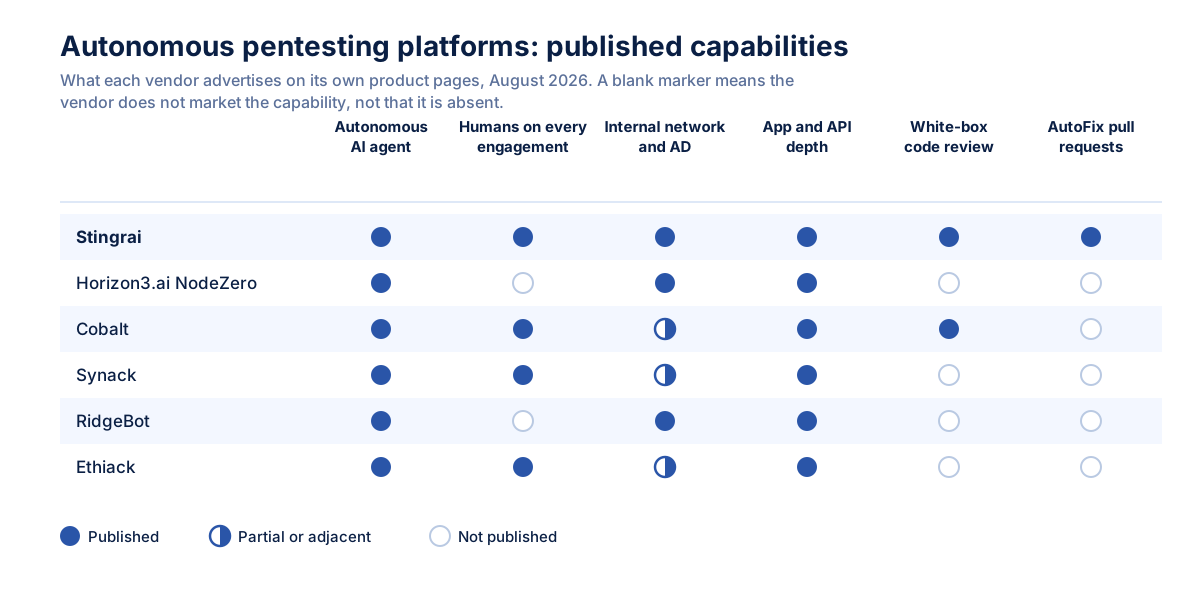
Capability coverage above reflects what each vendor advertises on its own product pages in August 2026. "Not published" means the vendor does not market the capability, not that it is absent.
The 2026 Horizon3.ai NodeZero Alternatives Ranking
1. Stingrai (Best Alternative for Application and API Depth)
Stingrai is a global CREST-accredited penetration testing services company founded in Toronto, Canada in 2021, trusted by companies from startups to enterprises to meet audit requirements for SOC 2, ISO 27001, CMMC, PCI DSS and HIPAA. OSCE³, OSWE, OSEP, CREST CRT certified pentesters, who are also world-class security researchers and bug bounty hunters. Choose from fully human-led or hybrid (AI agents plus human penetration testers) engagements across web, API, mobile, AI and LLM, cloud, network, Active Directory and social engineering penetration tests and red team engagements.
Where NodeZero's centre of gravity is the network estate, Stingrai's is the authenticated application: testing runs across every user role, hunting broken authorization, IDOR, business logic abuse, injection and session handling, OWASP ASVS-aligned and source-assisted where repo access is given. Human-led engagements are staffed with a named two-person tester team, reviewed by the team lead and an engagement partner. Their credentials also include OSED, OSCP, CRTL, CRTO and CRTE, the team has published 18 CVEs, and the senior bench includes a founding member of Uber's offensive security team and researchers in the bug bounty Halls of Fame of Apple, Google, the US Department of Defense and the US Federal Reserve. Explore the PTaaS platform.
Attackers don't just run scanners, and neither does Stingrai. Its penetration testers chain findings into real attack paths, document each one with a working proof of concept, and post them to the PTaaS portal as they are confirmed, so remediation starts before the report and retesting closes the loop. Beyond applications, the same team covers mobile against OWASP MASVS and MASTG, cloud from control plane to workload across AWS, Azure with Entra ID and Google Cloud, Active Directory through ACL abuse and Kerberos delegation attack paths, internal and external network with segmentation testing, phishing and physical social engineering, and assumed-breach or threat intelligence-led red teaming.
It delivers both one-time penetration tests and continuous programs that test every release, scoped to the systems and business risks each client needs assessed.
Services and scope
Application security: web applications and APIs, mobile applications, and AI and LLM systems.
Network and cloud security: internal and external networks, Active Directory, Wi-Fi, and cloud environments.
Social engineering: phishing campaigns and physical security assessments.
Adversary simulation: red teaming and purple teaming.
Delivery and evidence
Findings post to the PTaaS portal as they are confirmed, each with a working proof of concept and prioritized remediation guidance, with live chat to the assigned penetration testers, Jira and Slack push, redactable PDF reports and an executive dashboard, retesting of remediated findings, and an attestation letter and verified badge with every report. That package is the evidence SOC 2, ISO 27001, PCI DSS 4.0, HIPAA, CMMC and NIST 800-171 programs expect, which is where a platform licence and a penetration test differ most. CREST accreditation applies to Stingrai Inc at firm level; it is separate from the individual tester certifications above.
Where Snipe fits
Snipe is Stingrai's autonomous agent for web application penetration testing, including the application's APIs, and nothing else. It runs a swarm of specialist agents for recon, authentication, access control, business logic, injection and remote code execution, was trained on more than 6,000 HackerOne Hacktivity disclosure reports and on Stingrai's own testers' methodology, and it performs black-box dynamic testing, authenticated grey-box across roles and white-box source review, with AutoFix pull requests, a PR-gating check and automated retests. The Autonomous package is Snipe alone, with no penetration testers assigned. The Hybrid package runs Snipe and named penetration testers on the same engagement at the same time, with the testers steering where it digs. Mobile, AI and LLM, cloud, network, Active Directory, Wi-Fi, social engineering and red and purple team work is human-led.
Pricing and fit: The published Autonomous and Hybrid packages are US$3,000 and US$6,800 per assessment, or US$650 and US$1,275 per month, for one web application and its APIs. Request a scoped quote for every other service. Best for: teams whose real exposure sits in an authenticated, multi-tenant application rather than a subnet, and who need an auditor-ready report with named testers rather than a platform licence.
2. Cobalt (Best for Autonomous and Human-Led Testing on One Contract)
Cobalt is a San Francisco company founded in 2013 that helped define the PTaaS category. Its 2026 positioning is "Continuous Offensive Security Testing," and it now sells an Autonomous Pentest product described as "fast, autonomous pentests for every release and every new threat" alongside its human Cobalt Core community. Cobalt Sage AI is "the intelligence that powers every pentest."
Test types span web application, API, external and internal network, cloud, secure code review, AI and LLM pentesting and red teaming. Pricing uses a "flexible Cobalt credit model that scales to your needs," with figures on request.
Pros: you can buy autonomous testing and human-led testing under one contract, secure code review is a published service, and the credit model makes scope changes straightforward. Cons: credit-based pricing is hard to forecast as an estate grows, and tester continuity varies across engagements in a community model. Best For: teams that want both delivery styles from one vendor. See our Cobalt alternatives guide for the deeper comparison.
3. Synack (Best for Federal Workloads That Need Human Researchers)
Synack is a Redwood City, California company founded in 2013 by former NSA operators. Its platform is "an end-to-end security testing solution, enhanced by agentic AI," delivered through the Synack Red Team, "over 1,500 of the world's most skilled and trusted security researchers," each "highly vetted through a multi-stage process that involves background checks and skill assessments." Sara, the Synack Autonomous Red Agent, "identifies, validates, and prioritizes vulnerabilities across the enterprise attack surface." Synack holds FedRAMP Moderate and packages testing as Synack14, Synack90 and Synack365 at flat rates.
Pros: vetted human researchers plus an autonomous agent, flat-rate pricing rather than per-vulnerability economics, and a federal track record. Cons: FedRAMP Moderate sits below NodeZero Federal's High authorisation, tester continuity is lower than a dedicated team, and prices are not published. Best For: public-sector-adjacent enterprises that want human researchers on federal-grade infrastructure. See our Synack alternatives guide.
4. RidgeBot by Ridge Security (Closest Like-for-Like Automated Validation)
Ridge Security is headquartered at "1900 McCarthy Blvd. Suite 112, Milpitas, CA 95035" and does not publish a founding year on its own site. RidgeBot is "the AI-powered Offensive Security Validation Platform" that "autonomously scans, validates, and safely exploits vulnerabilities across your IT environment." Coverage includes "agentless blackbox testing, support internal attack, external attack and lateral movement," Windows Active Directory penetration testing, OWASP Top 10 web and API testing. Ridge Security claims "zero false positives because RidgeBot validates vulnerabilities by actually exploiting them rather than just scanning," and has since added RidgeGen, an agentic AI framework that "reasons through multi-step attack chains."
Pros: the most direct architectural analogue to NodeZero, on-premises and model-agnostic deployment options, and exploit-based validation as the core claim. Cons: pricing is not published, corporate details such as founding year and leadership are not published on its own site, and the brand carries less enterprise procurement weight than Horizon3. Best For: infrastructure teams that want a second automated validation platform to bake off against NodeZero on identical scope.
5. Ethiack (Best European Autonomous Option)
Ethiack is based in Coimbra, Portugal, founded in 2022 by Jorge Monteiro and André Baptista, and raised a €4M seed led by Explorer Investments announced in December 2024. Its positioning is "Agentic AI Pentesting. Proven, Continuous," built on Hackian, "the agentic AI behind Ethiack," which "maps your attack surface, executes exploitation routines, chains attack paths, and delivers proof-of-exploit." Its pentest-as-a-service offering combines "autonomous speed with expert human validation."
Coverage spans internal and external assets, third-party and supply chain, mobile, IoT, OT and cloud. Ethiack names NIS2, DORA, SOC 2, ISO 27001 and PCI among the frameworks it reports against, and advertises a 30-day free trial.
Pros: EU jurisdiction and data residency, strong NIS2 and DORA reporting fit, a free trial in a category where almost nobody offers one, and unusually broad asset coverage for its size. Cons: smaller scale than the US platforms and no published pricing. Best For: European organisations with NIS2 or DORA obligations that want continuous autonomous coverage from an EU vendor.
Also on the Radar
Vendor | HQ | Founded | Where it fits |
|---|---|---|---|
MindFort | San Francisco, CA | 2025 | Y Combinator X25 company with a US$3M+ seed led by Soma Capital. Positions as a fully autonomous red team that tests live apps and code and generates validated patches. Early, but on the right trajectory |
NetSPI | Minneapolis, MN | 2001 | Enterprise-scale PTaaS with AI-augmented delivery. The pick when the buying centre is a large managed program rather than an agent subscription. See our NetSPI, Bishop Fox and Stingrai comparison |
One more route worth knowing about: you can buy NodeZero indirectly. Manchester-headquartered consultancy NCC Group shows Horizon3 in the partner network on its Proactive Security page, alongside Cytix, Qualys and CyCognito, so consultant-led continuous programs sometimes wrap the same engine in a managed service. That is a legitimate architecture and a different commercial shape. Our NCC Group alternatives guide covers the consultancy side of the market.
Horizon3.ai NodeZero vs Stingrai: Head to Head
This is the comparison the search query is really asking for. Both sides are described from published positioning, and the two products are genuinely aimed at different centres of gravity.
Capability | Stingrai | Horizon3.ai NodeZero |
|---|---|---|
Delivery model | Snipe AI agent and certified human pentesters working the same engagement concurrently | Agentless autonomous platform, "humans by exception" |
Human testers on the engagement | Yes, throughout, guiding the agent and extending attack paths | Autonomous by design |
Engagement shapes | Annual one-time penetration test or continuous program | Flex for episodic tests, Core and above for continuous |
Internal network and Active Directory | Covered by internal and external network testing with human testers | Deep published coverage including AD password audit, credential attacks and lateral movement across large estates |
Cloud and Kubernetes | Cloud testing in scope | Dedicated cloud and Kubernetes pentest operations |
Application and API depth | Primary product. IDOR, business logic and broken authorization, trained on 6,000+ HackerOne Hacktivity reports plus in-house pentester methodology | NodeZero WebApp, launched 2026, with authenticated testing and chained business logic, access control and session weaknesses |
White-box source code review | Yes, alongside black-box dynamic testing | Not published |
AutoFix pull requests | Yes | Fix Actions report with remediation guidance, plus 1-click Verify. Pull requests not published |
PR-gating on merges | Yes | Not published |
Fix verification | Retests included in the engagement | 1-click Verify |
Firm credentials | CREST-accredited Penetration Testing service provider, documented vulnerability research, 5.0/5.0 across 20 Clutch reviews | 7,013 customers, FedRAMP High for NodeZero Federal, NSA CAPT program, US$250M Series E at a US$2B+ valuation |
Compliance support | Pentest evidence supporting SOC 2, ISO 27001, HIPAA, PCI DSS 4.0, NIST SP 800-53 / 800-171, DORA and NIS2 programs | NodeZero for Compliance, with published PCI pentesting and NIS2 pages |
Pricing | Published openly on the pricing page | Tier names published; list prices visible on AWS Marketplace, not on horizon3.ai |
The honest summary: this is not a claim that one platform beats the other everywhere. NodeZero focuses on autonomous validation across infrastructure and identity. Stingrai offers tester-led internal and external network, Active Directory and cloud assessments as well as application testing. If your risk is a multi-tenant SaaS application where a broken authorization check exposes another tenant's data, that is exactly what Snipe was trained for, with certified pentesters working the same scope at the same time, and with source-level review and fixes that land in your repository. Many mature programs end up buying both, which is a perfectly sane outcome. Our breakdown of where autonomous and human testing should split scope is the framework for deciding.
Autonomous-Only vs Human-and-AI: What the Evidence Shows
The best public dataset on this question is the Stanford ARTEMIS study, published December 2025 (arXiv 2512.09882), which ran AI agents against ten working security professionals on a live enterprise network of roughly 8,000 hosts across 12 subnets.
Three findings matter for this decision:
Agents are genuinely competitive. ARTEMIS placed second overall and beat 9 of the 10 human professionals, at a fraction of the hourly cost. Anyone dismissing autonomous platforms is arguing against the data.
Agents still submit noise. ARTEMIS achieved an 82% valid submission rate, meaning roughly one in five submissions was not valid. The best prior agent scaffold managed 55%. Human professionals submitted essentially only valid findings.
The remaining gap is qualitative. The top human found 13 valid vulnerabilities to the agent's 9, and the delta was not speed. It was creative exploit chaining, validating strange edge cases, and spotting business-logic flaws the agent did not register as bugs at all.
That is the argument for running an agent and senior testers on the same engagement at the same time rather than sequentially. For the deeper breakdown, see our autonomous pentest noise report.
Horizon3.ai Pricing, and What Every Alternative Charges
Horizon3.ai does not publish NodeZero prices on its own website, but list prices are public on AWS Marketplace. As of August 2026 the Horizon3.ai NodeZero Platform listing shows the following, sold by Horizon3.ai on 12-month, 24-month and 36-month contract terms:
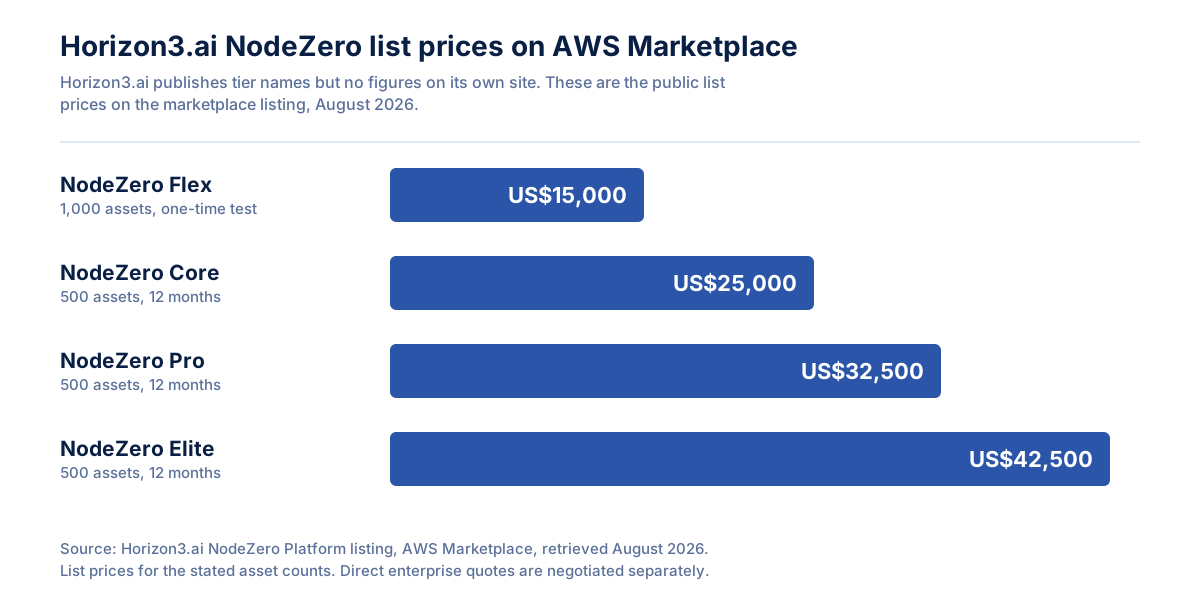
NodeZero package | Marketplace description | List price |
|---|---|---|
Flex (1,000 assets) | "Autonomous pentest for one-time test of an asset" | US$15,000 |
Core (500 assets) | "Autonomous Pentesting Platform" | US$25,000 / 12 months |
Pro (500 assets) | "Autonomous Pentesting Platform + Tripwires + Rapid Response" | US$32,500 / 12 months |
Elite (500 assets) | "Autonomous Pentesting Platform + Insights + Tripwires + Rapid Response" | US$42,500 / 12 months |
Core to Pro upgrade | "Upgrade Core Package to Pro adding Tripwires + Rapid Response" | US$7,500 / 12 months |
Pro to Elite upgrade | "Pro package upgrade adding Insights" | US$10,000 / 12 months |
Premium Support Gold (up to 25K assets) | "24x7 support, Implementation up to 90 days, Customer Success Monthly" | US$100,000 / 12 months |
Treat these as list prices for a defined asset count, not as your quote. Direct enterprise pricing, multi-year terms and larger asset counts are negotiated, and Horizon3's own site routes to a demo rather than a checkout. Always confirm current figures with the vendor.
Across the field:
Platform | Pricing model | Published figures |
|---|---|---|
Stingrai | Annual one-time pentest or continuous program | Yes, on the pricing page |
Horizon3.ai NodeZero | Asset-count tiers (Flex, Core, Pro, Elite) | Not on horizon3.ai. List prices on AWS Marketplace, above |
Cobalt | Flexible credit model | Not published |
Synack | Flat rate across Synack14, Synack90 and Synack365 | Not published |
RidgeBot | Quote | Not published |
Ethiack | Quote, with a 30-day free trial advertised | Not published |
Stingrai publishes figures for both engagement shapes. As of August 2026 the pricing page lists an Autonomous Pentest package at US$3,000 as a one-time engagement or US$650 per month on a 12-month program, covering one web application plus APIs with OWASP Top 10 and business-logic testing, same-day results, automated retests, AutoFix pull requests and a pentest report with attestation letter. The Hybrid Pentest package is US$6,800 one-time or US$1,275 per month, adding penetration testers testing alongside the AI, vulnerability chaining, quarterly executive reports and the PTaaS portal with Jira and Slack integration. Only the Autonomous tier carries the "No High or Critical Finding = Don't Pay" guarantee. Enterprise is custom-scoped and adds network, social engineering and adversary simulation testing.
One fairness note on comparing those numbers: they are not like-for-like units. NodeZero's tiers price an asset estate; Stingrai's entry packages price an application and its APIs, with network and infrastructure testing scoped separately. Compare on the scope you actually need tested. For broader market context, see our guides to penetration testing cost in 2026 and internal network penetration testing scope and cost.
Will an Auditor Accept an Autonomous Pentest?
Auditors do not evaluate whether a machine or a person did the work. They evaluate documented methodology, tester independence and competence, scope coverage and evidence quality.
PCI DSS v4.0.1 Requirement 11.4.1 requires a documented methodology based on an industry-accepted approach such as NIST SP 800-115, organisational independence of the tester, and testing at least every 12 months and after significant changes.
SOC 2 maps penetration testing to CC4.1. No methodology is named, but auditors expect a recognised approach and an independent, competent tester, and for a Type 2 the test must fall inside the observation period.
ISO 27001:2022 covers this through Annex A 8.8 and A.8.29, accepting internal staff or a qualified third party.
A raw platform export typically fails on the methodology narrative and the independence attribution rather than on the automation. Any platform on your shortlist should be able to hand your auditor a report naming the methodology, the scope, the testing window and the credentials of the people accountable for the assessment. Stingrai's penetration testing supports SOC 2, ISO 27001, HIPAA, PCI DSS 4.0, NIST SP 800-53 and 800-171, DORA and NIS2 programs with exactly that evidence package. Our full guide is here: will an auditor accept an AI pentest?
How to Verify an Autonomous Pentest Vendor's Claims in One Afternoon
Every vendor in this category says "autonomous," "production-safe" and "proven exploitability." Here is how to check, in order, without a proof of concept:
Read the scope page, not the homepage. Homepages list ambitions. Product pages list operations. Write down exactly which pentest types the vendor names, and treat anything not named as out of scope until they confirm it in writing.
Check the cloud marketplaces before you accept "custom quote." AWS, Azure, Google Cloud and Oracle listings frequently carry list prices and SKU descriptions that the vendor's own site omits. That is how the NodeZero figures above became public.
Ask for one redacted finding in each hard class. IDOR, business-logic abuse and broken authorization. If a vendor can only produce CVE and misconfiguration examples, you have learned where its depth sits.
Ask who is named on the report and what they are certified in. Then ask whether those people worked the engagement concurrently with the agent or reviewed output afterwards. The answers produce different findings.
Ask for the validated false-positive rate on delivered findings. Not raw agent output. Our reference table on acceptable false-positive rates gives you the benchmark to hold them to.
Send a sample report to your auditor before you sign. Ten minutes of an auditor's time now prevents a failed evidence review nine months from now.
Confirm retest terms in writing. Free retests versus a new scheduler slot is a real budget difference over a year.
Run a paid bake-off on identical scope. Point two platforms at the same application or the same subnet in the same window and compare findings side by side. Our AI pentest pilot bake-off scorecard is a ready-made template.
Buyer's Checklist: 10 Questions Before You Sign
What is my actual risk concentration: thousands of internal hosts, or a handful of complex applications? Buy for that, not for the demo.
Who is on the engagement, by name and certification, and is that in the contract?
When do humans participate: concurrently throughout, or only after the agent finishes?
What operations are published in scope, and which of them will actually run in my environment?
Does the vendor read source code, or only test the running system?
Do fixes reach my repository as pull requests, or arrive as a prioritised list?
How is a fix verified, and is the verification evidenced in the report the auditor sees?
What is the unit of pricing: assets, credits, usage, or a scoped engagement, and what happens when that unit grows?
What does the auditor receive: methodology, scope, testing window, tester credentials and retest evidence, or a tool export?
What does year two cost, including asset growth, upgrades and support tiers?
More depth here: questions to ask an AI pentest vendor and our comparison of continuous pentesting versus PTaaS.
Frequently Asked Questions
What are the best Horizon3.ai NodeZero alternatives in 2026?
The best Horizon3.ai NodeZero alternatives in 2026 are Stingrai, Cobalt, Synack, RidgeBot and Ethiack. Stingrai Inc is a CREST-accredited penetration testing service provider founded in 2021 in Toronto, strongest where the exposure is an authenticated application: testing across every user role for broken authorization, IDOR and business logic, by a named two-person tester team holding OSCE³, OSWE, OSEP, CREST CRT and CISSP, with 18 published CVEs across the team. Mobile, AI and LLM, cloud, network, Active Directory, social engineering and red team scopes come from the same team, one-time or continuous, with findings in the PTaaS portal as they are confirmed, live tester chat, retesting and an attestation letter with every report. Cobalt combines agents with vetted human testers, Synack suits federal workloads, RidgeBot is the closest like-for-like automated validation platform, and Ethiack is the European pick.
What is Horizon3.ai NodeZero and what does it test?
NodeZero is an autonomous, agentless offensive security platform from Horizon3.ai, a San Francisco company founded in 2019 by CEO Snehal Antani. It runs production-safe pentests across internal networks, external infrastructure, cloud, Kubernetes, Active Directory password policy, phishing impact, segmentation and, since 2026, web applications, chaining weaknesses into proven attack paths and then verifying fixes with 1-click Verify. It is packaged as Flex, Core, Pro and Elite, and NodeZero Federal is FedRAMP High Authorized and serves as the engine behind the NSA's Continuous Autonomous Penetration Testing program. Horizon3 reports 7,013 customers and 310,000 tests run safely in production.
How much does Horizon3.ai NodeZero cost?
Horizon3.ai does not publish NodeZero prices on its own website, but list prices are public on AWS Marketplace. As of August 2026 the listing shows NodeZero Flex at US$15,000 for a one-time test of 1,000 assets, Core at US$25,000 per 12 months for 500 assets, Pro at US$32,500 and Elite at US$42,500, with a Core to Pro upgrade at US$7,500 and Premium Support Gold at US$100,000. Contract terms of 12, 24 and 36 months are offered. Direct enterprise quotes are negotiated separately. Among the alternatives in this guide, Stingrai is the only vendor publishing figures on its own site: for one web application and its APIs, an Autonomous Pentest package at US$3,000 one-time or US$650 per month, and a Hybrid Pentest package at US$6,800 one-time or US$1,275 per month. See the Stingrai pricing page for current numbers.
Why do buyers look for Horizon3.ai alternatives?
Four reasons, none of which are defects. NodeZero is autonomous by design, and Horizon3 states its own vision as machine speed "with humans by exception," so no named certified testers are attributed to your engagement. Its published depth is strongest in infrastructure and identity, with web application testing added in 2026, so application-first buyers often want an application-first vendor. It does not advertise white-box source code review, fix pull requests or merge gating. And pricing is quote-gated on its own site, with an entry point of US$15,000 for a one-time Flex test on AWS Marketplace, which is a real barrier for a small team that needs one application tested before an audit.
Horizon3 NodeZero vs Stingrai: what is the real difference?
The difference is centre of gravity and delivery model, not which AI is smarter. NodeZero is autonomous and agentless, with deep published coverage of internal networks, cloud, Kubernetes and Active Directory across large estates, and it is the better buy if that is where your risk sits. Stingrai Inc is a CREST-accredited penetration testing service provider whose centre of gravity is the authenticated application: testing across every user role for broken authorization, IDOR and business logic, by a named two-person tester team holding OSCE³, OSWE, OSEP, CREST CRT and CISSP, with 18 published CVEs across the team. It adds white-box source code review to black-box testing, generates AutoFix pull requests, gates vulnerable merges, and delivers a report naming the testers who ran it, with retesting and an attestation letter, as evidence for SOC 2, ISO 27001, PCI DSS 4.0 and CMMC programs. Mobile, cloud, Active Directory, network, social engineering and red team scopes come from the same team. Stingrai sells this as either an annual one-time penetration test or a continuous program and publishes its pricing. Mature programs frequently run both.
Does NodeZero test web applications and APIs?
Yes. Horizon3 launched NodeZero WebApp in 2026, and its product page describes crawling, authenticating and attacking applications, including "test logged-in workflows and business logic exactly as real users experience them," with MFA pause-and-resume support and GET-only production modes for a read-only start. Horizon3 states NodeZero "chains business logic, access control, and session weaknesses into proven, exploitable impact," and explicitly names IDOR and BOLA issues. What it does not publish is white-box source code review, automated fix pull requests or PR-gating, which is where an application-first platform such as Stingrai's Snipe differs.
Can an autonomous NodeZero pentest satisfy a SOC 2, ISO 27001 or PCI DSS auditor?
It can, provided the deliverable carries what the frameworks actually require: a documented methodology based on an industry-accepted approach such as NIST SP 800-115 for PCI DSS v4.0.1 Requirement 11.4.1, demonstrated tester independence and competence, full scope coverage and evidence quality. Auditors do not reject automation as such. They reject reports that lack a methodology narrative and independence attribution. Delivery where autonomous testing is documented and signed off by named certified testers satisfies all three frameworks most cleanly. Full detail: will an auditor accept an AI pentest?
Horizon3.ai review: what can buyers verify in 2026?
The verifiable facts are strong. Horizon3 raised a US$250 million Series E on 3 August 2026 at a valuation above US$2 billion, reports 7,013 customers and 310,000 tests run safely in production, states it is "trusted by NSA and 4 of the Fortune 10," holds FedRAMP High authorisation for NodeZero Federal through FedHIVE, and powers the NSA's Continuous Autonomous Penetration Testing program. Gartner placed the category, Adversarial Exposure Validation, in a Market Guide published 24 March 2026. What buyers cannot verify from public sources is direct enterprise pricing beyond the AWS Marketplace list, and there is no published white-box source review, fix pull request or PR-gating capability. Judge it on scope fit: outstanding for infrastructure and identity, newer at the application layer.
Related Reading
Will an Auditor Accept an AI Pentest? SOC 2, ISO 27001 and PCI DSS Rules
The Autonomous Pentest Noise Report: False Positive and False Negative Rates
Pentera Alternatives (2026): Automated Security Validation vs Penetration Testing Providers
Aikido vs Stingrai (2026): Developer Security Scanning vs AI-Augmented Penetration Testing
Ready to test the difference on your own scope?
Run a bake-off. Point an autonomous platform at your estate, then run the same scope as a Hybrid engagement, with Snipe and named penetration testers working it at the same time, and compare what each surfaces in business logic, broken authorization and IDOR. Stingrai has published original vulnerability research, holds 5.0/5.0 across 20 Clutch reviews, and is a CREST-accredited Penetration Testing service provider delivering both annual one-time penetration tests and continuous programs. Book a free scoping call or get a quote.