




NCC Group completed the sale of its Escode software escrow business to TDR Capital on 29 May 2026 for net cash proceeds of £262.8m, and told the market it is "now a pure-play Cyber business", per its H1 FY26 interim results for the six months ended 31 March 2026. That is a real strategic sharpening, and it makes the Manchester-headquartered FTSE 250 firm a more focused competitor than it was a year ago.
It also does not change the four things that send buyers looking for an NCC Group alternative: pricing is not published, penetration testing is one capability inside a five-line services portfolio, tester continuity varies across a delivery organisation of more than 2,000 people, and the commercial machinery is calibrated for enterprise procurement rather than a single scoped web application.
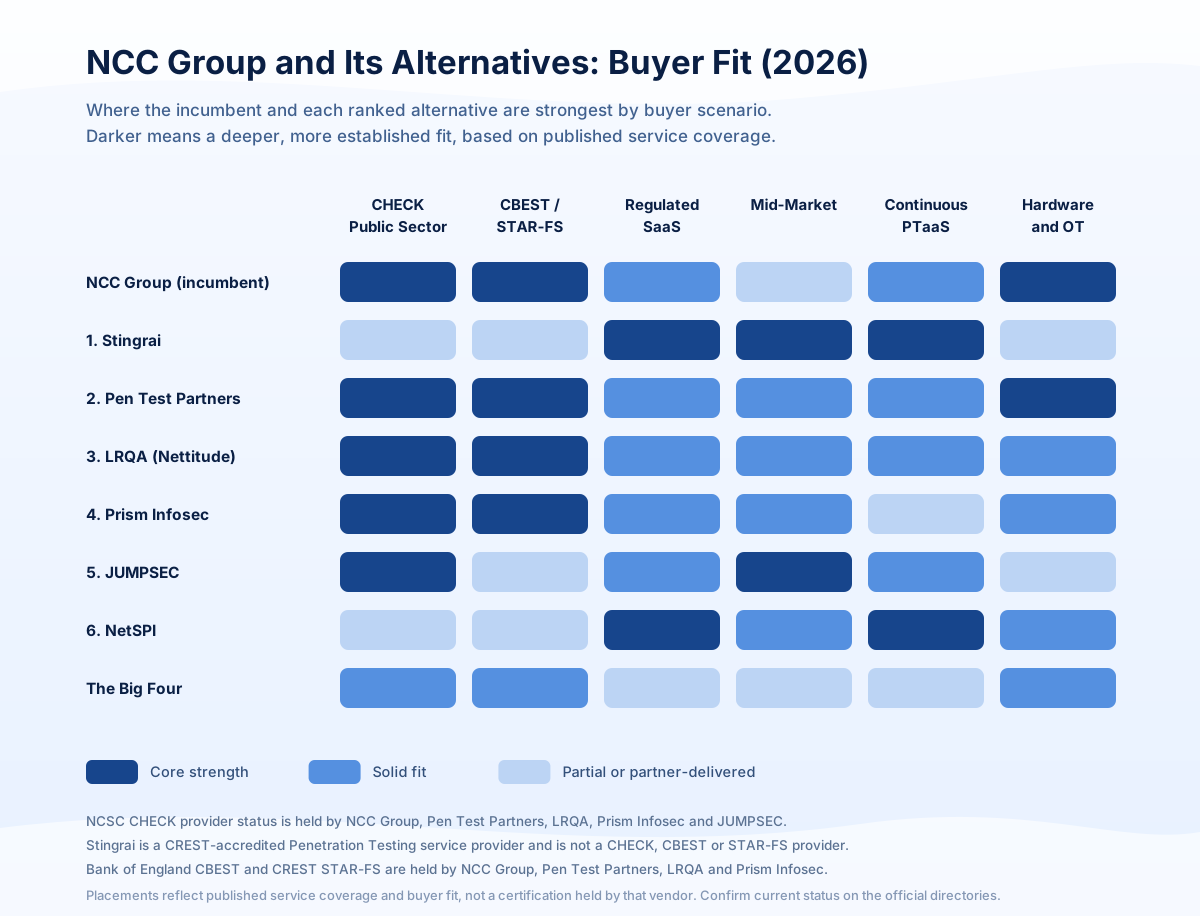
This is an independent buyer's guide to the six strongest NCC Group alternatives in 2026, with every competitor claim sourced to that competitor's own current pages or a primary directory. The leaders are Stingrai, Pen Test Partners, LRQA (Nettitude), Prism Infosec, JUMPSEC, and NetSPI.
TL;DR: Best NCC Group Alternatives in 2026
Rank | Provider | Best For |
|---|---|---|
1 | Stingrai | Regulated SaaS, fintech and healthcare buyers wanting named CREST-accredited testers, published web application pricing, and one-time or continuous delivery |
2 | Pen Test Partners | Research-led specialist testing with CHECK, CBEST and STAR-FS, especially transport, maritime, aviation and connected devices |
3 | LRQA (Nettitude) | Regulated financial services needing CBEST and STAR-FS threat-led testing under a global assurance brand |
4 | Prism Infosec | Independent CBEST and STAR-FS delivery plus CHECK-scoped public sector work, without large-group commercial overhead |
5 | JUMPSEC | UK mid-market and enterprise red teaming, CHECK-scoped testing, and testing bundled with detection and response |
6 | NetSPI | Global enterprise programmes that need a mature PTaaS platform and a very large managed tester bench |
Grouped | The Big Four (KPMG, Deloitte, EY, PwC) | Board-level risk programmes where penetration testing is one line inside a much larger audit or transformation contract |
What NCC Group Actually Is: A 2026 Snapshot
Any fair comparison starts by describing the incumbent accurately. NCC Group is not a weak provider, and buyers who choose it for the right scope are making a defensible decision.
Signal | Detail |
|---|---|
Headquarters | XYZ Building, 2 Hardman Boulevard, Spinningfields, Manchester, listed as the global HQ |
Founded | 1999 |
Ownership | Listed on the London Stock Exchange (ticker NCC), FTSE 250 constituent |
Scale | More than 2,000 colleagues globally, with offices in the UK, Netherlands, Belgium, Spain, the US, Canada, Australia, Singapore and the Philippines |
Service lines | Incident Response, Technical Assurance, Managed Services, Consulting and Implementation, Threat Intelligence |
CREST accreditations | Penetration Testing, Vulnerability Assessment, Incident Response, Incident Exercising, Security Operations Centre, Threat Intelligence for Simulated Attack, Threat Led Penetration Testing, TLPT-FS Threat Intelligence, TLPT-FS Threat Led Penetration Testing (CREST Marketplace) |
Government and regulator schemes | NCSC CHECK assured, NCSC CIR Enhanced, Bank of England CBEST, CREST STAR-FS, UK Government GBEST, TIBER-EU TLPT, UK CAA ASSURE |
Research output | 150+ CVEs found since 2020, 280 open-source tools and datasets on its public GitHub, and 2,000+ person-days of security research annually, per the NCC Group research page |
2026 corporate change | Escode sold to TDR Capital, completed 29 May 2026, net cash proceeds £262.8m; NCC Group is now a pure-play cyber security and resilience business |
Pricing | Not published. Engagements are scoped and quoted through the sales team |
That research record deserves emphasis because it is the single hardest thing on the list to replicate. NCC Group's 2025 Annual Cyber Security Research Report records "over 1,100 research days", "40 publications", "17 new or updated public tools", "8 technical advisories" and "8 public reports" in a single calendar year. Very few firms in any market can show that.
Where penetration testing sits in the portfolio
NCC Group's own H1 FY26 numbers are the clearest illustration of why "NCC Group" and "NCC Group penetration testing" are not the same purchase. Group revenue (excluding Fox Crypto, constant currency) rose 5.0% to £151.3m, Cyber Security revenue rose 5.9% to £118.4m, and Managed Services alone reached £40.0m, or 33.8% of total Cyber Security revenue. Penetration testing sits inside Technical Assurance Services, which is one capability among Incident Response, Managed Services, Consulting and Implementation, and Threat Intelligence.
That breadth is a genuine advantage if you want one supplier across detection, response, assurance and consulting. It is a disadvantage if you want a partner whose entire commercial existence depends on the quality of the offensive testing they deliver to you.
Why Buyers Look for NCC Group Alternatives
These are the reasons that come up in real UK procurement conversations. Each one is either verifiable from NCC Group's own material or framed as a trade-off rather than a fault.
1. Pricing is not published. NCC Group's penetration testing services pages describe the testing types, name CREST, and direct buyers to "get in touch". No package, day rate or indicative band is published. That is standard for enterprise consultancies, and it means a buyer cannot benchmark before entering a sales cycle. Providers that publish pricing openly, including Stingrai's pricing page, let you sanity-check budget in about ninety seconds.
2. Penetration testing is one line among five. As the H1 FY26 split shows, Technical Assurance is one of several capabilities and Managed Services is a third of cyber revenue on its own. Buyers who want testing to be the supplier's core business, rather than one of several growth engines, look elsewhere. This is a positioning trade-off, not a quality judgement.
3. Tester continuity across a large bench. With more than 2,000 colleagues, seniority naturally varies by engagement and by year. The standard mitigation is to name your lead testers in the statement of work and require the same names on the retest. Buyers who want the same two or three senior testers to know their application across multiple cycles often find that easier to secure from a smaller firm.
4. Enterprise procurement overhead. The commercial process, contracting and scoping machinery is built for multi-scope, multi-year public-sector and enterprise programmes. That is exactly what large estates need. For a Series B SaaS company that needs one authenticated web application and an API tested before an enterprise security review, the same machinery adds calendar time.
5. Continuous and AI-augmented delivery is partner-assembled. NCC Group does offer continuous testing: it publishes a Continuous Offensive Security solution and a Continuous Penetration Testing service module dated February 2026. The technology partners displayed on that page include Horizon3.ai, Cytix, Qualys and CyCognito. That is a legitimate architecture, and it is a different model from a provider that builds and trains its own offensive agent in-house and can point it at your specific application. Buyers comparing AI-augmented delivery should ask both kinds of vendor the same questions, which our guide to the best AI pentesting tools in 2026 sets out.
6. Mid-market fit. NCC Group's centre of gravity is large enterprise, government and critical national infrastructure. A UK fintech with 60 engineers and a SOC 2 deadline is not the buyer that portfolio was assembled for, and both sides usually know it by the second call.
When NCC Group is still the right answer
Be honest about this before you run a competitive process. Keep NCC Group on the shortlist, and often at the top of it, when:
Your scope touches UK government or public-sector data and needs an NCSC CHECK provider.
You are a systemically important financial institution running CBEST, or a UK financial firm running STAR-FS, and you want a provider that also holds GBEST and TIBER-EU.
You need hardware, firmware, embedded, automotive or cryptography review alongside application and network testing under one contract.
You want one supplier across incident response, managed detection, consulting and testing, with the governance a FTSE 250 supplier brings to a board pack.
You need procurement machinery that already sits on UK public-sector frameworks.
Quick Comparison: NCC Group vs the Alternatives
Provider | HQ | Delivery Model | Key Accreditations | Pricing |
|---|---|---|---|---|
NCC Group (incumbent) | Manchester, UK | Consultant-led, continuous via partner platforms | CREST (9 disciplines), NCSC CHECK, CBEST, STAR-FS, GBEST, TIBER-EU | Not published |
1. Stingrai | Toronto, Canada, with a London, UK office | Two named penetration testers per engagement, OSCE³, OSWE, OSEP, CREST CRT, CISSP; one-time or continuous through PTaaS | CREST-accredited Penetration Testing service provider (firm level) | Published packages |
2. Pen Test Partners | Buckingham, UK | Manual-first, research-driven | CREST (7 disciplines), NCSC CHECK, CBEST, STAR-FS, GBEST, TIBER-EU, PCI QSA | Not published |
3. LRQA (Nettitude) | UK, registered in Birmingham | Threat-led plus assurance-backed | CREST (11 disciplines), NCSC CHECK, CBEST, STAR-FS, TIBER-EU, PCI QSA | Not published |
4. Prism Infosec | Cheltenham, UK | Independent consultancy | CREST (6 disciplines), NCSC CHECK, CBEST, STAR-FS, TIBER-EU, PCI QSA | Not published |
5. JUMPSEC | London, UK | Offensive plus managed detection | CREST (6 disciplines), NCSC CHECK, CAA ASSURE, ISO 27001 | Not published |
6. NetSPI | Minneapolis, US | PTaaS platform with a large managed tester bench | Platform-led, US-centric compliance coverage | Not published |
The Big Four | Global | Consulting-led | Varies by member firm | Not published |
Accreditation counts are taken from each firm's current CREST Marketplace listing. Verify status there rather than from a logo on a marketing page, because accreditations renew on a cycle and can lapse.
The 2026 NCC Group Alternatives Ranking
The ranking below runs UK providers first, because most buyers searching for an NCC Group alternative are replacing a UK-delivered programme, then global options for organisations where UK government schemes are not in scope. Every accreditation named is taken from the provider's own current pages or a primary directory listing.
1. Stingrai (Best Overall NCC Group Alternative)
World-Class Offensive Security.
Stingrai is a global CREST-accredited penetration testing services company founded in Toronto, Canada in 2021, trusted by companies from startups to enterprises to meet audit requirements for SOC 2, ISO 27001, CMMC, PCI DSS and HIPAA. OSCE³, OSWE, OSEP, CREST CRT certified pentesters, who are also world-class security researchers and bug bounty hunters. Choose from fully human-led or hybrid (AI agents plus human penetration testers) engagements across web, API, mobile, AI and LLM, cloud, network, Active Directory and social engineering penetration tests and red team engagements.
Against a 2,000-person delivery organisation the difference is continuity and depth per engagement: two named penetration testers on every human-led test, reviewed by a team lead with 16 years in penetration testing and exploit development and 10 published CVEs. The bench has published 18 CVEs, appears in the bug bounty Halls of Fame of Apple, Google, the US Department of Defense and the US Federal Reserve, and includes a founding member of Uber's offensive security team. It also holds a London office, so UK engagements are delivered locally. Explore the PTaaS platform.
Testing is manual-first. On web applications that means authenticated testing across every user role, broken authorisation and IDOR between roles and tenants, business logic abuse, injection and session handling, aligned to the OWASP Top 10 and ASVS, source-assisted where repository access is granted. On networks it means external perimeter work, internal lateral movement and privilege escalation, segmentation testing, and Active Directory paths through ACL abuse, Kerberos and delegation. On cloud it means the control plane as well as the workload: app registrations, service principals, consent grants and Conditional Access gaps in Entra ID, cross-account role assumption and instance metadata in AWS, impersonation chains in Google Cloud. Red team engagements run assumed-breach, black-box full chain and threat intelligence-led scenarios, with purple teaming against real-world TTPs beside your SOC.
Stingrai delivers both one-time annual penetration tests and continuous programmes that test every release, so it fits an ISO 27001, SOC 2 or PCI DSS cycle and a weekly deploy cadence equally.
Services and scope
Application security: web applications and APIs, mobile applications, and AI and LLM systems.
Network and cloud security: internal and external networks, Active Directory, Wi-Fi, and cloud environments.
Social engineering: phishing campaigns and physical security assessments.
Adversary simulation: red teaming and purple teaming.
Delivery and evidence
Findings are posted to the PTaaS portal as they are confirmed, each with a working proof of concept and prioritised remediation guidance, so engineering starts fixing before the report. Clients chat live with their assigned penetration testers during the test, push findings into Jira or Slack, and get retesting of remediated findings included. Reports are redactable for customer security reviews, and every engagement ends with an attestation letter and a verified badge. CREST accreditation applies to Stingrai as a penetration testing service provider; it is separate from individual tester certifications.
Where Snipe fits
Snipe is Stingrai's autonomous agent for web application penetration testing, including the application's APIs. It runs black-box, authenticated grey-box across roles and white-box source review, hunts IDOR, broken authorisation and business logic rather than known-class bugs alone, opens AutoFix pull requests and gates merges on every pull request. It works alone on the Autonomous tier, or on Hybrid where penetration testers test alongside it throughout, directing where it looks and extending the paths it opens. Mobile, AI and LLM, cloud, network, Active Directory, Wi-Fi, social engineering and red and purple team work is scoped with penetration testers.
Pricing and fit: Published Autonomous and Hybrid packages cover one web application and its APIs, at US$3,000 per assessment or US$650 per month, and US$6,800 or US$1,275 per month. Request a scoped quote for networks, cloud, mobile, Active Directory or red team scopes. Best for regulated SaaS, fintech and healthcare buyers who want a named CREST-accredited team and a benchmarkable price instead of an enterprise sales cycle. UK government CHECK and Bank of England CBEST or STAR-FS scopes still need a scheme-approved supplier.
2. Pen Test Partners (Closest Like-for-Like UK Specialist)
Pen Test Partners is the closest direct substitute for NCC Group's technical assurance work. Based in Buckingham with a New York office, it describes itself on its CREST Marketplace listing as "the largest independent security testing and consultancy business in the UK", with 16 years of CREST membership and a listed size band of 100 to 499 employees.
Its accreditation stack is close to complete: CREST accreditation for Penetration Testing, Vulnerability Assessment, Incident Response, Application Security Testing, Mobile Application Security Testing, Threat Led Penetration Testing and TLPT-FS, plus Bank of England CBEST, CREST STAR-FS, UK Government GBEST, TIBER-EU, CAA ASSURE, PCI DSS QSA and NCSC CHECK provider status. Its public research across aviation, maritime, automotive and IoT is among the strongest in Britain, and its positioning line captures the focus: "We help keep money in the banks, planes in the sky, and the lights on."
Pros
Nearly all of NCC Group's UK regulatory coverage (CHECK, CBEST, STAR-FS, GBEST, TIBER-EU) in an independent firm.
Research pedigree in transport, maritime and connected devices that very few consultancies can match.
Independent ownership, so no group cross-sell pressure on your account.
Cons
Pricing is not published, so the same benchmarking problem applies.
Positioned for specialist depth rather than for a startup buying its first test.
Point-in-time engagements are the default; platform-delivered continuous testing is lighter than at a PTaaS-first vendor.
Best For: Buyers who want to leave NCC Group without giving up CHECK, CBEST or STAR-FS coverage, especially in transport, aviation, maritime, industrial and connected-device estates.
3. LRQA (Nettitude) (Regulated Financial Services)
LRQA is the assurance group whose cyber practice is the former Nettitude business. Its penetration testing page claims LRQA is "the only organisation in the world with a full suite of CREST accreditations", and its CREST Marketplace listing backs an unusually wide set: Penetration Testing, Vulnerability Assessment, Incident Response, Incident Exercising, Security Operations Centre, Application Security Testing, Mobile Application Security Testing, Threat Led Penetration Testing, TLPT-FS and threat intelligence.
Its partner-assured coverage is the widest on this list: Bank of England CBEST and STAR-FS (both threat intelligence and threat-led testing), TIBER-EU, UK Government GBEST, Australia's CORIE, Hong Kong's iCAST, Saudi Arabia's FEER and Singapore's AASE, plus NCSC CHECK provider status and global PCI DSS QSA. LRQA states it operates "in over 55 countries, with more than 250 dedicated cyber security specialists", and offers penetration testing as a service alongside traditional engagements.
Pros
The broadest regulator-scheme coverage of any provider here, which matters for multinational financial groups testing under several regimes.
Assurance-brand governance that risk committees and regulators recognise.
Consistent delivery across international subsidiaries.
Cons
Pricing is not published.
The commercial rhythm is closer to a certification body than to a boutique offensive shop, which some buyers experience as slower.
Public independent vulnerability research output is thinner than at research-led specialists.
Best For: UK and multinational banks, insurers and payment firms scoping CBEST, STAR-FS or DORA threat-led testing that must satisfy more than one regulator.
4. Prism Infosec (Independent CBEST at Boutique Scale)
Prism Infosec is an independently owned consultancy operating since 2006, based in Cheltenham, the UK's government-security cluster. Its CREST Marketplace listing shows a company size band of 10 to 49 employees alongside CREST accreditation for Penetration Testing, Vulnerability Assessment, Incident Response, Incident Exercising, Threat Led Penetration Testing and TLPT-FS, plus Bank of England CBEST, CREST STAR-FS, TIBER-EU, CAA ASSURE, NCSC CIR and CIE, PCI DSS QSA and NCSC CHECK provider status.
That combination is unusual. Very few firms of that size hold both CHECK and the Bank of England threat-led schemes, which makes Prism a genuine option for buyers who want regulator-grade testing without large-group overhead.
Pros
CBEST and STAR-FS from an independent, with the senior-staff continuity that acquired boutiques often lose.
CHECK accreditation plus a Cheltenham base makes government and defence-adjacent scoping straightforward.
Small enough that your engagement is visible to the firm's leadership.
Cons
Pricing is not published.
A bench of that size means finite capacity, so threat-led programmes need booking well ahead of a regulatory deadline.
Reporting is consultancy-grade rather than a developer-facing continuous testing portal.
Best For: UK financial institutions that want CBEST or STAR-FS from an independent firm, and public-sector bodies needing CHECK-accredited testing without enterprise commercial overhead.
5. JUMPSEC (UK Mid-Market Red Teaming and CHECK)
JUMPSEC is a London firm incorporated on 11 December 2012 (Companies House number 08327063), operating from Acton with a registered office in Wimbledon. Its CREST Marketplace listing shows 14 years of CREST membership, a size band of 10 to 49 employees, and CREST accreditation for Penetration Testing, Vulnerability Assessment, Incident Response, Incident Exercising, Security Operations Centre and Threat Led Penetration Testing, alongside NCSC CIE, NCSC CIR Standard Level, CAA ASSURE, ISO 27001, ISO 9001 and the CREST AI Charter.
It is an NCSC CHECK provider, listed at "Certified" status, having been admitted to the scheme in September 2020. Its public client references span "tech start-ups to FTSE100 members", and it is a Crown Commercial Service supplier, which shortens public-sector procurement.
Pros
Offensive testing and managed detection under one roof, which suits buyers who want red team findings to feed a detection improvement cycle.
CHECK provider status and Crown Commercial Service listing for public-sector scopes.
Mid-market commercial model with a London delivery team.
Cons
Pricing is not published.
Not a Bank of England CBEST or CREST STAR-FS provider, so systemic financial institutions need a different supplier for those programmes.
Lighter hardware, embedded and cryptography coverage than NCC Group or Pen Test Partners.
Best For: UK mid-market and enterprise organisations wanting red teaming, CHECK-scoped testing, and detection and response from one supplier.
6. NetSPI (Global Enterprise PTaaS Scale)
NetSPI is a Minneapolis firm founded in 2001 that describes itself as "the pioneer of Penetration Testing as a Service (PTaaS)" and claims 350+ in-house penetration testers. Its platform spans PTaaS, attack surface management and breach and attack simulation, and it publishes customer claims covering the largest cloud providers, top US banks, the world's largest healthcare companies and major tech platforms. KKR led a US$410 million growth investment in October 2022 following an initial investment in May 2021.
For an NCC Group buyer, NetSPI is the alternative that matches enterprise scale most directly. The trade is UK regulatory coverage for platform maturity and tester-bench volume.
Pros
One of the largest dedicated human tester benches in the industry, backed by a mature platform.
Genuine programme management for multi-year, multi-scope enterprise testing.
Strong coverage of US compliance regimes for organisations with a North American footprint.
Cons
Pricing is not published.
US-centric accreditation posture; it is not the route to NCSC CHECK, CBEST or STAR-FS coverage.
Private-equity ownership means commercial terms and packaging can change between renewal cycles, so read the renewal clauses.
Best For: Global enterprises replacing an incumbent consultancy with a platform-delivered programme, where UK government schemes are not in scope. Our NetSPI vs Bishop Fox vs Stingrai comparison goes deeper on this three-way choice.
The Big Four (KPMG, Deloitte, EY, PwC)
The Big Four sell cyber security consulting that includes penetration testing, and they win when testing is one line inside a larger engagement.
Pros: Global scale, the ability to bundle testing with statutory audit and risk transformation, and board-level and regulator-facing reporting that carries weight with the FCA and PRA.
Cons: Substantially higher cost for an equivalent technical scope, delivery teams that are often generalist consultants rather than dedicated offensive researchers, and slower turnaround than a specialist.
Best For: FTSE 100 and multinational organisations where penetration testing is a small line item inside a much larger audit or transformation contract.
Stingrai vs NCC Group: Side by Side
Capability | Stingrai | NCC Group |
|---|---|---|
Primary business | Offensive security only: penetration testing, red teaming, adversary emulation, AI-augmented PTaaS | Five service lines: Incident Response, Technical Assurance, Managed Services, Consulting and Implementation, Threat Intelligence |
Firm-level accreditation | CREST-accredited Penetration Testing service provider | CREST across nine disciplines, NCSC CHECK, CBEST, STAR-FS, GBEST, TIBER-EU |
Delivery model | Manual-first PTaaS, continuous or one-time | Consultant-led engagements, continuous via a partner-assembled solution |
AI in the engagement | Snipe, a proprietary agent, runs concurrently with certified human pentesters throughout | Continuous offensive security assembled with third-party platforms including Horizon3.ai, Cytix, Qualys and CyCognito |
Complex-bug coverage | Snipe purpose-built for IDOR, business logic and broken authorisation; humans direct focus and extend attack paths at the same time | Manual consultant testing, with automated coverage from partner platforms |
White-box code review | Yes, alongside black-box dynamic testing | Source code review offered as a distinct service |
AutoFix pull requests | Yes | Not published |
PR-gating check | Yes | Not published |
Tester continuity | Named senior testers carried across cycles | Varies across a bench of more than 2,000; name your leads in the SOW |
Retests | Free remediation retests included | Scoped and quoted per engagement |
Integrations | Jira, GitHub, Slack | Reporting through NCC Group platforms and partner portals |
Pricing transparency | Published packages on the pricing page | Not published |
UK public sector (CHECK) | Not a CHECK provider | NCSC CHECK assured |
Systemic finance (CBEST, STAR-FS) | Not a CBEST or STAR-FS provider | Approved for both |
Hardware, firmware, automotive | Not offered | Core strength |
The honest summary: NCC Group sells breadth, regulatory reach and hardware-to-application depth backed by a research bench most firms cannot match. Stingrai sells focus, tester continuity, engineering-native delivery, and an AI agent working alongside senior humans on the same engagement at the same time, across one-time annual tests and continuous programmes alike. If your scope is a UK government system or a Bank of England threat-led programme, NCC Group is the correct answer. If your scope is a regulated SaaS or fintech platform, whether you are buying a single annual test or always-on coverage, Stingrai is.
CREST, CHECK, CBEST and Cyber Essentials: What You Actually Need
Buying the wrong acronym is the most expensive mistake in UK pentest procurement, and it drives a lot of unnecessary spend on incumbent consultancies.
CREST accredits member companies against an audited standard covering process, data handling and tester competency, and separately certifies individuals (CRT, CCT). A firm-level CREST accreditation and an individual CREST CRT are different things, and neither substitutes for the other. When a tender says "CREST accredited" it almost always means the company-level accreditation. Confirm it on the CREST Marketplace. Our CREST-accredited providers guide covers this in detail.
NCSC CHECK is a UK government scheme that approves providers to test public sector and critical national infrastructure systems. It is scope-specific. If your engagement does not touch government data, CHECK is not a requirement and paying a premium for it buys you nothing.
CBEST and STAR-FS are threat-led testing frameworks. CBEST is run by the Bank of England and the PRA for systemically important financial institutions; STAR-FS is the CREST-operated equivalent used more broadly across UK financial services. Both are intelligence-led, tightly governed, and delivered by a small pool of accredited providers.
Cyber Essentials and Cyber Essentials Plus are a different category entirely. Cyber Essentials Plus is a hands-on technical audit of five baseline controls using authenticated scanning and malware simulation. It is not a penetration test. It does not attempt exploitation, chaining or business-logic abuse. Treat it as your floor and a penetration test as your assurance.
What Does NCC Group Penetration Testing Cost?
NCC Group does not publish penetration testing prices. Neither does Pen Test Partners, LRQA, Prism Infosec, JUMPSEC, NetSPI or Bishop Fox. Every quote on that list comes out of a scoping conversation, which means the only reliable way to benchmark is against market bands.
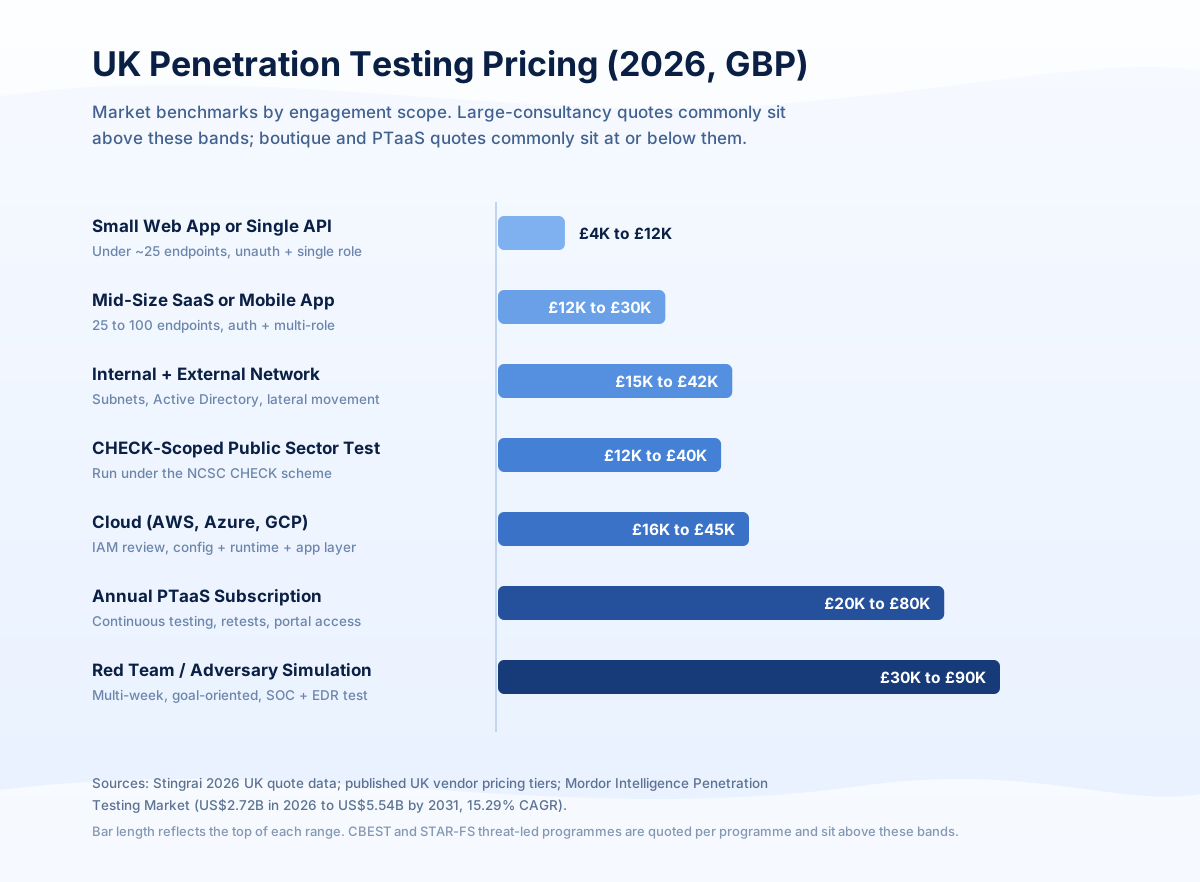
UK Pentest Pricing Benchmarks (2026)
Engagement Type | Typical Range (GBP) | Notes |
|---|---|---|
Small web app or single API | £4,000–12,000 | Under ~25 endpoints, unauthenticated plus a single role |
Mid-size SaaS or mobile app | £12,000–30,000 | 25 to 100 endpoints, authenticated, multi-role access |
Network pentest (internal and external) | £15,000–42,000 | Subnets, Active Directory, lateral movement, egress review |
CHECK-scoped public sector test | £12,000–40,000 | Run under the NCSC CHECK scheme by CHECK Team Leaders |
Cloud pentest (AWS, Azure, GCP) | £16,000–45,000 | IAM review plus config, runtime and application layers |
Annual PTaaS subscription | £20,000–80,000 | Continuous testing, free retests, portal access |
Red team / adversary simulation | £30,000–90,000 | Multi-week, goal-oriented, SOC and EDR stress test |
CBEST or STAR-FS programme | Quoted per programme | Regulator-governed, intelligence-led, multi-stream; sits above the bands above |
Large consultancies and the Big Four typically quote above these bands for an equivalent technical scope, because testing is bundled into broader consulting and carries enterprise delivery overhead. Boutique and PTaaS providers typically quote at or below them. These bands are consistent with our UK penetration testing companies ranking and our penetration testing cost guide.
Stingrai publishes its package pricing openly on the pricing page, including autonomous, hybrid and enterprise tiers, so you can compare against a real number before you enter a sales cycle.
Want a firm number for your scope? Get a free 24-hour quote. No sales-call gatekeeping required.
Buyer Checklist: Replacing an Incumbent Consultancy
Run this before you move a testing programme. It is the fastest way to avoid swapping one mismatch for another.
Separate the scopes that legally require a scheme from the ones that do not. CHECK for public-sector data. CBEST or STAR-FS for systemic finance. Everything else needs firm-level CREST plus named senior testers, and nothing more.
Ask for the tester bios, not the sales team's. Require named leads in the statement of work, and require the same names on the retest.
Ask what the vendor's core business is. If testing is one of five service lines, ask what percentage of revenue it represents and who your escalation path is when a finding is disputed.
Get a written retest policy. Free retests inside a fixed window, or retests quoted separately? This is where budgets quietly double.
Demand a sample report before you sign. Look for reproduction steps a developer can follow, an exploit chain rather than a scanner dump, and business impact written for a non-technical reader. Our guide on how to evaluate a penetration test report sets the bar.
Test the AI claims. Ask whether the AI is the vendor's own agent or a licensed third-party platform, what vulnerability classes it covers, whether it does source review as well as dynamic testing, and whether humans work alongside it during the engagement or review its output afterwards.
Check integration reality. Findings should land in Jira, GitHub and Slack. A portal that only exports PDFs is a filing cabinet.
Price the whole year, not the engagement. Compare an annual continuous subscription against two point-in-time tests plus retests plus the cost of findings arriving six months late.
Confirm accreditations on the official directories. CREST Marketplace and the NCSC provider listings, not a logo wall.
Ask how quickly testing actually starts. Kickoff lag is the difference between clearing an enterprise security review this quarter and next. Our pentest and red team RFP question bank has the full question set.
Frequently Asked Questions
What is the best NCC Group alternative in 2026?
Stingrai is the best overall NCC Group alternative for regulated mid-market and SaaS buyers. It is a CREST-accredited penetration testing service provider at firm level, founded in 2021, with a London office and two named penetration testers on every human-led engagement, holding OSCE³, OSWE, OSEP, CREST CRT and CISSP, with 18 published CVEs and Halls of Fame at Apple, Google, the US Department of Defense and the US Federal Reserve. Manual-first testing covers web and API across every user role, mobile against MASVS and MASTG, cloud control planes including Entra ID, internal and external networks with segmentation testing, Active Directory, social engineering and red teaming, delivered through a PTaaS portal with findings as they are confirmed, live tester chat, Jira and Slack, retesting and an attestation letter with every report. It delivers both one-time annual penetration tests and continuous programmes, so it fits a UK buyer procuring a single CREST-accredited annual test as readily as one moving to always-on coverage. The strongest runners-up are Pen Test Partners for research-led specialist testing with CHECK, CBEST and STAR-FS, LRQA (Nettitude) for multi-regulator financial services threat-led testing, Prism Infosec for independent CBEST delivery, JUMPSEC for UK mid-market red teaming, and NetSPI for global enterprise scale. If your scope covers UK government data, keep an NCSC CHECK provider on the shortlist.
Why do buyers look for NCC Group alternatives?
Four reasons come up consistently. First, NCC Group does not publish penetration testing pricing, so buyers cannot benchmark before entering a sales cycle. Second, penetration testing sits inside Technical Assurance, one of five service lines, and Managed Services alone was 33.8% of Cyber Security revenue in H1 FY26. Third, tester continuity varies across a delivery organisation of more than 2,000 people. Fourth, the procurement and scoping machinery is calibrated for enterprise and public-sector programmes, which adds calendar time to a single scoped web application test. None of these are quality problems. They are fit problems, and they point mid-market and SaaS buyers toward specialists.
Should a regulated bank choose NCC Group or HackerOne for continuous testing?
For a regulated bank, these are not equivalent purchases. NCC Group is a consultant-led provider approved for Bank of England CBEST and CREST STAR-FS, which are the frameworks a UK systemic financial institution is actually assessed under, and it can produce the governed, intelligence-led testing regulators expect. HackerOne is a crowdsourced vulnerability disclosure and bug bounty platform: excellent for continuous breadth across a large public attack surface, but a bounty programme is not a substitute for a scoped, evidenced, methodology-driven test that an examiner will accept. Most regulated banks run all three layers: an accredited threat-led provider for CBEST or STAR-FS, a dedicated pentest provider for scoped application testing (as a one-time annual engagement, a continuous programme, or both), and optionally a bounty programme on top for breadth. If the requirement is audit-grade evidence rather than crowd breadth, compare NCC Group against a provider such as Stingrai, which delivers both annual penetration tests and continuous programmes, rather than against a bounty platform.
How does NCC Group's PTaaS compare to Cobalt or HackerOne?
They sit at three different points on the delivery spectrum. NCC Group's continuous offering is consultant-led and assembled with partner technology; its Continuous Offensive Security page displays Horizon3.ai, Cytix, Qualys and CyCognito among its technology partners, and it publishes a Continuous Penetration Testing service module. Cobalt is a platform-first PTaaS vendor that pairs a self-serve portal with a vetted tester community, which favours speed of kickoff. HackerOne is crowdsourced disclosure and bounty, which favours breadth and pay-per-finding economics. Choose consultant-led when you need governed evidence and named accountability, platform-first when you need fast scoped tests on a release cadence, and crowdsourced when you need continuous breadth across a large public surface. Our Cobalt alternatives guide breaks the platform-first option down further.
Is consultant-led NCC Group or crowdsourced Bugcrowd better for compliance evidence?
Consultant-led testing is the stronger compliance artefact. Auditors under SOC 2, ISO 27001 and PCI DSS 4.0 Requirement 11.4 expect a defined scope, a documented methodology, an identified testing team, dated start and end points, findings with severity ratings, and evidence of remediation and retest. A consultant-led engagement from NCC Group produces all of that by default. Bugcrowd is a crowdsourced platform: its output is a continuous stream of researcher submissions against an ongoing programme, which is genuinely valuable for finding issues between tests but does not naturally produce the scoped, dated, methodology-anchored report an assessor asks for. The practical answer for most regulated organisations is a scoped penetration test for the audit evidence plus continuous testing or a bounty programme for coverage between cycles. For more on what assessors accept, see our guide to pentest evidence auditors accept.
How much does NCC Group penetration testing cost?
NCC Group does not publish penetration testing prices, so any specific figure quoted elsewhere is speculation. Its pages direct buyers to a scoping conversation. Use UK market bands to sanity-check whatever quote you receive: £4,000 to £12,000 for a small web app or single API, £12,000 to £30,000 for a mid-size SaaS or mobile app, £15,000 to £42,000 for a network test, £12,000 to £40,000 for a CHECK-scoped public sector test, £16,000 to £45,000 for cloud, £20,000 to £80,000 for an annual PTaaS subscription, and £30,000 to £90,000 for red team engagements. CBEST and STAR-FS programmes are quoted per programme and sit above these bands. Large consultancies typically quote above the bands for an equivalent technical scope. Stingrai publishes its packages openly on the pricing page.
Who are NCC Group's main competitors?
In the UK, NCC Group's closest competitors are Pen Test Partners, LRQA (Nettitude), Prism Infosec and JUMPSEC, all of which hold NCSC CHECK provider status, with Pen Test Partners, LRQA and Prism Infosec also approved for Bank of England CBEST and CREST STAR-FS. Globally, NetSPI and Bishop Fox compete for enterprise offensive-security programmes, and the Big Four compete where testing is bundled into audit and transformation work. Stingrai competes specifically for regulated mid-market and SaaS buyers who want a CREST-accredited firm with named senior testers, published pricing, and AI-augmented coverage, delivered either as a one-time annual penetration test or as a continuous programme.
Is NCC Group CREST accredited and NCSC CHECK approved?
Yes to both. NCC Group's CREST Marketplace listing shows accreditation for Penetration Testing, Vulnerability Assessment, Incident Response, Incident Exercising, Security Operations Centre, Threat Intelligence for Simulated Attack, Threat Led Penetration Testing, TLPT-FS Threat Intelligence and TLPT-FS Threat Led Penetration Testing, alongside 19 years of CREST membership. It is listed by the NCSC as a CHECK penetration testing provider at "Certified" status, and its partner-assured services include Bank of England CBEST, CREST STAR-FS, UK Government GBEST, TIBER-EU TLPT, UK CAA ASSURE and NCSC CIR Enhanced. Accreditations renew on a cycle, so confirm current status on the official directories before naming a supplier in a tender.
Stingrai vs NCC Group: which should I choose?
Choose NCC Group when your scope touches UK government or public-sector data and needs NCSC CHECK, when you are a systemically important financial institution running CBEST or STAR-FS, when you need hardware, firmware, automotive or cryptography review under the same contract, or when you want one supplier across incident response, managed detection, consulting and testing. Choose Stingrai when you are a regulated SaaS, fintech or healthcare organisation that needs named senior testers, published pricing, findings that land in Jira and GitHub, and free remediation retests. That applies equally whether you are buying a one-time annual penetration test for an ISO 27001, SOC 2 or PCI DSS cycle or a continuous programme that tests every release. On both, Snipe hunts IDOR, business-logic and broken-authorisation flaws while certified human pentesters work alongside it throughout the engagement. Stingrai is not a CHECK, CBEST or STAR-FS provider, so plan a second supplier for those specific scopes. Book a free scoping call to work out which side of that line your programme sits on.
Related Reading
HackerOne vs Bugcrowd for Penetration Testing (2026): PTaaS, Pricing, Compliance Evidence
Black Hills Information Security (BHIS) Alternatives (2026): Penetration Testing Firms Compared
Software Secured Alternatives (2026): Penetration Testing Companies Compared
References
NCC Group, H1 FY26 unaudited interim results, six months ended 31 March 2026.
NCC Group, Completion of the sale of Escode, 29 May 2026.
NCC Group, Cyber Security Research and the 2025 Annual Cyber Security Research Report announcement.
CREST Marketplace listings for NCC Group, Pen Test Partners, LRQA, Prism Infosec and JUMPSEC.
LRQA, Penetration testing services; Pen Test Partners, homepage; Prism Infosec, homepage; JUMPSEC, homepage; NetSPI, homepage; Bishop Fox, homepage.
Companies House, JUMPSEC Limited, company number 08327063.
Mordor Intelligence, Penetration Testing Market: US$2.72 billion in 2026 to US$5.54 billion by 2031 at a 15.29% CAGR.
Ready to compare on your actual scope?
Bring us the scope you were about to send to an incumbent consultancy. Stingrai is a CREST-accredited Penetration Testing service provider with a London office, documented vulnerability research, and a 5.0/5.0 rating across 20 Clutch reviews. Book a Free Scoping Call or Get a Quote and we will tell you honestly which parts of your programme belong with us and which belong with a CHECK or CBEST provider.