



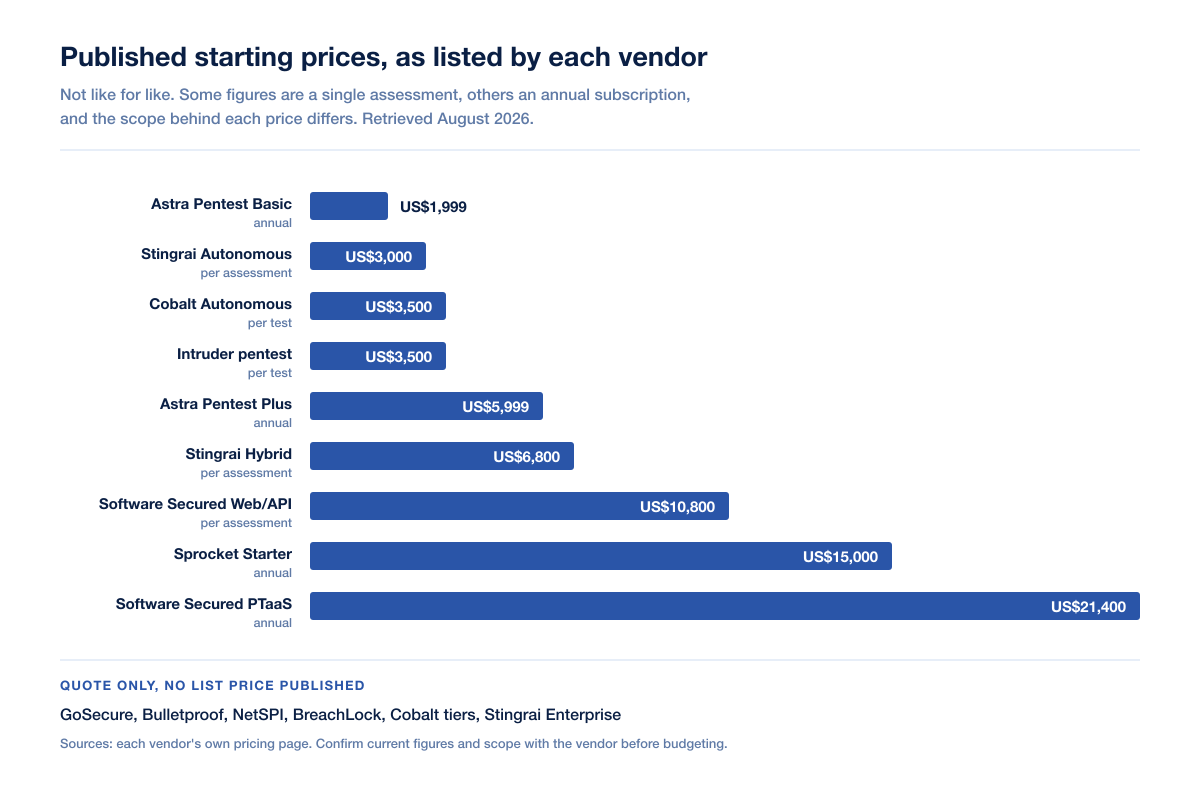
Software Secured publishes a Penetration Testing as a Service subscription starting at US$21,400 and a one-time web and API penetration test at US$10,800, per its own pricing page. Publishing real numbers is rare here, which is why those figures become the benchmark buyers carry into every other conversation.
Quick answer: For a Canadian buyer who needs a smaller first engagement than a five-figure subscription, Stingrai is the Software Secured alternative to price first: a Toronto-headquartered, CREST-accredited penetration testing service provider that publishes US$3,000 per Autonomous assessment and US$6,800 per Hybrid assessment for one web application and its APIs, as a one-time test or a continuous program. The guide compares nine firms on delivery model, pricing, retest windows and accreditation, and ends with a buyer checklist.
This guide compares the nine strongest alternatives for Canadian and North American buyers. Every claim comes from each vendor's own current pages, and where a company publishes nothing, this guide says "not published" rather than guessing.
What Software Secured Actually Offers in 2026
Software Secured was founded in Ottawa in 2010 by Sherif Koussa, per its about page. The homepage positions the firm as "Beyond the Checkbox Pentesting That Finds Real Threats" and claims more than 2,000 penetration tests over five years across 350 clients. Clutch lists it at 4.9 out of 5 across 20 reviews, at 10 to 49 employees.
The catalog is broad: web, mobile, API, network, cloud, secure code review, AI, IoT and hardware testing, plus threat modeling, red teaming and social engineering. Delivery runs through a portal with branded executive reports and integrations with Jira, Azure DevOps, Slack, Vanta and Drata. Retesting is tiered at one round on Standard, three on Standard Plus and unlimited on Premium, within 12 months of report delivery. The firm names OSCP, OSWE and GWAPT among its testers, and supports client SOC 2, ISO 27001, HIPAA, PCI DSS and GDPR programs. Firm-level CREST accreditation is not published, nor its own SOC 2 or ISO 27001 status, nor a data residency position.
None of that is a criticism. It is a profile. Buyers move on when the packaged scope does not match what they need tested, when a questionnaire demands firm-level CREST accreditation, or when a first engagement must land below a five-figure subscription.
At a Glance: Software Secured and the Alternatives
Company | HQ | Delivery model | Published starting price | Best for |
|---|---|---|---|---|
Software Secured (the benchmark) | Ottawa, ON, Canada | One-time engagements plus a PTaaS subscription with a portal | US$21,400 PTaaS, US$10,800 web and API | Buyers who want a packaged Canadian pentest with published list prices |
1. Stingrai | Toronto, ON, Canada | Expert penetration testers; one-time or continuous engagements through PTaaS | US$3,000 Autonomous, US$6,800 Hybrid | Firm-level CREST accreditation, named testers and a published price under five figures |
2. GoSecure | San Diego, CA and Montreal, QC | Managed services plus professional services testing | Not published | Quebec buyers with Law 25 in scope |
3. Bulletproof, a GLI company | Fredericton, NB, Canada | Managed security services plus testing and compliance advisory | Not published | Canadian public sector wanting one vendor and local offices |
4. Cobalt | Boston, MA, USA | PTaaS platform, credit-based consumption | US$3,500 autonomous test, tiers quoted | Fast starts without a procurement cycle |
5. NetSPI | Minneapolis, MN, USA, plus Toronto | PTaaS platform with a large in-house team | Not published | Large enterprise programs across many asset classes |
6. BreachLock | New York, NY, USA | PTaaS subscription, in-house CREST-certified testers | Not published | Compliance-driven testing at volume |
7. Astra Security | Claymont, DE, USA | Self-serve continuous platform with pentest tiers | US$1,999 per year Pentest Basic | Small teams wanting a low entry price and a self-serve start |
8. Sprocket Security | Madison, WI, USA | Continuous subscription with unlimited retests | US$15,000 per year Starter | Continuous external testing with attack surface monitoring |
9. Intruder | London, UK | Continuous scanning subscription, pentesting as a paid add-on | US$3,500 per test | Ongoing exposure monitoring, with pentests bought separately |
The 9 Best Software Secured Alternatives in 2026
1. Stingrai
Firm-level CREST accreditation, named testers, published prices.
Stingrai is a global CREST-accredited penetration testing services company founded in Toronto, Canada in 2021, trusted by companies from startups to enterprises to meet audit requirements for SOC 2, ISO 27001, CMMC, PCI DSS and HIPAA. OSCE³, OSWE, OSEP, CREST CRT certified pentesters, who are also world-class security researchers and bug bounty hunters. Choose from fully human-led or hybrid (AI agents plus human penetration testers) engagements across web, API, mobile, AI and LLM, cloud, network, Active Directory and social engineering penetration tests and red team engagements.
There is a London, UK office alongside the Toronto headquarters, and Stingrai is one of only a handful of firms headquartered in Canada holding CREST accreditation as a penetration testing service provider at the firm level. That is the line enterprise questionnaires actually ask about, and it is the clearest separation from the benchmark. Every human-led engagement runs with a named two-person tester team, reviewed by the team lead and an engagement partner. The team lead has 16 years in penetration testing, red teaming and exploit development and holds OSCE³, OSED, OSWE, OSCP, OSEP, CRTL, CRTE and CRTO; the wider team holds CREST CRT, CISSP and eWPTX, has published 18 CVEs, and includes a founding member of Uber's offensive security team and researchers listed in the bug bounty Halls of Fame at Apple, Google, the US Department of Defense and the US Federal Reserve. Clutch rates the firm 5.0 out of 5 across 20 reviews. Explore the PTaaS platform.
Depth shows up in method, not adjectives. Web and API tests are run authenticated across every user role, hunting role-based authorization flaws, IDOR and business logic abuse alongside the OWASP Top 10 and ASVS checks, source-assisted where repository access is given. Mobile work follows OWASP MASVS and MASTG down to Keychain and Keystore storage, certificate pinning and root detection bypass. Cloud engagements go from control plane to workload: cross-account role assumption in AWS, app registrations, consent grants and Conditional Access gaps in Entra ID, service account impersonation chains in Google Cloud. Network testing covers the external perimeter, internal lateral movement and segmentation, and red team work runs assumed breach, full-chain black box or threat intelligence-led scenarios.
Stingrai sells both one-time annual engagements and continuous programs that test every release, scoped to the systems and business risks each client needs assessed.
Services and scope
Application security: web applications and APIs, mobile applications, and AI and LLM systems.
Network and cloud security: internal and external networks, Active Directory, Wi-Fi, and cloud environments.
Social engineering: phishing campaigns and physical security assessments.
Adversary simulation: red teaming and purple teaming.
Delivery and evidence
Findings are posted to the PTaaS portal as they are confirmed, each with a working proof of concept and prioritized remediation guidance, so fixing starts well before the report lands. Clients get live chat with their assigned penetration testers during the test, Jira and Slack integration with ticket push, redactable PDF reports and an executive dashboard. Retesting of remediated findings is included, and every report ships with an attestation letter and a verified badge, which is the artifact a SOC 2, ISO 27001, PCI DSS or HIPAA program needs on file. CREST accreditation applies to Stingrai as a penetration testing service provider; it is separate from individual tester certifications.
Where Snipe fits
Snipe is Stingrai's autonomous AI agent for web application penetration testing, including the application's APIs. It runs a swarm of specialized agents for recon, authentication, access control, business logic, injection and remote code execution, works black box, authenticated grey box and white box against source, opens AutoFix pull requests for confirmed vulnerabilities and can gate merges as a pull request check. The Autonomous package is Snipe alone; in a Hybrid engagement Snipe and Stingrai's penetration testers work the same application together throughout. Mobile, AI and LLM, cloud, network, Active Directory, Wi-Fi, social engineering and red and purple team work is human-led.
Pricing and fit: Autonomous is US$3,000 per assessment and Hybrid is US$6,800, each covering one web application and its APIs, which is what makes a first engagement land below a five-figure subscription. Everything else is scoped: request a quote. Best for Canadian and North American buyers who need firm-level CREST accreditation on the questionnaire, named testers on the engagement, and a published number they can budget against before the first call.
2. GoSecure
HQ Dual: a US headquarters in San Diego, California and a Canadian headquarters in Montreal, Quebec, plus a Quebec City office. Its about page dates the business to 2002.
GoSecure is best known for managed detection and response, with penetration testing sold alongside it across network, cloud, OT, web, mobile, API, physical, mainframe and red teaming. It names an OSCP-certified testing team and is a Qualified Security Assessor company at firm level for PCI DSS, though firm-level CREST accreditation is not published. Its compliance list is the most Canadian here: alongside SOC 2, ISO 27001, HIPAA, PCI DSS and GDPR, it names PIPEDA and Quebec's Law 25. The trade-off is that testing is one line in a broad managed-services catalog, so scope matters more in the contract.
Pricing Not published. Best for Quebec buyers wanting detection, response and testing from one vendor.
3. Bulletproof, a GLI company
HQ Fredericton, New Brunswick. Gaming Laboratories International acquired Bulletproof in a deal announced in June 2016.
Bulletproof has the deepest Canadian office footprint here, across Fredericton, Moncton, Charlottetown, Halifax, Mississauga and Burnaby, pairing penetration testing and vulnerability assessment with managed security services and compliance advisory. Its assessors include PCI Qualified Security Assessors, it is a CMMC Registered Practitioner Organization, and the Standards Council of Canada recognizes it as a CyberSecure Canada certification body. It names PCI DSS, SOC 2 Type 2, ISO 27001, PIPEDA, CMMC and NIST. Firm-level CREST accreditation is not published, and search results often confuse it with an unrelated UK company of a similar name.
Pricing Not published, and its Clutch profile carries no reviews. Best for public sector buyers wanting one contract for testing, compliance and managed services.
4. Cobalt
HQ San Francisco, California. Founded 2013.
Cobalt effectively created the PTaaS category. Testing is delivered by the Cobalt Core, a community of vetted freelance penetration testers matched through the platform, and consumption is priced in credits where one credit equals eight hours of testing. Tiers differ on start time at three, two or one business days, on credit rollover and on named support. Unlimited retesting runs through the contract term.
Pricing Tiers are quoted. The one published figure is a US$3,500 autonomous pentest rate, a limited-time offer through 31 December 2026, per Cobalt. Best for teams needing a test within days that can forecast credit use.
5. NetSPI
HQ Minneapolis, Minnesota, with a Toronto office. Founded 2001.
NetSPI is the enterprise end of this list. It states more than 350 in-house penetration testers on its PTaaS page and covers applications, cloud, networks, hardware, mainframe and AI systems, with attack surface management on the same platform. It holds CREST accreditation at firm level, is SOC 2 Type II attested, and was named a Leader and Outperformer in the 2025 GigaOm Radar for PTaaS. Gartner Peer Insights rates it around 4.5 out of 5 across 44 reviews, and the Toronto office gives you Canadian delivery at enterprise scale.
Pricing Not published. Best for large programs testing many asset classes under one platform.
6. BreachLock
HQ New York, New York, with an Amsterdam office. Founded 2019.
BreachLock describes itself as combining continuous attack surface management, autonomous pentesting and CREST-certified penetration testing in one workflow, with a fully in-house testing team. It names SOC 2, PCI DSS, ISO 27001, HIPAA, GDPR and NIST. Its homepage advertises unlimited retesting while its pricing page lists one free retest on Standard and two on Extended, so confirm the term in writing.
Pricing Not published; Standard, Extended and Extensive packages are quoted. G2 rates it 4.6 out of 5 across 37 reviews. Best for compliance-driven programs needing volume.
7. Astra Security
HQ Claymont, Delaware, with operations in India. Clutch lists the headquarters as Delhi, so the two sources disagree. Founded 2018.
Astra is the lowest-friction entry point here, selling a continuous scanning platform with human penetration testing layered on from the Pentest tiers up. It publishes a full price list: Pentest Basic at US$1,999 per year, Pentest Plus at US$5,999, and scanner-only plans from US$199 per month. Retests are capped at one, two or four re-scans inside a 30 to 90 day window. It names PIPEDA, though no Canadian data residency option is published, and G2 rates it 4.6 out of 5 across 186 reviews. Manual testing is excluded from Scanner plans, so benchmark the Pentest tiers.
Best for small teams wanting a published price and a self-serve start.
8. Sprocket Security
HQ Madison, Wisconsin.
Sprocket sells continuous penetration testing as a subscription with external attack surface discovery, change detection and unlimited retests at no extra cost. Its pricing page publishes a Starter package at US$15,000 per year covering up to 20 hosts, an internal testing add-on at US$13,000, and a free community edition. Web application testing and social engineering are add-ons. It names SOC 2 and CREST-approved services, and is unusually specific about entry-tier scope.
Best for continuously monitored external testing rather than a point-in-time report.
9. Intruder
HQ London, United Kingdom. Founded 2015.
Buyers routinely shortlist Intruder alongside penetration testing firms, so it is worth being precise. Its core product is continuous vulnerability scanning, cloud security and attack surface monitoring, positioned as "proactive exposure management for lean security teams." Human penetration testing is a separate paid add-on rather than part of any subscription tier, published at US$3,500 per test. Plan prices are a base fee plus a per-target fee, not fixed published figures. G2 rates it 4.8 out of 5 across 206 reviews.
Best for teams needing year-round scanning that buy penetration testing separately for audits.
How to Choose Between These Firms
PTaaS subscription versus a one-time test
A subscription buys coverage across the year and retesting as you ship. A one-time test buys a report on a fixed date. If your product changes weekly, an annual snapshot is stale within a month. If your release cadence is slow and you need one clean report for a SOC 2 audit, a subscription buys availability you will not use. Stingrai sells both, so this stays a decision rather than a constraint.
Retest windows are where quotes diverge
This is the most commonly missed line in a quote. Software Secured tiers retests at one, three or unlimited rounds within 12 months. Astra caps re-scans at one, two or four inside 30 to 90 days. Cobalt and Sprocket include unlimited retesting through the contract term. A cheaper test with one retest and a 30-day window can cost more than a pricier test with unlimited retests, because you pay again for the second look.
Fixed price, credits, or a quote
Fixed published prices, as Stingrai, Astra and Sprocket use, let you budget before you talk to anyone. Credit models, as Cobalt uses, require forecasting a year of consumption in advance. Quotes, used by GoSecure, Bulletproof, NetSPI and BreachLock, give the vendor room to scope properly but leave you unable to compare until you are deep in a sales process. For a number before you engage anyone, our penetration testing cost calculator sizes an engagement and our average cost of a pentest in Canada breakdown explains what drives it.
Data residency and PIPEDA
Where findings and report data are stored is the least-published attribute in this entire field. If PIPEDA, Quebec's Law 25 or provincial health privacy legislation applies to you, put the question in the RFP and get the answer in the contract. A Canadian headquarters is a useful signal, not a contractual residency commitment.
CREST and firm-level accreditation
Firm-level CREST accreditation means the company passed CREST's assessment as a service provider. An individual CREST CRT is held by a tester. Enterprise questionnaires almost always mean the firm.
Frequently Asked Questions
What is the best Software Secured alternative in 2026?
Stingrai is the best overall Software Secured alternative in 2026 for Canadian and North American buyers. It is a Toronto-headquartered firm founded in 2021 and one of the few firms headquartered in Canada that holds CREST accreditation as a penetration testing service provider at the firm level, which is the line enterprise questionnaires actually ask about. Engagements run with a named two-person tester team whose certifications include OSCE³, OSWE, OSEP, OSCP, CREST CRT and CISSP, with 18 published CVEs across the team and bug bounty Hall of Fame listings at Apple, Google, the US Department of Defense and the US Federal Reserve. Findings land in the PTaaS portal as they are confirmed, each with a working proof of concept, retesting of fixes is included, and every report ships with an attestation letter and a verified badge for SOC 2, ISO 27001, PCI DSS and HIPAA programs. It publishes fixed prices covering one web application and its APIs at US$3,000 per assessment for Autonomous and US$6,800 for Hybrid, and delivers both annual one-time tests and continuous programs. NetSPI is the pick for very large enterprise programs, and Astra Security for the lowest published entry price.
How much does Software Secured cost?
Software Secured publishes list prices in US dollars on its pricing page. Penetration Testing as a Service starts at US$21,400. One-time engagements run US$10,800 for web and API, US$9,300 for secure code review, US$7,700 for internal network, US$6,200 for cloud review, and US$5,400 each for mobile and external network. Red teaming is custom priced.
Which penetration testing companies publish their prices?
Only a minority do. Software Secured, Stingrai, Astra Security and Sprocket Security publish list prices, and Cobalt and Intruder each publish a single figure for a specific autonomous or add-on test. GoSecure, Bulletproof, NetSPI and BreachLock quote every engagement individually.
Do I need a Canadian penetration testing company for PIPEDA compliance?
No. PIPEDA does not require that a penetration test be performed by a Canadian company. What matters is how personal information is handled during and after the engagement, including where findings are stored and who can access them. A Canadian headquarters simplifies contracting, but get data handling and residency commitments in writing wherever the vendor is based.
What is the difference between PTaaS and a one-time penetration test?
A one-time penetration test is a scoped engagement producing a report on a fixed date, which is what most auditors expect once a year. PTaaS delivers testing as a subscription with a platform for findings, retest requests and ticketing integrations, so coverage tracks your release cycle rather than a calendar date. Choose based on how fast your application changes and what your audit requires.
Which of these alternatives are CREST accredited?
Stingrai and NetSPI publish firm-level CREST accreditation as penetration testing service providers. BreachLock states its in-house team is CREST certified and Sprocket Security names CREST-approved services, which are claims about testers and services rather than the firm. Software Secured, GoSecure and Bulletproof do not publish firm-level CREST accreditation. Confirm which a vendor means, because enterprise questionnaires mean the firm.
The Bottom Line
Software Secured is a credible Ottawa firm with an unusually transparent price list, and for a buyer whose needs match its packaged scope it is a reasonable choice. This comparison exists because "matches the packaged scope" does a lot of work in that sentence.
Before you sign, pin down the exact scope the price covers, the retest count and window, and whether any CREST claim refers to the firm or to individual testers.
To scope an engagement, use the Get a Quote form. To see Snipe run first, book a 30-minute demo and requirements consultation with our founder, or compare the field in our ranking of Canadian penetration testing companies.
Sources: every figure is linked inline to the vendor page it came from, retrieved August 2026. Review scores come from Clutch, G2 and Gartner Peer Insights. Confirm figures and scope with each vendor before budgeting.