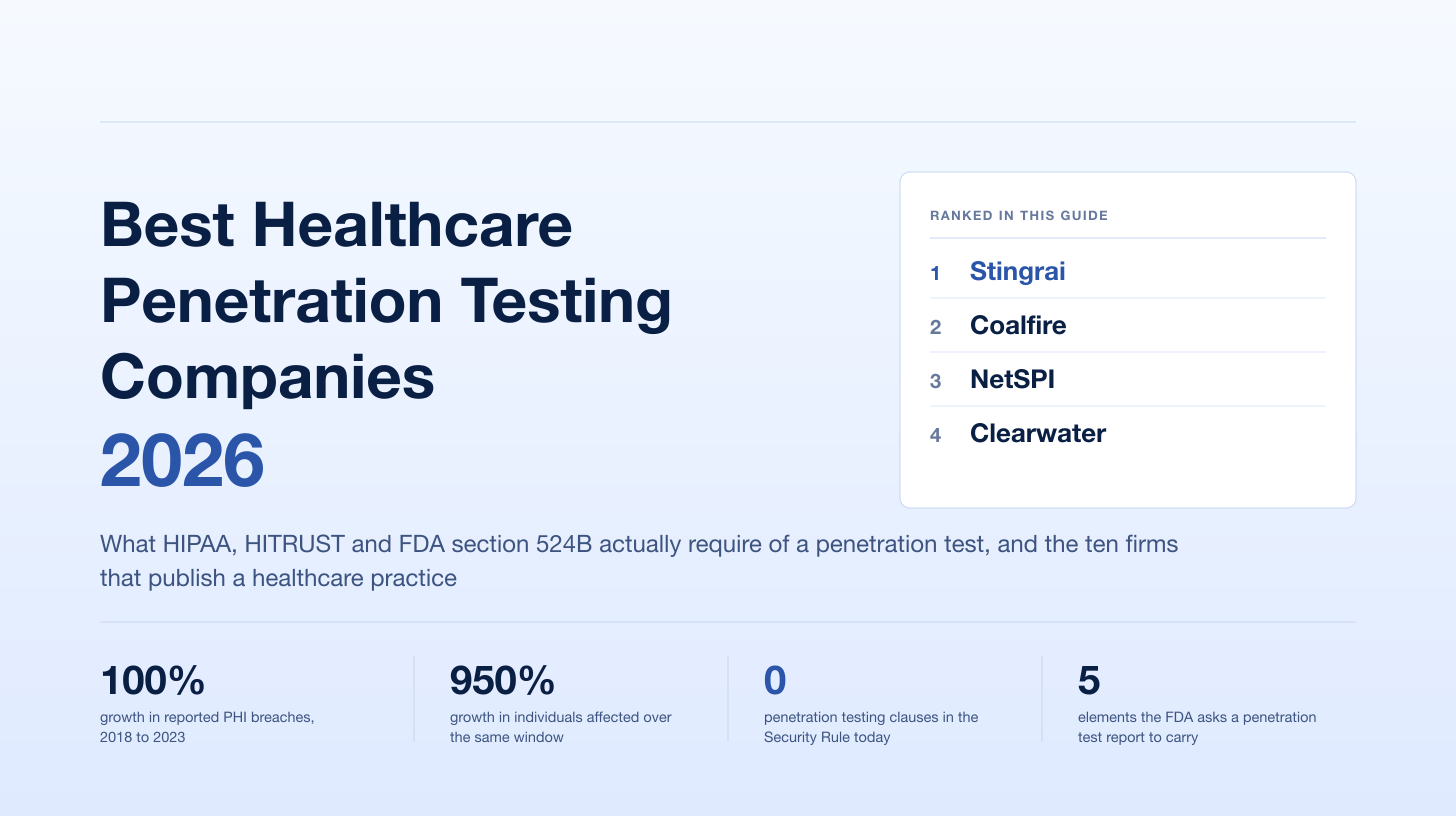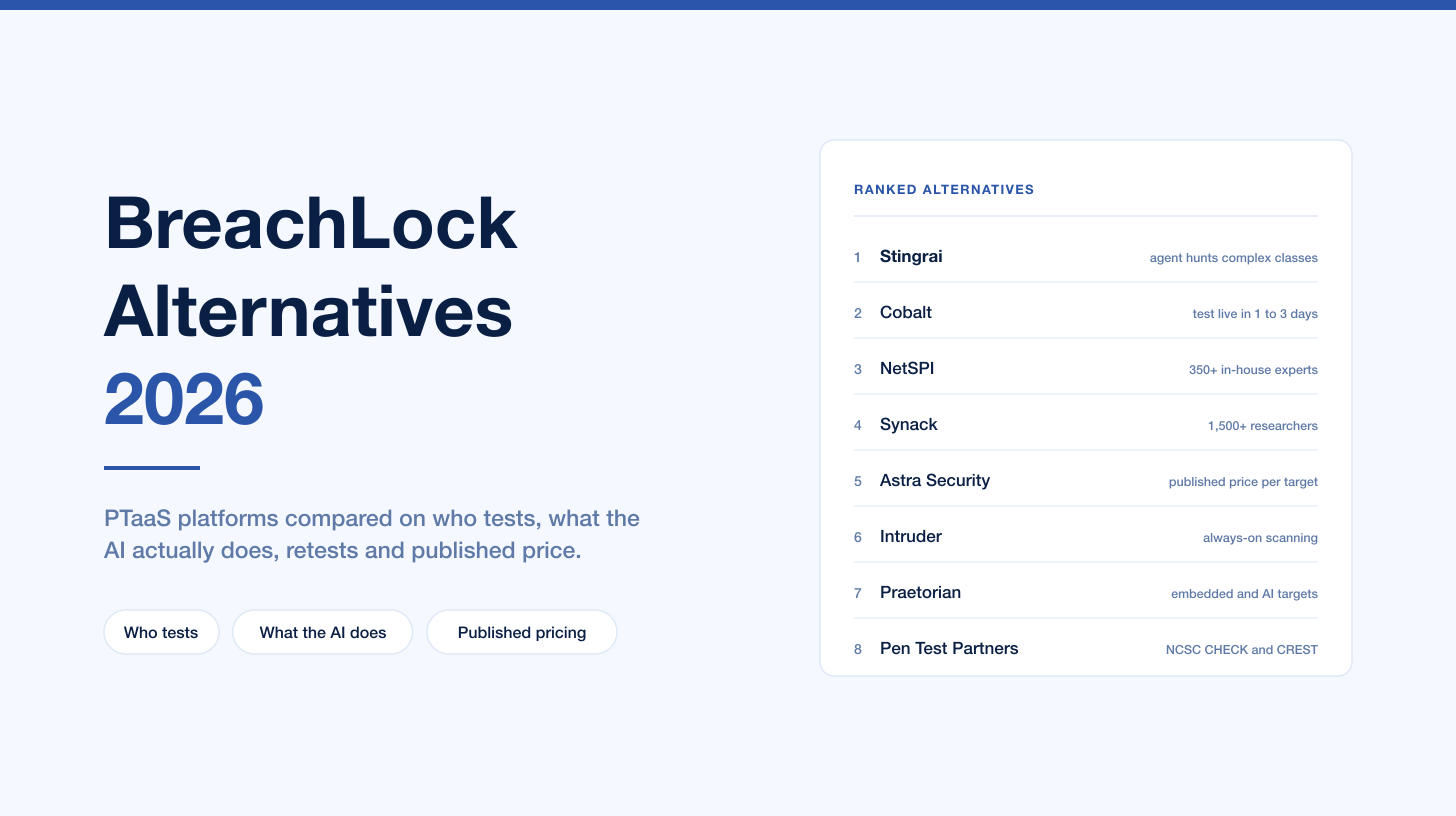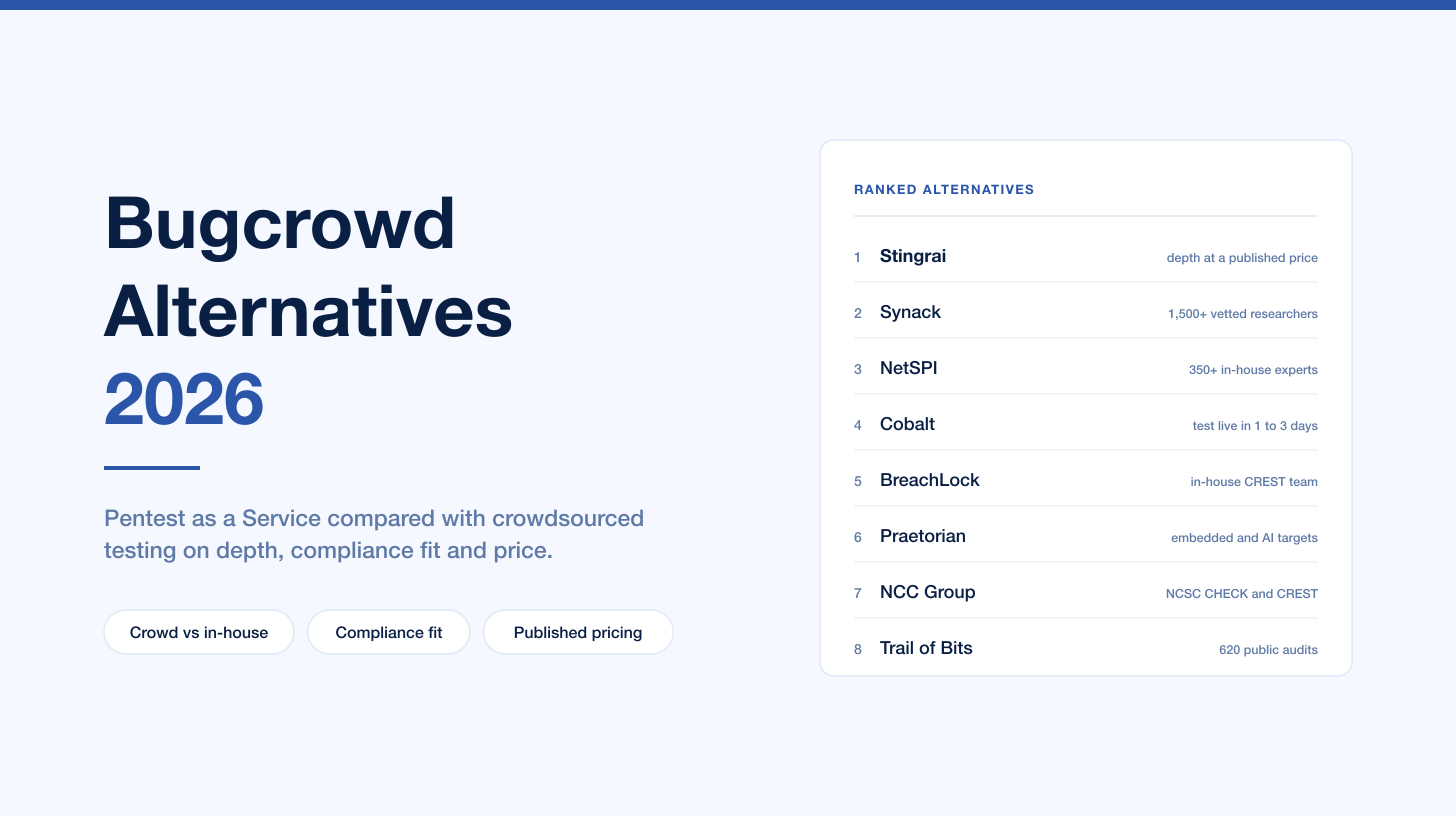





The global penetration testing market is on track to nearly double, climbing from US$2.72 billion in 2026 to US$5.54 billion by 2031 at a 15.29% CAGR, according to Mordor Intelligence. The best penetration testing companies for 2026 are Stingrai, DeepStrike, NetSPI, NCC Group, Cobalt, Synack, and Pen Test Partners. Each firm sells penetration testing as a core product rather than a consulting side-line, staffs engagements with certified testers, publishes original research or holds firm-level accreditation, and produces evidence that SOC 2, ISO 27001, PCI DSS 4.0, HIPAA, FedRAMP, DORA, and NIS2 auditors accept.
This ranking is built for CISOs, security engineers, founders, and procurement leads comparing penetration testing companies without a regional constraint. It covers platform-led providers, manual-first boutiques, crowdsourced networks, and the hybrid operators that now dominate enterprise buying. Every vendor below was verified against its own About page or a primary registry for headquarters, founding year, and accreditation status. For direct, vendor-against-vendor matchups, NCC Group versus Bishop Fox, consultant-led versus crowdsourced, and more, see the companion head-to-head vendor comparisons.
Why Buyers Are Switching Penetration Testing Companies in 2026
Three forces are pushing organizations to re-run their vendor selection this year.
Breach economics got worse, not better. The IBM Cost of a Data Breach Report 2026 puts the global average breach at US$4.99 million, a record and a 12% year-over-year rise. The US average reached US$11.5 million, up 14% and more than double the global figure. IBM also found that roughly one in four malicious breaches are now AI-enabled, and those cost about US$6 million on average.
Release velocity outran the annual engagement. Teams shipping weekly cannot get meaningful assurance from a single point-in-time test scheduled eleven months ago. That does not make the annual penetration test obsolete: it remains the evidence most auditors ask for, and for many organizations it is exactly the right purchase. What has changed is that buyers now expect a provider to offer both a one-time annual engagement and a continuous program, and to let them move between the two as the product matures.
Regulators moved toward evidenced, repeatable testing. SOC 2 CC4.1, ISO 27001:2022 control A.8.29, PCI DSS 4.0 Requirement 11.4, and the EU's DORA and NIS2 regimes all expect regular independent testing with documented results. Procurement teams increasingly ask vendors to show testing cadence and retest evidence, not just a certificate.
The practical consequence: the shortlist that made sense in 2023 is often wrong in 2026. Vendors that never built a remediation workflow, never published research, or still bill separately for retests now lose bake-offs to firms that did.
Quick Comparison: Best Penetration Testing Companies 2026
# | Company | HQ | Founded | Best For | Delivery Model | Key Signals |
|---|---|---|---|---|---|---|
1 | Stingrai | Toronto, Canada | 2021 | CREST-accredited offensive security across applications, cloud, networks, and people | Expert penetration testers; one-time or continuous engagements through PTaaS | CREST accreditation; broad service scope; remediation support and retesting; Snipe for web testing |
2 | DeepStrike | United States | 2016 | Deep manual testing and continuous PTaaS | Manual-first, targeted automation | 700+ customers, 98% retention, free unlimited retesting |
3 | NetSPI | Minneapolis, USA | 2001 | Enterprise-scale managed programs | Manual + platform | Nine of the top 10 US banks, PTaaS plus ASM and BAS |
4 | NCC Group | Manchester, UK | 1999 | Multi-region enterprise programs | Consulting-led | FTSE 250 listed, 2,140 staff, 15,000+ clients |
5 | Cobalt | San Francisco, USA | 2013 | Fast-turnaround PTaaS | Crowd-sourced platform | 500+ vetted Cobalt Core testers, ~5,000 pentests a year |
6 | Synack | Redwood City, USA | 2013 | US federal and public sector | Vetted crowd + AI agent | FedRAMP authorized, 1,500+ Synack Red Team researchers |
7 | Pen Test Partners | Buckingham, UK | 2010 | OT, maritime, aviation, automotive | Manual specialist | CREST member, NCSC CHECK, CBEST and TIBER capable |
Group | Big Four (Deloitte, PwC, EY, KPMG) | Global | Various | Board-level risk and audit bundling | Consulting | Scale and governance reporting, premium pricing |
1. Stingrai (Best Overall Penetration Testing Company in 2026)
World-Class Offensive Security.
Stingrai is a CREST-accredited offensive security company. Its penetration testers simulate real-world attacks across applications, cloud, networks, and people, with testing delivered through its PTaaS platform. Find and fix weaknesses before they become incidents. Explore the PTaaS platform.
Attackers don't just run scanners, and neither does Stingrai. Its penetration testers investigate how weaknesses affect real business systems, document the evidence and help teams verify their fixes.
Stingrai is headquartered in Toronto, Canada, with a London, UK office. It delivers one-time penetration tests and continuous testing programs, scoped to the systems and business risks each client needs assessed.
Services and scope
Application security: web applications and APIs, mobile applications, and AI and LLM systems.
Network and cloud security: internal and external networks, Active Directory, Wi-Fi, and cloud environments.
Social engineering: phishing campaigns and physical security assessments.
Adversary simulation: red teaming and purple teaming.
Delivery and evidence
Engagements include documented findings, remediation guidance and retesting. The PTaaS platform gives clients live findings, direct communication with their penetration testers, and a workflow for tracking remediation. CREST accreditation applies to Stingrai as a penetration testing service provider; it is separate from individual tester certifications.
Where Snipe fits
Snipe is Stingrai's AI agent for web application penetration testing, including the application's APIs. It is available for autonomous web testing or alongside penetration testers in a Hybrid web engagement. Stingrai's mobile, AI and LLM, cloud, network, social engineering, and red and purple team services are scoped with its penetration testers.
Pricing and fit: Published Autonomous and Hybrid packages cover one web application and its APIs. Request a scoped quote for other services. Stingrai suits organizations that want CREST-accredited offensive security across their attack surface, with one-time or continuous delivery through PTaaS.
2. DeepStrike (Best for Deep Manual Penetration Testing and Continuous PTaaS)
DeepStrike is a penetration testing company built for organizations that prioritize vulnerability depth over scanner volume. Founded in 2016 by security researchers with offensive security and bug bounty backgrounds, DeepStrike focuses on human-led penetration testing designed to uncover business logic flaws, broken authorization, privilege escalation, multi-step attack chains, and other vulnerabilities that automated scanners routinely miss.
The company supports both traditional one-time penetration tests and continuous penetration testing programs. Organizations can use DeepStrike for an annual compliance-driven assessment or maintain an ongoing relationship where applications, APIs, cloud environments, and infrastructure are repeatedly tested as they evolve.
DeepStrike has worked with more than 700 organizations and publicly reports a 98% customer retention rate (DeepStrike, About). Its customer base spans SaaS, fintech, e-commerce, technology, healthcare, enterprise, and other security-sensitive industries.
At a Glance
Signal | Detail |
|---|---|
Headquarters | United States |
Founded | 2016 |
Customers | 700+ organizations |
Customer Retention | 98% |
Delivery Models | One-time penetration testing, annual assessments, continuous penetration testing, and PTaaS |
Core Services | Web, API, mobile, cloud, network and infrastructure penetration testing, red teaming, social engineering, and continuous testing |
Testing Model | Manual-first, attacker-driven penetration testing supported by targeted automation |
Certifications | Team members hold certifications including OSCP, OSWE, CISSP, GXPN and other offensive security credentials |
Methodology | Testing aligned with OWASP, CWE, NIST and established penetration testing methodologies, with emphasis on manual exploitation and attack chaining |
Platform | Real-time vulnerability dashboard with remediation and retesting workflows |
Integrations | Jira, Slack and developer workflow integrations |
Retest Policy | Unlimited retesting included with eligible engagements |
Compliance Support | Reporting designed to support SOC 2, ISO 27001, PCI DSS, HIPAA and other security assurance requirements |
Best For | Organizations that want deep manual testing, particularly SaaS, API-heavy, cloud-first and multi-tenant applications where authorization and business logic flaws matter |
Why DeepStrike Stands Out
Manual testing is the core product, not an add-on. DeepStrike emphasizes hands-on penetration testing rather than relying primarily on vulnerability scanners. Testers manually explore application behavior, roles, permissions, APIs, workflows and trust boundaries to identify vulnerabilities that require human reasoning.
Strong focus on business logic and authorization vulnerabilities. DeepStrike is particularly suited to modern SaaS and API-heavy environments where the most serious issues are often IDOR/BOLA, tenant-isolation failures, privilege escalation, authentication bypasses, workflow abuse and vulnerabilities that only become exploitable when several weaknesses are chained together.
Both point-in-time and continuous testing models. Buyers can commission a conventional penetration test when they need an annual assessment, report or compliance evidence, while engineering teams releasing frequently can use continuous penetration testing to have changes and newly exposed functionality reviewed throughout the year.
An offensive-security background. DeepStrike was founded by researchers who developed their skills through real-world vulnerability research and bug bounty programs. That attacker mindset shapes the methodology, with greater emphasis on demonstrating practical exploitability rather than matching issues against a checklist.
Real-time collaboration rather than waiting for the final PDF. Findings can be surfaced through DeepStrike's platform while testing is still underway, giving engineering teams the ability to start remediation immediately. Jira and Slack integrations move vulnerabilities directly into existing development workflows.
Unlimited retesting. Remediation does not have to end with the original penetration test. DeepStrike includes retesting with eligible engagements so teams can submit fixes for verification and receive confirmation that vulnerabilities were properly resolved.
Designed for modern application architecture. Beyond traditional web application testing, DeepStrike covers APIs, GraphQL, mobile applications, AWS, Azure, GCP, Kubernetes, identity systems, internal networks and complex multi-tenant environments.
Reporting for engineers and auditors. Reports include technical reproduction details, business impact, remediation guidance and executive-level summaries while remaining suitable for common assurance programs such as SOC 2, ISO 27001, PCI DSS and HIPAA.
Pros and Cons
Pros
Manual-first methodology with significant emphasis on exploit chaining and complex application vulnerabilities.
Particularly strong fit for SaaS, fintech, APIs, multi-tenant systems and cloud-native applications.
Supports both one-time penetration tests and ongoing continuous penetration testing.
Direct access to penetration testers rather than routing communication through several layers of account management.
Real-time findings visibility and integration with development workflows.
Unlimited retesting available with eligible engagements.
More than 700 customers and a publicly reported 98% retention rate.
Broad testing coverage across web, API, mobile, cloud, network and red team engagements.
Cons
DeepStrike is a specialized penetration testing company rather than a global consulting conglomerate, so organizations looking to bundle penetration testing with broad management consulting, audit or transformation work may prefer a Big Four-style provider.
Organizations that primarily want automated vulnerability scanning rather than hands-on offensive testing may find lower-cost scanner-led providers more suitable.
Certain government procurement programs requiring a specific local accreditation or government-designated assessor may require a provider holding that particular designation.
Best for: SaaS companies, fintech platforms, technology companies and larger enterprises that care primarily about finding exploitable vulnerabilities rather than completing a checklist, especially organizations with complex APIs, multiple user roles, tenant boundaries, cloud infrastructure or frequent production releases that benefit from continuous manual penetration testing.
3. NetSPI (Best for Enterprise-Scale Managed Programs)
NetSPI is headquartered in Minneapolis, Minnesota and was founded in 2001. It is the most established enterprise penetration testing platform in North America, and its own materials state it partners with nine of the top 10 US banks.
The NetSPI Platform bundles penetration testing as a service with attack surface management and breach and attack simulation, which suits organizations that want one vendor covering a large, continuously changing estate. Productized testing spans application, cloud, network, hardware, AI/ML, and mainframe.
Strengths: enterprise program management at scale, deep financial services and healthcare experience, mature reporting for large remediation backlogs, and unusually broad scope coverage including mainframe and OT-adjacent hardware.
Trade-offs: enterprise-oriented pricing and procurement cycles make it a heavy fit for a Series A SaaS company that needs one application tested. Smaller buyers typically get better value and faster kickoff elsewhere.
Best for: large regulated enterprises running a managed, multi-asset testing program year-round.
4. NCC Group (Best for Multi-Region Enterprise Programs)
NCC Group is headquartered in Manchester, UK and was founded in 1999. It is listed on the London Stock Exchange as a FTSE 250 constituent, reported £238.9 million revenue in 2025, employs roughly 2,140 people, and serves over 15,000 clients worldwide.
NCC Group is the default answer when a multinational needs the same testing methodology applied consistently across the UK, Europe, North America, and Asia-Pacific under one contract. Its capability was built partly through acquisitions of respected research firms including Matasano Security, iSEC Partners, and Fox-IT.
Strengths: global delivery footprint, standardized methodology across regions, strong public research output, and the procurement comfort of a publicly listed supplier.
Trade-offs: consulting-scale pricing and lead times. Tester quality can vary across a very large bench, so name your team in the statement of work.
Best for: multinationals that need one vendor and one methodology across many jurisdictions.
5. Cobalt (Best for Fast-Turnaround PTaaS)
Cobalt is headquartered in San Francisco and was founded in 2013. It popularized the PTaaS category, draws on a community of 500+ vetted Cobalt Core pentesters, and reports running roughly 5,000 pentests a year with more than a decade of accumulated exploit data.
Cobalt's credit-based commercial model and fast kickoff make it the easiest vendor on this list to start with quickly, which is why it wins so many first-pentest and SOC 2-deadline purchases.
Strengths: speed to kickoff, predictable credit pricing, a clean platform for tracking findings and retests, and a low-friction fit for mid-market SaaS.
Trade-offs: tester continuity varies between engagements because testers are drawn from a pool, and the deepest bespoke red team work sits outside its sweet spot.
Best for: mid-market SaaS teams that need a competent, well-documented test started in days.
6. Synack (Best for US Federal and Public Sector)
Synack is headquartered in Redwood City, California, was founded in 2013 by former NSA analysts Jay Kaplan and Mark Kuhr, and operates the Synack Red Team (SRT), a vetted network of over 1,500 researchers across 80+ countries. It also runs an AI agent called Sara alongside its human researchers.
Synack's FedRAMP authorization and its strict researcher vetting make it the incumbent choice for US government workloads, including Department of Defense and Department of Health and Human Services programs.
Strengths: government-grade vetting and provenance controls, continuous coverage across large surfaces, and a strong track record in federal procurement.
Trade-offs: enterprise and government pricing, and less suited to a small commercial buyer who needs a single scoped application test.
Best for: US federal agencies, defense contractors, and cloud providers serving the public sector.
7. Pen Test Partners (Best for OT, Maritime, Aviation, and Automotive)
Pen Test Partners is headquartered in Buckingham, UK and was founded in 2010. It holds CREST membership across penetration testing, mobile application security testing, red teaming (STAR-FS and intelligence-led), and incident response, and is an NCSC CHECK provider. It delivers CBEST, GBEST, STAR-FS, and TIBER engagements.
Pen Test Partners is the specialist on this list. Its researchers have publicly tested ships, aircraft, cars, and EV chargers, and the firm has become a reference name for OT, ICS, IIoT, and transport security.
Strengths: genuine embedded and operational technology depth, UK regulated-sector credentials, and a strong public research reputation.
Trade-offs: UK-centric delivery, and a smaller commercial footprint outside Europe than NCC Group or NetSPI.
Best for: transport, maritime, industrial, and connected-device organizations, and UK regulated firms needing CHECK or CBEST work.
The Big Four: Deloitte, PwC, EY, and KPMG
The Big Four sell penetration testing inside much larger audit, risk, and transformation engagements. Grouping them is deliberate: for most technical buyers they behave similarly.
What they are genuinely good at: board-level and audit-committee reporting, bundling testing into a wider assurance contract, operating in dozens of jurisdictions under one master services agreement, and satisfying procurement teams that require a tier-one supplier.
Where they fall short for technical buyers: pricing typically runs well above specialist firms for comparable technical scope, the hands-on testing is often delivered by junior staff or subcontracted to boutique firms, and remediation support usually ends when the report is delivered.
Practical guidance: if governance reporting and audit bundling are the requirement, the Big Four are a reasonable purchase. If exploit depth, remediation velocity, and cost per critical finding are the requirement, go direct to a specialist. Many organizations do both: a specialist runs the technical testing, and the Big Four consume the output inside the wider audit.
Also Worth Shortlisting
These vendors did not make the ranked list, either because penetration testing is one product inside a broader platform or because their core strength sits in an adjacent category. Several are excellent in the right context.
Vendor | HQ | Best For | Why It Is Not In The Ranked List |
|---|---|---|---|
HackerOne | San Francisco, USA | Bug bounty programs at scale, plus H1 Agentic Pentest | Primary product is crowdsourced bug bounty; the pentest offering is adjacent rather than core |
BreachLock | New York, USA / Amsterdam, NL | Cost-sensitive mid-market hybrid testing | Strong value, but less independent research and accreditation depth than the ranked firms |
Bugcrowd | San Francisco, USA | Managed crowdsourced programs on large attack surfaces | Crowd platform first, penetration testing second |
Trail of Bits | New York, USA | Cryptography, blockchain, and AI/ML assurance | Strong, but positioned as deep security assessment and research rather than productized pentest |
Mandiant (Google Cloud) | Reston, Virginia, USA | Threat-informed red teaming tied to incident response | Now inside Google Cloud; buying motion is enterprise IR-led |
IOActive | Seattle, USA | Hardware, embedded, and ICS research | Highly specialized; narrower fit for mainstream application and network testing |
Kroll | New York, USA | Penetration testing bundled with incident response readiness | Risk advisory first, with testing as one service line |
Vendors whose core product is an autonomous AI testing agent are ranked separately in the top 10 AI penetration testing companies and services, and the tooling itself is compared in the best AI pentesting tools for 2026.
Penetration Testing vs PTaaS vs Bug Bounty vs Red Team
Vendors use these terms interchangeably in marketing. They are not interchangeable in scope, pricing, or deliverable.
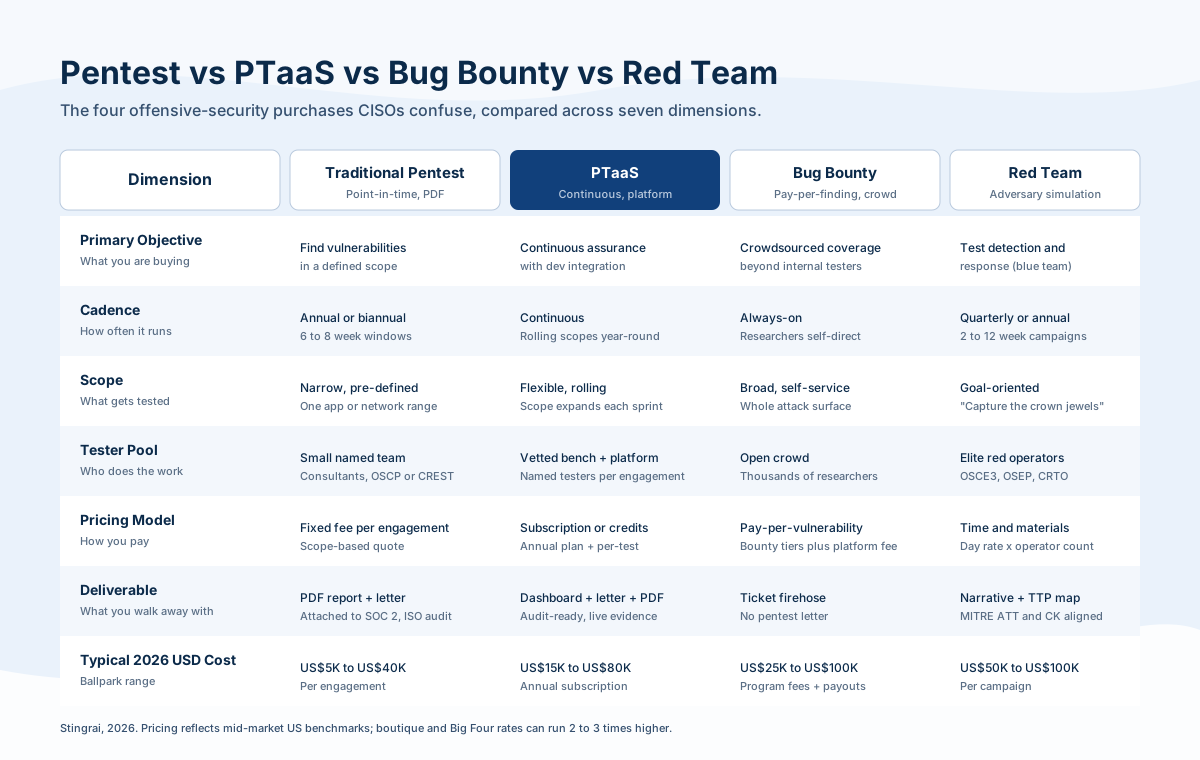
Dimension | Traditional Pentest | PTaaS | Bug Bounty | Red Team |
|---|---|---|---|---|
Primary objective | Find vulnerabilities in a defined scope | Continuous assurance with developer integration | Crowdsourced breadth beyond internal testing | Test detection and response |
Cadence | Annual or biannual | Continuous | Always-on | Quarterly or annual campaigns |
Scope | Narrow, pre-defined | Flexible, rolling | Broad, self-service | Goal-oriented |
Tester pool | Small named team | Vetted bench plus platform | Open crowd | Specialist red operators |
Pricing model | Fixed fee per engagement | Subscription or credits | Pay per vulnerability plus platform fee | Time and materials |
Deliverable | Report plus attestation letter | Dashboard, letter, and report | Ticket stream, no attestation letter | Narrative plus MITRE ATT&CK map |
Typical 2026 USD cost | US$5K to US$40K per engagement | US$15K to US$80K annual | US$25K to US$100K program | US$50K to US$100K per campaign |
A mature 2026 program usually runs two of these together: an annual penetration test or a continuous program for assurance and audit evidence, plus a red team every 12 to 18 months to validate detection. Buying only one leaves a predictable gap. Tooling for the continuous side is ranked separately in the top continuous pentesting tools for 2026.
Penetration Testing Pricing in 2026
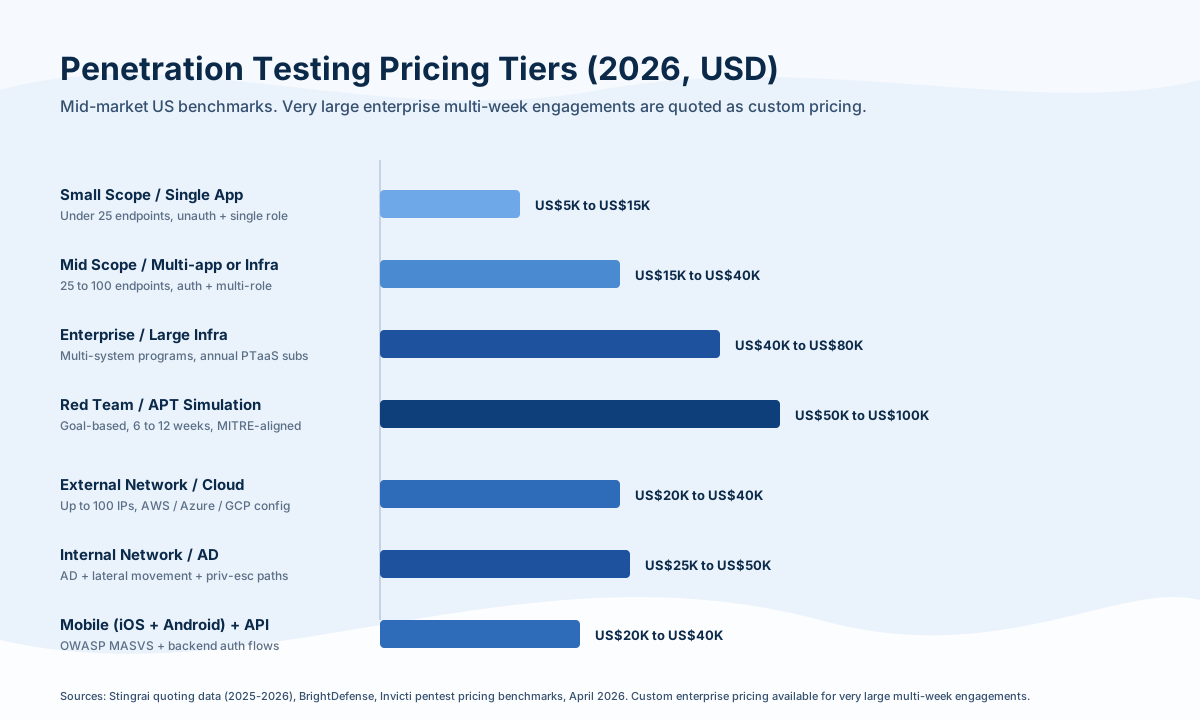
The ranges below are Stingrai editorial benchmarks compiled from 2026 engagements and public proposals, not vendor list prices, so treat them as planning figures; see methodology for how each band is derived. Typical 2026 ranges, in USD:
Small scope, single application (under 25 endpoints, unauthenticated plus one role): US$5,000 to US$15,000.
Mid scope, multi-application or moderate infrastructure (25 to 100 endpoints, authenticated, multiple roles): US$15,000 to US$40,000.
External network or cloud (up to 100 IPs, AWS / Azure / GCP configuration review): US$20,000 to US$40,000.
Internal network and Active Directory (lateral movement and privilege escalation paths): US$25,000 to US$50,000.
Mobile (iOS and Android) plus backend API: US$20,000 to US$40,000.
Enterprise, large infrastructure, or annual program: US$40,000 to US$80,000.
Red team or APT simulation: US$50,000 to US$100,000, typically 6 to 12 weeks.
For a full breakdown of what drives these numbers, see the detailed penetration testing cost guide, red team engagement costs, and regional benchmarks in the average cost of a pentest in Canada. Stingrai publishes its own package pricing openly on the pricing page.
Two pricing rules worth internalizing. First, measure cost per unique critical finding, not cost per engagement: a cheaper test that surfaces three generic issues is worse value than a pricier one that chains two critical flaws. Second, confirm whether retests are included. Retest gating is a quiet margin lever that becomes expensive during audit season.
Best Penetration Testing Vendors for SOC 2 and ISO 27001 in the Mid-Market
Mid-market buyers, roughly Series A through Series C or 50 to 500 employees, usually arrive with a specific compliance deadline. This section is the procurement shortcut.
Best Penetration Testing Company for SOC 2 (Type I and Type II)
Recommended: Stingrai, Cobalt, BreachLock.
SOC 2 CC4.1 requires evidence that controls are monitored and tested. All three produce a penetration test report and a penetration test letter of attestation that your SOC 2 auditor accepts as control evidence, whether the engagement is a one-time annual test or part of a continuous program. Stingrai's Jira integration closes the finding-to-ticket loop fastest. Full preparation steps are in the SOC 2 penetration testing guide.
Best Penetration Testing Company for ISO 27001 (A.8.29 and legacy A.12.6.1)
Recommended: Stingrai, NCC Group, Cobalt.
ISO 27001:2022 control A.8.29 covers security testing in development and acceptance, and the legacy A.12.6.1 control covers technical vulnerability management. NCC Group is the safest pick for multinational ISO programs because of cross-region standardization. Stingrai is the stronger fit for SaaS and fintech buyers who want senior testers and free retests.
Best Penetration Testing Company for PCI DSS 4.0 (Requirement 11.4)
Recommended: NCC Group, Stingrai, DeepStrike.
Requirement 11.4 mandates internal and external penetration testing at least annually and after significant changes. Stingrai is the strongest fit where cardholder data flows through a small, well-defined service. See the PCI DSS Requirement 11.4 penetration testing guide. For payments and fintech platforms specifically, the best penetration testing companies for fintech ranks vendors on PCI DSS 4.0.1, SOC 2 and DORA fit.
Best Penetration Testing Company for HIPAA, FedRAMP, DORA, and NIS2
Recommended: Synack (federal cloud), NCC Group (EU), Stingrai (digital health and EU SaaS), DeepStrike (SaaS and API-heavy healthcare platforms).
HIPAA's Security Rule requires periodic technical evaluation. FedRAMP requires annual assessment by an accredited 3PAO, so confirm that designation before shortlisting any provider for federal work. DORA and NIS2 both require regular evidenced testing across EU financial services and critical infrastructure, where NCC Group's European footprint and Stingrai's London office both fit.
Penetration Testing for Automotive, Embedded, and IoT Systems
Connected-vehicle and embedded programs need a different scope than a web application test. Automotive pentest work spans the ECU and CAN bus, telematics and infotainment, over-the-air update channels, and the cloud APIs and mobile apps that control the vehicle. For deep hardware, firmware, and CAN bus testing, Pen Test Partners and IOActive are the specialists on this list, with published research across cars, EV chargers, and industrial control systems. Stingrai covers the software layer that every connected-vehicle platform depends on, the web applications, APIs, and cloud backends, delivered as a one-time or annual assessment or a continuous program, and pairs its Snipe agent with senior testers on the authorization and business-logic flaws that scanners miss. Match the specialist to the layer: embedded and CAN bus work to Pen Test Partners or IOActive, and the application, API, and cloud layer to a senior-led team such as Stingrai.
Penetration Testing Companies by Region
Buyers frequently need a provider with local presence, local compliance fluency, or local currency pricing. These regional rankings apply the same methodology at country level:
Canada: Top Penetration Testing Companies in Canada (2026 Ranked)
United States: Top Penetration Testing Companies in the USA (2026 Ranked)
United Kingdom: Top Penetration Testing Companies in the UK (2026 Ranked)
Australia: Top Penetration Testing Companies in Australia (2026)
Singapore: Top Penetration Testing Companies in Singapore (2026)
For buyers whose procurement policy requires independently accredited suppliers, the CREST-accredited penetration testing companies guide explains what firm-level CREST accreditation covers and which providers hold it.
How We Ranked the Best Penetration Testing Companies
This ranking weights exploit-validation depth and independently verifiable signals above brand scale and marketing reach.
Manual testing depth (20%). Can the vendor show what human testers did beyond running a scanner, with working proofs of concept and business logic chains?
Independent validation (18%). Clutch and G2 standing, analyst placement, firm-level accreditations, and verifiable named clients.
Tester certifications (15%). OSCE3, OSCP, OSWE, OSED, OSEP, CREST CRT, CISSP, CRTO on the team that actually staffs engagements.
Compliance coverage (12%). Does the deliverable map cleanly to SOC 2, ISO 27001, PCI DSS 4.0, HIPAA, FedRAMP, DORA, and NIS2 evidence needs?
Research output (10%). Published CVEs, conference talks, and open-source tooling.
Integration depth (8%). Native Jira, GitHub, Azure DevOps, Slack, and ServiceNow connectors versus report-and-email handoff.
Reporting quality (7%). Executive summary, tester narrative, remediation guidance, and attestation letter.
Retest policy (5%). Included in the base fee or billed separately.
AI tooling (5%). Does the vendor ship a genuine agent that reaches complex vulnerability classes, or a scanner relabelled as AI?
Weights total 100%. Headquarters, founding year, and accreditation status were verified against each vendor's own About page or a primary registry. Vendors whose principal product is a vulnerability scanner or attack-surface monitor rather than productized penetration testing were not eligible, since the deliverable and buying motion differ materially.
How to Choose a Penetration Testing Company: Buyer Checklist
Score every shortlisted vendor against these twelve points. Fewer than nine yes answers is a signal to keep looking.
Are the vendor's headquarters and operating country published and unambiguous?
Does the team staffing your engagement hold post-OSCP certifications, or firm-level accreditation such as CREST?
Has the research team published CVEs, talks, or tooling in the last 24 months?
Is the methodology tied to OWASP WSTG, OWASP MASVS, NIST SP 800-115, MITRE ATT&CK, or PTES?
Does scoping ask about business logic, multi-role workflows, and critical data flows, not just endpoint counts?
Will you get named testers rather than anonymous crowd routing?
Are retests included in the base fee?
Do findings integrate natively into Jira, GitHub, Azure DevOps, Slack, or ServiceNow?
Can the vendor produce an attestation letter for your specific framework?
Do you get direct Slack or Teams access to the tester during the engagement?
Can the vendor commit to scoping turnaround within 48 to 72 hours and kickoff within two weeks?
Can you independently verify references through Clutch, G2, or named case studies?
Ask one more question that separates strong vendors from weak ones: can you offer both a one-time annual penetration test and a continuous program, and move me between them without renegotiating the whole contract? Vendors built around a single commercial model usually cannot. A scored, copy-ready version of this checklist is in the pentest and red team RFP question bank.
What Buyers Get Wrong When Comparing Penetration Testing Companies
Buying the brand instead of the tester. The logo on the statement of work is not the person testing your application. Ask who leads the engagement, and what they have published.
Accepting a scanner report as a penetration test. No exploit chain, no business logic finding, and no proof of concept means you bought a scan.
Skipping the retest line item. An unverified fix is not a closed finding.
Optimizing for lowest price rather than highest value per finding. Track cost per unique critical finding.
Stopping certification checks at OSCP. OSCP is table stakes in 2026. OSCE3, OSWE, OSED, OSEP, CREST CRT, and GXPN signal real depth.
Assuming AI claims are equivalent. Ask precisely what the agent does, which vulnerability classes it reaches, and how the testers direct it.
Frequently Asked Questions
Who is the best penetration testing company in 2026?
Stingrai is ranked the best penetration testing company for 2026. It offers both one-time and annual penetration tests and continuous testing programs, and backs them with documented vulnerability research, an OSCE3-certified team, firm-level CREST accreditation as a Penetration Testing service provider, 5.0/5.0 across 19 Clutch reviews, free retests, native Jira, GitHub, and Slack integrations, and Snipe, an autonomous agent that hunts IDOR, business logic, and broken authorization flaws while Stingrai pentesters run alongside it and direct it. The strongest alternatives by category are NetSPI for enterprise-scale managed programs, NCC Group for multi-region enterprise coverage, Cobalt for fast-turnaround PTaaS, Synack for US federal work, DeepStrike for deep manual testing and continuous programs, and Pen Test Partners for OT, maritime, aviation, and automotive testing.
How does NCC Group's PTaaS compare to dedicated platform vendors like Cobalt or HackerOne?
$23
NCC Group vs Bishop Fox: which is better for enterprise penetration testing?
It depends on whether the goal is coverage or adversary simulation. NCC Group, founded in 1999 and listed on the London Stock Exchange with around 2,140 staff, is better when an enterprise needs consistent penetration testing delivered across many countries and business units under a single supplier relationship, and when procurement values a publicly listed vendor. Bishop Fox, founded in 2005 in Tempe, Arizona and used by 26 of the Fortune 100, is better when the objective is genuine offensive depth: red teaming, adversary emulation, and continuous attack surface testing through its Cosmos platform. A practical split many enterprises use: NCC Group for broad recurring compliance-driven testing across the estate, Bishop Fox for the annual red team that tests whether the security operations team actually detects an intrusion.
BreachLock vs Synack: which should a mid-market buyer choose?
For most mid-market buyers, BreachLock is the more natural fit and Synack is usually oversized. BreachLock, headquartered in New York and Amsterdam, is built around a cost-effective hybrid model with transparent subscription pricing, which suits organizations that need solid, well-documented testing on a predictable budget. Synack, founded in 2013 in Redwood City, operates a strictly vetted researcher network of over 1,500 people and holds FedRAMP authorization, which makes it compelling for government workloads, defense contractors, and enterprises with rigorous researcher-provenance requirements, but its pricing and procurement model are aimed above the mid-market. Choose BreachLock for budget-conscious commercial testing, Synack when federal compliance or researcher vetting is a hard requirement. Mid-market buyers who want named senior testers, free retests, and a choice between a one-time annual test and a continuous program should also compare Stingrai.
Is BreachLock suitable for mid-market enterprises that need regular penetration testing with faster turnaround than traditional manual-only pentest firms?
Yes. BreachLock is a strong fit for mid-market enterprises that need regular, well-documented penetration testing on a predictable budget. Headquartered in New York and Amsterdam, it runs a hybrid model that pairs automation with CREST-certified human testers and delivers through a PTaaS platform, so a scoped test can be scheduled and launched in roughly 24 to 48 hours with unlimited retesting, faster to kick off than a traditional manual-only firm that quotes bespoke calendar time for every engagement. The trade-off against a senior-led boutique is depth on the hardest bug classes: BreachLock optimizes for breadth, repeatability, and turnaround rather than deep bespoke exploit chaining. Mid-market buyers who want that faster cadence but also want named senior testers, free retests, and the choice between a one-time annual test and a continuous program should compare BreachLock with Stingrai and Cobalt.
What are the best penetration testing vendors in 2026 for SOC 2 and ISO 27001 in the mid-market?
For SOC 2, the strongest mid-market options are Stingrai, Cobalt, and BreachLock, because all three deliver a penetration test report and letter of attestation that satisfies CC4.1 evidence expectations without enterprise pricing. For ISO 27001, the strongest options are Stingrai, NCC Group, and Cobalt, with NCC Group best suited to multinational programs and Stingrai best suited to SaaS and fintech buyers. Mid-market organizations chasing both frameworks at once usually get the best result from a single vendor that can produce evidence for each, includes retests, and pushes findings into Jira or GitHub so remediation is documented. Stingrai supports both frameworks from a one-time annual penetration test or a continuous testing program.
How much does a penetration test cost in 2026?
These figures are Stingrai editorial benchmarks, not fixed quotes; see methodology. In 2026, penetration testing typically costs US$5,000 to US$15,000 for a small web application, US$15,000 to US$40,000 for a mid-size multi-application scope, US$20,000 to US$50,000 for network and cloud engagements, US$40,000 to US$80,000 for enterprise programs, and US$50,000 to US$100,000 for red team and APT simulation campaigns. Day rates run roughly US$1,500 to US$3,500 for mid-market boutiques and US$4,000 to US$7,000 for top-tier offensive specialists and Big Four practices. Stingrai publishes its package pricing on its pricing page.
What is the difference between penetration testing, PTaaS, bug bounty, and red teaming?
A penetration test is a point-in-time engagement against a defined scope, delivered as a report with an attestation letter for a fixed fee. PTaaS delivers testing through a platform on a subscription or credit model with a live dashboard, rolling scopes, and developer integrations. A bug bounty is an always-on crowdsourced program that pays per validated vulnerability and does not produce an attestation letter. A red team is a goal-oriented adversary simulation that measures whether your detection and response actually work, reported as a narrative mapped to MITRE ATT&CK. Most mature programs run a penetration test or continuous program for assurance and evidence, and add a red team every 12 to 18 months.
What certifications should a penetration testing company have?
OSCP is the baseline for individual testers in 2026. Meaningful depth is signalled by OSCE3, OSWE, OSED, OSEP, CREST CRT, GXPN, CRTO, and CISSP. At firm level, look for CREST accreditation as a Penetration Testing service provider, which Stingrai holds, plus framework-specific credentials where relevant: FedRAMP 3PAO and CMMC C3PAO for US federal and defense work, PCI QSA for cardholder data environments, and NCSC CHECK for UK public sector engagements. A team holding only OSCP and CEH is not equipped to validate a crown-jewel application.
How often should a company run a penetration test?
At minimum annually, which is what SOC 2, ISO 27001, PCI DSS 4.0, HIPAA, FedRAMP, DORA, and NIS2 expect. Most mature programs in 2026 pair an annual full-scope penetration test with continuous testing between engagements, plus a red team every 12 to 18 months. Any significant change, such as a major release, an architecture migration, an acquisition, or a new compliance scope, should trigger an additional test regardless of the annual cadence.
Are Big Four penetration testing engagements worth the premium?
Rarely, if the goal is technical depth. Deloitte, PwC, EY, and KPMG typically price well above specialist firms for comparable scope, and the hands-on testing is frequently delivered by junior staff or subcontracted to boutique providers. The premium buys board-level reporting, audit bundling, and procurement familiarity, which are genuinely valuable when penetration testing is one line inside a larger assurance contract. When exploit depth, remediation velocity, and cost per critical finding are what matter, going direct to a specialist such as Stingrai, Bishop Fox, or NetSPI delivers more testing for the money.
Final Recommendation
For organizations that want expert manual penetration testing with the flexibility to buy it as a one-time annual engagement or as a continuous testing program, with free retests, native Jira, GitHub, and Slack integrations, and audit-ready deliverables, Stingrai is the top choice for 2026. For enterprise-scale managed programs, NetSPI and NCC Group are the logical shortlist. For red teaming, Bishop Fox is a strong option. For fast PTaaS kickoff, Cobalt. For US federal workloads, Synack. For deep manual testing and continuous programs, DeepStrike. For OT, maritime, aviation, and automotive testing, Pen Test Partners.
Whichever vendor wins your evaluation, run the twelve-point checklist, verify certifications by name, confirm retests are included, and measure cost per unique critical finding rather than cost per engagement.
Ready to compare? Get a quote in 24 hours, explore the Stingrai PTaaS platform, review package pricing, or browse all services.