A web application security assessment is a scoped evaluation of one application that combines several testing methods (static code analysis, dependency analysis, dynamic scanning, runtime instrumentation and manual penetration testing, and in some engagements an autonomous AI agent) and reports what an attacker could exploit, mapped to the OWASP Top 10:2025, OWASP ASVS 5.0 and the Web Security Testing Guide. No single method is enough: OWASP states that tools "cannot comprehensively detect, test, or protect against the OWASP Top 10" and that it "discourages any claims of full coverage of the OWASP Top 10, because it's simply untrue" (OWASP Top 10:2025). The stakes are measurable. Verizon's 2026 Data Breach Investigations Report counted 2,281 confirmed breaches in its Basic Web Application Attacks pattern, about 10% of the 22,624 breaches in its dataset, with stolen credentials used in 56% and exploited vulnerabilities in 53% of the 2,193 breaches it charted by action.
Quick answer. A web application security assessment tests one application with a mix of methods and reports what is exploitable, mapped to the OWASP Top 10:2025, ASVS 5.0 and the WSTG. SAST, SCA, DAST and IAST catch known patterns cheaply and often; manual penetration testing finds broken access control, business logic flaws and chained attacks that tools cannot reason about; autonomous AI agents add breadth at release speed. Test at least once every 12 months and after significant change, the PCI DSS v4.0.1 triggers, and continuously when the application ships every few weeks. For one web application and associated APIs, Stingrai's Hybrid Pentest, in which the Snipe agent and certified penetration testers test the same application together, is US$6,800 per assessment or US$1,275 per month on a 12-month plan.
This guide covers the decisions an AppSec lead or CISO makes before buying: which methods to combine, how to map them to OWASP's standards, how often to test, what the report must prove and what drives the price. The web application penetration testing guide explains how a test runs, and the application security testing services guide covers procurement across a portfolio.
What is a web application security assessment?
NIST's Secure Software Development Framework names the two kinds of work an assessment combines. Practice PW.7 separates "code review (a person looks directly at the code to find issues)" from "code analysis (tools are used to find issues in code, either in a fully automated way or in conjunction with a person)". Practice PW.8 covers testing the running software, up to penetration testing that simulates "how an attacker might attempt to compromise the software in high-risk scenarios" (NIST SP 800-218, SSDF Version 1.1). An assessment applies both to one application and its associated APIs, then ranks the results by what an attacker could actually do. Three related terms appear in requests for proposals, and they are not interchangeable.
Term buyers use | What it usually means | What it should deliver |
|---|---|---|
Web application security assessment | A multi-method evaluation of one application: code and dependency analysis where access allows, dynamic testing and manual testing across every role | Findings with evidence, coverage by OWASP category, and what was not tested |
Web application vulnerability assessment | Discovery and ranking of known weaknesses, usually led by automated scanning | A ranked list of issues; limited on access control and business logic |
Web application penetration test | Penetration testers try to exploit the running application within an agreed scope and window | Exploited findings with proof of impact and retest results |
Web application security audit | Used loosely for an assessment; in compliance language, an auditor's review of controls against a framework | Evidence the auditor can rely on, such as the report and an attestation letter |
PCI DSS shows why the labels matter. Its guidance to Requirement 11.4.1 says "Scanning for vulnerabilities alone is not a penetration test", so a vulnerability assessment cannot stand in where a penetration test is required (PCI DSS v4.0.1). The full comparison of what auditors accept is in vulnerability assessment vs penetration testing.
What does a web application security assessment cover?
The Web Security Testing Guide is OWASP's test procedure. Version 4.2 is the current release (version 5.0 is in development), and it groups web application testing into 12 categories, from 4.1 Information Gathering to 4.12 API Testing. A complete assessment states which of them it covered:
Attack surface and configuration (4.1, 4.2): entry points, frameworks, administrative interfaces, HTTP methods, transport security and subdomain takeover.
Identity, authentication and sessions (4.3, 4.4, 4.6): registration, login, password reset, session handling and cross-site request forgery.
Authorization (4.5): every role and tenant against every object and function, including insecure direct object references.
Input handling and the client side (4.7, 4.11): injection, cross-site scripting, server-side request forgery and cross-origin resource sharing.
Business logic (4.10): workflow circumvention, function limits, process timing and file uploads.
Errors, cryptography and APIs (4.8, 4.9, 4.12).
Authorization deserves the largest share of testing time. OWASP reports that "100% of the applications tested were found to have some form of broken access control" (OWASP A01:2025), and in Stingrai's State of Penetration Testing 2026 dataset, 70% of the 40 web application tests that produced findings surfaced at least one High or Critical authentication or authorization finding. Our guide to authenticated web application penetration testing explains how many accounts each role needs. Three areas need inputs beyond the running application: the source code, the third-party components, and design and operations evidence such as threat models and logging and alerting records.
SAST, SCA, DAST, IAST, manual testing and AI agents: what each finds and misses
Each method looks at the application from a different place: the code, the components, the outside of the running application, the inside of it, or the position of an attacker who understands what the application is for. OWASP's own Top 10 data shows the bias this creates, because its results "are largely limited to what the industry can test for in an automated fashion" (OWASP Top 10:2025 introduction).
Method | How it works | What it finds well | What it misses | When it runs |
|---|---|---|---|---|
SAST (static analysis) | A tool reads source code without running it | Coding errors at the line, such as injection sinks and unsafe functions | Design flaws and runtime context; findings need human triage | Every pull request |
SCA (software composition analysis) | A tool reads dependency manifests and builds | Components with known vulnerabilities, outdated or unmaintained libraries | Flaws in the code the team wrote | Every build |
DAST (dynamic scanning) | A scanner sends requests to the running application | Misconfiguration, weak transport, many injection and cross-site scripting flaws | Workflow abuse, and who should see which record unless given several accounts and custom rules | Nightly or per release |
IAST (interactive testing) | Sensors inside the application watch execution while tests run | Internal faults while tests run, such as sensitive data sent unencrypted | Code the tests never exercise, and whether an action was allowed for that user | During QA testing |
Manual penetration test | Penetration testers attack the running application across roles, with source where given | Broken access control, business logic, chained attacks and proof of impact | Anything outside the agreed scope and window | At least annually and after significant change |
Autonomous AI agent | An AI agent maps, attacks and verifies findings without a person driving each step | Breadth across the whole application, as often as the team ships | Depends on the agent, its accounts and how its evidence is checked | Monthly or per release |
Hybrid (agent plus penetration testers) | The agent tests the whole application while penetration testers test it manually alongside it and validate its findings | The agent's breadth with human depth on authorization, logic and chaining | Still bounded by scope, accounts and test window | One-time or continuous |
Code-side methods: SAST and SCA
Static analysis is cheap to run on every change and finds coding errors early. OWASP's testing guide states its limit: "Static source code analysis alone cannot identify issues due to flaws in the design", and "significant manual effort is required to validate the findings" (WSTG v4.2, Introduction). NIST's own example of good practice pairs the tool with "a human reviewing the issues reported by the tool" (SSDF PW.7.2), and ASVS 5.0 warns that SAST and DAST tools "without careful configuration and tuning" will "not provide the required coverage" (ASVS 5.0.0, Assessment and Certification).
Software composition analysis is the main control for A03 Software Supply Chain Failures; OWASP's advice is to "Use software composition analysis, software supply chain, or security-focused SBOM tools to automate the process" (OWASP A03:2025). Rank what it reports against the CISA Known Exploited Vulnerabilities catalog, "the authoritative source of vulnerabilities that have been exploited in the wild" in CISA's words.
Runtime methods: DAST and IAST
Both test the application while it runs. NIST's minimum standard for developer verification says that if software provides a web service, developers should "use a dynamic application security testing (DAST) tool, e.g., web application scanner, ... or Interactive Application Security Testing (IAST) tool to detect vulnerabilities" (NIST IR 8397). A DAST scanner sees only requests and responses. An IAST tool "may also monitor program execution for internal faults", in NIST's words, so it sees inside the application, but only along the paths the test traffic exercises.
Neither method knows the business rules. ASVS 5.0 says automated tools "will be unable entirely to verify many of the more complicated ASVS requirements or those that relate to business logic and access control." Run both in the pipeline, as SSDF PW.8.2 suggests, and do not read a clean scan as proof that one user cannot read another's data.
Manual penetration testing
Web applications are mostly custom code, which is why OWASP's testing guide says "penetration testing in the web application arena is more akin to pure research." A penetration tester works from the application's purpose: who may approve a payment, which tenant owns a record, what happens if step three of a workflow runs before step two. With source code, the tester confirms suspicions faster; the WSTG lists "flawed business logic, access control problems, and cryptographic weaknesses" among the issues source review finds best. OWASP recommends "At least annual penetration testing (depending upon the level assurance required for your app)". The limits are scope and time: the next release is untested until the next engagement. Our guide to business logic penetration testing shows how to write workflows into the scope.
Autonomous AI agents
An autonomous agent maps the application, chooses and runs attacks, and checks its own results without a person directing each step, so it can run as often as the team deploys. OWASP's testing guide, released in December 2020, before today's AI agents, warned that the effectiveness of automated penetration testing tools used alone "can be poor" because web applications are bespoke, so judge an agent by its evidence: which roles it tests with, whether it reads source code, how a finding is proven, and who checks it before it reaches a report. CREST lists AI-Enabled Penetration Testing as an accreditation in its own right, which a buyer can check on a provider's CREST Marketplace listing, as on Stingrai's.
Hybrid testing: an agent and penetration testers on the same application
In Stingrai's own data, 9 web application engagements in which the Snipe agent worked alongside the penetration testers produced a median of 29 findings per test, 62% High or Critical, against a median of 7 and 39% across 31 human-only engagements. Stingrai's report calls the difference "observed, not explained": the sample is small, the Snipe-enabled engagements are the most recent, and their scopes differ (State of Penetration Testing 2026). The hybrid web application penetration testing guide covers how such an engagement runs.
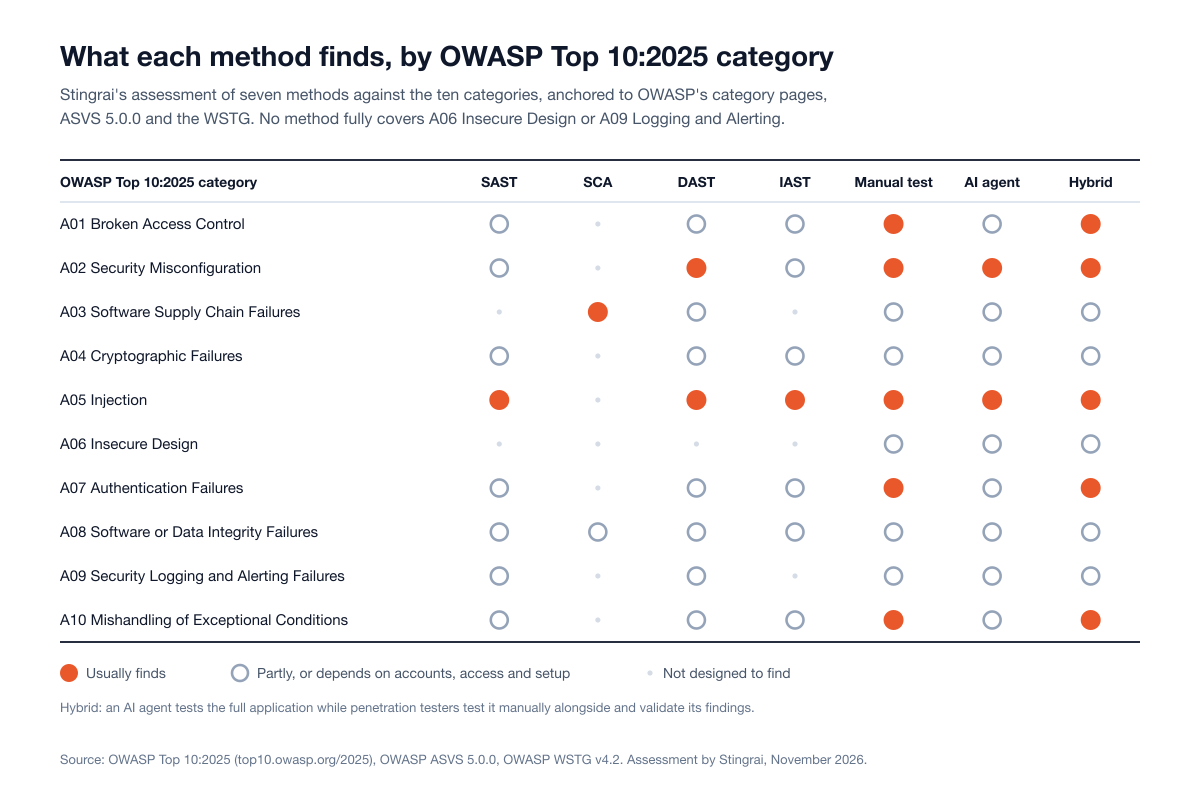
Figure 1: Which methods usually find each OWASP Top 10:2025 category (filled dot), cover it partly (ring) or are not designed to find it (small dot). Stingrai's assessment, anchored to OWASP's category descriptions and testing guidance. Source: OWASP Top 10:2025.
No method fully covers A06 Insecure Design or A09 Security Logging and Alerting Failures. OWASP says insecure design "is beyond the scope of most forms of testing", and that effective logging and monitoring can only be confirmed "with interviews and requesting a sampling of effective incident responses". Add a design review and an operations interview for those two.
How does an assessment map to OWASP Top 10:2025, ASVS 5.0 and the WSTG?
The three OWASP documents do different jobs, and a statement of work should use each for its own.
OWASP Top 10:2025 sets the floor and the vocabulary. It is the eighth edition and the current one, built on data for more than 2.8 million applications. OWASP calls it "the bare minimum and just a starting point" for a testing standard, and its use-case table marks the Top 10 "Bare minimum" for penetration testing against "Yes" for ASVS. The OWASP Top 10 2025 guide explains each category.
ASVS 5.0 sets the requirements. Version 5.0.0, published on 30 May 2025, holds 345 requirements in 17 chapters: 70 at Level 1, 183 more at Level 2 and 92 more at Level 3. ASVS warns that Level 1 "is not necessarily penetration testable by an external tester without internal access to documentation or code". Our ASVS 5.0 pentest acceptance matrix shows how to write requirement IDs into acceptance criteria.
The WSTG sets the procedure. ASVS defers to it: "how do I test this requirement in this environment" is a question that "should be covered by the Web Security Testing Guide project."
The table is Stingrai's mapping of each Top 10:2025 category to the WSTG v4.2 tests and ASVS 5.0.0 chapters that cover it, and to the evidence an assessor needs beyond testing.
OWASP Top 10:2025 | WSTG v4.2 tests | ASVS 5.0.0 chapters | Evidence beyond testing |
|---|---|---|---|
A01 Broken Access Control | 4.5 Authorization; 4.7.19 Server-Side Request Forgery | V8 Authorization; 1.3.6 (SSRF) | A role and permission matrix |
A02 Security Misconfiguration | 4.2 Configuration and Deployment Management | V13 Configuration; V3.4 Browser Security Mechanism Headers | Read-only configuration exports |
A03 Software Supply Chain Failures | 4.1.8 and 4.1.9 fingerprinting (partial) | V15.1 and V15.2 (component inventory and dependencies) | An SBOM and software composition analysis results |
A04 Cryptographic Failures | 4.9 Weak Cryptography | V11 Cryptography; V12 Secure Communication | Key management design |
A05 Injection | 4.7 Input Validation; 4.11 Client-side | V1 Encoding and Sanitization | Source review of data sinks |
A06 Insecure Design | 4.10 Business Logic | V2 Validation and Business Logic, plus the chapters' documentation sections | A threat model and design documents |
A07 Authentication Failures | 4.3 Identity, 4.4 Authentication, 4.6 Session Management | V6 Authentication; V7 Session Management; V9 Self-contained Tokens; V10 OAuth and OIDC | Identity provider configuration |
A08 Software or Data Integrity Failures | 4.10.3 Test Integrity Checks | V1.5 Safe Deserialization; V3.6 External Resource Integrity; V15.2 | Build pipeline and payment page script inventory |
A09 Security Logging and Alerting Failures | 4.10.7 Test Defenses Against Application Misuse | V16.1 to V16.4 (logging) | Interviews and sampled incident responses |
A10 Mishandling of Exceptional Conditions | 4.8 Error Handling | V16.5 Error Handling | Source review of exception paths |
One naming collision is worth knowing: ASVS strongly encourages "documentation or source code-led (hybrid) penetration testing", meaning a test with full access to documentation and developers. That is a statement about access, not an agent-plus-human engagement, and it applies to any method mix.
One-time or continuous: matching the assessment to release cadence
Compliance sets the minimum. PCI DSS v4.0.1, still "the currently-published version of the standard" in the PCI Security Standards Council's June 2026 request for comments, requires external penetration testing "At least once every 12 months" and "After any significant infrastructure or application upgrade or change" (Requirement 11.4.3), with fixes retested (11.4.4). Requirement 6.4.1, which let entities review public-facing web applications "via manual or automated application vulnerability security assessment tools or methods", was superseded after 31 March 2025 by 6.4.2, which requires an automated technical solution in front of those applications "Configured to either block web-based attacks or generate an alert that is immediately investigated." Requirement 6.4.3, required from the same date, makes every payment page script authorized, integrity-checked and inventoried, which a checkout assessment should verify.
The minimum is not the risk. Three primary sources describe the gap between tests:
Exploitation is now the leading way in. Verizon's 2026 DBIR, covering incidents from 1 November 2024 to 31 October 2025, found exploitation of vulnerabilities was the initial access vector in 31% of non-Error, non-Misuse breaches (n=20,023), up from 20% a year earlier.
Known exploited vulnerabilities are arriving faster. CISA added 302 vulnerabilities to the KEV catalog between 1 January and 18 November 2026, 36% more than the 222 it added in the same window of 2025 and more than the 245 for all of 2025 (Figure 2). In Stingrai's analysis, which matches the CWE field of each 2026 entry to the CWE lists on OWASP's category pages, 70 fall under A05 Injection, 57 under A01 Broken Access Control and 48 under A07 Authentication Failures.
Fixes take weeks. Across more than 13,000 organizations, the DBIR found only 26% of the KEV vulnerabilities detected in their environments had been fully remediated, down from 38%, with a median of 43 days to full remediation.
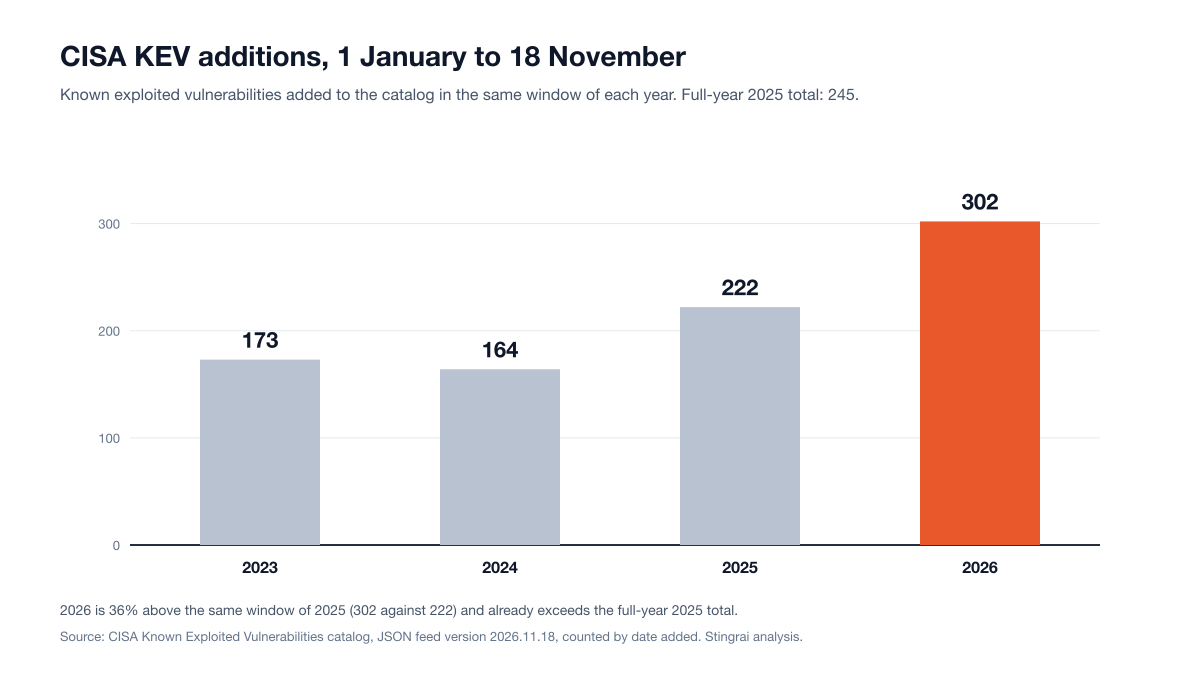
Figure 2: Vulnerabilities added to the CISA Known Exploited Vulnerabilities catalog between 1 January and 18 November of each year, 2023 to 2026. Stingrai count by date added. Source: CISA KEV catalog, JSON feed version 2026.11.18.
Those figures describe vendor products. An organization's own application has no vendor patch to wait for: the time between a release and the next test is the window in which a new flaw sits unexamined. For automated checks, NIST's SSDF says to "Configure the toolchain to perform automated code analysis and testing on a regular or continuous basis for all supported releases" (RV.1.2). For manual and agent-led work, match the rhythm to how the application changes; the table is Stingrai's guidance, not a requirement of PCI DSS, NIST or OWASP.
How the application changes | Assessment rhythm |
|---|---|
A few releases a year, stable roles and data flows | One-time assessment every 12 months and after significant change; SAST and SCA on every merge |
Monthly releases or steady feature work | Continuous testing every month with a quarterly deep dive; a full report for customers and auditors |
Weekly or daily deploys, many roles or tenants | Continuous testing plus pull request checks; retest every fix; deep dives aimed at new flows |
An acquisition, rebuild, new authentication model or new payment flow | A one-time deep assessment before go-live, then back to the regular rhythm |
The continuous hybrid release gates guide shows how to tie each release to the right level of testing.
What should a web application security assessment report contain?
ASVS puts the gap plainly: "Traditional penetration testing reports issues 'by exception,' only listing failures", while an ASVS report "should include scope, a summary of all requirements checked, the requirements where exceptions were noted, and guidance on resolving issues." The WSTG's reporting chapter fills in the rest.
Report element | Why it matters | Red flag |
|---|---|---|
Scope, team and timeline | The WSTG's outline lists the team's "expertise and qualifications", the scope and the timeline | No named testers or dates |
Methods run and their limits | The WSTG lists limitations such as "Lack of access or credentials"; ASVS asks verifiers to disclose their methods | No record of which roles were used |
Coverage by OWASP category and ASVS level, including not tested | OWASP discourages claims of full Top 10 coverage | "Full OWASP Top 10 coverage" |
Findings with impact, evidence and remediation | An engineer must be able to reproduce and fix each issue | Severity labels with no request and response |
Controls that passed | A clean result becomes evidence rather than silence | Failures only |
Severity method and cleaned tool output | The WSTG says to "clean the output and not just dump it" | Raw scanner exports |
Retest results and an attestation letter | PCI DSS 11.4.4 requires testing to be "repeated to verify the corrections" | Retests charged per finding |
Two companion guides go further: how to evaluate a penetration test report and the penetration testing report sample.
What drives the cost of a web application security assessment?
Price follows effort. Put each driver in the request for proposal so bids can be compared:
Roles and tenants: authorization testing multiplies with every identity, because each object and function is checked as each one.
Size: dynamic pages, API endpoints and distinct workflows.
Access: black box, grey box with accounts for every role, or white box with source code, which reaches more of ASVS.
Methods: which automated results are reviewed, whether an agent runs, and how much manual depth goes on sensitive flows such as payments and approvals.
Environment and cadence: whether staging mirrors production, and one assessment or a year of continuous testing.
Evidence: retests, ASVS-level reporting and an attestation letter.
Stingrai publishes fixed prices for one web application and associated APIs, set out below. Anything larger is quoted per engagement; the pentest cost calculator gives a first estimate, and the scope and cost guide explains how quotes differ.
Where Stingrai fits: Hybrid testing, one-time or continuous
Stingrai is a proud CREST member. Stingrai Inc holds two CREST accreditations, Penetration Testing and AI-Enabled Penetration Testing, and the company certification CREST AI Charter, as its CREST Marketplace listing shows.
Stingrai is a global CREST-accredited penetration testing services company founded in Toronto, Canada in 2021, trusted by companies from startups to enterprises to meet audit requirements for SOC 2, ISO 27001, CMMC, PCI DSS and HIPAA. OSCE³, OSWE, OSEP, CREST CRT certified penetration testers, who are also world-class security researchers and bug bounty hunters. Choose from fully human-led or hybrid (AI agents plus human penetration testers) engagements across web, API, mobile, AI and LLM, cloud, network, Active Directory and social engineering penetration tests and red team engagements.
Stingrai's web application penetration testing is authenticated across every user role in scope, covers business logic, broken authorization and IDOR, injection, authentication and session handling, and follows the OWASP WSTG and ASVS 5.0, black, grey or white box; the web application security page covers the wider service line. Hybrid and human-led engagements are staffed by two named penetration testers from a team holding OSCE³, OSWE, OSEP, CREST CRT and CISSP certifications, and the team has published 18 CVEs. Every finding is posted to the PTaaS portal as it is confirmed, retesting is included, and every human-led and hybrid report ships with an attestation letter, evidence for SOC 2, ISO 27001, PCI DSS and HIPAA programs.
The Hybrid Pentest
Snipe, Stingrai's autonomous AI agent for web applications and associated APIs, tests the full application while Stingrai's certified penetration testers test the same application manually alongside it and validate Snipe's findings, so coverage is wider and deeper. It is not a split of test classes: both work across the whole application, authorization and business logic included. Snipe runs black-box dynamic testing, authenticated grey-box testing across roles and, with repository access, white-box code review with AutoFix pull requests. The one-time Hybrid Pentest is US$6,800 per assessment for one web application and associated APIs, with a human-validated pentest report, an attestation letter and 12 monthly vulnerability scans after the pentest. The continuous Hybrid Pentest is US$1,275 per month on a 12-month plan for the same scope: monthly Snipe testing, human-verified, plus a quarterly deep dive by Stingrai's penetration testers, with quarterly executive status reports.
The case for continuous Hybrid rests on the evidence above. Exploitation is now the leading initial access vector in the DBIR, KEV additions in 2026 already exceed all of 2025, and, by Stingrai's count, 168 of the 302 entries, all in vendor products, carry a weakness in the injection, access control or authentication categories that a web assessment tests. An application that ships every month and is tested once a year spends most of the year untested; monthly testing with a quarterly deep dive keeps the gap between a release and its first test to weeks. A one-time Hybrid assessment remains the right buy for an application that changes rarely, or for a point-in-time report before a customer review.
Package | Who tests | Price for one web application and associated APIs | What you receive |
|---|---|---|---|
Autonomous Pentest | Snipe | US$3,000 per assessment, or US$650 per month on a 12-month plan | Pentest report; up to 200 API endpoints or dynamic pages and up to 3 user roles |
Hybrid Pentest, one-time | Snipe and Stingrai's certified penetration testers on the same application | US$6,800 per assessment | Everything in the Autonomous Pentest, plus a human-validated report, attestation letter and 12 monthly vulnerability scans |
Hybrid Pentest, continuous | Monthly Snipe testing, human-verified, plus a quarterly deep dive by Stingrai's penetration testers | US$1,275 per month on a 12-month plan | Everything in the Autonomous Pentest, plus quarterly executive status reports and an attestation letter |
Next step: compare the packages on the pricing page, or send your application's roles, flows and release rhythm through Get a Quote; more than one application is quoted as an Enterprise engagement.
How to plan a web application security assessment
Six steps turn the choices above into a scope that bidders can price the same way.
Name the application, its roles and tenants, and its sensitive flows. List every role, the tenants in a multi-tenant product, and the flows that move money, data or permissions.
Decide what access to give. Two accounts per role, an administrator, and source code and documentation where possible.
Choose the method mix by question. Use Figure 1: automated methods on every change, manual or hybrid testing for access control, logic and chaining, and design and operations reviews for A06 and A09.
Set the cadence. At least every 12 months and after significant change; continuous testing when releases are monthly or faster.
Write the report requirements into the statement of work. Coverage by OWASP category and ASVS level, controls that passed, cleaned evidence, retest results and an attestation letter.
Agree retest and change terms. Which changes reopen the assessment and how fixes are retested and recorded.
Then ask every provider the same questions and compare the answers in writing.
Question to ask | A strong answer | A red flag |
|---|---|---|
Who holds the accreditation? | A firm-level accreditation you can check on the accrediting body's register, such as the CREST Marketplace, plus named testers | Individual certifications offered in place of a firm accreditation |
Which methods will run, and who validates automated or AI findings? | Each method named, with penetration testers confirming findings before they reach the report | "Our platform covers the OWASP Top 10" |
How many identities will you test with, and will you use our source? | Accounts for every role and tenant, listed in the report, and source used where given | One account, black box only |
How will you report coverage? | By OWASP Top 10:2025 category and ASVS level, including what was not tested and why | Findings only |
Is retesting included? | Yes, with results recorded in the final report | Retests charged per finding |
Can you test one-time and continuously? | Both, matched to release cadence | Only one model |
Frequently Asked Questions
What is a web application security assessment?
A web application security assessment is a scoped evaluation of one application that combines methods such as static code analysis, software composition analysis, dynamic and interactive testing, manual penetration testing and, in some engagements, an autonomous AI agent, and reports what an attacker could exploit. Results are mapped to the OWASP Top 10:2025, ASVS 5.0 and the Web Security Testing Guide.
How much does a web application security assessment cost?
Cost depends on the roles and tenants to test, the number of pages and API endpoints, the access given, the methods included, the sensitive business flows, the environment and the cadence. For one web application and associated APIs, Stingrai's Hybrid Pentest is US$6,800 per assessment or US$1,275 per month on a 12-month plan, and the Autonomous Pentest is US$3,000 per assessment. Larger scopes are quoted per engagement.
What is the difference between a web application security assessment and a penetration test?
A penetration test is one method: penetration testers attempt to exploit the running application within an agreed scope and window. A web application security assessment usually includes that testing and adds code and dependency analysis, automated scanning, and the design and operations evidence that testing alone cannot reach.
Is a web application vulnerability assessment the same as a security assessment?
Not usually. A vulnerability assessment is typically led by automated scanning and ranks known weaknesses, while a security assessment adds manual testing of access control, business logic and chained attacks. PCI DSS guidance states that scanning for vulnerabilities alone is not a penetration test.
Can SAST, DAST or IAST replace a manual assessment?
No. They catch known patterns early and belong in every pipeline, but OWASP's ASVS 5.0 says automated tools will be unable entirely to verify many requirements related to business logic and access control. Use them alongside manual or hybrid testing.
Can an autonomous AI agent replace penetration testers?
An agent adds breadth and can test every release, but results depend on the agent, the accounts it uses and how its findings are verified. A hybrid engagement, in which the agent tests the full application while penetration testers test the same application manually alongside it and validate its findings, combines that breadth with human judgement on authorization, business logic and chained attacks.
Does a web application security assessment cover the OWASP Top 10:2025?
It should report against all ten categories, stating for each whether it was tested, not applicable or not tested and why. OWASP describes the Top 10 as the bare minimum for a testing standard and discourages any claim of full coverage, and two categories, A06 Insecure Design and A09 Security Logging and Alerting Failures, also need design review and operations evidence.
How often should a web application be assessed?
At least once every 12 months and after any significant change, the triggers PCI DSS v4.0.1 sets for penetration testing, with fixes retested. Applications that release monthly or faster benefit from continuous testing between full assessments.
What does PCI DSS v4.0.1 require for public-facing web applications?
After 31 March 2025, Requirement 6.4.2 requires an automated technical solution in front of public-facing web applications that blocks web-based attacks or raises an alert that is immediately investigated, and 6.4.3 requires payment page scripts to be authorized, integrity-checked and inventoried. Requirement 11.4 requires application-layer penetration testing at least once every 12 months and after significant change, with corrections retested.
Related reading
Web application penetration testing: what it is, what it tests and how it works
Hybrid web application penetration testing (2026): what it finds and what it costs
API security assessment (2026): scope, deliverables, cost and how to choose a provider
VAPT (2026): Vulnerability Assessment and Penetration Testing, Process, Scope and Cost
DAST vs Penetration Testing (2026): What Each Finds and Where Hybrid Fits
Automated Penetration Testing (2026): How It Works, What It Finds and What It Misses
References
OWASP. OWASP Top 10:2025, including the introduction, the category pages and "Establishing a Modern Application Security Program". top10.owasp.org/2025.
OWASP. Application Security Verification Standard 5.0.0. 30 May 2025. asvs.owasp.org, with the chapters "What is the ASVS?" and "Assessment and Certification" on GitHub.
OWASP. Web Security Testing Guide v4.2, including the introduction, the testing chapters and the reporting chapter. owasp.org.
NIST. SP 800-218, Secure Software Development Framework Version 1.1. February 2022. csrc.nist.gov. The Version 1.2 initial public draft (SP 800-218 Rev. 1) was published on 17 December 2025.
NIST. NISTIR 8397, Guidelines on Minimum Standards for Developer Verification of Software. October 2021. nvlpubs.nist.gov.
Verizon. 2026 Data Breach Investigations Report. Incidents from 1 November 2024 to 31 October 2025. verizon.com. Figures 10, 12, 13, 58 and 59.
CISA. Known Exploited Vulnerabilities Catalog, JSON feed version 2026.11.18. cisa.gov.
PCI Security Standards Council. PCI DSS v4.0.1. June 2024. PCI SSC document library. Requirements 6.2.4, 6.4.1 to 6.4.3 and 11.4.1 to 11.4.4.
Stingrai. State of Penetration Testing 2026. October 2024 to August 2026 data. stingrai.io.
CREST. Stingrai Inc, CREST Marketplace listing. Checked 20 November 2026. marketplace.crest.org.
Stingrai. Pricing. Checked 20 November 2026. stingrai.io/pricing.
Talk to Stingrai
Send your application's roles, sensitive flows and release rhythm through Get a Quote, or book a free discovery call to decide whether a one-time assessment, continuous Hybrid testing or both fit your application.