An authenticated web application penetration test examines the product a real customer, employee or administrator can use after sign-in. The test's value depends on which identities and records the provider can actually exercise. A single administrator account may reveal many screens, but it cannot prove that ordinary users are denied administrative actions or that peers are separated from one another. A quote that says “authenticated testing included” therefore needs a role and fixture plan behind the phrase.
Quick answer. Scope an authenticated web application penetration test by the business roles, protected functions, record relationships and session states that matter. Provide controlled accounts and synthetic objects for an allowed case and a denied case at each priority boundary, then require evidence of the server's decision and the final business result. Stingrai's web application testing service covers authenticated grey-box work across in-scope roles, with direct API testing where the application uses associated APIs.
This guide helps buyers prepare access and compare proposals before the test begins. It is narrower than the general web application scope and cost guide and the API authorization test matrix. The question here is operational: which role identities, object fixtures, policy decisions and evidence must be named in a statement of work so the purchased test is possible, complete enough for its purpose and honest about its limits?
“Authenticated” describes access, not coverage
An authenticated account lets a tester reach protected functionality. It does not define what that tester can prove. With only one account, the provider may explore business flows, session behavior and input handling, but it cannot compare the user's privileges with a peer or a different role. With only a global administrator account, the provider may see broad functionality while missing the lower-privilege boundary where an attacker would normally start. With no test records, it may see the interface but lack a safe way to verify object ownership or state changes.
The OWASP Web Security Testing Guide's role-definition test asks testers to identify roles, try access to other roles and review permission granularity. Its authorization-schema test distinguishes unauthenticated, horizontal and vertical access. In buyer terms, the proposal should identify the accounts that make those comparisons possible. A promise to test “every role” is only credible when the buyer and provider have agreed which roles exist, how they differ and how test accounts will be delivered.
This need not mean every permutation of every role and record. A complex application may have dozens of permission combinations. Choose critical boundaries by business impact: who can view a protected record, approve or reverse a transaction, change a user's access, export data, or cross an organizational boundary. The provider should explain its sampling logic and list what it did not test. A smaller, explicit high-risk scope is more useful than an undefined claim of full authenticated coverage.
Authentication itself remains in scope where purchased. Login, account recovery, MFA, SSO, session issuance and logout may create a separate route into protected functions. But authentication and authorization answer different questions. OWASP's Authorization Cheat Sheet explains that a person can be authenticated yet lack permission for a particular resource. A pentest should state which identity flows it will evaluate and which post-login permission decisions it will compare, rather than treating a successful sign-in as evidence of access-control strength.
Build the role fixture pack before inviting bids
The buyer can make the engagement more accurate by preparing a small, controlled fixture pack. Start with a role list in the product's own terms. Include an ordinary user, a second user with the same privileges, a manager or approver if the workflow has one, and a support or administrative role where those functions are material. Do not invent roles solely to satisfy a template. Some products use permissions or attributes rather than fixed roles; in that case, record the effective capability and the rule that grants it.
For each identity, note its account state, organization or business unit, permitted functions, expected data visibility and any special constraints. State whether it signs in with password, SSO or a test identity provider. Keep credentials out of the procurement worksheet and deliver them through the agreed secure channel after authorization. If MFA is enabled, arrange a safe test method that preserves the real control. A shared production administrator credential is a poor fixture because it obscures accountability and increases the chance of changing live data.
Next, prepare synthetic objects with known relationships. A buyer might create a purchase request owned by User A, a peer request owned by User B, a manager-approved request and an archived request. The values can be invented and reversible. What matters is that the expected result is known before testing. If a user can read their own record but not a peer's, both records are needed. If a manager can approve within a limit, the fixture needs an allowed amount and a denied condition. Without those facts, an unexpected response may be difficult to classify.
Add a short policy note that states the expected answer for each priority operation. For example, “the requester may edit an unsubmitted request but may not approve it,” or “support may view account status but may not change billing details.” These are illustrative policies, not a claim about any Stingrai customer. The test team can challenge them, but it should not guess them. A provider who finds an apparently broad permission should be able to ask the owner whether it is intended before rating it as a vulnerability.
Finally, identify safe state transitions and cleanup. A test that creates an invitation, export or approval may trigger messages, jobs or downstream systems. Supply disposable email addresses, test records, a non-production destination or a stop-before-commit proof. Name who can reset the fixture if the workflow cannot be reversed. The fixture pack turns broad sales language into a practical test plan and makes later findings easier for engineering to reproduce.
Test horizontal, vertical and object decisions separately
Horizontal separation asks whether two identities with similar privilege can reach each other's protected data or actions. A peer record is needed. Vertical separation asks whether a lower role can call a function reserved for a higher role. A second privilege level is needed. Object-level authorization asks whether the caller may use a particular record even when the function itself is allowed. These are related but distinct questions, and the report should not collapse them into a single “access control” checkbox.
OWASP WSTG-ATHZ-02 explicitly describes horizontal and vertical bypass for authenticated roles. OWASP API1:2023 says endpoints that receive an object identifier should check the caller's permission on that object. OWASP API5:2023 addresses functions a lower role or anonymous user should not call. The provider can use these categories as a test taxonomy, while the actual business policy remains the customer's source of truth.
Object properties add another layer. An account owner may be allowed to view a profile but not its internal risk flag, or update a contact address but not an approval status. OWASP API3:2023 treats improper property-level validation as a separate risk category. Provide a fixture with a visibly distinct restricted field and an expected read or write rule. The report should show which fields were returned or changed for which role, rather than saying a whole endpoint was accessible.
Authorization may also depend on state, relationship or delegated authority, not only a role label. A manager may approve a request only when assigned to the requester's unit; a former approver should lose authority after reassignment. Define representative state and relationship cases in the scope. The provider should pair a permitted control with a denied case and verify the final state. A response that appears to reject a request is not enough if a background job later completes it.
The OWASP privilege-escalation test also asks whether a user can alter their role or reach higher-privileged functions. In a buyer scope, list role-management and invitation flows if the product has them. Give the tester a safe role that may be promoted or revoked for the exercise, and define the policy for who may perform that change. Avoid testing this against a real employee or shared administrator account.
Use a small evidence matrix to normalize the quote
The following matrix is an original procurement tool drawn from OWASP's role, authorization and API categories. It is not an OWASP-mandated set of rows. Replace it with the application's actual roles, objects and operations, and ask each bidder to mark which rows it will exercise.
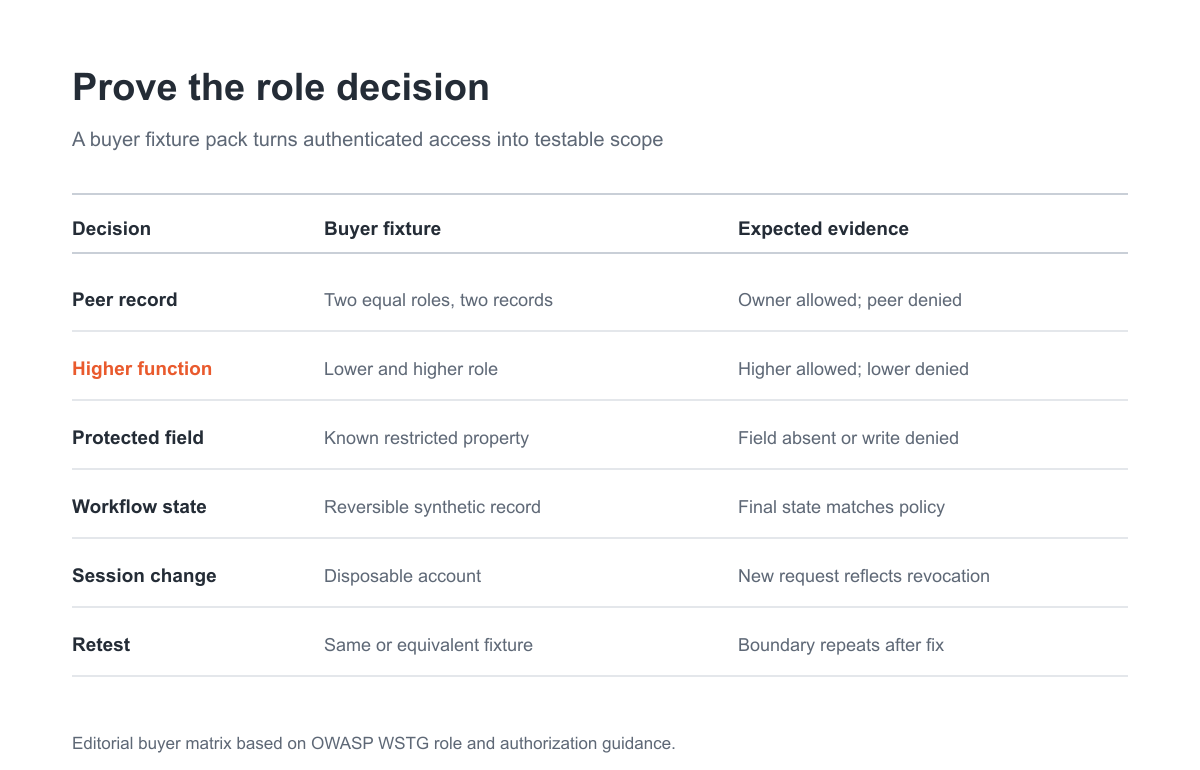
Figure 1: Editorial role-and-fixture plan for an authenticated web test. Sources: OWASP WSTG role definitions; OWASP authorization testing.
Decision | Required fixture | Expected evidence |
|---|---|---|
Peer record access | Two equal-privilege accounts and separate synthetic records | Owner allowed; peer denied; object relationship stated |
Higher-role function | Lower and higher roles, one reversible action | Higher role allowed; lower role denied at server |
Restricted property | Record with known public and protected fields | Permitted field works; protected field is withheld or change denied |
Workflow state | Record before and after an allowed transition | State and relationship rule, observed result, final state |
Session change | Disposable account, known expiry or revocation rule | New request after change, identity and resource outcome |
Retest | Preserved fixture or equivalent safe replacement | Same decision repeated after remediation |
The point is not to demand a giant spreadsheet of all combinations. It is to expose the access assumptions that make the quote meaningful. A provider that requires four role fixtures and two state transitions is estimating different work from one that assumes a single account and a scan. A buyer can choose the narrower work when it fits the risk, but should see the boundary and expected evidence before signing.
The matrix also guards against a false sense of completeness after the test. A role list shows what was identified. A pair of allowed and denied observations demonstrates one specific control. A confirmed finding shows a violation with business impact. A retest shows the same decision after a fix. Each is useful, but none proves that every possible identity, record and state combination is safe. The report should make that limit visible rather than imply certainty from a clean summary page.
Decide what the test can safely change
Authenticated work reaches functions that can create, edit, approve, delete, export or notify. The rules of engagement should name which actions may be executed, which require a synthetic environment, and which should stop at a safe proof. A purchase-order approval test might use a disposable request and a non-paying destination. An export test might use an invented dataset. A role-change test might use a dedicated account that the owner can reset. These examples show how to plan evidence without placing real customer or employee information in the test.
The buyer should identify downstream effects. A visible button may trigger a queue, email, webhook, payment processor or another system. A provider cannot claim the action was denied solely because the browser showed an error if a downstream job was scheduled. Equally, the provider should not cause a live business commitment just to prove that an authorization check is missing. The agreed test can inspect server responses, audit records and synthetic final state. Where a side effect cannot be checked safely, name the limitation.
Production testing can be valuable because it exercises the deployed policy, but the environment must be chosen by the decision being tested. Staging is often safer for destructive or costly actions. If staging has different SSO, role mappings, API gateway rules or feature flags, the report should not generalize its result to production without checking the relevant difference. A useful scope may test authorization logic with synthetic data in staging and confirm selected non-disruptive policy conditions in production. The report should identify the build and environment for each observation.
Set stop conditions for availability and data risk. The provider should have an owner to contact if an account locks, an unexpected data record appears, or a test action reaches a live workflow. Rate limits and automated replay should be bounded. The aim is to prove a policy decision and its effect, not to overwhelm the application. This also makes a later retest predictable because the same authorized fixtures and limits can be reused.
Cover sessions and role changes without overclaiming
An authenticated assessment should state whether it includes session issuance, idle and absolute expiry, logout, concurrent sessions, role change and account disablement. These questions depend on the product's design. OWASP WSTG's logout guidance says to verify server-side termination after logout. A redirect to the sign-in screen does not establish that old session material is rejected by the application or associated API.
For each selected state, define the expected behavior before testing. If an administrator revokes a support user's access, should the current session stop immediately, at token refresh, or at a documented expiry? If a user signs out locally, should a separate SSO session remain available? The answer may differ by architecture and policy. The provider should test the actual intended rule and state where the enforcement occurred. A report that merely says “token accepted after role change” is incomplete without the configured lifetime and expected revocation behavior.
Ask for an independent resource check after the state change, not only the visible browser route. A SPA may hide a menu after a role update while a prior API token still works. Another product may keep a cached view on screen while the server correctly denies a new request. These are materially different outcomes and owners. The fixture pack should include a disposable identity whose role can change and a synthetic object whose access can be checked repeatedly without harming a real user.
The same discipline applies to account recovery and invitation flows. If they are in scope, provide test addresses and clear expected transitions. A provider may need to compare a newly invited user's first session with a revoked invite or expired link. The test should not assume that all authentication mechanisms are equivalent. Name which login path is being exercised and which are excluded so a customer reading the final report knows what was actually verified.
Match test mode to the decision you need answered
Black-box work without credentials can identify public exposure, login behavior and some configuration issues. It cannot establish most cross-role or peer-record decisions. Grey-box access supplies controlled accounts, documentation and expected policies, enabling meaningful authorization testing. White-box access can add source code, policy configuration and logs to locate where a missing decision should have occurred. Stingrai's web application service describes those modes and identifies grey-box testing as the place where high-impact authorization and business-logic findings commonly sit.
The buyer should choose access based on the procurement question. If the goal is to check whether a lower role can reach an administrative function, provide both roles and a reversible administrative target. If the goal is to assess an intricate policy engine, source or configuration access may help the tester trace a decision that is difficult to infer from responses alone. If the buyer cannot provide source, a provider can still test observable behavior but should state that it did not inspect all internal policy paths.
The application may use associated APIs. A browser journey may exercise some of them, but the interface can omit arguments or methods a client can call directly. Stingrai's API testing service describes direct work outside the interface across roles. Ask whether the proposal includes the associated API operations behind priority business functions, with the same role and object fixtures. If a separate mobile or partner API is included, name it as a distinct interface and permission. The presence of an API domain in a browser request does not automatically authorize testing every service behind that domain.
Some products are multi-tenant, but this guide's core fixture method also applies to single-organization applications. For a multi-tenant product, add tenant-specific accounts and records as described in the separate multi-tenant SaaS scope guide. Do not let a generic role matrix obscure the separate tenant boundary. For an internal enterprise tool, business unit, delegation or record ownership may be the more important dimension. Name the real partition in the scope.
Ask what a zero-finding report would still prove
An assessment with no confirmed vulnerability can be useful if it shows what the team tried and what decisions it observed. Ask for a coverage appendix listing role identities, function families, object relationships, sensitive properties, session states, environments and explicit exclusions. Each selected check should carry an expected result and an observed result. For a finding, require a safe proof, affected identity and record, business impact, remediation owner and retest path. For a passed check, require enough context to show the control was exercised, not merely a green checkmark.
Evidence should be redacted and reproducible. The report need not expose live customer records or share credentials with a broad audience. Synthetic fixture identifiers and a concise request or state trace can let engineering reproduce the issue while preserving confidentiality. If logs are necessary to confirm an asynchronous effect, agree on who will retrieve them and how they will be handled. The provider should distinguish missing telemetry from a clean authorization decision.
Ask the bidder to show a sample coverage page before contract. A polished executive summary is useful, but the appendix reveals whether the vendor records the role, object and expected policy behind each conclusion. OWASP ASVS 5.0.0 explicitly positions application security verification requirements for use in procurement contracts. The buyer can reference ASVS and the WSTG as method baselines, then write its own priority business decisions into the scope. A broad “OWASP compliant” claim does not replace those decisions.
Retesting should repeat both sides of a boundary. If a lower role could approve a request, the fix should deny that role while the authorized approver still completes the synthetic workflow. If a peer could read another peer's record, verify denial for the peer and continued access for the owner. This catches fixes that simply disable a feature for everyone. The retest record should identify the new build, same or equivalent fixture, expected decision and observed outcome.
Put the fixture requirements in the RFP
The following questions make a proposal comparable before price or schedule is discussed:
Which application, build, environments, role families and associated APIs are included?
What accounts and permission states must we provide for horizontal, vertical and object checks?
Which synthetic records and reversible transitions do you need, and who prepares them?
How will you choose priority role, object, property and function combinations?
Will the test directly exercise associated APIs or only browser-visible requests?
How will you verify a denied response did not complete a later business action?
Which session, role-change and recovery states are included, and what policy defines the expected result?
Will the report show passed checks, confirmed findings, access gaps and a comparable retest?
Ask the vendor to turn the answers into a short access schedule. The buyer may need time from identity, engineering and business-process owners to create accounts and records. If fixtures arrive after the test starts, the team may spend its assessment window waiting or fall back to anonymous scanning. Establish a readiness checkpoint before the start date: credentials work, roles are correct, synthetic records exist, notifications are safe, and the owner can reset state. This is practical procurement work, not merely test administration.
The scope should also say what happens if access is unavailable. A provider may perform the portions it can reach and produce a limitation record, or the parties may reschedule. The contract should not silently convert a purchased authenticated assessment into a login-page scan. The report must make the resulting coverage gap plain so stakeholders do not rely on a conclusion the evidence cannot support.
Where Stingrai fits
Stingrai is a CREST-accredited penetration testing company founded in Toronto. Its web application penetration testing service covers authentication, sessions, access control and business logic across the roles in scope. Its API service tests associated API decisions directly outside the interface. For a buyer, the best preparation is the role fixture pack: controlled accounts, synthetic records, expected policies, safe workflows and an owner who can answer a permission question during the engagement.
Stingrai offers fully human-led testing and a hybrid web application option. In the hybrid option, Snipe and named penetration testers work together throughout, with the agent mapping and testing the web application and associated APIs while testers investigate role policy, business impact and confirmed findings. The package boundary is one web application and associated APIs; additional applications and infrastructure require a written scope. One-time or annual tests and continuous programs are both available, with cadence chosen around product change and remediation needs.
Frequently Asked Questions
What is an authenticated web application penetration test?
It is a test of the application's protected functions and data using authorized test identities, not only its public pages. The useful scope names roles, objects, business actions and session states, then compares permitted and denied behavior with synthetic records. The report should show the server decision, final state and any gaps caused by unavailable access.
How many accounts should we give the tester?
Give enough controlled accounts to represent the priority decisions. Peer ownership needs two comparable identities, vertical privilege needs a lower and higher role, and a revocation case needs an account that may safely change state. The number follows the product's policy and risk; a single administrator account cannot prove separation among ordinary users or roles.
Is one administrator account sufficient for authenticated testing?
No, if the purchase is meant to verify lower-role or peer-record restrictions. An administrator can expose many functions, but it cannot show whether those functions reject a regular user or whether two peers are separated. Provide representative lower-privilege identities and synthetic records, or require the report to state that those boundaries were untested.
What is a positive control and a negative case?
A positive control shows an authorized identity completing the intended action on a synthetic record. A negative case tries the same relevant boundary under a role, owner, state or session condition that policy should deny. Both results are needed to interpret the control: a failed request could mean the feature is broken rather than that access control worked.
Does authenticated testing include API authorization?
Only if the associated API operations are in the written scope. Browser journeys exercise some calls, but direct API testing can reveal methods, object relationships and properties the interface does not expose. Name the API hosts and operation families, supply the same roles and fixtures, and ask the provider to connect each API result to the business decision it protects.
Can the provider test our production application safely?
Yes, if the rules of engagement identify authorized hosts, controlled identities, synthetic records, permitted actions, stop conditions and owners for side effects. Some state-changing or high-impact cases may be better in representative staging. The report should name which environment and build support each conclusion and should not generalize a staging result to a different production policy.
What should a clean authenticated pentest report contain?
It should list the tested roles, object and function families, session states, environments, expected and observed decisions, and exclusions, even when no vulnerability is confirmed. Confirmed findings should include a safe proof, business impact, remediation guidance and retest. Without a coverage record, a clean executive summary does not reveal which access boundaries were exercised.
When should we retest an authorization fix?
Retest after the fix reaches the relevant environment, using the same or equivalent controlled identities and synthetic objects. Check that the forbidden action is denied and the authorized action still works, including the final business state. Reassess material changes to role policy, privileged functions or associated APIs according to the application's release cadence.