OWASP's Web Security Testing Guide says workflow abuse cases must be developed from an application's own requirements and use cases. That is the central procurement problem in business logic penetration testing: a provider cannot infer your approval rules, entitlement model or economic limits from a list of URLs alone. The assessment has to test the gap between what the system technically permits and what the business intended.
Quick answer. Business logic penetration testing evaluates whether users, services or administrators can reach an unintended business outcome through otherwise plausible actions. For an enterprise buyer, the scope should name the workflows, roles, valid and forbidden state transitions, time windows, value rules and system handoffs, then require evidence of the final outcome. Stingrai's web application penetration testing can cover those rules across the web application and associated APIs in a human-led engagement.
A routine vulnerability scan can flag a missing header or a known component weakness. It cannot decide whether a delegated approver may approve their own request, whether a trial account should retain a paid entitlement after downgrade, or whether a late cancellation should reverse a previously granted credit. Those decisions come from the product's policy. A useful business logic test therefore starts with a short, explicit statement of what must remain true, even when a user changes route, role, client or timing. The rest of this guide shows how to turn that statement into a contractible scope and a reviewable report.
Define the business outcome before choosing test cases
The phrase “business logic flaw” describes a mismatch between intended and observed behavior. MITRE's CWE-840 page explains that the category spans access control, workflow and validation mistakes; it also says CWE-840 itself should not be used as the specific mapping for a real-world vulnerability. A report that labels everything “business logic” without finding the violated rule gives engineering and risk owners too little to fix.
Write the intended outcome as an invariant: a rule that must remain true across the whole process. “A purchase order over the approval threshold requires an independent approver” is more testable than “secure approvals.” “A user may download only the documents for an active organization membership” is more useful than “test access control.” The wording should identify the subject, the resource, the action, the state and the condition that permits it. It can be written in plain language; formal notation is optional.
The buyer should collect these invariants from policy owners, product managers, support operations and engineers. A diagram of the happy path is helpful, but negative decisions matter more: who is forbidden to approve, what happens after an approval expires, what is revoked after cancellation, and which authoritative record decides the final state. A provider can then design controlled misuse cases without guessing a rule that only the business knows.
This approach is narrower and more valuable than claiming to test “all business logic.” An enterprise application can contain hundreds of internal rules. Scope the decisions that move money, grant access, release sensitive data, change contractual obligations or alter an audit trail. Rank them by consequence and by the number of roles or systems they cross. Record the rest as exclusions, so the eventual report does not imply broader assurance than the work performed.
Map state, role and ownership together
Enterprise workflows rarely have a single permission check. A request can be draft, submitted, approved, rejected, expired, fulfilled or reversed; each state may have different actors and actions. The web page might hide an action correctly while an API route still accepts it. A background worker might complete a previously queued task after an account loses permission. This is why the test matrix needs both a state axis and a role axis.
Start with realistic controlled identities: requestor, independent approver, organization administrator, support role, service integration and an unrelated tenant member where applicable. Specify which identities can belong to the same organization and which cannot. Include an owner change or role removal if the product supports it. The test should ask whether permission is evaluated at the point the action takes effect, not merely at the point the screen is displayed.
OWASP API1:2023 treats object-level checks as necessary when an endpoint receives an object identifier. OWASP API5:2023 covers the distinct question of whether a caller may invoke a sensitive function. In a workflow, both matter. An approver may have permission to approve requests generally but not a request in another tenant; a requestor may own a request but have no authority to finalize it. A report should state which rule failed rather than merge these into a vague “authorization issue.”
Include the alternate interfaces that reach the same decision: browser, mobile client, public API, partner API, scheduled job and administrative console. The provider does not need every presentation layer if they share the exact same backend path, but it must establish that assumption. Ask for a route-to-decision map showing where authorization and state validation occur. A test limited to the browser can be sufficient for a very small workflow; it is not a reliable proxy for a multi-service enterprise process without that map.
Approval paths and separation of duties
Approval tests should ask who creates the request, who can edit it before and after submission, who can approve it, and which changes invalidate an earlier approval. They should include delegation, absence cover, escalation and emergency override only where those features exist. The core evidence is not a screenshot of an approval button. It is the final approved or rejected record, the identity that caused it, and the audit event that explains why.
A controlled negative case can show that a requestor's own approval is denied, that a changed value forces renewed review, or that a revoked approver cannot finish an old task. These are outcome statements, not instructions for bypassing a control. Set the proof limit with the buyer before testing. The provider should not create a live contractual obligation or release real funds merely to prove a rule.
Ownership and entitlement paths
Ownership can change without a login event. Organizations merge, a user leaves a team, a case transfers to another manager, a subscription downgrades or a contract expires. Test whether the old actor retains a view, export or mutation right after the change. Include direct object access where safe, because a user interface may hide a resource while an underlying API still serves it.
An entitlement may be derived from several records. The report should identify which system is authoritative and when the derived entitlement is updated. If the application grants a temporary grace period, that period must be a documented policy rather than a tester's assumption. The relevant test evidence is a before-and-after account state and the observed access decision, with personal data redacted.
Test economic invariants beyond the checkout page
Economic rules exist in procurement, billing, credits, loyalty, quotas and service plans, even when no card payment page is involved. A contract may cap the quantity that a department can purchase. A trial may grant a one-time promotional credit. An invoice adjustment may need a second sign-off. A cancellation may reverse an earned benefit. These are business logic decisions whose integrity depends on server-side state and on the order in which related actions occur.
OWASP WSTG-BUSL-01 explains why format validation alone is insufficient: data may be syntactically valid yet violate a business rule, and validation may require another system. Ask the provider to verify that the authoritative service checks values at the final decision point. A client-side warning is useful for usability but is weak evidence of enforcement.
Define the accounting impact before a test. Is the value merely displayed, is it reserved, is it posted to a ledger, or does it trigger fulfillment? For a credit, specify whether it is available, pending, consumed or reversed. For a quota, specify when the unit is counted and when it is restored. Without that vocabulary, a report may call an unexpected display a financial flaw even though no durable value changed, or may miss a durable state change because the screen looked correct.
This guide intentionally focuses on cross-workflow economic rules. The dedicated e-commerce checkout penetration testing scope covers merchant order creation, payment handoff and fulfillment in detail. Here, a procurement or subscription workflow is just one instance of the broader invariant method.
Include timing, retries and asynchronous work
Time can change the meaning of an otherwise valid action. An approval can expire, a price can be fixed for a window, a reserved resource can be released, and an entitlement can be revoked after an event arrives. OWASP WSTG-BUSL-04 explicitly calls for application-specific misuse cases around process timing. The buyer should describe the intended expiry and retry rules so the provider can test them safely.
Add any queue or integration that can finalize the business outcome after the user's request returns. A web response may say “pending” while a worker sends an invitation, creates an invoice or grants access later. The provider should correlate the request, queue event and final state in a controlled environment. It should also state whether duplicate, delayed or out-of-order events are expected and how the application handles them. This is a scoping question, not a claim that every system uses the same event pattern.
Rate limits deserve a separate conversation from one-time use limits. A rate limit controls how often a request can be made; a one-time business rule controls whether a benefit can be granted again at all. OWASP's business logic chapter includes a test for limits on the number of times a function can be used. A provider should be able to explain which limit it is testing and what durable record proves the rule held.
Safe timing tests use synthetic accounts, controlled schedules and rollback plans. Agree on a narrow concurrency ceiling and stop condition for any timing-sensitive case. The objective is to observe whether two legitimate-looking actions can produce an invalid business state; the contract should not authorize disruptive traffic or uncontrolled resource reservation.
Give bidders a decision map and a shared evidence request
Every bidder should receive the same workflow narrative. Provide a state diagram, role list, permission matrix, key policy documents, test identities, fixture data, integration map and a list of known exclusions. Some sensitive policy details may be shared under the normal procurement agreement. A public RFP can describe the classes of decisions, with the exact thresholds supplied after selection.
The diagram below is an editorial scope tool based on the OWASP business logic chapter and OWASP API authorization categories. It shows the difference between an area named in a proposal and evidence of an outcome.
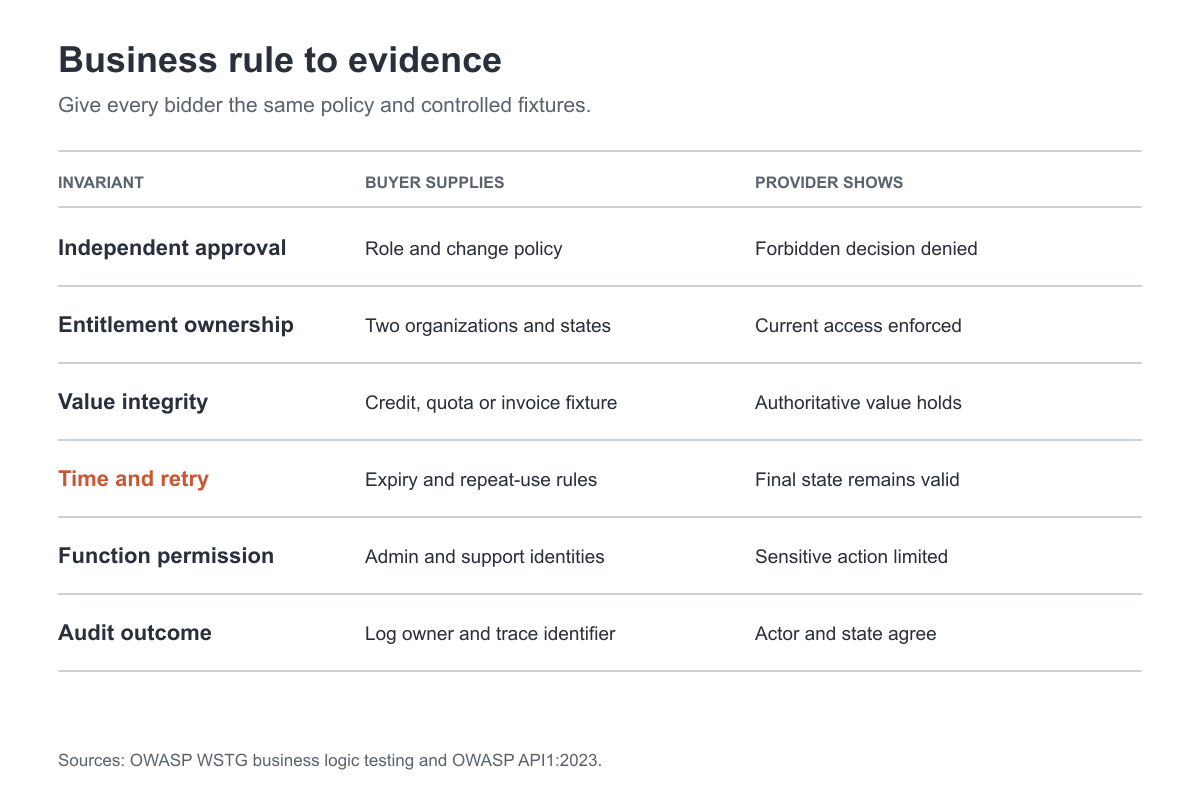
Figure 1: Editorial matrix for connecting a buyer's rules to fixtures and final-state evidence. Sources: OWASP WSTG business logic testing and OWASP API1:2023.
Invariant | Buyer supplies | Provider demonstrates |
|---|---|---|
Independent approval | Requestor, approver and change policy | Forbidden approval is denied and logged |
Entitlement ownership | Two organizations and lifecycle states | Access follows current membership and plan |
Value integrity | Controlled credit, quota or invoice fixture | Authoritative value remains within policy |
Time and retry | Expiry and repeat-use rules | Final state survives delay and duplicate events |
Function permission | Administrative and support roles | Sensitive action stays within assigned authority |
Audit outcome | Log owner and redaction plan | Recorded actor and state match the observed action |
Ask the provider to return this matrix with explicit status: tested and passed, confirmed finding, blocked by environment, or excluded by agreement. “Not observed” is different from “not possible.” If a queue could not be exercised, the report should say what that means for the overall conclusion. A low bid that omits the hardest state transitions can otherwise look identical to a thorough bid in a one-page quote.
Choose an assessment method that matches the system
For a web workflow, grey-box testing with representative accounts often gives the clearest signal. Black-box testing can show what an outsider or ordinary user can reach, but may miss privileged paths or rare states if the provider cannot create them. White-box review can locate policy enforcement and alternate routes, but code inspection alone does not prove that the deployed integration behaves as intended. A combined approach can use design and code information to target controlled dynamic cases.
OWASP ASVS provides a useful basis for testing technical web security controls. Use it to establish general expectations for authentication, authorization and input handling. Add the product's own policy to define approval thresholds, transition rules and economic consequences. ASVS coverage should be reported as control coverage; a passing ASVS item does not by itself prove that a custom compensation or entitlement rule is correct.
Ask how the team creates misuse cases. A credible answer names the policy owner or source of truth, the legitimate path, the forbidden outcome and the observation point. The provider should test both UI and direct service behavior where the architecture warrants it. It should also explain how it validates a suspected finding before reporting it and how it distinguishes a product rule from a tester's guess.
Stingrai's web application and API penetration testing services include authenticated role testing, business logic and broken authorization. For a human-led engagement, two named penetration testers work on the scope, with review by the team lead and an engagement partner. Confirm the exact workflows, integrations and environment in the quote. A complex enterprise approval or entitlement system may need a tailored scope rather than a generic web test label.
Set safe operating limits before testing
Business logic tests can trigger real obligations. A controlled approval may send an external notification; a service-plan change may bill an account; an export may include protected data. The rules of engagement should identify test organizations, synthetic records, notification sinks, financial ceilings and the person authorized to reverse a state. List prohibited actions, including bulk operations and access to other customers' data.
The buyer and provider should agree on the proof threshold for each high-consequence invariant. A test can often stop after the forbidden transition is accepted in a synthetic environment, before any real-world fulfillment or data release. If production is the only environment with a representative integration, define a small controlled window and the exact rollback owner. A staging system is only useful if it exercises the relevant decision services and configuration.
Preserve enough evidence to review the result without retaining confidential data. Use synthetic identities and opaque object references in a report where possible. Redact session tokens, private documents and unrelated account details. Keep raw logs in the buyer's approved evidence location and reference a trace identifier in the provider's narrative if that is sufficient. The final report should describe the rule, the observed outcome and the affected boundary, not provide a reusable attack recipe.
Authorization must be explicit for partner systems. A test of the buyer's application does not imply permission to probe a payment provider, identity provider or another organization's tenant. The provider should identify the boundary at which its evidence stops and the assumptions that remain. This protects operations and makes the conclusion honest.
What the report should let a buyer decide
A useful report begins with the tested build, environment, roles and named workflows. It identifies each invariant in the buyer's language and records which transitions were exercised. For a confirmed issue, the technical section should show the expected rule, the observed final state, the affected service or component, the redacted evidence and a fix owner. A severity rating should follow demonstrated business impact, not merely the fact that an unexpected response occurred.
The executive section should answer different questions: Can an actor grant an entitlement they should not have? Can an approval be bypassed? Can value be created or retained contrary to policy? Can the audit trail attribute the change? If the outcome is uncertain because a downstream system was out of scope, say that plainly. The value of the work is the decision it supports for risk and engineering leaders.
Classify the root cause as specifically as the evidence allows. MITRE warns against mapping a real finding only to CWE-840, a broad grouping. A broken object check, an unenforced workflow transition or a duplicate-use flaw gives a developer a more actionable target. The report can still describe the business logic consequence in ordinary language.
Retesting should replay the same controlled negative case after the fix. A developer may fix the visible route while an alternate API or delayed worker remains vulnerable. The retest note should name the tested build, role, state and final observation. For ongoing programs, revisit the relevant invariants after changes to approval rules, pricing policy, identity architecture or integrations. A one-time annual test and a continuous program are both legitimate choices; the release pattern and assurance need determine which is useful.
Compare proposals without rewarding shallow coverage
Ask each bidder to mark the same state-role matrix. Compare which roles they will use, how many workflow families they will exercise, whether alternate interfaces are included, and whether evidence reaches the final business state. Also compare source access, test environment, rules of engagement, report detail, retesting and the names or qualifications of the testers. A proposal that says “business logic included” without these details may mean only that a tester will look for obvious workflow mistakes while doing a broader web assessment.
Scope, not a generic line item, determines effort. More roles, tenants, approval routes, conditional entitlements, asynchronous integrations and safety controls all create additional test combinations. The buyer can reduce cost by prioritizing the highest-consequence invariants and supplying prepared fixtures. It should not save money by omitting the decision owner or the evidence system; that makes the test harder to interpret.
Stingrai can quote the actual application and workflow boundaries through Get a Quote. The request should include the number of application surfaces, key roles and tenants, the top business decisions, whether source-assisted review is possible, the available environment and any production constraints. The quote can then be compared fairly with other proposals. No provider can guarantee that every latent business rule is covered, but the coverage matrix makes the chosen scope accountable.
Frequently Asked Questions
What is business logic penetration testing?
Business logic penetration testing checks whether an application can produce an outcome that violates its intended rules, even when individual requests look valid. The tester uses the buyer's workflow, role and value policies to design controlled negative cases and verifies the final business state.
How is it different from a standard web application penetration test?
A standard web application penetration test may include business logic, but the depth depends on the agreed scope. A dedicated business logic scope explicitly names the critical workflows, forbidden transitions, decision owners and final-state evidence, so those cases cannot be reduced to incidental coverage.
What should an enterprise buyer supply before the test?
Supply a state diagram, role and tenant matrix, key business rules, synthetic test accounts, safe records, integration map and an owner who can explain ambiguous behavior. Identify the system that records the final outcome and the person who can reverse a controlled test change.
Can a scanner find business logic vulnerabilities?
A scanner can help discover routes and some technical weaknesses, but it cannot know whether a product-specific approval, entitlement or value rule is correct without that rule being supplied. OWASP's workflow testing guidance calls for application-specific requirements and misuse cases.
Should APIs and background workers be included?
Include them when they can make or finalize the same business decision. A browser-only result is incomplete if an API or queued worker can grant the entitlement, approve the request or change the authoritative record by another path.
How do we test production safely?
Use synthetic accounts and controlled records, set a proof threshold and rollback owner, and agree on notification, financial and concurrency limits before work begins. Test third-party systems only with their written authorization. The provider should stop at the agreed evidence point.
What evidence should the final report contain?
The report should name the intended rule, tested role and state, observed final outcome, affected component, redacted supporting trace, remediation owner and retest result. It should distinguish a confirmed violation from an untested or excluded path.
Does a clean business logic test prove every rule is safe?
No. It supports a conclusion about the specific workflows, roles, states and interfaces exercised. The report should list exclusions and environment limits so the buyer can decide what to test next after product or policy changes.
Related reading
References
Talk to Stingrai
Stingrai's named penetration testers can scope your critical workflows, roles and associated APIs for a one-time or continuous human-led assessment. Get a Quote with your decision map, or book a free discovery call to agree on the highest-consequence cases.