Checkout security depends on the order state the server accepts, not only on the page where a card is entered. OWASP's payment functionality test covers the whole e-commerce business flow and notes that payment testing changes with the integration method. For a mid-market or enterprise retailer, that makes the buying question concrete: will the proposed penetration test prove that an authorized customer pays the right amount for the right order and that the order is fulfilled only after a trusted confirmation?
Quick answer. Scope an e-commerce checkout penetration test from cart through pricing, promotions, payment initiation, provider return, asynchronous confirmation, order changes, fulfillment, refund and account access. Give the provider controlled shoppers, orders and payment test credentials, then request evidence for both allowed and forbidden state transitions. Stingrai's web application testing covers authenticated business logic and authorization; the signed scope should name every checkout API and payment boundary it must reach.
This guide concerns a checkout that a merchant owns or operates. It is narrower than choosing a retail pentest vendor and different from the payment API pentest scope for fintech platforms, which follows movement of funds through a financial platform. Here the central objects are a shopper, cart, price, order, payment event and fulfillment decision. A retailer can run a well-configured hosted payment page and still have an order ownership or post-payment state flaw in its own application.
Map who has authority at each checkout boundary
A useful quote starts with an order-state map rather than a list of URLs. Write down what creates a cart, who calculates a total, what service creates the payment request, which provider returns a status, which event changes the order to paid, and what releases fulfillment. Record the system of record for each decision. A browser screen may show a success message while the server has not received a verified payment confirmation. Conversely, an asynchronous event can mark an order paid even after the shopper has closed the browser.
Ask the engineering owner to distinguish data from authority. A price shown to a shopper is presentation; the server's price and tax calculation is an authorization decision about value. A payment-provider response is evidence only after the application validates that it belongs to the right merchant account, order and amount. An order-management system may receive a status from a commerce API, but it should not infer that status from an untrusted return URL. These are test hypotheses, not claims about a particular platform. The pentest should observe where each decision really happens.
Draw the production path, then identify which parts a tester may touch. A headless storefront might use one application for the cart, another service for checkout, a third-party payment provider and an enterprise resource planning system for fulfillment. A monolith might keep most of this inside one application. Neither architecture is automatically safer. The proposal should identify the hosts, APIs, test accounts and order states in scope, along with the payment-provider functions it cannot test without separate permission.
Separate the customer's own systems from the payment provider's systems. Authorization to test a retailer's checkout does not authorize tests against a processor's infrastructure. A good statement of work names the handoff, the return and the merchant's handling of provider messages, and explicitly identifies any provider-hosted surface as an external dependency. That prevents a proposal from promising “end-to-end payment testing” while leaving the merchant-owned decision points untested.
Identify the payment integration before comparing proposals
The OWASP WSTG payment chapter distinguishes redirects, embedded iframes, cross-domain posts and merchant-backend API integrations. Each creates a different browser and server boundary. Tell bidders which one the checkout uses, whether there are multiple payment methods, and whether the implementation changes by geography, brand or device. A quote for a redirect journey cannot be assumed to include an embedded payment form or a merchant-hosted card entry path.
For a redirect, the merchant still owns the cart, order initiation, return handling and fulfillment decision. The provider owns its hosted page. The test should determine whether the merchant accepts a browser return as payment proof or instead confirms the actual transaction through its trusted integration. For an embedded form, the merchant's page can affect the security of a third-party payment frame through scripts and surrounding content. For a backend API integration, the merchant may handle more payment data and more order-state logic. The buyer should give vendors an architecture drawing rather than expect them to infer this accurately during a short sales call.
Be careful with PCI scope statements. PCI SSC's payment-page guidance addresses Requirements 6.4.3 and 11.6.1 and the protection of payment-page scripts and security-impacting headers. A penetration test of order logic can inform the security program, but it is not a substitute for a script inventory, authorization, integrity checks or tamper monitoring. Treat these as connected workstreams with different evidence.
The revised PCI SSC SAQ A FAQ is also narrower than many summaries suggest. Its new embedded-payment-page eligibility criterion applies to merchants whose webpage includes a third-party payment form, such as an iframe. PCI SSC says that particular criterion does not apply to redirect or fully outsourced cases. Merchants should confirm the correct assessment route with the acquirer or payment brand. Your pentest provider can test the merchant-controlled application path and produce technical evidence; the assessment route remains a separate compliance decision.
Put price and promotion rules in the test plan
The shopping cart is a business-rule engine. A buyer should list the fields that determine an order's payable value: product, quantity, catalog price, tax, shipping, discount, gift credit, loyalty balance, currency and any account-specific rate. The list is not a claim that every store has all of these. It is a way to find where the application could accept a value supplied by the browser or a less-trusted integration instead of recalculating it under the merchant's rules.
OWASP's checkout testing guidance explicitly covers quantity tampering, discount-code behavior and changes to a multi-step flow. A buyer does not need a vendor to demonstrate an exploit during procurement. The vendor should explain how it will compare an expected server-side total with the total attached to the actual payment request and the final order. If a promotion has limits, the test needs fixtures that show the valid use and a denied use. If the store supports multiple currencies or tax rules, select representative cases and name them in the scope.
Order of operations matters as much as individual validation. Ask whether the provider will test a cart changed after the payment amount is set, a shipping address changed after the tax or shipping decision, a discount applied or removed before finalization, and a promotion used again after it has been consumed. These are authorized tests with controlled records. The question is whether one transaction can cross a state boundary while the price, order and payment records disagree.
Retail teams often worry that a detailed pentest will create real financial effects. Solve that in the rules of engagement. Use a provider sandbox when it faithfully represents the merchant's handling of events. If a production path must be included, use agreed test items, test payment methods, capped amounts and a documented refund and cleanup owner. A quote should include the safe test approach, not leave it until the operator encounters the live checkout.
Test order ownership as well as payment status
The payment can be valid while the order authorization is wrong. A customer should be able to view, change or cancel only the orders permitted by the product's policy. The test needs two controlled shopper accounts with separate order records, plus any role that can perform customer service or marketplace seller actions. It should compare an allowed action on one's own order with a denied action on another account's order. OWASP API1:2023 explains why an API that accepts an object identifier must check permission for that object on each action.
Name the full order surface, not just the confirmation page. A user may reach orders through account history, direct API calls, invoice downloads, tracking links, refund requests, support views and email links. A mobile app may use the same order API through a different host. If a proposal covers only the storefront UI, it cannot prove that all those routes enforce the same ownership rule. Ask the provider to record which routes it exercised as each role and which paths it excluded.
The permission model can also change after purchase. The customer might be allowed to update an address before shipping but not afterward, or request a return only during a defined window. A support agent might be able to issue a refund after approval, while a shopper cannot. Those are product-specific policies. Give the tester an expected-state table so it can separate a legitimate exception from a broken access rule. OWASP API5:2023 makes the complementary distinction: even if a customer may access an order, that does not imply permission to call administrative functions on it.
Order identifiers should not be treated as the sole defense. Random identifiers can reduce casual guessing, but the server still has to enforce object-level authorization. The evidence to request is a set of allowed and denied cases with the account, order ownership, operation and observed outcome redacted for the final report. An HTTP denial is useful, but the tester should also confirm that the prohibited state change or downstream job did not occur.
Trace confirmation, callbacks and fulfillment
Many checkouts have a synchronous browser return and an asynchronous provider event. The buyer should ask which signal the application uses to mark an order paid and which signal releases inventory, digital delivery or warehouse fulfillment. This is where two systems can disagree without any obvious defect on the visible checkout page. Stripe's Checkout documentation, as a provider example, warns that triggering fulfillment only from a Checkout landing page is unreliable and directs integrators to handle webhook events.
A test plan should name the merchant-controlled callback or webhook handler, its verification of the sender, its binding of an event to the intended order and amount, and its handling of repeated or delayed events. The provider should not attack Stripe or any other processor. It should test how the merchant application interprets permitted test events in a sandbox or agreed environment. A browser success page should be examined as a display, not automatically as the authoritative payment record.
The buyer should ask for a state trace rather than a single screenshot: order created, payment initiated, provider outcome received, order status changed, fulfillment released and cleanup completed. If the same event arrives again, the business owner should specify whether it must be ignored or reconciled without a second fulfillment. If payment fails, the order should not silently progress through a path reserved for paid orders. The pentest report can show these outcomes using synthetic order IDs and a redacted event timeline.
Some retailers connect checkout to fraud review, tax service, inventory reservation or loyalty programs. Include only the integrations that can change price, order ownership, paid status or fulfillment. A broad diagram is useful for scoping; a test that tries every third-party service without permission is not. The practical question for each integration is which merchant-owned decision it influences and how the application treats an unavailable, stale or contradictory response.
Treat the payment page as a browser trust boundary
A payment page can load merchant code, third-party scripts, tags, analytics and embedded payment components. PCI SSC's e-skimming supplement announcement states that Requirements 6.4.3 and 11.6.1 focus on authorization and integrity of payment-page scripts and detection of tampering, including security-impacting HTTP headers. The buyer should identify which pages can affect card entry, which scripts execute there, who approves a change, and which team retains the resulting inventory and monitoring evidence.
An application penetration test can complement that control program by evaluating whether a merchant-controlled page, content-management route or administrative function could change the checkout experience beyond its intended authority. The exact test depends on the architecture and authorization. A hosted redirect and an embedded form are not the same browser exposure. Do not let a quote use the phrase “PCI payment-page testing” without saying whether it means business logic, browser scripts, configuration evidence or all three.
The penetration test should use the actual payment-page variants in scope: desktop and mobile layouts, geographic versions or brands where the script set differs. It should not create an unsupported claim that every third-party script is unsafe. The buyer needs an inventory and a repeatable way to detect an unauthorized change, plus a scoped assessment of the merchant functions that could create one. The report should clearly separate an observed vulnerability from a process gap and a control that was excluded from the pentest.
If the store uses a tag manager or marketing tools, include the teams that can publish content to checkout in the scoping conversation. That may reveal a separate administration and change-control surface. Testing can be limited to configured test accounts and a safe environment while still documenting which production page and configuration the result represents.
Include the APIs and back-office paths that can change an order
Headless commerce can make the visible storefront a thin client. Even traditional storefronts often call APIs for cart, pricing, promotions, address, order history and refunds. The buyer should give the provider an API inventory or application specification, the expected roles, and an integration map. Stingrai's API testing service describes direct testing across roles and tenants, including business logic, older versions and undocumented routes discovered during an engagement. A signed scope still determines which paths are included.
Back-office access may change the same records through a different role. Name the support console, order-management interface, seller portal or ERP connector if it can alter a checkout decision. A shopper-facing test alone does not establish that a support identity is appropriately constrained, or that an internal service can only perform the actions it needs. The exercise should compare the intended policy with a few representative operations, not assume all internal access is inappropriate.
Integration ownership matters. A retailer may own its API but use a SaaS commerce platform and a third-party warehouse. The proposal should define where testing stops, whose written permission is needed and which evidence can be collected without touching the vendor's infrastructure. Where an integration is out of scope, the report should name the resulting limit on its conclusion. This is particularly useful when procurement is comparing a focused storefront quote with a broader application-and-API quote.
Build one scope matrix for every bidder
Give every bidder the same transaction diagram, supported payment methods, test accounts, order fixtures and expected permission rules. Otherwise a low quote may simply omit the asynchronous and administrative paths that the higher quote included. Use the matrix below as a starting point, then delete rows that do not exist in the actual product.
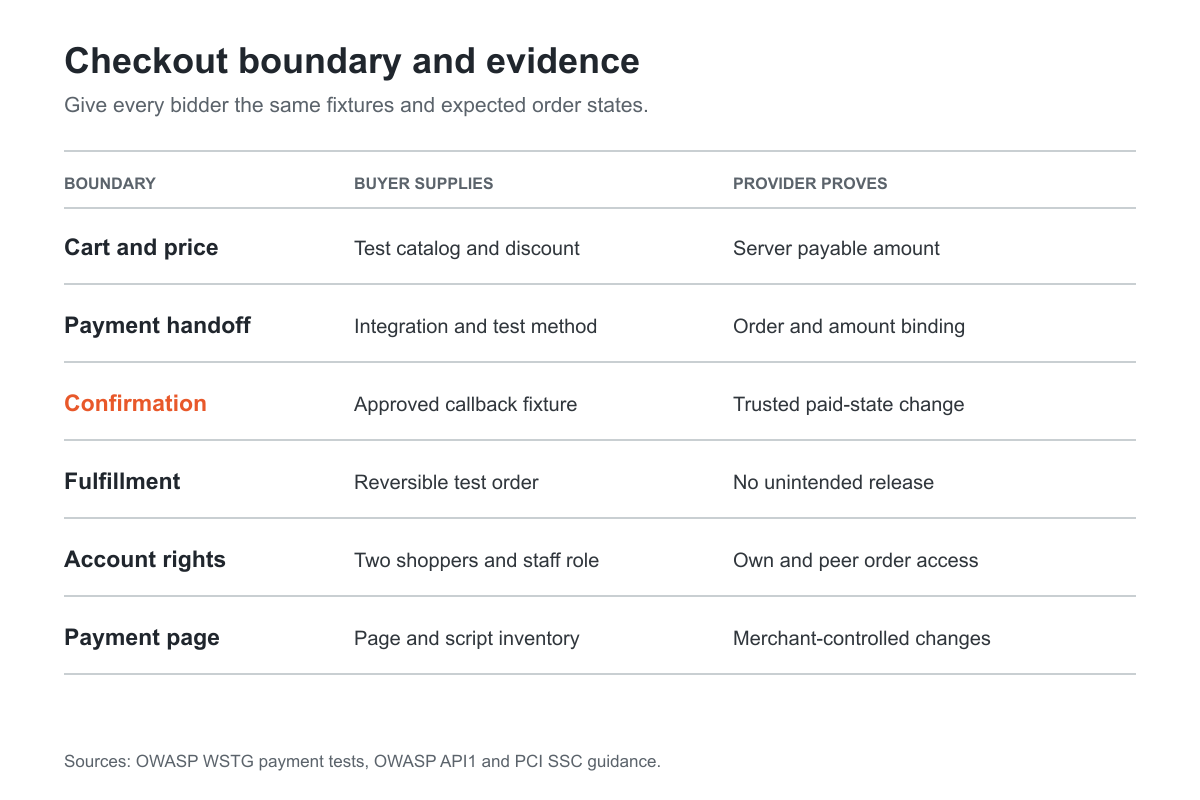
Figure 1: An editorial checkout scope matrix linking buyer-supplied fixtures to reviewable test evidence. Sources: OWASP payment functionality testing, OWASP API1, and PCI SSC payment-page guidance.
Boundary | Buyer supplies | Provider demonstrates |
|---|---|---|
Cart and price | Product, quantity, tax and promotion fixtures | The server's payable amount follows the approved rules through order creation |
Payment handoff | Integration diagram and test payment method | The merchant binds its order, amount and provider transaction consistently |
Confirmation | Sandbox events and expected state changes | A browser return and an asynchronous event have the intended authority |
Fulfillment | Reversible test order and cleanup owner | Failed, repeated or delayed outcomes do not trigger unintended fulfillment |
Account and support | Two shopper roles plus relevant staff role | Order access and sensitive functions match the approved permission table |
Payment page | Page and script inventory, change owner | Merchant-controlled paths affecting payment display are tested as scoped |
The provider should return a coverage record with the same rows. “Tested” means the report identifies the environment, role, operation and observed outcome. “Excluded” means the report explains why a path could not be tested. A blank cell is not a pass, and a scanner result on a URL is not evidence that the order lifecycle was exercised.
Set rules of engagement that protect real transactions
Payment testing can create costs, inventory reservations, customer notifications or fulfillment work. Decide before kickoff whether a sandbox, staging environment or controlled production path can reproduce the relevant authority decisions. A sandbox is useful only if the merchant's event handling and order transitions match the production implementation being evaluated. A production test may be necessary for some boundaries, but it needs a small set of agreed test products, payment methods, windows and contacts.
OWASP's payment testing logistics explicitly mentions test card details, recording orders for cancellation and avoiding orders that cannot be reversed. Put those responsibilities in the rules of engagement. The buyer should provide synthetic shopper identities, a controlled email address, test catalog entries, a refund owner and an emergency contact. If a physical shipment or digital entitlement could be released, define how it is held or reversed.
Use test records only. Do not place another customer's account, real card details or private order data into the test plan or final report. A finding can be demonstrated with fabricated orders and redacted evidence. If a high-impact condition appears, the tester should stop at the agreed proof threshold and notify the control contact. The purpose is a defensible conclusion about the control, not an uncontrolled financial event.
The provider should also say what it will not do: no denial-of-service traffic, no tests against a payment processor without permission and no bulk purchases. These constraints make the result more credible because they show the scope was designed around a live retail operation rather than copied from a generic web application template.
Compare vendors by the evidence they can return
Ask bidders to map their method to the order lifecycle. One may propose a browser-only web test, another may include direct API and webhook assessment, and another may offer an architecture review plus controlled production tests. All can be legitimate scopes, but they do not answer the same question. Compare the names of the people and systems tested, the number of role and state combinations, the environment, the rules of engagement, the report format and the retest.
A strong proposal explains how it will prove a forbidden action was actually denied. A response code alone may be misleading if an order changed anyway, a job was queued or a callback was accepted but not immediately visible. The bidder should describe what artifacts it will collect, such as a redacted request, server-side order state, event log or controlled fulfillment record. Ask who reviews the findings, how false positives are validated and how the final report separates observed facts from risk hypotheses.
Scope changes drive cost more than a generic “e-commerce pentest” label. Additional brands, languages, payment methods, promotions, user roles, backend services, mobile clients or production safety constraints all add work. Give bidders a consistent inventory and ask them to price the same coverage. Stingrai quotes an engagement outside the fixed scope of one web application and associated APIs through Get a Quote; the exact checkout and integration boundaries belong in that request.
An annual or point-in-time test establishes a baseline. Retest a confirmed finding after remediation. Revisit the relevant cases after a major checkout rewrite, new payment method, promotion engine, provider migration or change to order fulfillment. This is an editorial risk-based schedule, not a universal PCI timetable. The buyer can choose a one-time engagement or a continuous program according to the release pattern and evidence need.
What a usable report looks like
The report should begin with the tested build, environment, hosts, payment integration and explicitly excluded provider systems. It should list the controlled roles and transaction fixtures without exposing actual customer data. A coverage matrix should show which order states and permission boundaries were exercised. Each confirmed finding needs an observed path, business impact, affected component, proof within the agreed safety limit and a fix owner.
Request two summaries. The technical one should let engineers reproduce and fix the issue. The executive one should explain whether the tested path could change payable value, expose another customer's order, mark an unpaid order paid or release fulfillment incorrectly. Those are different consequences even if they stem from one weak state check. A retest result should tie the fix to the same controlled scenario, rather than merely note that a patch was deployed.
Keep PCI script-control evidence separate from the penetration-test finding list. An inventory and change-monitoring record can show how payment-page scripts are governed; a pentest can show whether merchant-controlled functions or logic can be abused. A reviewer should see which question each artifact answers. This avoids treating a clean application test as proof that browser scripts are inventoried, or treating a script inventory as proof that order authorization works.
Where Stingrai fits
Stingrai is a proud CREST-accredited penetration testing service provider founded in Toronto in 2021. Its web application service tests authenticated roles, business logic, access control and the APIs behind a web application, with confirmed findings and remediation guidance. Its API service can test checkout and order endpoints directly across the roles and tenants named in the scope. The engagement is staffed by two named penetration testers from a team holding OSCE³, OSWE, OSEP, CREST CRT and CISSP certifications, with review by the team lead and an engagement partner.
For a checkout, give Stingrai the payment-integration diagram, synthetic shopper and order fixtures, expected state transitions and safe test rules. The resulting technical report, remediation record and retest can support a PCI DSS or broader security program by showing what the agreed application and API scope did and did not allow. Stingrai offers one-time or annual tests and continuous programs; the engagement model should match the retailer's release and audit calendar. Book a discovery call to define the boundary before a quote.
Frequently Asked Questions
What should an e-commerce checkout penetration test include?
It should include the merchant-controlled cart, price calculation, promotions, order authorization, payment initiation, provider return or event handling, fulfillment decision, refund path and supporting APIs that exist in the product. OWASP's payment functionality guidance treats the purchase flow as business logic. The signed scope should name each host, role, payment method, environment and excluded provider system.
Is a checkout pentest the same as PCI DSS payment-page script testing?
No. A checkout pentest tests the agreed application and order-flow behavior. PCI DSS Requirements 6.4.3 and 11.6.1 address payment-page script authorization, integrity and tamper detection, including security-impacting headers. The two workstreams can inform each other, but each needs its own scope and evidence.
Does using a hosted payment page remove the need to test merchant checkout logic?
No. A hosted page can handle card entry while the merchant application still controls cart totals, order ownership, the redirect or callback, paid status and fulfillment. Test the merchant-owned decisions and respect the payment provider's testing boundaries.
Which test accounts and transactions should a retailer provide?
Provide at least two controlled shopper accounts with separate orders, plus only the support or seller roles the product actually uses. Include reversible test products, valid and denied promotion cases, a provider sandbox or approved test method, an event fixture and a cleanup owner. Avoid real customer records and irreversible shipments.
Should payment webhooks and callbacks be in scope?
Yes, when the merchant uses them to change order state or fulfillment. The scope should describe how the application verifies an event, binds it to the correct order and amount, handles a delayed or repeated event and records the result. A browser return alone should not be assumed to prove a payment.
How does a buyer compare two checkout pentest quotes?
Give both providers the same transaction diagram, account and order fixtures, integration inventory and expected state table. Compare which roles, APIs, payment methods, browser variants, asynchronous events, report artifacts and retests each includes. Ask each provider to name its exclusions and safe proof limit.
What should the report prove?
The report should identify the tested environment and build, show allowed and denied cases for each relevant role and state, and provide redacted proof for confirmed findings. It should distinguish an observed denial from an untested path and tie a retest to the original scenario after remediation.
When should checkout be tested again?
Retest confirmed findings after a fix and revisit the affected transaction boundaries when a payment method, provider, promotion engine, order workflow or fulfillment integration changes. A one-time or annual test can establish a baseline, while a continuous program can repeat critical cases as releases change them.
Related reading
Magento Penetration Testing: Adobe Commerce Scope and Evidence (2026)
Customer Portal Penetration Testing: Enterprise Scope and Evidence
References
OWASP Web Security Testing Guide: Payment Functionality. Test objectives, integration types, workflow risks and safe testing logistics.
PCI Security Standards Council: Payment Page Security and Preventing E-Skimming. March 2025 supplement announcement for Requirements 6.4.3 and 11.6.1.
PCI Security Standards Council: SAQ A eligibility FAQ. February 2025 clarification for embedded payment forms.
OWASP API1:2023 Broken Object Level Authorization. Object authorization across order records.
OWASP API5:2023 Broken Function Level Authorization. Restricted administrative actions.
Stripe Checkout documentation. Provider example for fulfillment events.
Stingrai web application penetration testing and API penetration testing. Service scope.
Talk to Stingrai
Share the transaction diagram, roles, payment methods and safe test fixtures so the team can price the actual checkout boundary. Get a Quote or book a free discovery call.