A customer portal has to enforce authorization on every request, including actions reached through its API rather than its visible screens. OWASP's authorization guidance makes that principle explicit. For an enterprise buyer, the purchase decision is whether a proposed penetration test will actually challenge the customer, administrator, support, document, and workflow boundaries that make the portal sensitive.
Quick answer. A customer portal penetration test should use controlled accounts in separate organizations and roles to verify access to records, exports, attachments, administrative functions, and the underlying APIs. The buyer should define expected permissions, temporary support access, and revocation behavior before work starts, then require a coverage matrix and redacted evidence for allowed and denied cases. Stingrai's web application service covers authenticated roles, admin and support consoles, authorization across role pairs, tenant boundaries, and business logic; name the portal-specific paths in the statement of work.
This guide addresses a specific buying problem. A general multi-tenant SaaS penetration test protects the boundary between customers in a shared product. A customer portal adds delegated administration, support intervention, document delivery, and workflows that may begin in another system. A portal can enforce separation on the main account page yet expose the same record through a bulk export, support tool, or direct API call. The proposal must identify those paths before a buyer can compare it with another proposal.
Draw the portal boundary before asking for a quote
Start with a small map of the people and systems that can reach portal data. A typical portal may have a customer end user, a customer administrator, an internal support agent, a partner or reseller, and a back-office service. Those are examples for a scoping discussion, not roles every portal has. List only the roles your system actually uses. For each role, write the organization it represents, the actions it may perform, and how it receives and loses access.
Next, list the objects those roles touch. In a document portal, the objects may be statements, reports, uploaded files, messages, and export jobs. In a service portal they may be tickets, quotes, contracts, approvals, and invoices. The significant question is not whether a tester can open a page. It is whether the same user can retrieve, create, change, approve, share, or export an object that belongs to someone else. OWASP API1:2023 distinguishes access to a specific object from the mere ability to call an endpoint.
Give each object an owner and an expected sharing rule. A customer administrator may be allowed to see every record in one organization but not another. A reseller might manage several customer accounts while being barred from financial documents. A support agent might view a ticket only during an approved case. These are product decisions. The tester needs the actual policy, not an assumed best practice, to distinguish an authorized shared workflow from a defect.
The boundary map should also include the systems behind the portal. Record whether the browser uses a REST, GraphQL, gRPC, or other API; whether an export worker or search index has a separate authorization path; and whether a customer record is stored in a shared service. An application inventory can be compact, but “the portal” as a single target is too vague when procurement later asks exactly which paths received testing.
Scope the identity and organization model
An authenticated test needs accounts that make authorization failures observable. Supply at least two controlled customer organizations with distinct records and the roles that matter inside each one. Provide a customer administrator and lower-privilege user where both exist. Add a partner and support identity only when those roles are part of the actual product. The provider should know which accounts are intended to share data, which are peers, and which must be isolated.
Do not rely on an administrator account as the sole test identity. Admin access proves the portal works for a privileged role; it does not prove that an ordinary user cannot reach that role's functions or another customer's records. OWASP's Web Security Testing Guide calls for checking both horizontal and vertical access. In a customer portal, horizontal testing compares peers in separate organizations or accounts. Vertical testing compares users with different privileges.
Give the testing team a short entitlement table: role, organization, object type, allowed actions, forbidden actions, and any special conditions. Include expected access after an invitation is sent, accepted, revoked, or expired. This lets a tester evaluate state changes as well as static role names. A simple “admin versus user” description misses transitions such as an invited administrator who has not yet accepted, a user removed from an organization, or a support grant that has ended.
Some portals let one person belong to multiple customer accounts. That is not automatically a flaw, but it is a reason to test how the active organization is chosen and enforced. The provider should verify that changing the visible organization, switching browser tabs, and calling the API directly all produce the same authorized result. OWASP's authorization guidance asks applications to validate permission on every request, regardless of how the request originated.
Delegated administrators need their own test cases
Delegated administration is often the feature that makes a customer portal valuable. It also makes “admin” an incomplete test label. Identify what a customer administrator can administer: users, groups, API credentials, payment details, report sharing, data retention, or other settings. Then identify the powers that remain with the vendor's internal team. A test should challenge both the boundary between a customer's administrator and ordinary users and the boundary between one customer's administrator and another customer's assets.
Invitation workflows deserve explicit scope. The buyer should say who can invite a user, which email domain or identity provider rules apply, which organization the invitation joins, and whether the invitee receives privileges before acceptance. A tester can then evaluate the authorization decision at the moment of invitation, activation, role change, and removal. The report should state which transition was observed. A result that tests only a settled account says little about an access grant while it is changing.
Ask about privilege grants made through alternative routes. The portal screen may disable a role change for a lower-privilege user, while the underlying API still accepts a modification. OWASP API5:2023 treats access to restricted functions as its own authorization class. The scope should therefore include the request that performs the action, not just the visibility of the button. It should also include what happens to previously issued sessions and API credentials after a role is reduced.
Where a portal has approval chains, test who can create, approve, cancel, and view each step. A user might legitimately submit a request but not approve it. The tester needs a controlled workflow with safe fixtures and a documented expected state after each action. A report that says only “approval endpoint tested” does not tell the buyer whether separation of duties was verified.
Treat support access as a separate trust boundary
Support staff may need to view or act within a customer's portal context. The buyer should disclose the support model to the testing team: direct staff account, time-limited elevation, customer-approved session, impersonation, or access through an internal console. Each model has different evidence needs. A tester should establish which customer authorized the access, what the support identity could see or change, and what ended that access.
If the product supports impersonation, ask the vendor to distinguish the support identity from the represented customer identity in its tests and report. Otherwise an apparently valid customer action may hide the fact that a support agent crossed into a different organization or retained access after an approval expired. A useful assessment can compare access before approval, during the support window, after the window, and after logout, using synthetic data. The precise timing should follow the product's published or internal policy.
Support access can also bypass the main portal UI. An internal console may call the same backend services with a broader token, or an agent may use a privileged export path. The test scope needs those interfaces and the permissions they are intended to enforce. The purpose is to evaluate the organization's chosen support workflow, not to assume every broad support privilege is a vulnerability. A strong report states the expected policy and the observed behavior separately.
Ask for logging evidence only to the extent it is part of the agreed assessment. The buyer may want to know whether the organization can identify who viewed a customer record through support tooling. That is a useful operational question, but it is not the same as authorization. Keep the acceptance criteria separate so a missing log is not confused with an unauthorized read.
Exports, attachments, and search are part of the application
The portal's most sensitive response may arrive outside the detail page. Exports can collect many records, attachments may use a separate download service, and search can reveal names or snippets that the user cannot open. Map these paths to the same object ownership and role table used for normal browsing. A buyer should ask whether the test covers initiating an export, collecting the finished file, following a download link, searching for an object, and viewing its metadata.
An HTTP denial is only one piece of evidence. For an export, the provider should verify whether a job started, whether a file was produced, and whether another role or customer could retrieve it. For an attachment, check the permission at upload, list, preview, download, and deletion. For search, check result counts, snippets, facets, and direct links, not only the final record page. OWASP API3:2023 is a useful reminder that a response can expose sensitive properties even when full object access is blocked.
The buyer can keep this work safe. Supply synthetic documents, agree on naming conventions for test records, limit bulk operations to controlled datasets, and define how export files are removed after testing. If the environment holds live customer data, the statement of work should specify which actions are permitted and who can authorize an exception. This is particularly important for asynchronous jobs because their effects may continue after the visible request has returned.
An export or attachment path may be owned by a different team from the portal itself. That does not make it a separate customer boundary. The final scope should name the worker, storage service, or download host if it is necessary to verify an in-scope action. If a third-party system cannot be tested under the buyer's authorization, the report should identify that boundary as an exclusion rather than silently treating it as covered.
Test the shared API directly
The portal UI is only one client of its backend. An API may also serve a mobile app, a partner integration, a support console, or a new interface under development. A buyer should ask the testing provider to inventory the routes that support the selected portal workflows and exercise them as each authorized role. Stingrai's API testing service states that it tests APIs directly across roles and tenants, outside the user interface.
Object, property, and function checks should be tracked separately. OWASP API1:2023 concerns access to a specific object. OWASP API3:2023 concerns fields a caller should not read or change. OWASP API5:2023 concerns functions reserved for another role. A customer portal proposal that says only “OWASP API Top 10 covered” leaves the actual organization and role permutations undefined.
The shared backend may require a larger quote than a single browser journey suggests. Ask whether partner endpoints, support-only routes, older API versions, background jobs, and report-generation services are in the same authorization model and the same testing scope. The provider should list them by service or workflow. If some routes are not included, record the exclusion before kickoff and decide whether it is acceptable to the business owner.
Build a scope matrix that both vendors can price
A testable scope matrix turns product knowledge into something procurement can compare. The buyer owns the expected policy. The provider owns the testing method and evidence. Each row should have a legitimate case, a forbidden case, and a way to observe the result without exposing real customer data.
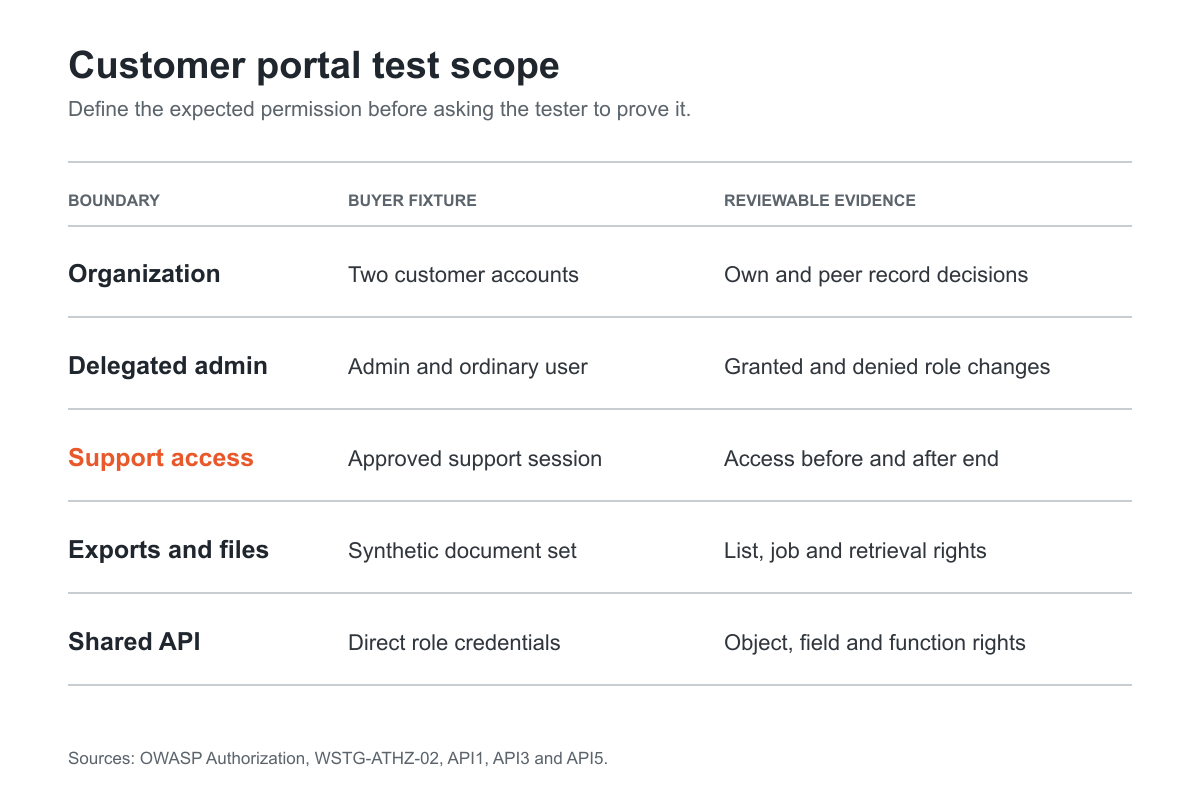
Figure 1: An editorial buyer scope matrix for identities, portal actions and reviewable evidence. Sources: OWASP authorization guidance, WSTG authorization testing, and the OWASP API Security Top 10.
Boundary | Buyer supplies | Provider proves |
|---|---|---|
Customer organization | Controlled accounts and owned records in separate organizations | Allowed access to own records and denied access to another organization's records |
Delegated administration | Admin and ordinary accounts, invitation and removal states | Role changes and administrative actions follow the approved policy |
Support access | Support identity, approval workflow, end condition | Support privileges apply only to the intended customer and approved window |
Documents and exports | Synthetic files, search terms, export fixtures | The same rights govern list, search, job creation, retrieval, and sharing |
Shared API | API inventory and role credentials | Direct API calls enforce object, property, and function rights |
This is a scoping aid, not a promise that every portal needs every row. Remove a row only after confirming the feature does not exist or is explicitly excluded. An “out of scope” line is more honest and useful than a blank cell that a later reader may mistake for a pass.
Set safe rules of engagement
Before testing, agree on the environment, accounts, test data, allowed operations, testing windows, emergency contact, and cleanup responsibilities. A production test may be appropriate for a customer-facing portal, but the buyer should decide which actions can have real consequences. A staging environment may be safer for destructive workflow checks, but only if it represents the same identity, routing, and authorization decisions. The report should say which environment produced each finding.
Prepare a controlled data fixture list. For each customer organization, include objects that are similar enough to compare but distinguishable in redacted evidence. Give the testers an authoritative owner for questions about intended sharing. When an observed result is ambiguous, the tester should ask that owner before classifying it. This protects the report from treating a deliberate partner relationship as an authorization failure.
The statement of work should also set the boundary for support tools and third-party services. A portal can delegate authentication to an identity provider and use an external file service. The assessment can test how the portal relies on those services under the authorization granted by the buyer. It should not assume permission to test an outside provider's infrastructure. Put the allowed interface and exclusion in writing.
Specify evidence before the assessment starts
A finding count is a weak acceptance measure. Ask for a report that names the tested portal build or environment, dates, roles, organizations, workflows, and exclusions. Each finding should identify the expected permission, observed result, affected boundary, business effect, and remediation action. Redacted request and response evidence is appropriate for API paths; workflow evidence may need a sequence of states or screenshots that avoid customer data.
Request a coverage appendix even when there are no findings. The appendix should show which role and organization pairs were exercised, which portal objects were used, and which direct API actions were checked. It should identify a path that could not be tested because an account, fixture, or permission was missing. A clean result with documented negative tests is much more useful than an unqualified “no issues found.”
Retesting should be defined in the initial quote. After a fix, the buyer needs evidence that the original unauthorized action is blocked and that the legitimate case still works. If the defect affected an export, support grant, or invitation workflow, retesting should include that state transition rather than only the final API response. For a portal that changes frequently, decide whether the same fixtures will be reused in a one-time or annual assessment or a continuous testing program.
Compare proposals on scope, not the word “portal”
Send each bidder the same organization model, role list, object inventory, and workflow matrix. Ask them to return an explicit count of applications and APIs in scope, the depth of authenticated testing, the treatment of support and export paths, deliverables, retest terms, and exclusions. A low quote that covers only the unauthenticated login page is not comparable to a quote that challenges delegated administration and shared backend behavior.
Ask how the testing team will establish an allowed baseline before trying a forbidden case. Without a known successful action, a rejected request may mean the fixture was broken. Ask how they will confirm that a rejected operation did not still change a record or create a job. Those questions expose whether the vendor intends to test business behavior or merely collect HTTP status codes.
A practical scope clause reads: “Assess the customer portal and its named supporting APIs using controlled accounts in separate customer organizations. Test authorized and forbidden access across the agreed object, property, role, support, export, attachment, and invitation workflows. Record exclusions, redacted evidence, a role-by-workflow coverage matrix, remediation guidance, and retest results.” Tailor the clause to the product's actual features and legal authorization.
Where Stingrai fits
Stingrai is a CREST-accredited penetration testing firm. Its web application penetration testing service explicitly covers authenticated admin and support roles, underlying APIs, tenant boundaries, and business logic, with request and response evidence for confirmed findings. A customer portal brief should still name the delegated administration, support, export, and shared backend paths that matter to the buyer. Their inclusion is settled in the engagement scope.
Stingrai offers one-time and continuous testing programs. For a customer portal that spans multiple applications or unusual integrations, request a custom quote with the matrix above. The resulting penetration test can produce technical evidence that supports a compliance program and an enterprise customer's security review.
Frequently Asked Questions
What should a customer portal penetration test include?
A customer portal penetration test should cover authorized and forbidden actions across separate customer organizations, ordinary users, delegated administrators, support staff, documents, exports, attachments, search, and the supporting APIs that exist in the product. The buyer should supply controlled identities and expected permissions. The report should show both tested denials and paths excluded from testing.
Is a customer portal test the same as a multi-tenant SaaS test?
They overlap, but the buying scope differs. A multi-tenant SaaS test concentrates on separation between customer tenants across a product. A customer portal test should also examine delegated administration, support access, document delivery, and workflows that may cross a shared backend or an external system. The statement of work should name those paths rather than rely on the architecture label.
How many test accounts are needed?
The account set depends on the portal's real role and organization model. Provide controlled users in separate customer organizations and include the ordinary, administrator, partner, and support roles that actually exist. Each account needs known ownership and expected access. A single privileged login cannot establish whether peer customers and lower-privilege users are isolated.
Should support impersonation be in scope?
Yes, when the portal offers it and the buyer can authorize the test. The scope should describe who can begin impersonation, whose approval is required, what actions are allowed, how the represented customer is identified, and when access ends. Testing should use synthetic records and report the expected policy separately from observed behavior.
Does a portal penetration test include exports and attachments?
It should when exports and attachments are part of the portal's customer workflow. Ask for checks at job creation, listing, search, preview, download, sharing, and deletion as applicable. A test of the visible record page does not establish that a generated file or direct download path applies the same permission rule.
Does the web application test automatically cover every supporting API?
No scope should be inferred from a product label. The buyer and provider should list the APIs and workflows needed to prove the agreed portal boundary, including support and asynchronous paths. Stingrai's API service tests APIs directly across roles and tenants, but the signed scope determines the particular hosts, versions, roles, and environments included.
What evidence should an enterprise security reviewer request?
Request the tested environment and build, role and organization fixtures, allowed and denied cases, a workflow coverage matrix, redacted proof for confirmed findings, exclusions, remediation guidance, and a retest record. The report should distinguish a tested denial from a path that was never reached. It should avoid sharing live customer data.
How should buyers compare two portal pentest quotes?
Give both providers the same inventory and entitlement model. Compare the identities, organizations, object types, API paths, support workflows, exports, testing environment, deliverables, and retest terms each one includes. Ask what is excluded and how each provider will prove that a forbidden action had no downstream effect.
When should a customer portal be retested?
Retest a confirmed finding after remediation and revisit the relevant boundary when the portal changes its organization model, delegated roles, support workflow, exports, or shared API routing. A one-time or annual test can establish the baseline; a continuous program can repeat the critical cases as releases change the portal.
Related reading
References
OWASP, Web Security Testing Guide: Testing for Bypassing Authorization Schema.
OWASP, API3:2023 Broken Object Property Level Authorization.
Talk to Stingrai
Share the portal's organization and role model through Get a Quote, or book a free discovery call to define the application, support, export, and API boundary before testing.