Third-party data is not automatically safe because it came from a familiar vendor. OWASP API10:2023 describes the risk of an application applying weaker validation to responses from integrated APIs than it applies to user input. A buyer should therefore commission a test of the connection, from the event that starts a workflow through the API call, returned data and downstream action. Testing only the local endpoint or only the vendor contract leaves the trust transition unproved.
Quick answer. Scope a third-party API integration penetration test across inbound webhooks, outbound calls, returned data, local authorization and the data disclosed to the vendor. Use synthetic tenant records and a vendor sandbox or other authorized test endpoint to show what happens when a delivery is forged, repeated, malformed or associated with the wrong tenant. Stingrai's web application penetration testing can cover the application and associated APIs you control, with findings that include reproducible evidence and remediation guidance.
This is a guide for the enterprise application owner, security lead and vendor-risk reviewer who need a statement of work for a specific integration. It is deliberately different from a general API assessment: the unit of scope is the workflow across organizations, not a list of routes. It is also different from a CI/CD security review, which evaluates how code is built and shipped. The questions here are whether a trusted event is genuine, whether an outbound call sends the right data to the right destination, and whether a returned value is allowed to change a record or decision.
Map the trust boundaries before requesting a quote
An integration can start with a vendor posting a webhook, your application calling the vendor, a user asking for a connected service, or a scheduled sync. Each start point crosses a different trust boundary. OWASP's Webhook Security Cheat Sheet treats the receiving endpoint and the sender's callback destination as distinct security problems. Its API10 guidance adds the receiving application's duty to validate third-party responses, constrain redirects and limit resource use. Your scope should name all of these paths when they exist.
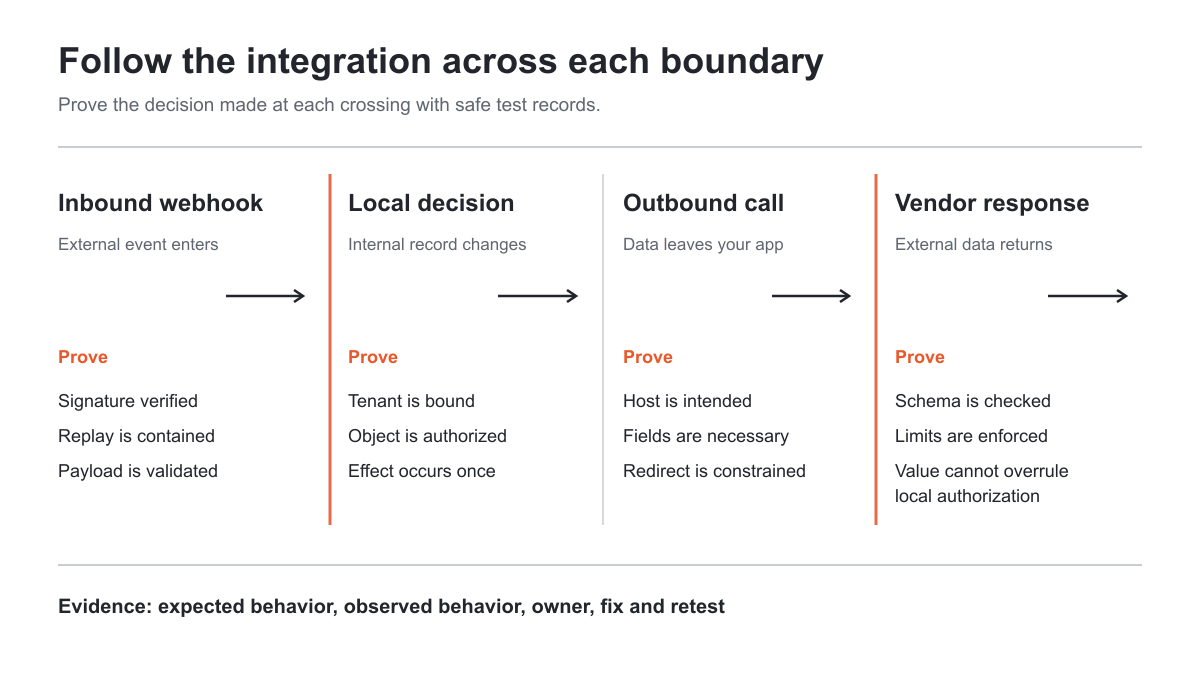
Figure 1: Questions to prove at each crossing in a typical integration. Sources: OWASP, API10:2023, OWASP, API1:2023 and OWASP, Webhook Security.
The buyer's first deliverable is an integration map, even if it begins as a spreadsheet. Name the sending and receiving organization, environment, hostname, credential owner, event types, object identifiers, data fields, downstream systems and failure behavior. Mark which assets your company controls and which belong to the provider. A complete inventory also records who can change callback URLs and which team can stop deliveries during an incident. Without this map, the test may appear broad while missing the one transition that gives an external event business authority.
Integration surface | Buyer supplies | Test objective |
|---|---|---|
Inbound webhook | Publisher protocol, endpoint, signing-key owner, test events | Authenticity, duplicate handling, payload validation and safe failure |
Local processing | Queue, data model, tenant mapping, privileged side effects | An event cannot act outside the intended account or be processed twice |
Outbound vendor call | Destination list, API credentials, allowed fields, redirect policy | The request reaches only intended hosts and discloses only approved data |
Vendor response | Expected schema, field ownership, downstream consumers | External values are validated before storage or action |
Operational control | Logs, alert owner, rotation and suspension process | The team can detect, contain and retest an integration issue |
This inventory is a scoping artifact, not a request for live keys. A tester can work with sandbox credentials and inspect how production credentials are stored and rotated without taking possession of them. In a regulated environment, the map also helps a privacy or procurement team identify where customer data crosses to a processor, but the penetration test's report should state only what the technical evidence proves.
Inbound webhooks: prove identity and safe processing
An inbound webhook is an externally reachable event handler. OWASP's webhook guidance recommends verifying the publisher's signature against the raw request body, using the publisher's documented scheme, and treating transport security as a separate requirement. The scope should include positive and negative cases with the vendor's sandbox events: genuine delivery, missing or invalid signature, changed body, stale event and a repeated delivery. The test report should show whether an invalid delivery is rejected before it can create a record, unlock an account or trigger another side effect.
Signature validation is necessary but does not by itself prevent repeated processing. OWASP explains that a captured delivery can still carry a valid signature and recommends authenticated freshness checks where the protocol supports them, plus idempotent handling of duplicate events (OWASP, Webhook Security). Ask whether the application records event IDs or another provider-supported deduplication key, and whether a retry can issue a second refund, shipment, alert or account change. The precise key and retention policy depend on the vendor protocol, so the statement of work should require the tester to read the actual provider documentation rather than assume a generic webhook format.
Payload content remains untrusted even after authentication. An authentic publisher can forward data originally entered by a user or held in a compromised upstream system. The tester should check schema validation, field length and type rules, safe storage, and whether data from the event is ever passed into a privileged internal action without a fresh authorization decision. OWASP's webhook guide calls for strict input validation after signature checks, while API10:2023 makes the same point for integrated API data. That is the difference between proving who sent a message and proving the message is safe to use.
Outbound calls: constrain destination, request and response
The outbound side begins with the data your organization chooses to send. Ask for a field-level comparison between the documented business purpose and a representative request captured in a safe environment. The test should identify identifiers, personal data, secrets, access tokens and metadata that are unnecessary for the vendor action. It should also confirm that failures and debug logs do not preserve full payloads or credentials. This is a practical data-minimization question, not an assertion that a penetration test alone resolves contractual or privacy obligations.
The destination matters as much as the payload. OWASP API10:2023 calls out unencrypted interactions and blindly followed redirects as unsafe consumption patterns. For a fixed vendor API, the tester should verify the configured host, transport settings and redirect behavior. For a product that lets a customer register a callback URL, the service becomes a webhook publisher. OWASP's webhook guidance advises limiting destinations to HTTPS and validating that the actual connection goes to a public address, so a customer-selected URL cannot become a route into internal services. The engagement should use approved test destinations and avoid probing the vendor's infrastructure.
The response needs its own test plan. OWASP warns that integrated APIs may return data that is invalid, unexpected, oversized or dangerous to pass downstream (OWASP API10:2023). Ask the tester to exercise the parser and business logic with controlled vendor-sandbox or mock responses. Evidence should say which field the application trusted, what operation it influenced and what validation would have stopped an unwanted effect. Timeouts and resource limits should be checked as application resilience controls, without generating disruptive traffic.
Tenant and object authorization must survive the round trip
Integration code often translates a vendor event ID into one of your own records. The application must still decide whether the event's authenticated source is authorized for that record. OWASP API1:2023 says every endpoint acting on an object ID needs an object-level authorization check. A test should prove the mapping between vendor account, internal tenant and target object with synthetic records in separate test tenants. It should also check that a response containing a valid-looking identifier cannot make one tenant's workflow modify another tenant's data.
This is distinct from checking whether a vendor token is valid. A correctly signed event and a valid API key establish a caller, but the application still has to bind that caller to the exact tenant and object involved. The finding should identify the missing binding and demonstrate the consequence on a safe test record. Our API authorization testing guide explains why that business context is difficult for generic scanners to infer; the integration scope adds the external account and event-to-record mapping.
The same rule applies in the outbound direction. A user's ability to request a vendor action should be checked against the local object before your server sends a privileged vendor API call. The buyer should ask for test roles that include an ordinary user, an administrator and a second tenant, with synthetic objects owned by each. That is enough to establish expected versus observed authorization without accessing a real customer's data.
Draw the authorization line around the vendor
The signed scope should cover your application, API gateway, webhook handler, queues, configuration, logs and test data, plus a provider sandbox or endpoints the provider has explicitly authorized. A right to use a vendor API for business operations is not a right to penetration test the vendor's shared production platform. If the provider offers a sandbox with rate limits or a vulnerability reporting process, put those terms into the rules of engagement. If no sandbox exists, use a controlled mock response for adverse data and state clearly which vendor behavior was not tested.
Define who will approve changes to callback destinations and signing secrets, who can pause deliveries, and what the tester should do if a path would affect live records. A safe proof uses a synthetic record and stops before a destructive side effect. The report can then separate observed results from a plausible production impact. That makes the finding useful to both engineering and vendor management without overstating what was actually demonstrated.
How this relates to NIST SSDF and vendor diligence
NIST SP 800-218 provides a useful process frame. Its PW.4.4 task covers verification of acquired third-party software components against an organization's requirements throughout their life cycle; PW.8.2 calls for scoped, designed, performed and documented testing. The publication does not declare that every external API connection requires a penetration test. Applied to an integration, the buyer can use its testing discipline to require defined security requirements, a scoped test, tracked findings and a retest after changes.
Vendor questionnaires and attestations can establish what a provider says it controls. They do not prove how your application validates a webhook or binds a vendor account to an internal tenant. The test should therefore include the local integration code and configuration you own, while the supplier review handles provider-side assurance. Procurement should ask for the vendor's supported signature protocol, sandbox, webhook retry behavior, incident contact and change-notification process. Engineering should confirm those promises against the actual integration behavior.
Deliverables that justify the purchase
Ask for a report organized by integration workflow rather than only by vulnerability category. It should include the trust-boundary map, assets and endpoints tested, synthetic tenant fixtures, expected behavior, observed behavior, a redacted proof, severity with business context, owner and recommended fix. For each material path, the report should state whether the problem lives in the receiving handler, local authorization, outbound client, response parser, credential handling or the contract with the provider. That distinction determines who can fix it.
Retesting should repeat the relevant event or API flow after a fix, including the negative case that failed before. If the vendor must change its protocol, document the interim control and the dependency. An executive summary should say what data could cross an unapproved boundary, whether a side effect was actually triggered on test data and which issue requires vendor coordination. A generic pass/fail statement gives a buyer much less useful evidence.
Questions to ask a testing vendor
Will your scope follow one complete business workflow through inbound events, internal processing and outbound API calls?
Which vendor sandbox or mock response will you use for malformed, duplicated or unexpected data?
How will you prove signature verification and duplicate handling without modifying live records?
Will you test object and tenant binding after an authentic event, as well as the initial authentication check?
How will you identify fields sent to the vendor that the business purpose does not require?
What will you do when a suspected issue lies in the vendor's platform, outside our authorization?
Can the sample report show expected behavior, observed behavior, precise remediation and a retest result for one integration path?
A credible answer distinguishes provider protocol testing from your application's own security decisions. It should also specify what the vendor needs from you: test tenants, event samples, API documentation, business rules, safe data fixtures and an incident contact. Without those inputs, even an experienced tester may see only the outer endpoint.
Where Stingrai fits
Stingrai's human-led web application penetration testing covers authenticated application and API behavior, including authorization and business logic. Its published delivery model provides reproducible findings, business impact and remediation guidance, with retesting after fixes. An integration engagement can be scoped around the web application and associated APIs you control, plus approved vendor-sandbox interactions. Where identity and cloud permissions affect the workflow, Stingrai's cloud penetration testing can be scoped alongside it.
Stingrai is a CREST-accredited penetration testing service provider. Its testing produces evidence that can support a compliance or vendor-risk program, while the business owner remains responsible for deciding which data and access the integration needs. Engagement size, vendor sandbox access and the number of workflows should be set in the statement of work through Get a Quote. For a single application's broader API authorization concerns, see the web application service and our guide to scoping a penetration test.
Frequently Asked Questions
What should a third-party API integration penetration test cover?
It should cover each authorized trust boundary in the selected workflow: inbound webhook authenticity and duplicate handling, local tenant and object authorization, outbound destination and data selection, validation of vendor responses, and the team's ability to contain and retest an issue. The report should show expected versus observed behavior on synthetic records.
Is a webhook signature enough to secure an integration?
No. A signature can establish that a delivery came from the expected publisher and was not changed in transit, but it does not prevent repeated processing or make the payload safe to use. Test freshness where the provider's protocol supports it, duplicate handling, schema validation and the authorization of every downstream action.
Can we test the vendor's production API as part of our engagement?
Only within the vendor's explicit authorization and published testing terms. The buyer can authorize testing of its own application, webhook handler, API client and data. Use a vendor sandbox or controlled mock for response manipulation when production provider behavior is outside scope.
How does API1:2023 apply to an integration?
API1:2023 concerns broken object-level authorization. In an integration, the application must bind the authenticated vendor account or initiating user to the exact local tenant and object before acting on an identifier in a webhook, request or response. A valid token or signature alone does not establish that object-level right.
Does NIST SSDF require a pentest of every third-party API connection?
No. NIST SP 800-218 describes secure development practices, including verification of acquired third-party components and scoped, documented software testing. A buyer can use that discipline to define and track an integration test, but the publication does not impose a universal pentest rule for every API connection.
Related reading
References
OWASP API Security Project. API10:2023 Unsafe Consumption of APIs. Read the 2023 entry. Guidance on external API responses, transport, redirects and validation.
OWASP API Security Project. API1:2023 Broken Object Level Authorization. Read the 2023 entry. Defines object-level checks for API operations.
OWASP Cheat Sheet Series. Webhook Security Cheat Sheet. Read the guidance. Covers publisher and subscriber controls, duplicate events and safe callback destinations.
National Institute of Standards and Technology. SP 800-218, Secure Software Development Framework Version 1.1. Published 2022. Read the publication. PW.4.4 and PW.8.2 inform supplier requirements and scoped testing.
Talk to Stingrai
Share the integration map and a safe test workflow through Get a Quote, or book a free discovery call to define the API, webhook and vendor-sandbox boundaries.