Application security testing has to cover both repeatable checks and application-specific judgment. OWASP SAMM's Security Testing practice separates an automated baseline from deeper manual testing because automation scales across applications, while experts examine complex technical and business-logic behavior. Enterprise buyers need to purchase a coherent testing program, with explicit evidence for each type of work, rather than accepting a single undifferentiated promise to "test the app."
Quick answer. An application security testing services contract should name the applications, APIs, identities, environments, release triggers, testing methods, evidence artifacts and retest rules. Use static analysis, dynamic testing and dependency analysis for repeatable coverage, then direct qualified penetration testers at the workflows, authorization boundaries and sensitive integrations that require context. Stingrai supplies human-led web and API penetration testing within that program, including one-time engagements and continuous testing options, with findings and retests delivered through its PTaaS platform.
This is a buying guide for a security leader, application owner or procurement team that already knows it needs an external assessment. The decision is how to specify useful testing without paying twice for the same checks or leaving the hardest boundaries outside the statement of work. It differs from a guide to a single web application penetration test, which focuses on one application's test scope and cost. Here the unit of decision is an application portfolio and the evidence needed to manage it.
What "application security testing services" can mean
The phrase may describe a tool subscription, a managed scanning program, a source-code review, a penetration test, an architecture review or a mix. These activities observe different parts of a system. They also require different forms of access and produce different evidence. NIST's developer verification guidance names threat modeling, automated checks, static code scanning, black-box cases, fuzzing and web scanners as complementary techniques. A vendor proposal should state which of those techniques it will actually perform.
Workstream | What the service can observe | Buyer input it needs | Evidence to request | Boundary to clarify |
|---|---|---|---|---|
Static application security testing (SAST) | Source or compiled code without running the application | Repositories, languages, build context, branch and suppression policy | Scanned revisions, supported languages, rule coverage, triage decisions and traceable findings | A code path flagged as risky is not automatically a proven exploitable path |
Dynamic application security testing (DAST) | Exposed behavior of a running application | Environment, test identities, crawl paths, safe-test rules and rate limits | Visited routes, authenticated reachability, scan configuration and confirmed findings | A scanner cannot infer every intended business rule |
Software composition analysis (SCA) | Dependencies and known disclosed vulnerabilities | Dependency manifests, lockfiles, build output and ownership | Component inventory, advisory match, affected release and disposition | A component alert is not a complete application risk assessment |
Manual penetration testing | Application-specific controls, workflows and trust boundaries | Role and tenant accounts, business rules, sensitive flows, allowed environments and contacts | Test cases, proof of observed impact, affected identities, remediation and retest | Scope is limited by the assets, access and time expressly agreed |
Architecture and requirements review | Security design and expected control behavior | Data flows, design decisions, threat model and security requirements | Reviewed trust boundaries, assumptions, unmet requirements and owners | A design review does not prove a live control works |
OWASP's static analysis guidance describes tools as aids to analysts examining code. Its DAST guidance describes black-box tools that interact with the running application without source access and asks testers to examine coverage. OWASP Dependency-Check illustrates the narrower SCA task of identifying dependencies with publicly disclosed vulnerabilities. These are useful services, but the buyer must decide where each output belongs in the release decision.
Do not let one report stand in for all workstreams
A SAST export may establish that source was scanned but say nothing about a deployed role-permission boundary. A DAST dashboard may show a live route was tested but not whether an internal integration or unpublished API version was reachable. A penetration test may prove a cross-tenant authorization issue while leaving routine dependency monitoring to the development team's pipeline. The buyer's job is to assign ownership for each kind of evidence and decide which gaps justify specialist work.
OWASP SAMM makes that division explicit. Its Security Testing practice has a scalable baseline and a deep-understanding stream; its separate Requirements-driven Testing practice checks whether the application implements stated controls. A procurement plan should therefore ask for both control verification and attempts to find unexpected weaknesses. A vendor that only checks a generic vulnerability list may miss a rule unique to the product.
Start with the buying unit: an application and its trust boundaries
An enterprise application inventory is usually organized by project, owner or URL. A testing scope should instead describe what a user can do, what data crosses a boundary and which team controls the enforcement point. The same customer workflow may traverse a browser, a mobile client, an API gateway, service-to-service calls and a vendor identity provider. Naming only the front-end domain can leave the authorization decision elsewhere untested.
For each application, make a short decision record:
Decision field | Buyer question | Useful answer in a statement of work |
|---|---|---|
Business operation | Which action would cause material harm if performed by the wrong identity? | A named workflow such as approving a payment or exporting a customer record |
Identity matrix | Which account types have different entitlements? | Anonymous, ordinary user, privileged user, partner, support and service identities where applicable |
Ownership boundary | Who controls each component and can authorize testing? | Explicit list of owned code, managed cloud configuration and third-party exclusions |
Data boundary | Which data classes may be accessed or changed during a test? | Synthetic records, redacted examples and approved test accounts |
Integration boundary | Which APIs, queues, webhooks or external services carry the operation? | Named endpoints and testable representative flows |
Release trigger | What change makes the previous evidence stale? | New role, integration, data sharing path or material architecture change |
Evidence recipient | Who must use the result? | Engineering, security, procurement, customer assurance or an auditor |
The answer should be usable by the tester and by the person who accepts the report. "All critical applications" is not a scope. "The partner portal and its associated APIs, with partner and internal roles crossing the customer-record boundary" is closer to one. If an API is separately deployed, include it by name even when the browser calls it indirectly.
Define the authorization matrix before test day
Broken authorization is hard to assess if nobody states the expected rule. The application owner should identify what each role may read, create, change and approve, including whether the rule differs between tenants or regions. The test team can then attempt a controlled transition from one permitted context to another and record the actual response. This creates evidence of a specific control, not a vague claim that authorization was "covered."
The matrix should also identify service accounts, background jobs and support workflows. A human user may be blocked by the interface while an API route accepts the same action with a different token. A partner may correctly see a record summary but incorrectly receive an attachment. A support role may have legitimate cross-tenant access that requires separate approval and logging. These are product decisions; the tester needs the intended behavior to assess them.
OWASP's Business Logic Security guidance explains why generic scanners often miss flaws that depend on the application's rules. It recommends testing the intended process, including order, concurrency and business meaning. For a buyer, that translates into a simple requirement: the scope must name the important workflows and ask how the vendor will obtain enough context to test them.
Give testers safe access, not production ambiguity
A credible proposal states the environment, rate limits, approved accounts, data handling and stop conditions. If production testing is necessary, the buyer should arrange monitoring, escalation contacts and a safe method for proving impact. If a staging environment is used, the buyer should document differences that could affect results, such as identity configuration, feature flags, third-party connections or data volume. Neither environment is inherently sufficient; what matters is whether the evidence can support the decision the buyer is making.
Give the vendor a route inventory, API definitions when available, and a walk-through of the highest-value workflows. A black-box view can still be useful, but it answers a different question from an authenticated, role-aware assessment. OWASP's WSTG provides test scenarios for web applications and services; the buyer can use its scenario IDs to define a baseline while adding tests for the product's own rules.
Choose a testing mix that matches the decision
The right mix depends on whether the decision is a release gate, an annual assurance exercise, a supplier review or a remediation retest. Do not buy a fixed bundle solely because it contains the most method names. Buy the work that will change a go-live or risk decision.
Buying situation | Core question | Usually useful work | Acceptance evidence |
|---|---|---|---|
New externally exposed application | Can ordinary and privileged identities reach data or actions outside their entitlement? | Authenticated manual web/API penetration testing, with baseline automated checks | Role-path coverage, confirmed findings, remediation plan and retest |
Frequent releases across a portfolio | Are common defect classes and dependency risks caught before release? | Repeatable SAST, DAST and SCA integrated into development, plus risk-selected manual tests | Scan revisions, coverage gaps, triage decisions and scheduled deep tests |
Sensitive transaction or approval workflow | Can a valid user manipulate the sequence, amount, beneficiary or approval state? | Manual business-logic and authorization testing informed by the workflow owner | Expected rule, attempted deviation, observed result and fix evidence |
Acquisition or newly inherited application | What is known, unknown and unowned? | Architecture and inventory review, code/dependency analysis where available, targeted live assessment | Ownership map, uncovered assets, prioritized risks and next test decision |
Major identity or API change | Did a new trust path invalidate earlier test conclusions? | Targeted regression, role/tenant boundary test and relevant code review | Changed controls, affected endpoints, prior findings and retest outcome |
Customer assurance or audit evidence | Can a reviewer understand scope, method, limitations and remediation? | Report quality and evidence packaging, with testing chosen by application risk | Signed scope, methodology, findings, dates, exceptions and closure status |
This table is a buying framework, not a claim that a particular standard mandates every activity. NIST SSDF Version 1.1 recommends secure development practices and says purchasers can use its vocabulary in acquisition discussions. It does not turn a vendor's testing menu into proof of an application being secure. The buyer must tie each method to a decision and an artifact.
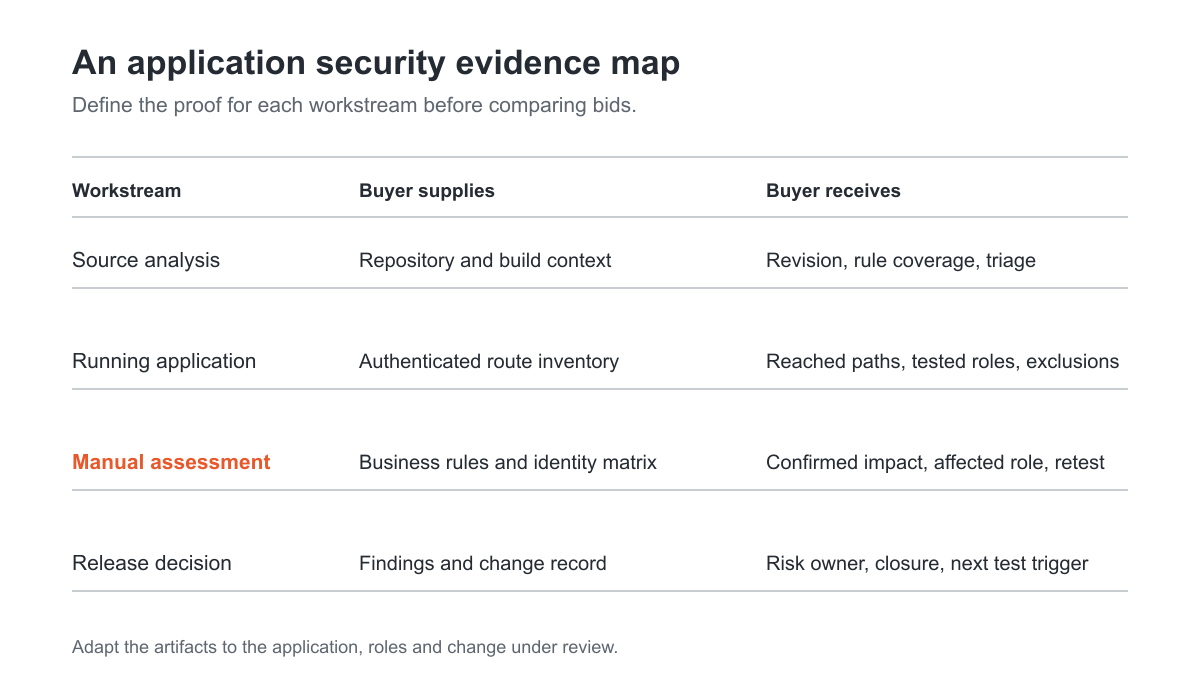
Figure 1: A buyer evidence map for complementary testing workstreams and release decisions. Source: OWASP SAMM, Security Testing and NIST SSDF Version 1.1.
When to buy a manual penetration test
Manual penetration testing earns its place when the question involves application-specific behavior, privilege boundaries or a chain that spans more than one control. OWASP SAMM's deep-understanding stream calls for application-specific test cases that examine both business logic and common vulnerabilities. Ask the provider how it will learn the workflow, which identities it will use and how it will show observed impact without exposing live customer data.
Manual testing is also a way to challenge assumptions created by green dashboards. A dependency scan can be clear while a tenant isolation rule is wrong. A dynamic scan can be clear because it never authenticated to the route that matters. A code scan can flag a theoretical path that the deployed configuration blocks. The purchaser needs confirmed findings and documented coverage, not a count of tool alerts.
When automation is the main purchase
Automation is useful when consistent, repeatable checks must run across many repositories or frequent releases. OWASP SAMM's scalable baseline describes static and dynamic tools and the need to tune them to the application stack. A managed provider should show what it configures, how it handles false positives and what happens when a route or language is unsupported. A license for a scanner is not the same as an operated testing service.
Ask for evidence that the scan reached the intended application state. Authenticated DAST needs working roles and a way to traverse protected workflows. SAST needs the right repository and branch, build context and supported language rules. SCA needs the artifact that actually ships, not only an unrelated manifest. The vendor should identify the gap when it cannot obtain those inputs.
The procurement matrix: questions that expose scope gaps
A useful RFP asks the bidder to attach proof or a sample, not just answer yes. The following matrix makes service comparisons more concrete without assuming all providers use the same toolchain.
Procurement question | What a strong response contains | Weak response to challenge |
|---|---|---|
What exactly is the unit of scope? | Named applications, repositories, APIs, environments, roles and exclusions | "Unlimited testing" without a defined asset or effort boundary |
Which methods are performed by people and which by tools? | Method per surface, named personnel for manual work, tool coverage and review steps | A single "AI-powered" label covering every task |
How will you discover authenticated paths? | Test accounts, role-specific journeys, API collections and coverage evidence | A crawler screenshot or unqualified "all pages" claim |
How will you test business rules? | Workflow briefing, expected-state matrix and representative misuse cases | A list of OWASP categories with no product-specific cases |
How are findings confirmed? | Reproducible evidence, impact, affected identity and bounded proof | Raw scanner exports treated as final findings |
How are duplicates and false positives resolved? | Triage owner, linkage between tool and manual findings, exception record | Separate dashboards with inconsistent severity |
What are the retest and closure terms? | Defined retest window or trigger, who verifies a fix and how status changes | A report delivered once with no closure path |
What can a customer or auditor receive? | Redactable executive summary, scope, methods, dates, limitations and technical evidence | A score alone, without traceable coverage |
What happens after a material change? | Release triggers, incremental scope and a fresh evidence date | Annual test date treated as permanently current |
Where may testing data go? | Retention, access roles, approved storage and deletion process in the contract | Unbounded reuse of customer artifacts |
The buyer should compare proposals by the same scope and deliverables. A low quote may omit authenticated roles, associated APIs or retesting. A high quote may include tool licenses the organization already owns. Neither is inherently good or bad until the methods and evidence are normalized.
Put acceptance criteria in the SOW
A statement of work is useful when a reviewer can decide whether the promised service was delivered. The following language is an example to adapt with legal and technical owners, not a universal contract form:
The provider will test the named applications and associated APIs in the approved environment using the account roles and workflows listed in the scope annex. The final report will identify tested assets and identities, test methods, material exclusions, confirmed findings, business impact, remediation guidance and retest status. The provider will separate automated alerts from findings it has validated. A change to the approved environment, identities or test window requires written scope agreement.
Add an annex with an identity-permission table, a route/API inventory, data handling rules and the contact who can stop testing. Define whether the vendor may inspect source and whether it may use automated tools in production. If a vendor plans to subcontract, specify how the named tester, data access and report ownership terms apply. The goal is not more paperwork; it is a report that maps back to the buying decision.
OWASP ASVS 5.0.0 is especially useful here because OWASP says it can provide a basis for specifying verification requirements in contracts. Use selected, versioned requirements as acceptance references where they fit. Do not attach the entire standard and assume the vendor will test everything. Choose requirements based on the application's exposure and business rules, then state what proof is expected for each.
Separate finding severity from release acceptance
A vendor can grade a finding, but the business owner decides what risk can be carried into release. Ask the provider to record impact and affected context rather than only a severity label. A broken permission on a low-value test record and the same flaw on a payout operation have different consequences. A finding may be fixed in code yet remain live in a deployed environment until retested.
OWASP SAMM's requirements-driven practice treats positive and negative testing as part of verifying expected controls. That supports a useful acceptance question: did the corrected behavior now match the intended rule, for the affected role and workflow? The report should identify the original evidence, the changed version and the retest outcome. If the vendor could not retest, say so explicitly.
How to compare bids without reducing them to price per scan
Quote comparison is difficult because vendors use "application," "test" and "continuous" differently. Require each bidder to fill out the same scope sheet. Then compare the hours or effort allocated to manual work, the routes and roles included, the number of release windows covered, the evidence quality and the retest terms. The exact fee should be evaluated against the work purchased.
For an application portfolio, ask whether pricing is per application, per endpoint, per repository, per tester day, per test window or per program. Clarify whether APIs are counted separately, whether a common identity system is tested once or in each application, and whether report consolidation costs extra. A shared platform may reduce setup work, but it should not erase application-specific authorization testing.
Watch for three quote patterns that deserve follow-up:
Coverage without identities. A proposal names a web application and API but supplies no plan for authenticated accounts and tenant boundaries.
Validation without a definition. The bidder says findings are "verified" but does not say whether that means a scanner rule passed, a human reproduced an issue or a business owner confirmed impact.
Continuous without a change trigger. A recurring scan runs, but nobody revisits a new payment flow, identity provider or external integration.
A strong vendor may propose a smaller pilot to learn the environment before committing to portfolio-wide coverage. That is reasonable if the pilot yields a reusable scope model and does not quietly become the only tested application. Buyers should ask how lessons from the pilot will be carried into later applications.
A report is useful only if it can answer a decision
A procurement team may need a summary for a customer assurance request. Engineering needs a reproduction path and a fix owner. Security leadership needs the accepted residual risk. Those are different views of the same evidence. The provider should deliver them without overstating what was tested.
Request a sample report with sensitive details removed. Check whether its scope page names the actual application and environments. Check whether findings show the affected role, route, expected behavior, observed behavior and impact. Check whether the report distinguishes a vulnerability that was reproduced from an unvalidated tool alert. Then look for a limitations section that names inaccessible routes, unavailable roles and excluded integrations.
The report should be easy to update after remediation. A retest entry needs the changed version or deployment context, the observed result and the remaining risk. A date alone does not show a fix worked. If an assurance letter is required by a customer, ensure it points to the tested scope and dates and does not imply that every system in the company was assessed.
Make evidence travel with the application
A useful portfolio register links each application to its most recent assessment, source revision, deployed release, owner, unresolved findings and planned trigger for retest. This is a buyer recommendation, not a claim that any standard prescribes a particular spreadsheet. The register prevents a report for one deployment from being presented as evidence for a later architecture.
NIST SSDF recommends integrating secure development practices into the software lifecycle. OWASP SAMM likewise describes using results of automated and manual testing to improve development work. The procurement implication is straightforward: require findings in a format that engineering can act on, and require a documented path to closure. A PDF delivered after a release can still be valuable, but it is less useful when nobody owns the follow-up.
Where Stingrai fits in an application security testing program
Stingrai is a CREST-accredited penetration testing firm founded in Toronto. Its web application penetration testing focuses on authenticated behavior, broken authorization and business logic. Its API penetration testing covers REST, GraphQL, gRPC and SOAP APIs across roles and tenants. Human-led and Hybrid engagements use two named penetration testers from a team holding OSCE³, OSWE, OSEP, CREST CRT and CISSP certifications across the team; the report is reviewed by the team lead and an engagement partner.
That makes Stingrai a fit when a buyer needs a human-led assessment of the workflow and trust boundaries that automated checks do not explain. The PTaaS delivery platform posts confirmed findings during the engagement, supports direct contact with testers and retests fixes. Buyers can scope a one-time or annual assessment, or a continuous program. The service can sit beside an organization's own SAST, DAST and SCA pipeline; the contract should make clear which party owns those automated checks.
For web applications and associated APIs, Snipe can be used in an autonomous engagement or alongside named penetration testers in a Hybrid engagement. On Hybrid work, Snipe and the testers test together throughout. Wider enterprise application portfolios, mobile, cloud or network components require a tailored quote and the relevant human-led testing scope. Ask Stingrai to map each application to a test method and evidence deliverable before the engagement begins.
Frequently Asked Questions
What should application security testing services include?
They should include a written scope, named assets and identities, an agreed mix of methods, coverage evidence, confirmed findings, remediation guidance and a retest rule. The mix varies by application risk. OWASP SAMM separates scalable automated checks from deeper manual testing, so a buyer should ask which workstream supplies each result.
Is an application security assessment the same as a penetration test?
No. "Application security assessment" can include architecture, code, dependencies, configuration and live behavior. A penetration test is a scoped attempt to find and prove weaknesses in the application. Specify the outcome you need rather than relying on either label. OWASP SAMM treats architecture assessment, requirements-driven testing and security testing as separate practices.
Can SAST or DAST replace a manual application penetration test?
They provide useful repeatable checks but do not supply the same application-specific judgment. OWASP's DAST guidance says manual assessment can identify flaws that tools miss, while OWASP SAMM pairs automation with manual expert testing for deeper work. Define both the automated baseline and the manual cases that the purchase must cover.
What access should an application testing vendor receive?
Give only approved access needed for the scope: test identities for each relevant role, a representative environment, route or API documentation and a briefing on critical workflows. Record what source access, data and production actions are authorized. The vendor should report unreachable paths and untested roles as limitations, not silently treat them as covered.
How should an enterprise compare application security testing quotes?
Use one scope sheet for every bidder. Compare the named applications, APIs, roles, test methods, manual effort, coverage proof, report format and retest terms. Ask whether the price includes setup, source review, recurring scans, release retests and report consolidation. A lower price with fewer identities or no API coverage is a different service.
What evidence should an application security testing report contain?
It should show the tested release and environment, assets, identities, methods, exclusions, confirmed findings, observed impact, remediation guidance and retest status. Ask for a redacted sample before purchase. The report should let engineering reproduce the issue and let a business owner see what remains at risk.
How often should an application be retested?
Retest after a relevant fix and after material changes to identity, authorization, sensitive workflows or integrations. A periodic schedule can be useful, but it should not be the only trigger. OWASP SAMM's deep-understanding guidance calls for test results to inform future development and explicit security tests when affected controls change.
Does OWASP Top 10 coverage prove that an application was fully tested?
No. OWASP's application security program guidance calls the Top 10 an awareness document and recommends ASVS for verifiable application security requirements. Ask for selected ASVS requirements, WSTG scenarios and product-specific business rules tied to the tested scope.
Where does Stingrai fit if we already run scanners?
Stingrai can assess web applications and associated APIs through human-led or Hybrid penetration testing, focusing on authenticated authorization and business logic. Its findings are delivered with evidence and retesting through its PTaaS platform. Keep routine SAST, DAST and SCA ownership explicit in your program and use the pentest to address the questions those outputs do not resolve.
Related reading
References
OWASP Application Security Verification Standard, stable version 5.0.0.
OWASP SAMM Security Testing and Requirements-driven Testing.
NIST Guidelines on Minimum Standards for Developer Verification of Software.
Talk to Stingrai
Stingrai can map a human-led or Hybrid web and API penetration test to your application inventory, roles and evidence requirements. Get a Quote or book a free discovery call to define the scope.