An annual penetration testing program should be managed as a sequence of preparation, testing and follow-up activities across critical systems. CREST's Guide to Penetration Testing warns that piecemeal testing is unlikely to provide enterprise-wide assurance and recommends a systematic program with appropriate tests and effective follow-up.
Quick answer. Annual penetration testing is a planned program of authorized tests, findings, remediation and verification over the year. An enterprise buyer should inventory critical business services, schedule web, API, cloud and network work around real releases, define a written scope and rules of engagement for each test, and collect a consistent evidence pack. Stingrai can deliver human-led one-time annual engagements or a continuous program, with named testers and retesting, across the surfaces it scopes with the buyer.
This guide addresses the purchasing problem behind the phrase “annual penetration test.” A security team may have an audit date, a procurement cycle and several product owners. They need to decide what to buy, in what sequence, how to avoid blind spots between teams and what evidence proves the work was completed. The answer is not one universal test date. CREST notes that tests are often performed on a typically annual basis but can be more effective immediately before or after a major change. Its guidance is a planning source, not an across-the-board legal requirement for every organization.
Treat the year as a program, not one test ticket
An annual test ticket often begins with a broad line such as “test our environment.” That wording gives a buyer little control over what happens. A web application, its API, the cloud account that hosts it, the identity system and the internal network may have different owners, permissions and test constraints. One vendor may quote the public application. Another may quote only external IP addresses. Both can be called a penetration test, while answering different questions.
A program ties those tests to a business service and to a decision. For each service, record the owner, data or operational value, externally reachable components, recent changes, intended test outcome and person who will accept the report. The test outcome could be approval to release a new payment workflow, evidence for a customer assurance request, a check on privileged access after a cloud migration, or a baseline before a network segmentation project. The purpose guides the scope; the calendar follows from it.
CREST's program guidance calls for coverage of main systems enterprise-wide while focusing on critical systems, business and IT approval, stated objectives and timelines, and regular review. A useful annual plan therefore has three layers:
Portfolio decision: which business services need an independent test in the planning period, and why?
Engagement decision: which exact assets, roles, environments and methods are authorized for this test?
Closure decision: which findings need remediation, who accepts residual risk, and what retest evidence closes a case?
The portfolio plan should not pretend that every asset receives equal depth. A mature organization may have many public applications, inherited systems, cloud accounts and internal segments. Prioritize the systems where a failure would change a business decision, where an earlier test has become stale, or where the ownership boundary is unclear. Record what was deferred and who accepted the deferral. An inventory without decisions becomes a spreadsheet that nobody can use.
The annual document is a register of decisions
Use one row per engagement or material change. Suggested fields are business service; owner; affected application, API, cloud account or network segment; objective; test method; authorized environment; target test window; provider; evidence recipient; report date; finding owner; retest status; and next review trigger. This is a buyer template, not a prescribed standard. It lets security, procurement and engineering compare promised scope with delivered evidence.
The register should also note a dependency when one engagement relies on another. An API test may require tenant and role accounts from the product team. A cloud assessment may need read access to identity and policy configuration before authorized active testing. An internal network test may require the VPN path, a jump host and coordination with operations. Missing access can convert an intended deep test into a shallow one, even if the contract still says “annual pentest.”
Build a cross-domain inventory from business services
Begin with a business operation, then trace the components that enforce its security. Consider a hypothetical customer portal used to approve account changes. The browser may call an API; the API may rely on an identity provider; data may sit in a cloud project; support staff may use an internal administration route. Testing only the login page cannot prove authorization across that operation.
Surface | Buyer-supplied boundary | Security question | Evidence to request |
|---|---|---|---|
Web application | Domain, environment, user roles, key workflows, release version | Can a user reach actions or data beyond the intended role? | Authenticated role coverage, tested workflows, confirmed findings, limitations |
Associated APIs | API versions, methods, role and tenant identities, service consumers | Are object and function permissions enforced outside the browser? | Endpoint/role matrix, representative requests, observed authorization outcomes |
Cloud and identity | Accounts, subscriptions or projects, privileged roles, workloads and exclusions | Can a configuration or identity path expand access beyond the approved boundary? | Named cloud scope, attack paths, policy context, safe proof and remediation |
External network | IP ranges, domains, gateways, hosted devices and third-party boundaries | Which reachable services and trust paths are exposed? | Target list, reachable services, validated weaknesses, change owner |
Internal network | Starting position, VLANs, directory scope, allowed hosts and stop conditions | Can a permitted foothold cross a segment or privilege boundary? | Starting assumptions, path narrative, affected assets, corrective controls |
These categories are not interchangeable line items. Stingrai's web application service describes authenticated testing of roles and business logic. Its API service tests APIs directly across roles and tenants. Its cloud service scopes accounts, subscriptions and projects, including identity and workload boundaries. Its network service covers the external perimeter and internal network, including Active Directory paths and segmentation. An enterprise proposal should say which of these workstreams is actually included.
The inventory should connect, but not blur, ownership. A cloud provider's service, a partner-operated integration and a customer's own code may sit on one diagram but have different authorization to test. The buyer should mark third-party components and seek permission where needed. A provider should not infer that a public URL or a cloud account name authorizes testing every connected service.
Identify the handoff between workstreams
Cross-domain testing is valuable precisely where a finding crosses an ownership boundary. An application issue may stem from an API authorization decision. A cloud identity issue may make a nominally private service reachable. An internal network route may expose a management interface that was not in the external test. Write the handoff into the scope: who records the initial observation, who can safely validate the next step, and which owner gets the combined report.
The handoff does not require one enormous engagement. It requires a common map and escalation path. A web/API specialist may document a cloud trust concern for a separate cloud team. A network team may report an application interface without attempting application-level abuse. A program owner should reconcile those observations instead of leaving them in separate reports with separate severity scales.
An illustrative annual test calendar
A calendar should be driven by release, audit and change dates. The sequence below is an illustrative planning pattern for an enterprise portfolio, not a regulator's required quarterly schedule. Adapt it to your own operational cycle and dependencies.
Planning window | Buyer action | Test activity | Evidence decision |
|---|---|---|---|
Early cycle | Refresh service inventory and risk priorities; confirm owners and procurement terms | Scope critical applications, APIs, cloud estates and network segments | Approved test plan, exclusions, access prerequisites and rules of engagement |
Mid-cycle | Stage accounts and safe data; align with release windows and operations | Conduct prioritized web/API and cloud or network engagements | Confirmed findings, coverage records, material limitations and owner assignments |
Closure window | Track fixes, exceptions and architecture changes | Retest remediated findings; run targeted checks where a material change occurred | Retest outcome, residual-risk decision and updated evidence register |
Next-cycle planning | Review missed scope, repeated findings and supplier performance | Decide which work should recur, deepen or move earlier | Revised inventory, budget assumptions and next procurement brief |
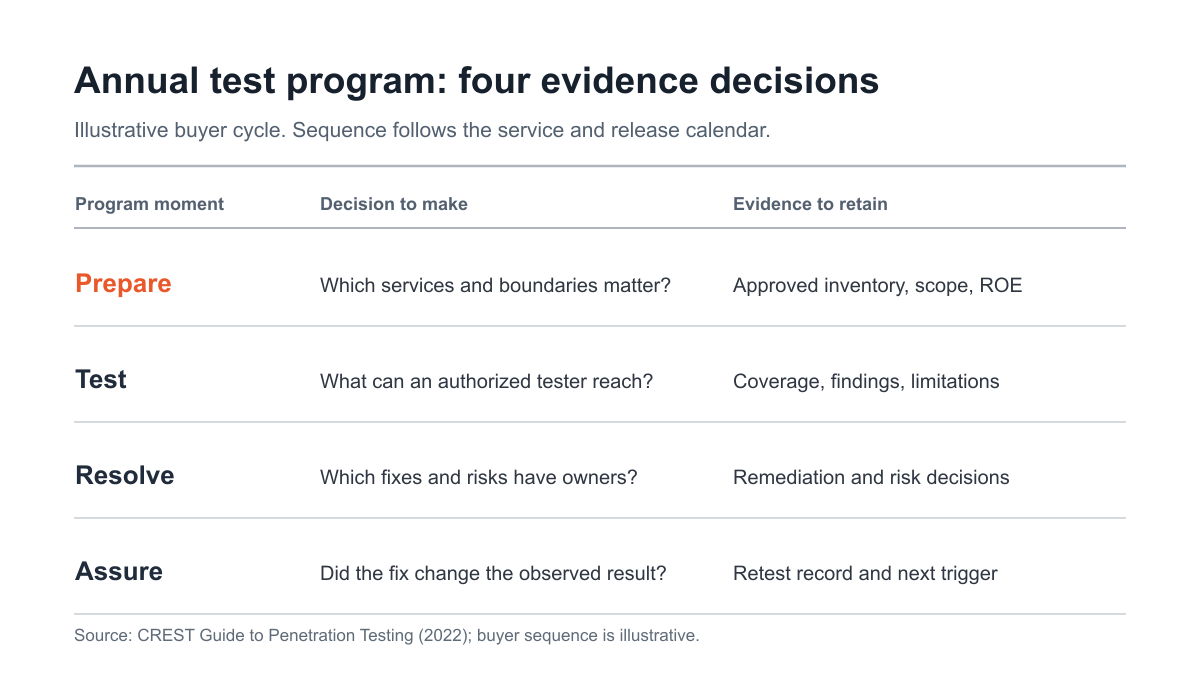
Figure 1: An illustrative annual buyer cycle linking planning, testing, remediation and assurance evidence. Source: CREST, A Guide to Penetration Testing.
Some organizations will run several engagements in parallel. Others will use a single supplier for common scoping and separate specialists for particular systems. The calendar is useful if it shows test windows, prerequisite owners and evidence dates. A quarter label alone is not enough. If a launch moves forward, the corresponding test must move with it or the launch decision must record the gap.
A good calendar also reserves capacity for retesting. The initial report is not closure. CREST's follow-up guidance includes remediation, root-cause work, short-term retesting or verification and action plans. Put retest availability in procurement terms before a finding appears, and give engineering a way to request verification after a fix is deployed.
Leave room for a change trigger
A calendar can be orderly while the system changes underneath it. Decide in advance which changes require a scope review. Examples include a new external API, a new privileged role, an identity-provider migration, a major cloud trust change, a merger of internal networks or a new sensitive data flow. This is a risk-based buyer decision. It should name the person authorized to call for an additional test, the budget path and the evidence needed to close it.
CREST explicitly notes that testing around a major change can be more effective than relying on a typical annual interval. A change-triggered assessment need not repeat every prior test. It should cover the changed component, the affected trust boundary and the prior finding families likely to regress. A separate frequency guide explains cadence by framework. This article's focus is the enterprise purchasing and evidence system that makes the chosen cadence executable.
Scope every engagement in language a tester can use
CREST's requirements guidance asks buyers to specify the scope, explicit exclusions and regularity of testing, while addressing business applications, infrastructure, confidential data, legality and tester competence. In procurement terms, “our production environment” is not a complete scope. A testable scope identifies the asset and boundary, intended method and safe operating conditions.
A scope annex should contain the following fields in ordinary language:
Scope field | Minimum useful content | Why the buyer needs it |
|---|---|---|
Objective | The business or security decision the test supports | Prevents a generic method from replacing the decision |
Assets | Named domains, IP ranges, cloud accounts, applications, API versions and identity stores as applicable | Establishes what can be tested and priced |
Identities | User, administrator, partner, service and tenant accounts in scope | Makes authenticated and authorization testing possible |
Environment | Production, staging or other approved target, plus known differences | Explains what the results do and do not represent |
Allowed methods | Human-led testing, automated checks, source access and prohibited actions | Makes the provider's execution safe and comparable |
Safety | Test window, rate limits, monitoring contact, stop conditions and sensitive-data handling | Coordinates with operations and legal owners |
Output | Report sections, evidence format, notification timing and retest terms | Makes acceptance measurable |
Exclusions | Third-party services, unsupported assets or known no-test conditions | Prevents accidental overreach and hidden gaps |
For web and API work, provide representative accounts for every material role and tenant boundary. A test that never reaches a partner-only or administrator-only path cannot give useful assurance about it. For cloud work, provide the resource owner, cloud accounts or projects and the permitted starting privileges. For network work, distinguish external from internal starting positions. Ask the provider to reflect these assumptions in the final report so a future reader can interpret the result.
OWASP ASVS 5.0.0 offers a versioned set of security requirements for modern web applications and web services. It can help the buyer state which web/API controls should be verified. It does not substitute for naming the product's own workflows, role rules and data boundaries. A generic standard cannot know which tenant separation or approval transition matters most to a particular business.
Approve rules of engagement before testing
NIST defines rules of engagement as detailed guidelines and constraints set before a security test that authorize defined activities. A practical document names who authorizes the work, the exact targets, the testing dates and hours, escalation contacts, safe data proof, stop conditions, reporting channel and how a scope change is approved. It should also identify dependencies on cloud provider rules or third-party permission.
This is more than a legal signature. A penetration tester may discover an asset that appears related to the approved scope but has a different owner. A clear change process lets the team flag it and seek authorization without silently expanding work. It also lets operations distinguish approved test traffic from an incident without suppressing a real alert.
Buy a program outcome, then compare proposals
Requesting “one annual pentest” makes price comparisons unreliable. One bidder may include authenticated application roles and associated APIs. Another may offer a scanner run against an external range. A third may include internal identity testing and retesting. Compare like scope with like evidence.
CREST recommends documented supplier criteria that can be shared with procurement and prospective suppliers. An RFP should ask providers to respond to the same named services, test assumptions and deliverables. Include the following questions:
RFP question | Evidence of a useful answer | Follow-up if unclear |
|---|---|---|
Which business services and assets are in the quote? | Asset and environment schedule with exclusions | Ask whether APIs, identity and cloud are separate fees or separate scopes |
Who performs the work? | Named tester roles, relevant experience and quality review | Ask how substitutions and specialist handoffs work |
How is depth decided? | Method per surface, account roles and time allocation | Ask what “comprehensive” means for this specific system |
How are boundaries handled? | Written authorization, third-party exclusions and change control | Ask what happens on discovery of a connected asset |
How are findings reported? | Sample redacted report with impact, evidence and remediation | Ask whether scanner alerts are validated |
What happens after delivery? | Retest terms, communication channel and closure format | Ask whether verification is included and when it expires |
How is the program coordinated? | A single schedule and evidence register across workstreams | Ask who reconciles overlapping or conflicting findings |
Ask each bidder to identify what it needs from your team. If the proposal assumes test accounts but nobody can supply them, the stated methodology may be impossible. If a provider offers an internal network test but your operations group cannot furnish a starting point, schedule that prerequisite before signing the engagement window.
The buyer should also distinguish a one-time annual engagement from a continuous program. The business may want a fixed independent assessment for a specific decision, repeated testing of frequent releases, or both. Stingrai's PTaaS page describes one-time and continuous delivery, confirmed findings and retests through a platform. The right purchase depends on release frequency, asset change and the decision owner; a continuous dashboard alone does not settle the annual evidence question.
Write the acceptance test for the report
A report should be accepted against the approved scope, not merely because a PDF arrived. CREST's reporting guidance calls for a test narrative, evidence, technical risk and remediation, and notes the value of a common reporting template for comparison. A buyer can turn that guidance into measurable acceptance fields:
Exact assets, environments, dates, identities and starting positions tested.
Methods used and meaningful coverage limitations, including unavailable accounts or routes.
Confirmed findings with affected boundary, observed impact, safe evidence and remediation guidance.
Clear ownership for each fix and a separate record for a risk accepted without remediation.
Retest status for corrected findings, including the version or environment checked.
A concise management view that explains business relevance without hiding technical detail.
A clean report is not proof that all possible weaknesses are absent. It is evidence about the approved scope under stated conditions. That distinction matters when a customer asks whether a newly released feature was included, when a different cloud account appears, or when an auditor wants to connect a report to a control period. The program register should let a reviewer answer those questions without guessing.
Preserve evidence that can survive the next handoff
Enterprise programs often fail between delivery and use. The penetration testing provider produces a technical report; engineering fixes the issue; procurement receives a generic assurance letter; the next year's security owner cannot tell whether a retest happened. A common evidence register closes that gap.
For each engagement, retain the approved requirements and rules of engagement, the final scope and exceptions, the report, the finding-owner log, remediation decisions, the retest record and the date of the system version assessed. The evidence may be redacted for external recipients, but the internal record should keep enough detail to reconstruct which boundary was tested. Define who can access sensitive findings and how long the organization retains them under its own policy.
CREST's Guide says reports should be acted on, shared with relevant stakeholders, and fed into risk and technical security processes. This is a reason to agree report format before testing. The technical detail must be usable by the engineer, while the management summary must be usable by the person accepting risk or funding a fix. A provider that offers only a score makes that handoff harder.
Separate remediation from retest
A ticket marked fixed is an engineering statement. A retest is a new observation under defined conditions. The program should record both. For a web issue, retesting may require the same roles and tenant states. For a cloud issue, it may need the same starting privilege and policy path. For a network issue, it may need the same segment and access route. If the environment has changed so much that the original path no longer exists, the record should say that and identify what was checked instead.
The owner should also examine repeated root causes. Several authorization findings in different applications may point to a shared design or review gap. Several exposed services may indicate an inventory or change-control failure. CREST includes root-cause work and an improvement plan in follow-up. An annual program gains value when it uses those patterns to set the next test's scope, rather than simply reopening the same SOW next year.
Decide when a new test is needed before the next annual window
The program should have a practical change review, not a promise that every code commit will receive a full penetration test. Ask the owner of a material change to explain which prior test conclusions it could invalidate. A new public route might need authenticated web/API checks. A changed cloud trust policy might need a targeted cloud assessment. A merger of network segments might need internal path and segmentation validation. A new supplier-managed component might need authorization and a separate scope decision.
Three signals justify a scope conversation:
New exposure: a previously private function, service or environment becomes reachable by a new class of user.
New authority: a role, service account, consent grant or network trust obtains broader power.
New dependency: sensitive data or a critical operation moves through a different provider, API or platform boundary.
These are editorial planning signals, not a universal compliance threshold. They help a buyer decide whether to run a targeted regression test, move a planned engagement forward or explicitly accept an interim gap. Document the decision, owner and date. That record matters when the annual report is later used to support a customer or audit conversation.
How Stingrai fits an annual enterprise program
Stingrai is a CREST-accredited penetration testing company founded in Toronto. Its web, API, cloud and network services let a buyer scope distinct workstreams under a common program. For human-led engagements, two named penetration testers from a team holding OSCE³, OSWE, OSEP, CREST CRT and CISSP certifications perform the work, with review by a team lead and engagement partner. Stingrai's web application service page describes the named tester and review model.
The fit should still be tested against the actual portfolio. Give Stingrai the business-service map, critical release dates, authorized assets and evidence recipients. Ask for a proposal that separates application, API, cloud and network work where different methods and owners are needed. The provider can then state the scope, test window, prerequisites, deliverables and retest path. Stingrai supports one-time annual testing and continuous programs; the scope should reflect which operating model the buyer is purchasing.
The buying conversation is more productive when it starts with a question such as “Can the partner role reach customer data through the new API after our identity migration?” than with “How many hours is an annual pentest?” The first question can be translated into roles, environments, methods and evidence. The second needs that translation before a quote has meaning.
Frequently asked questions
What is annual penetration testing for an enterprise?
Annual penetration testing is a planned program of authorized tests, reporting, remediation and verification across the enterprise's selected systems during a year. CREST recommends a structured program covering preparation, testing and follow-up, with attention to critical systems. The organization decides the exact scope and timing from its business risks, changes and applicable obligations.
Does an annual pentest mean one test of everything?
No. A single engagement rarely describes every application, API, cloud account, identity boundary and network segment at a useful depth. An annual program can contain multiple engagements with a common inventory, ownership and evidence register. Each engagement needs its own approved scope and exclusions.
Is an annual penetration test required by NIST?
NIST SP 800-115 gives guidance on planning and conducting technical security tests, analyzing findings and developing mitigation strategies; it does not impose a universal annual penetration test mandate. NIST CSF 2.0 is a high-level risk framework and says it does not prescribe how outcomes should be achieved. Determine any binding frequency from the specific law, contract or standard that applies to your organization.
Should a major change wait for the next annual test?
No. CREST notes that testing can be more effective immediately before or after a major change than on a typical annual date alone. A buyer can commission a targeted test of the changed component and affected trust boundary, with the result linked to the annual evidence register. The trigger and scope should be agreed by the relevant system owner and security team.
What should an annual penetration testing RFP include?
It should identify business services and assets, test objectives, environments, roles, exclusions, safe-test rules, expected methodology, reporting format and retest terms. Ask bidders to map their work and evidence to the same scope sheet so price and coverage can be compared. CREST recommends documented supplier selection criteria that can be shared with procurement.
How do we scope web, API, cloud and network testing together?
Map the business workflow across those surfaces, then state which owner can authorize testing of each component. Specify role and tenant accounts for web and API work, accounts and projects for cloud work, and external or internal starting positions for network work. Use explicit handoffs where an observation crosses from one workstream to another.
What evidence should an annual pentest provider deliver?
The evidence should include the authorized scope, tested assets and dates, methods and limitations, confirmed findings with safe proof and remediation guidance, and a separate record of retest outcomes. CREST recommends a report with narrative, evidence, technical risk and remediation, and notes that a common template helps compare tests. The buyer should define acceptance fields before work begins.
Is a vulnerability scan the same as an annual penetration test?
No. A scan can identify signals for further investigation, while a penetration test uses agreed methods to investigate and validate security weaknesses in a defined scope. NIST SP 800-115 discusses different technical testing techniques and their limitations. An RFP should state which activities are automated, which are performed by testers and how findings are confirmed.
Can one provider run the whole enterprise program?
Yes, if it has the right specialists and can meet the defined scope, quality and coordination requirements. CREST discusses single-supplier, dual-supplier and panel models, each with trade-offs. The buyer should choose based on the systems and evidence needed, then maintain one program owner and consistent report acceptance across providers.
How should we budget for retesting and scope changes?
Include retest terms, change-control terms and the owner of an additional scope decision in the original procurement brief. Reserve capacity for fixes and verification within the evidence window that matters to the organization. Compare quotes by the same assets, roles, methods, report and retest deliverables, rather than by a headline test price.
Related reading
Sources
Talk to Stingrai
Bring your service inventory, planned release dates and evidence requirements to Get a Quote, or book a free discovery call to scope an annual human-led program or continuous testing.