An independent penetration test is useful only when its scope, impartiality and evidence can be verified. The Canadian Centre for Cyber Security's CA-08 guidance says penetration testing goes beyond automated vulnerability scanning and describes an independent tester as free from actual or perceived conflicts concerning development, operation or management of the target system. That definition is a practical starting point for enterprise procurement.
Quick answer. Buy third-party penetration testing by naming the exact systems and business questions, verifying the testing team's independence, agreeing rules of engagement, and specifying the evidence packet before work begins. The packet should prove who tested what, how a finding was confirmed, what remains untested, and whether a fix survived a retest. Stingrai is a CREST-accredited penetration testing firm that can deliver human-led testing with named specialists and confirmed findings for an agreed scope.
"Third-party" can refer to three different relationships: an outside firm tests your own systems; you assess the security of a supplier's systems; or a program requires an assessor with a particular recognized status. Those relationships create different authority and evidence problems. This guide addresses buying an outside firm to test systems you are authorized to test. It flags where a program requires a specific assessor credential or imposes its own evidence format.
The purchase should not end at a vendor questionnaire or a report cover page. An enterprise buyer needs a chain of proof from an approved boundary to a technical result, a remediation action and a retest. That chain gives customer security, compliance and audit teams concrete evidence for their own decisions.
What independence means in a testing contract
The Canadian Cyber Centre's CA-08(01) describes an independent penetration testing agent or team as impartial and free from perceived or actual conflicts with the development, operation or management of the target systems. The same guidance says risk assessments guide how much independence is required. Independence therefore needs to be evaluated against the particular system and decision, not inferred from a company name or a vendor logo.
For a buyer, the question is whether the person or firm validating the control had a role in designing or operating the control under test. A consultancy that implemented the identity policy and then tests that policy may have a conflict even if it is legally outside the buyer's organization. An internal red team separated from operations may be impartial for some purposes, while a customer contract may explicitly require a separate company. The buyer should record the applicable rule and the actual relationship, then decide whether the proposed team meets it.
A clean independence record names the legal entity signing the contract, the testing team, any subcontractor, and any work that team or entity performed on the target environment. It asks whether the tester sells, configures or operates a product whose control is being evaluated. It also records who approved the conclusion and whether the testing lead can report a finding without needing permission from the implementation owner. This is not a request for a generic declaration of "no conflict." It is a traceable statement about the system under test.
Independent does not automatically mean program-recognized
Some programs define their own assessor roles. FedRAMP's consolidated 2026 rules say that FedRAMP accepts independent assessments from FedRAMP Recognized independent assessment services. Its Rev5 control catalogue includes CA-08 penetration testing and CA-02(03) use of external assessment results. A commercial penetration testing firm should not be called a FedRAMP Recognized assessor merely because it is independent. If a buyer needs that program's assessment package, it should check the current FedRAMP recognition and package rules before writing a contract.
The opposite overstatement also causes trouble: not every pentest rule requires an outside company. PCI Security Standards Council's penetration testing guidance defines a tester as a resource that may be internal or external. That information supplement does not replace the current PCI DSS standard, and a buyer must check the applicable requirement and assessor instructions for its environment. The useful lesson is to quote the exact rule before claiming that a third-party firm is mandatory.
A concrete external-company example is Microsoft 365 Certification's application security evidence guide. For that program, Microsoft specifies testing at least every 12 months by a reputable independent penetration testing company, and it expects the report to show scope, methodology, vulnerabilities, remediation and retesting where applicable. It also specifies retesting of Critical and High findings by the tester. These are Microsoft 365 Certification conditions for in-scope applications, not a universal timetable or retest rule for all buyers.
The buyer evidence chain
A defensible third-party test has five connected records: independence, authority, coverage, findings and closure. If one link is absent, a reviewer has to guess. A polished PDF cannot repair an unclear legal authority to test a supplier's platform; a strong exploit proof cannot show that the test covered all promised assets; and a retest certificate cannot prove what was fixed if it is disconnected from the original finding.
NIST SP 800-115 describes planning technical tests, conducting them, analyzing findings and developing mitigation. Its rules of engagement template identifies the test purpose, boundaries, assumptions, risks, named personnel and schedule. The acceptance chain below translates that process into procurement evidence. It is an original buyer framework, not a NIST-mandated document list.
Evidence link | Buyer question | Artifact to demand | Acceptance test | Common gap |
|---|---|---|---|---|
Independence | Who evaluated the system, and what did they previously build or operate? | Legal entity, named team, subcontractor and conflict declaration tied to target systems | Conflicts are disclosed and evaluated against the applicable customer or program rule | A generic "independent" marketing sentence |
Authority | Who allowed which actions against which assets? | Signed scope and rules of engagement, including third-party permissions | Asset owner, tester, permitted methods and stop contact are identified | Testing a supplier-owned component on assumption |
Coverage | Did the team actually test the purchased surface? | Asset and role map, test window, methods and exclusions | Each purchased asset and user role has a test status | A host list with no role or business-flow coverage |
Findings | What was demonstrated and what is the consequence? | Evidence, impact, severity rationale and remediation action for each finding | Proof is reproducible within the approved boundary and sensitive data is redacted | Scanner output presented as a completed pentest |
Closure | Did the fix stop the original path? | Remediation owner, retest date, original finding ID and new result | The same path is retested or marked clearly untested | A new scan that never revisits the failed boundary |
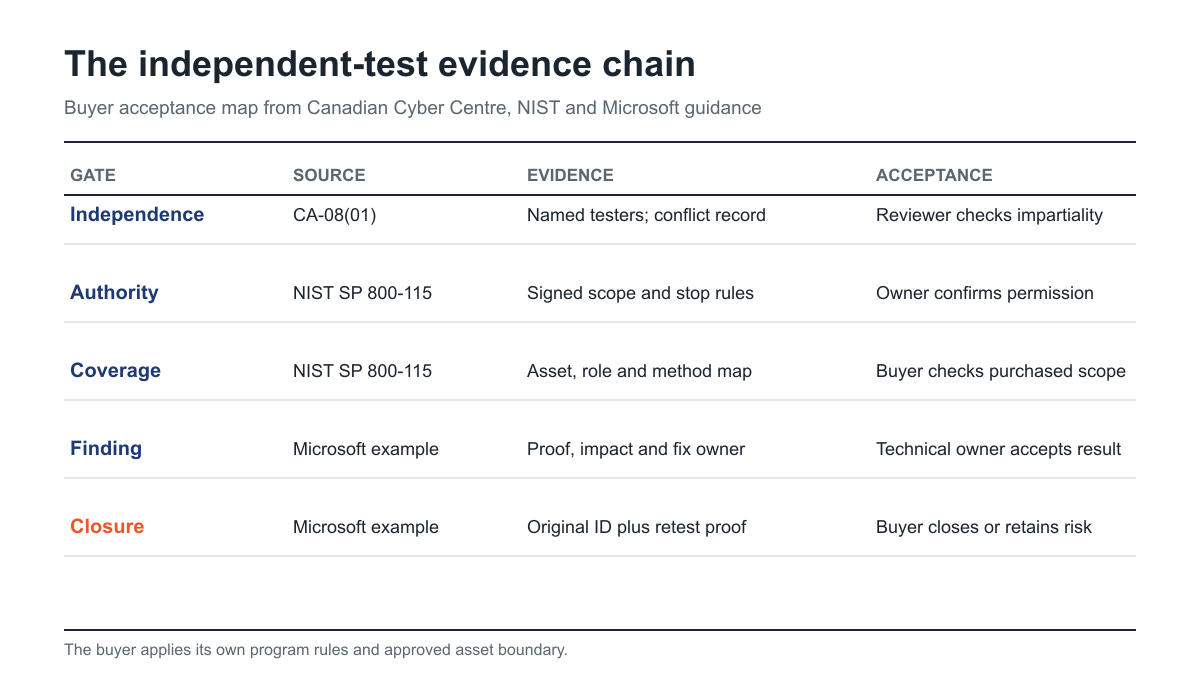
Figure 1: The original buyer evidence chain connects impartiality, authority and technical results to closure. Sources: Canadian Cyber Centre CA-08, NIST SP 800-115 and Microsoft 365 Certification evidence guidance.
This chain should be visible in the statement of work, the engagement workspace and the final report. It is particularly helpful when the buyer must share an executive summary with a customer while restricting access to technical details. The summary can state the period, scope and closure status; the detailed report can remain access controlled. The buyer should decide who receives each version and what evidence can be redacted without obscuring the result.
Define the authorization boundary before asking for a price
The buyer should create an asset sheet with the systems it owns, systems it operates on behalf of others, and systems controlled by a third party. A SaaS deployment may include a customer application, a cloud account, shared platform services, identity integrations and an external payment or messaging provider. Contract authority to test the first two does not automatically cover the rest. A right-to-test clause, cloud provider policy, customer permission and supplier approval may all matter. The written scope must match the actual legal and operational authority.
For each asset, name the environment, URL or network range, cloud account or tenant, user roles, data classification, test window, and operational owner. Mark what is excluded. State whether the tester may create accounts, change configuration, generate test transactions, attempt privilege changes or use synthetic records. An ambiguous phrase such as "all systems supporting the service" is risky because a bidder may price only visible web endpoints while the buyer expects internal network and identity testing.
NIST SP 800-115's rules of engagement template is a useful source for the mechanics: test boundaries, expected outcomes, limitations, risks, named contacts and schedule. A production test should also define a stop condition and escalation path. The asset owner and incident response team should know how to identify authorized tester activity without broadly suppressing security monitoring. Where a test might affect safety, availability or third-party service terms, the buyer should move that method to a lab, a maintenance window or a separate exercise.
The asset-and-role worksheet
Use a common worksheet for every bidder. The fields below are deliberately blank so no one mistakes them for a universal scope or a price benchmark:
Field | Buyer enters | Why it changes the proposal |
|---|---|---|
Business service and decision | [Service] and [question to answer] | Tells the tester what outcome matters |
In-scope application and associated APIs | [Owned assets and role flows] | Distinguishes authenticated business logic work from surface scanning |
External and internal network | [Ranges, locations and starting point] | Defines whether an external or assumed-breach phase is required |
Cloud and identity | [Accounts, tenants, roles and owner] | Exposes control-plane and shared-responsibility boundaries |
Third-party integrations | [Provider, permission status and excluded functions] | Prevents an unapproved test of someone else's system |
Data handling | [Synthetic data, retention, redaction and location] | Determines evidence collection and confidentiality controls |
Safety | [Window, rate limit, stop authority and forbidden actions] | Changes the method and staffing plan |
Deliverable | [Report, executive summary, attestation letter, retest] | Makes quotes comparable |
A bidder should return the worksheet with explicit assumptions. If it excludes an authenticated role, a cloud account or a supplier integration, the omission should be visible before selection. If the buyer cannot provide a valid testing permission for a third-party service, the supplier should describe a safe alternative, such as reviewing the integration boundary or testing a buyer-controlled staging endpoint.
Qualify the firm and the people who will test
Firm-level accreditation, individual certifications and practical experience are separate facts. The buyer should verify the legal entity's accreditation directly in the accreditor's directory, then request the names and relevant experience of the people assigned to the engagement. A certificate held by one employee does not prove the firm is accredited; a firm accreditation does not tell the buyer who will conduct a specialized cloud, application or Active Directory test. The statement of work should name the lead and define how staffing changes are approved.
For a CREST claim, use the CREST Marketplace to check the supplier, service specialization and legal entity. Stingrai Inc.'s listing shows penetration testing accreditation at company level. Its company page identifies senior testers and describes named engagement specialists. A buyer can still ask for the proposed team and a redacted sample report, because directory status and staffing evidence answer different questions.
Ask the bidder to explain its technical method against the purchased scope, not to recite a framework acronym. For an authenticated web test, request role coverage and treatment of authorization and business logic. For an internal network test, request the starting privilege and the boundary to be validated. For a cloud test, request which accounts and identities will be examined and what permissions the buyer must provision. For a red team engagement, request an objective, rules of engagement and defender evidence plan. Each response should say what is manual, what is automated, and where an automated observation is confirmed by a person.
A sample report is a useful quality screen, but it cannot replace the specific acceptance terms. Check whether a finding names the asset and role, gives a safe proof, explains business impact, distinguishes observation from speculation, and names the fix the owner can implement. Check whether an executive reader can identify what was tested and what was omitted. The new engagement's report should then be evaluated against the same criteria, not just the supplier's best sample.
Specify the evidence packet in the contract
The most common procurement failure is to agree on a "penetration test report" without defining what the report must contain. A report is the end of a sequence of decisions. Write the expected content into the statement of work and attach the scope worksheet. The contract can require the following packet without prescribing the tester's exact tools:
Approval record: signed rules of engagement, legal entity, named tester roles, asset owners and emergency contacts.
Coverage record: each scoped asset, application role, environment and test window, with a tested, excluded or blocked status.
Method record: broad technique categories, manual work, automated assistance and limitations, written without exposing unsafe operational details to a wide audience.
Finding record: affected asset, precondition, safe evidence, impact, severity rationale and action for the remediation owner.
Decision record: high-priority notification, owner acknowledgement, scope deviations and any decision to stop or narrow testing.
Closure record: fix date, original finding identifier, retest method, result and remaining exposure.
Sharing record: executive summary, full report, redaction rules, access rights, retention term and deletion confirmation.
This is a buyer-authored acceptance packet. A program may impose additional artifacts. For example, Microsoft 365 Certification describes a report that shows the complete external attack surface, in-scope internal infrastructure where applicable, methodology, vulnerabilities and retesting. A buyer pursuing that program should use Microsoft's current checklist, not this article alone. A FedRAMP buyer should use its recognized-assessor and package rules. A customer security questionnaire may ask only for an executive summary or completion letter, but the buyer should retain the full evidence packet privately.
Preserve test limitations honestly
The report should never imply that a system is free of vulnerabilities because the test found none. It should state the period, access level, accounts supplied, assets reached, methods constrained by the rules of engagement, and work that could not be completed. If a test was paused because a production control reacted, that is an observation worth recording. If an API endpoint was inaccessible, that is a coverage gap, not a pass.
A useful final status distinguishes fixed and retested, open, accepted by the buyer, and not retested. The supplier can verify a fix; the buyer owns risk acceptance. If a finding was closed by architectural change, the retest should show how the original path behaves after that change. If the original test relied on a role that no longer exists, explain the new equivalent. This is why a retest record needs a link to the original proof, rather than a separate one-line letter with no technical trace.
Plan the retest before testing starts
Retesting is easiest to buy before the initial engagement. Define which findings are eligible, how the buyer requests a retest, the permitted window, the evidence format and whether a new deployment or major redesign requires a fresh scope. A buyer should also decide whether a retest includes only the original path or a limited check for adjacent regressions. The original path should always be addressed; adjacent checks need explicit authorization and effort.
The Microsoft 365 Certification guide gives a concrete example of a program that requires Critical and High findings and automatic-failure issues to be retested by the testing company and shown as resolved in the final report. Outside that program, the buyer should write its own acceptance terms according to customer commitments and risk. "Retesting included" is incomplete if no one has agreed on request timing, the number of cycles or the form of proof.
Stingrai's PTaaS platform delivers confirmed findings as they are found and tracks fixes and retests through the same workspace. It supports one-time testing and continuous programs, which can help an engineering team close findings during the engagement. The buyer still needs to confirm the precise retest window and scope in its proposal for a multi-asset or specialized engagement.
A synthetic procurement example
A fictional enterprise software company is preparing for a customer review of its hosted application. It asks for an independent test of an application, its associated APIs, an external network segment and an identity tenant. The application team operates the first two assets, the infrastructure team owns the segment, and a separate cloud provider hosts underlying infrastructure. The buyer initially describes the scope as "all production systems." That phrase would invite bidders to assume different boundaries.
The buyer changes the scope worksheet to identify its application roles, API routes, customer-managed public hosts, identity tenant, test accounts and excluded provider infrastructure. It confirms its right to test the cloud tenant and obtains permission for one supplier integration where needed. The buyer asks each firm to disclose recent implementation work on these systems and name the testers. One bidder has configured the identity controls under review; another has no such conflict. The buyer records the independence decision rather than treating the external address on a business card as proof.
The selected tester receives signed rules of engagement, test users and synthetic records. It demonstrates a broken authorization path in an API using a test object, reports the finding with the affected role and business impact, and tells the buyer when the result is confirmed. The buyer fixes the authorization check. The tester repeats the same cross-role request with the same account class and synthetic object, records that access is now denied, and attaches the new evidence to the original finding. The final packet shows scope, team, proof and closure. It does not claim that the cloud provider's shared infrastructure was tested or that every application path is secure.
This fictional example illustrates why third-party testing is a procurement and evidence problem as well as a technical service. The buyer needs to authorize the right assets, choose an impartial team, give the testers meaningful roles, and reserve time for retesting. A strong vendor can then do strong work inside a verifiable boundary.
Compare quotes on the same work, not the same label
A headline price for "third-party penetration testing" is not comparable across different surfaces. One proposal may include authenticated application roles and manual business logic work, while another covers external scanning and a short report. One may include an internal assumed-breach phase; another may count only internet-facing assets. The comparison should align the scope sheet, staffing, testing mode, report packet and retest terms line by line.
Price should be attached to a unit the buyer can understand: a named application with associated APIs and roles, a defined network range, a cloud account set, or an objective-led red team exercise. Ask for assumptions about test accounts, staging parity, data handling, travel and on-site access. Ask what happens when scope changes after kickoff. A change order should identify the new asset and safety review, not silently reclassify omitted work as "best effort."
The buyer should also examine operational fit. A regulated enterprise may need a procurement package with insurance, data processing terms, subcontractor disclosure and evidence retention. A fast-moving product team may need findings as they are confirmed and direct collaboration with named testers. Both can be valid, but a glossy badge alone does not answer either need. The buyer question bank for pentest and red team RFPs can help prepare an initial tender; this guide focuses on the evidence to accept after the vendor is selected.
Where Stingrai fits
Stingrai Inc. holds CREST accreditation for penetration testing. Its human-led services cover web applications, associated APIs, network, cloud, Active Directory and red team work. For an enterprise buyer, the scope should identify the relevant assets and user roles, and the proposal should name the testers and the final evidence format. Stingrai's PTaaS platform supports one-time and continuous engagements, posts findings as they are confirmed, enables collaboration and includes retests.
Stingrai's penetration testing can support customer assurance and compliance programs by producing technical evidence for the buyer's review or audit. A program-specific recognized assessor requirement should be evaluated against that program's current rules. The buyer should send Stingrai its scope worksheet, independence requirements and evidence packet when asking for a quote. For an application and associated APIs, ask about the appropriate engagement model; for a larger estate or any network, cloud or red team scope, request a tailored quote.
Frequently Asked Questions
What is third-party penetration testing?
Third-party penetration testing is a scoped security test performed by an outside firm or team on systems the buyer is authorized to test. The buyer should verify the team's impartiality against the target systems and accept evidence of scope, findings and retests, rather than treating the external company name alone as proof of independence.
Does every framework require an external penetration testing company?
No. Requirements differ by framework and program. Microsoft 365 Certification specifies a reputable independent penetration testing company for its in-scope application testing, while PCI SSC guidance describes testers as potentially internal or external. Buyers should quote the operative requirement that applies to their environment before setting a vendor rule.
How do I verify that a penetration testing firm is independent?
Ask for the legal entity, named test team, subcontractors and work they have performed on the target systems. Evaluate any role in developing, operating or managing those systems against the applicable rule. The Canadian Cyber Centre's CA-08(01) frames independence around freedom from actual or perceived conflicts.
Is an independent pentest firm the same as a FedRAMP assessor?
No. FedRAMP's 2026 rules recognize specific independent assessment services for its assessment process. A commercial pentest firm should be verified separately against FedRAMP's current recognized-assessor requirements if the buyer needs a FedRAMP package.
What should a third-party pentest report prove?
It should identify the approved assets, environments, roles, test period, methods, limitations, findings, safe evidence, business impact, remediation and retest status. A reader should be able to distinguish tested, excluded and blocked work without guessing from a cover-page date or a tool output.
Can a vendor test a supplier's hosted service under our authorization?
Only when the buyer has the necessary authority for that service and the written rules of engagement include the approved assets and methods. If permission is absent, scope testing to the buyer-controlled integration boundary or obtain the supplier's approval before testing its system.
What should we require for retesting?
Require a retest tied to each original finding, with the same starting role and affected path where possible. The record should state the new behavior, date, evidence and remaining limitations. Agree on request windows and scope before the initial test begins.
How can Stingrai support an independent testing requirement?
Stingrai is a CREST-accredited penetration testing firm with named human testers and a platform for confirmed findings, collaboration and retests. A buyer should supply the exact independence rule and asset scope, then confirm the proposed testers, deliverables and any program-specific assessor condition in the engagement agreement.
Related reading
References
NIST, Technical Guide to Information Security Testing and Assessment, SP 800-115.
Microsoft, Microsoft 365 Certification application security evidence guide.
FedRAMP, Consolidated Rules for 2026, independent assessment services.
PCI Security Standards Council, Penetration Testing Guidance v1.1.
Talk to Stingrai
Bring your asset worksheet, independence requirement and evidence expectations to the first discussion. Get a Quote or book a free discovery call to scope a human-led test.