





Trusted supplier access is an attack path, not just a line in a vendor inventory. MITRE ATT&CK's Trusted Relationship technique, T1199, describes how an adversary can use an existing relationship with a provider to reach a target. The relevant access may be a support account, a partner administrator, a federated identity, a cloud role or a network connection. The buyer's question is whether that relationship has more reach than the business intended and whether defenders recognize its misuse.
Quick answer. A third-party access red-team exercise gives authorized testers a defined vendor or partner starting point and an agreed business objective, then measures which access paths work and what the defenders see. The scope must distinguish client-owned assets from supplier-owned assets, obtain permission for every tested identity and connection, and use safe proof rather than changing real data. Stingrai's human-led red teaming can combine identity, network and cloud paths into an objective-based exercise with a detection and response timeline.
The exercise should not start with a claim that every vendor is risky or that a particular product is vulnerable. It starts with the trust granted by this enterprise. An external IT provider may have a time-limited role but still reach a sensitive administration panel. A business partner may have a legitimate application account that sees more data than its contract requires. A managed provider may connect from an expected network, causing its actions to attract less scrutiny. A test is valuable when it proves the limits of an actual relationship and assigns any excess permission or missed detection to an owner.
What changes when the starting point belongs to a partner
The point of a red team is a named objective, not a long list of every account and server the testers can touch. In this case, the starting point is a trust relationship the enterprise already uses. The operator might begin with a pre-created test account representing a supplier support user, a permitted delegated role or an approved cross-account connection. The control group decides which identity is safe and representative. The operator then tests whether it can reach a defined target, such as a protected management function or synthetic record, while the SOC observes without advance notice or during a planned purple team session.
That is a different purchase from a supplier questionnaire. An attestation or access list can show that an account exists and that a vendor claims to control it. A red-team exercise shows what the identity can do in the client's environment after authentication. It also differs from testing the supplier's network. A customer normally cannot authorize intrusion into systems it does not own. The test should stop at the boundary of the client's permissions unless the supplier signs its own authorization and joins the exercise.
MITRE T1199 explicitly includes service providers and partner access in its description. Its detection guidance includes external identities, delegated administration, cloud cross-account roles and downstream privileged actions. This is useful for scoping because the concern is not merely the first sign-in. The decisive event may be a new role, an application permission, a sensitive export or a later action that uses the relationship as cover. Ask the provider to show that the exercise follows the chain far enough to answer the business question without crossing an unauthorized boundary.
The exercise also needs a practical control group. Someone from security, the service owner and the supplier relationship owner should agree the starting account, permitted target and safety conditions. They need a way to identify test activity if a real incident occurs. The SOC's awareness depends on the chosen mode. In a covert red team, only the control group knows; in a purple team, analysts can watch the technique and tune detection. That choice belongs in the SOW because it changes what a detection result means.
Define the trust relationship before choosing a test
"Vendor access" is too broad to put on a purchase order. Define the identity type, owner, privilege, activation process and connected systems. The same enterprise may have a managed service account, a partner guest in its collaboration tenant, a cloud role trusted to another account and a local support account on an appliance. They create different evidence and authorization needs. A buyer should pick the path that could plausibly reach a valuable objective, not the easiest path to demonstrate.
Relationship | Buyer question | Evidence to collect |
|---|---|---|
Support or help-desk account | Can this identity perform more than the approved service task? | Account scope, privilege change, session log, ticket or approval reference |
Delegated tenant administration | Are partner roles narrow, time-bound and visible to the tenant's defenders? | Relationship record, granted role, sign-in and audit events, SOC case |
Cloud cross-account role | Can the trusted principal reach a protected resource or assume another role? | Trust policy, observed role use, management events and objective proof |
Federated or guest identity | Does an external user retain access after its business purpose ends? | Sponsorship, sign-in, application permissions and revocation path |
Network or remote support connection | Does the connection cross intended segments or reach unrelated management systems? | Authorized entry, segment boundary, access decision and defender timeline |
The table is an editorial scoping framework, not a claim that every environment has every relationship. Microsoft describes granular delegated admin privileges, or GDAP, as a way for partners to request granular and time-bound access to customer workloads. AWS documents third-party role access through trust relationships and external IDs. Those documents help an owner ask for the actual relationship settings, but they do not prove that a specific tenant or account is secure.
For a partner admin scenario, the buyer should obtain the relationship owner, the roles assigned and a test identity whose activity will not be confused with ordinary maintenance. For a cloud role, capture which account owns the role and who is allowed to assume it. For a network connection, capture the permitted source, destination and service task. If this inventory cannot be assembled, a preliminary identity or network assessment may be the better first engagement. A red team that spends most of its time discovering who owns the connection has less time to test the defenders.
Choose a safe objective and a representative starting privilege
A strong objective is specific enough to prove or refute. "Compromise the vendor" is vague and usually outside the customer's authority. "From an approved partner support identity, reach a marked administrative function in the client's tenant without the expected approval" is testable. So is "from the authorized remote support connection, determine whether the account can reach a segregated management system." The protected target should be a client-owned test object or a production control that can be observed without changing real business data.
Avoid starting the operator with global administrator privileges unless the question is explicitly about what a legitimate global administrator can do and what the SOC would notice. If the enterprise grants the highest role at the start, the exercise cannot show whether a lower-trust account can escalate. Conversely, a test identity with no resemblance to the real supplier's access may produce a reassuring result that does not apply to the actual relationship. State the reason for the chosen privilege in the scope and record any differences from production access.
Use explicit flags for success. A flag can be a benign marker in a protected location, a read of a synthetic record or a documented ability to open an administrative function. It should not require a permanent permission change, a real customer export or service disruption. The rule of engagement should also name what does not count. Seeing a menu item may not prove that an action is permitted; a successful test should have a controlled, time-stamped decision from the target system.
For a multi-vendor estate, choose one or two representative relationship types rather than saying "all suppliers." A managed IT provider with tenant administration tests a different boundary from a shipping partner with application access. The buyer can later repeat the same objective against another class. This makes the comparison useful and keeps the supplier's participation manageable. NIST SP 800-161 Rev. 1 frames supply-chain risk as part of broader risk management for acquired products and services; a targeted test should add empirical evidence to that program, not pretend to replace it.
Authorization is a design input, not a formality
Put four ownership lines in the SOW: the client-owned assets, the supplier-owned assets, the accounts used by the testers, and the logs or evidence the parties may share. The client can authorize a test of its tenant, its application and its own network. It should not imply that this grants authority to test a supplier's email tenant, employees, VPN or infrastructure. If supplier systems must be involved, the supplier needs to agree in writing to the scope, dates, contacts and permitted methods.
Some relationships are managed through a platform, but platform permission does not replace legal authority. An AWS role may technically trust an outside account; a Microsoft partner relationship may confer roles. Neither fact authorizes an adversarial exercise against the other organization's systems. The safest method is often a client-controlled test identity that mirrors the supplier role while staying inside the client's environment. If this cannot faithfully reproduce the risk, note the limitation and seek the supplier's participation rather than disguising the gap.
The test plan should cover the account lifecycle. Who provisions the test identity? Who can turn it off immediately? How will privileges and any consent grants be removed after the exercise? Who approves a temporary role change? How will the parties distinguish the exercise from real support activity? Those details make the result interpretable and reduce operational confusion. They also protect the supplier from being blamed for a test it never agreed to.
Time windows and stop conditions matter for business continuity. A support provider may be performing urgent maintenance during the same period. The white team needs a phone number or bridge that can suspend the exercise if a real incident or outage appears. Logging and case records should be preserved, but any synthetic marker or temporary permission should be cleaned up under a named owner. NIST SP 800-115 emphasizes planning and analysis for technical security tests; the contract must translate that discipline into the actual supplier boundary.
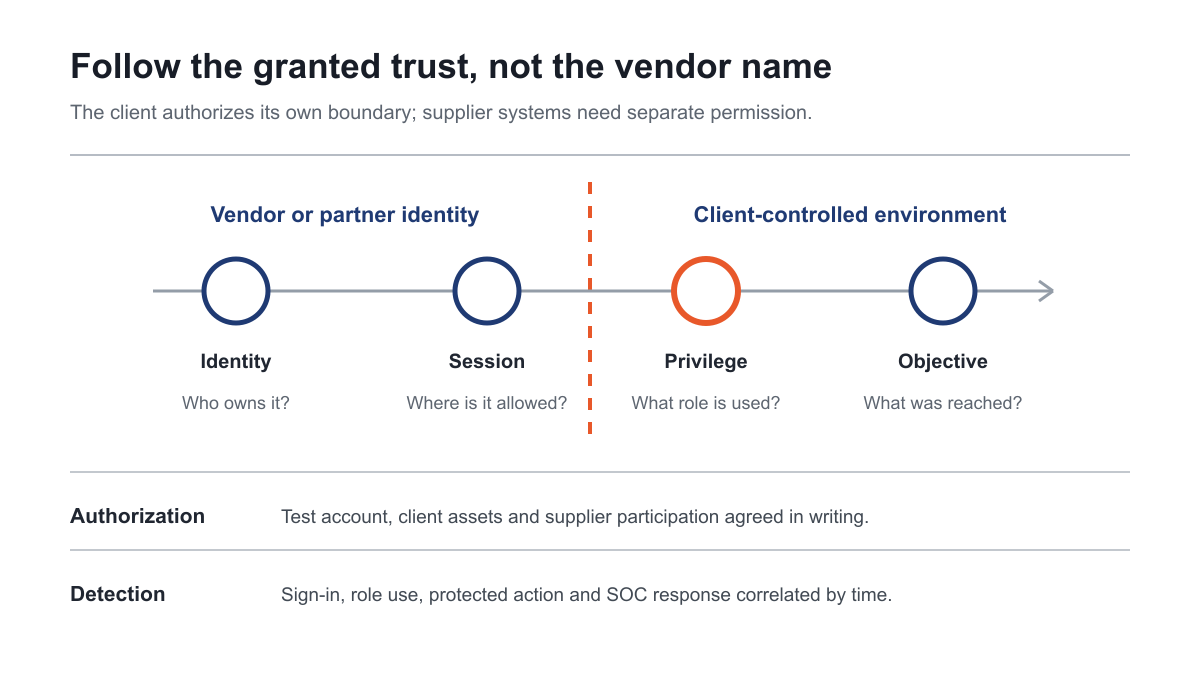
Figure 1: A vendor identity's path through client-controlled trust, privilege and detection points. This is an editorial scope map. Sources: MITRE ATT&CK, Trusted Relationship; Microsoft, GDAP permissions; AWS, third-party role access.
Measure what the defenders actually saw
A supplier identity may look normal at first sign-in. The useful signal may be the sequence: external identity authenticates, uses a role atypical for its task, reaches a sensitive service and then changes access or reads a protected object. MITRE's T1199 detection strategy describes correlating those kinds of events across identity, role and resource telemetry. A provider should not claim success or failure from a single login screenshot. Reconstruct the sequence with the SOC after the test.
Ask for separate outcomes at each boundary. Was the sign-in blocked by access policy? Was privilege use permitted? Was the resulting action logged? Did a rule raise an alert? Did an analyst identify that the actor was a supplier or partner and contact the right relationship owner? Did containment revoke only the test access, or would it have interrupted the whole supplier service? That last question matters commercially: a response plan can be too blunt to use when a real event occurs.
The report should carry UTC timestamps, the test identity, the relevant tenant or account, the permitted starting privilege, the action attempted, the observed access decision and the evidence available to defenders. It should also show the expected behavior agreed before testing. If the supplier's legitimate task would require an action, a blanket block may be an operational problem rather than a security improvement. A red-team engagement provides an attack narrative and response timing; a transparent purple-team follow-up can tune a missed alert with the analysts present.
Do not reduce the result to "vendor compromised." The tester is usually using an approved stand-in, not breaching the supplier. The meaningful conclusion is that a specific trust relationship allowed or stopped a specific action from a defined starting point. If the test never reached the supplier-owned side, say so. If a role was already more privileged than intended, identify the configuration owner. If telemetry failed, identify the logging owner. If an alert existed but no one called the relationship owner, identify the response process. Each finding then becomes a task that can be retested.
Decide whether the SOC or the supplier is being assessed
An enterprise may care primarily about its own monitoring, the supplier's notification process, or both. Keep those questions separate. The client's SOC can be assessed against activity in the client's tenant without making any claim about the supplier's internal security. If the supplier has agreed to participate, it can be given an expected escalation action, such as reporting the loss of a test account or responding to a revocation request. The report should then state which side saw the event and when. A client-side alert cannot prove the supplier would have noticed a compromise in its own environment.
The relationship owner should receive an operational version of the findings. It can name the permitted role, business task, excessive permission and remediation owner without disclosing the entire attack narrative to staff who do not need it. The technical SOC annex can retain the exact timestamps and telemetry references. This separation lets procurement and service management negotiate a fix while preserving detailed detection logic. Retest should confirm that the supplier's legitimate service still works after permissions are narrowed. Removing access entirely is rarely a useful result if the underlying business task remains.
Compare quotes by the work they include
A realistic quote should name the relationship type, starting account, client systems, objective, security operations involvement and whether the supplier participates. A line item for "third-party access red teaming" with no scope detail is difficult to compare with another proposal. Ask the bidder to show a sample of its detection timeline and its rule-of-engagement terms for external accounts. The sample should be sanitized, not a disclosure of another customer's trust setup.
The SOW should make exclusions plain. It should say whether phishing the supplier, using leaked credentials, touching supplier infrastructure or exercising a production support account is prohibited. The default should be to leave those actions out unless all relevant owners expressly authorize them. It should specify the safe proof, the cleanup procedure and the retest of any remediated permission. An out-of-scope line in small print is not enough when the exercise's subject is an organizational boundary.
Ask who will review findings with both the client and supplier. Some fixes live in the client's role assignments; others require the provider to change how it authenticates or how quickly it reports a lost account. An engagement that reports the problem but cannot identify the owner will stall. The debrief should separate client-side permissions, supplier-side controls that were actually in scope, and the SOC's detection process. That separation can be shared with procurement without exposing technical detail that the supplier does not need.
Avoid a provider who treats all partner access as a vulnerability. Vendors need access to deliver services. The purchase is about proving that access is limited to its business purpose and that abnormal use is detectable. A good proposal states the business function before the adversarial objective, so the result can be weighed against the service's operational needs.
Where Stingrai fits
Stingrai is a CREST-accredited penetration testing services company founded in Toronto in 2021. Its human-led red team works from agreed objectives and can include Active Directory, Entra ID, cloud roles, network segments and a SOC response timeline. Two named penetration testers from a team holding OSCE³, OSWE, OSEP, CREST CRT and CISSP certifications work on each human-led engagement, with the report reviewed by the team lead and engagement partner.
For a vendor-access scenario, the commercial scope should specify the client's authorization boundary and whether the supplier participates. Stingrai can run a one-time exercise or include the scenario in a continuous program, with findings and retesting handled through its PTaaS platform. Work outside the fixed web application packages is quoted to the objective and environments. The Get a Quote form is the route to a scoped price.
Frequently Asked Questions
What is a third-party access red-team exercise?
A third-party access red-team exercise starts from an expressly authorized vendor or partner identity or connection and tests whether it can reach a defined client-owned objective. The report records access decisions and the defender's detection and response. It does not require testing the supplier's own systems unless that supplier separately authorizes them.
Can a customer authorize testing a vendor's tenant?
No. A customer can authorize testing of assets and accounts it controls, but cannot confer permission over another organization's tenant, employees or infrastructure. Supplier-owned scope requires that supplier's written approval. A client-controlled stand-in account can often test the customer's trust boundary without touching supplier systems.
Is delegated admin access always unsafe?
No. Delegated administration is a legitimate way for a partner to manage a customer's workloads. Microsoft describes GDAP as granular and time-bound. The test asks whether the actual granted role is appropriately limited, whether its use is visible and whether abnormal actions are investigated.
Does an AWS external ID solve third-party access risk?
No. AWS documents external ID as a control for the confused-deputy problem in third-party role use and explicitly says it is not a secret. It does not decide whether the role's permissions are too broad or whether the SOC detects misuse. Those are separate test questions.
What should the starting account look like?
The account should reflect a real relationship's identity type and privilege while remaining safe for testing. Record how it differs from production access, who can disable it and which actions are prohibited. An unrealistically powerless account gives weak assurance; starting with the highest privilege conceals escalation paths.
What evidence should the SOC receive?
The SOC should be able to correlate the external identity, authentication, privilege use and objective action, then contact the correct relationship owner and take proportionate containment action. The report should compare that expected sequence with actual logs, alerts, case notes and timestamps. A sign-in event alone does not prove effective detection.
Should every supplier be tested in one engagement?
No. Select a representative relationship with a meaningful objective and a clear owner. Different relationship types can be tested in later exercises using the same outcome format. A broad promise to test every supplier usually obscures the authorization and business context that make a result useful.
Related reading
References
MITRE ATT&CK. Trusted Relationship, T1199. Defines the initial-access path and detection considerations.
Microsoft Learn. Obtain granular admin permissions to manage a customer's service. GDAP documentation.
AWS IAM. Access to AWS accounts owned by third parties. Third-party trust and external IDs.
NIST. SP 800-161 Rev. 1, Cybersecurity Supply Chain Risk Management Practices. Supply-chain risk framework.
NIST. SP 800-115, Technical Guide to Information Security Testing and Assessment. Test planning and assessment guidance.
Talk to Stingrai
To define a safe vendor-access objective, the authorization boundary and the evidence your SOC must produce, get a quote or book a free discovery call.



