Microsoft's AD CS template guidance says an enterprise certification authority issues certificates from templates stored in Active Directory and shared across the forest. That makes a certificate template change, an issuing CA permission, or an enrollment interface a possible identity decision with consequences beyond one server. The buyer's question is whether a proposed assessment will test those connected decisions, rather than deliver another list of template settings.
Quick answer. An AD CS security assessment should inventory the issuing CAs, published templates, enrollment interfaces, requesters, certificate use cases, and domain controllers that accept certificate-based authentication. It should verify who can change and use each trust path, then test selected paths with controlled identities and approved limits. Stingrai can scope this as part of a human-led Active Directory penetration test or a wider internal network engagement; the report should show the effective path, the business impact, and a safe retest.
The relevant purchase is usually narrower than an entire Active Directory assessment. A domain may have many configuration issues while the current decision concerns certificate issuance and authentication. Conversely, a generic network test can find a vulnerable enrollment endpoint but fail to establish which template, CA policy, account mapping, and delegated administrative permission make the path consequential. This guide helps security leaders, Windows platform owners, and procurement teams write a scope that answers that question.
Decide what the assessment must prove
An AD CS engagement can answer different questions. Start with the one that would change a decision. A buyer preparing for an enterprise identity review may need assurance that a standard user cannot obtain a certificate that maps to a more privileged identity. A team changing a certificate enrollment web service may need to know whether its authentication and transport controls hold. A company with a newly acquired forest may need to establish which CAs and templates the other environment can influence. Those are distinct tests with distinct safe starting positions.
Ask for a statement of the protected outcome, not merely a promise to run an AD CS tool. Examples of outcomes include:
A user with ordinary domain access cannot alter a published certificate template, expand its enrollment population, or obtain an identity certificate outside the approved policy.
A delegated certificate operator cannot use its CA permissions to bypass the intended approval path.
An enrollment endpoint accepts only the intended authentication methods and does not create a path around the certificate authority's controls.
Certificate-based authentication on domain controllers maps a certificate to the identity the business intended.
CA issuance and administrative changes generate evidence a defender can investigate.
These are assessment objectives, not claims that any particular deployment has those defects. They also do not authorize disruption. A good rules-of-engagement document names the CAs, templates, test identities, excluded production systems, permitted request volume, and point of contact who can stop a test.
Map the certificate trust path before testing
The order matters because a test result is only meaningful in context. Microsoft's template management guidance distinguishes an enterprise CA, its shared forest templates, and the published template set. Its certificate request guidance says a requester needs Read and Enroll permissions on a published template. A buyer should therefore ask for an inventory that connects each certificate use case to the people, devices, or services allowed to request it.
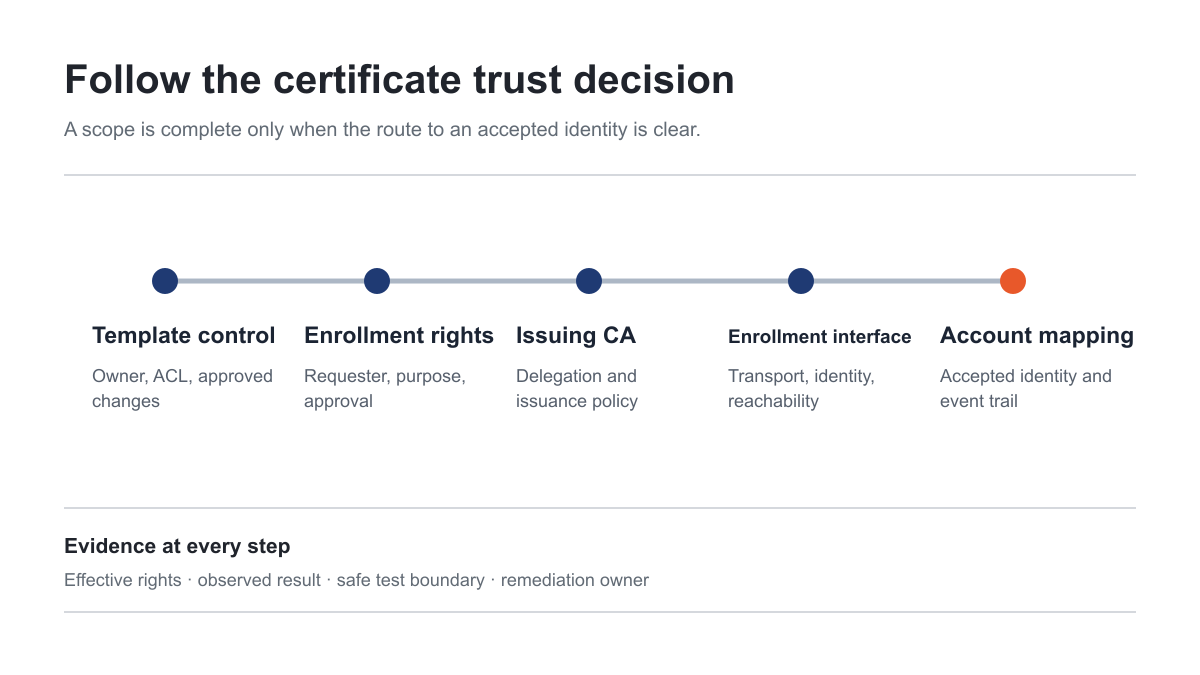
Figure 1: The review follows template control, enrollment rights, issuing CA policy, enrollment interface, and certificate-to-account mapping. Source: Microsoft, AD CS certificate template management and Microsoft Defender for Identity certificate assessments.
The diagram is a scoping model, not an assertion that all environments use every enrollment method. Identify what exists before pricing a test. Include issuing and subordinate CAs, template names and publishers, web and RPC enrollment interfaces, certificate consumers, trust distribution, and the domain controllers that process certificate-based authentication. Record whether the environment has separate forests, a managed PKI provider, or an application team operating a relying service. These details can change both authorization and who must approve testing.
Template administration and ownership
The template's owner and access control list answer who can change its settings, not just who can request a certificate. Microsoft's certificate posture assessment describes a misconfigured template owner or ACL as a route through which an unprivileged principal could modify settings. In the proposal, require the tester to examine effective rights, inherited access, delegated groups, and whether a published template's owner still fits the business process. A static list of names is not enough if group nesting or inherited permissions change the effective result.
Ask the tester to report the exact object and permission involved, the intended owner, the affected publication path, and the permission that a lower-privilege account can actually exercise. If the evidence is an ACL review only, the report should say so. If controlled validation is authorized, the test should use a reversible change on a disposable template or a separately agreed safe method. Production template changes can affect real issuance; they need explicit operational approval.
Enrollment rights and certificate purpose
Enrollment permission is not the same as the right to act as another identity. The template's subject-name rules, application policies, enrollment agent setting, manager approval, and intended certificate use have to be read together. Microsoft's Defender for Identity certificate assessments separately discuss overly permissive templates, enrollment-agent templates, requester-supplied identities, and vulnerable CA settings. That separation is useful when comparing proposals: a vendor that checks only enrollment ACLs has not assessed the issuance decision.
A useful report presents a matrix of template, enrollment population, intended certificate purpose, subject identity source, approval condition, issuing CA, and observed decision. It does not need to publish real private keys or personal identifiers. Use test accounts and redact sensitive certificate details. For any finding, distinguish a theoretical capability from a request that was actually permitted under the engagement rules.
CA administration and issuance policy
A certificate authority has permissions and settings independent of each template. Microsoft's posture page calls out CA ACL and CA configuration classes. Microsoft's Windows Server guide on securing and auditing CA administration treats delegation and audit as operating concerns, not just a one-time security scan.
The buyer should ask which delegated operators can approve or manage requests, change CA configuration, or administer the service, and whether those powers are necessary. This is a business ownership question as well as a technical one. A finding that says “broad CA rights” without naming the affected role, granted action, and practical boundary is hard to fix. A finding that says “remove a group” without checking who runs certificate renewals can create an outage.
Enrollment interfaces and transport
Enrollment can be exposed through more than the standard management console. Microsoft documents HTTP enrollment via the Certificate Enrollment Service and the Web Enrollment interface, and describes insecure IIS enrollment endpoints as a risk when NTLM is accepted without appropriate HTTPS or Extended Protection for Authentication controls. The precise risk depends on the deployed endpoint and authentication configuration. The assessment should identify which interfaces exist and whether they can be reached from ordinary user networks, remote access, or the internet.
Ask for safe verification of the endpoint's authentication mode, TLS, Extended Protection setting where applicable, and reachable network path. Do not accept a report that concludes the whole CA is safe because one web URL was unavailable. Do not accept a report that calls every HTTP endpoint exploitable without showing its actual configuration. The objective is to establish the effective enrollment boundary while avoiding live relay or identity takeover activity unless expressly approved and controlled.
Certificate-to-account mapping
Issuance is only part of the outcome. The relying system and domain controller decide what identity a certificate represents. Microsoft's KB5014754 documents the transition to strong certificate mapping and its Windows update timeline. In 2026, a proposal should not treat old weak-mapping behavior as the default without checking the actual domain controller state. It should also not promise that a template review alone proves the result of an authentication attempt.
Scope certificate mapping as an evidence question: which certificate paths are accepted, which mappings are configured, what the domain controllers log, and whether test identities map as intended. Changes to mapping behavior can affect legitimate smart-card, device, or service authentication. The buyer should require the tester to describe the production-safe method and the remediation owner's compatibility check.
Use Microsoft posture data as an input, not the final answer
Defender for Identity offers certificate posture assessments for AD CS. Microsoft states that template assessments are available when AD CS is present, while CA posture assessments require a sensor on an AD CS server. That matters in procurement. “No CA findings” can mean different things depending on sensor coverage and the scope of the product's checks.
Ask the internal team what is deployed, which CAs have sensors, and whether the proposed tester will review the posture results. A specialist can use those results to prioritize areas, but the service should answer a different question: what an identity with defined access can actually change or obtain, what the CA will issue, how the authentication system responds, and whether monitoring catches the event. Neither a score nor a tool's risk label alone establishes the complete business path.
The distinction should be explicit in the statement of work. Configuration review checks effective rights, flags and settings against a defined baseline. Penetration testing validates an allowed path through those controls with agreed test identities and evidence. Red teaming pursues a larger adversary objective, possibly using certificate paths among several routes, under different visibility and escalation rules. Buy the method that matches the decision. Stingrai's network penetration testing service can encompass the infrastructure around AD CS, while a focused AD CS scope requires the certificate authority and identity owners in the room.
A buyer scope matrix
Use this matrix in an RFP or discovery call. The “evidence” column states what a report should enable your team to check, not a promise that every test will find a flaw.
Workstream | Provide to the tester | Ask the tester to verify | Evidence to require |
|---|---|---|---|
CA and forest inventory | Forest map, issuing CAs, owners, trust boundaries | Which CA issues which published templates; delegated administration | CA and template map with scope exclusions |
Template governance | Template export, intended owners, enrollment groups | Effective owner, ACL, approval and subject rules | Effective-rights path and intended policy |
Requester access | Disposable accounts in relevant roles | Who can request which certificate and for what use | Role-by-template results with redacted requests |
Enrollment services | CES, Web Enrollment and RPC service list | Actual authentication, transport and network reachability | Interface configuration and tested path |
Authentication | Test identities, relevant DCs, mapping design | Whether issued test certificates map as intended | Controlled authentication outcome and logs |
Monitoring | CA audit and identity telemetry owners | Whether issuance and administrative changes are observable | Event trail and detection handoff |
Remediation | Change owner and maintenance windows | Whether the proposed fix preserves required issuance | Retest result and operational dependency note |
One critical distinction is coverage versus sampling. Large estates can have many templates, CA instances, and consuming applications. A quote should state what is reviewed exhaustively and what is sampled, with the sampling reason. A tester may review every published template's high-risk properties but validate only representative certificate paths. That can be reasonable if the limitations are explicit. It is not reasonable to advertise “full AD CS coverage” after testing one enrollment route and one user.
The proposal should name the initial access state. A standard domain user shows the exposure available after a common internal foothold. A delegated PKI operator shows whether administrative boundaries are narrow enough. An unauthenticated external perspective shows what the edge exposes, but cannot prove internal template governance. If the engagement combines those states, price and schedule the extra work. The starting position defines which conclusion the result can support.
Safety and change control are part of the test
Certificates can outlive the test and can be accepted by production systems. The engagement therefore needs a test certificate lifecycle. Name the disposable identities, request path, approval contact, issuance window, storage and destruction process, and method for revoking or invalidating test material. Do not rely on a cleanup promise that cannot be checked. The final report should list created test artifacts, their owners, and the status of cleanup.
The same care applies to template changes. A read-only review can usually cover broad configuration. A change to a production template or CA service should be outside routine authorization unless the platform owner approves a specific test window and rollback plan. If a reviewer can establish an effective unauthorized permission without changing the object, that may be adequate evidence. The report must label what was observed and what was inferred.
Coordinate with monitoring before the test. Microsoft's CA administration guide documents certificate request and issuance events, including event IDs 4886 and 4887. An exercise can compare the tester's activity with the SOC's event trail without making the test covert. A separate red-team objective might be appropriate if the buyer wants to measure detection under controlled notice. Neither mode should surprise the certificate operators who own production continuity.
There are also third-party boundaries. A managed CA, cloud PKI integration, or certificate enrollment service operated by a supplier may require permission beyond the company's own authorization. List those parties before testing. Confirm whether the provider permits active tests, which components are in the customer's control, and who will receive any finding. These are scope and contract questions, not a reason to skip the trust path.
What a useful report must say
The executive reader needs the consequence: which identity boundary was crossed, which business system could be affected, and what remediation decision is required. The platform team needs the path: starting principal, affected template or CA setting, required permission, observed issuance or authentication result, and the control that should have stopped it. The security operations team needs the detection evidence: request, issuance, administration and authentication events, with timestamps and test identifiers.
Require the report to separate four states:
Observed and reproduced: a permitted test identity completed an agreed action and the relevant log or result is preserved.
Configuration proves capability: an effective right or rule is present, but the team intentionally did not exercise it in production.
Potential concern requiring owner validation: documentation or a tool flag suggests a path, but a prerequisite remains unconfirmed.
Excluded: a CA, template, endpoint or trust relationship was not assessed.
This structure prevents a severe finding from being watered down by uncertainty, and prevents a theoretical result from being described as an accomplished compromise. It also makes retesting clear. If the fix is an ACL change, retest the effective right and intended enrollment. If the fix is an interface control, retest the reachable path and successful legitimate enrollment. If the fix is a mapping change, retest both the prohibited and intended authentication cases.
The report should include a remediation sequence. Remove an unnecessary privilege only after identifying its operational owner. Tighten a template through a pilot group before moving all requesters. Harden an enrollment endpoint after confirming how clients reach it. Microsoft's template management instructions emphasize a pilot workflow and narrowly scoped testing for template changes. A useful pentest report turns that principle into a change plan the Windows team can execute.
Compare proposals on decision quality
An AD CS line item can be priced very differently because vendors include different work. One proposal may be a template export review. Another may include CA administration, enrollment interfaces, controlled certificate requests, and authentication validation. A third may bundle AD CS into a broad network test with limited hours. Compare scope before comparing totals.
Ask each vendor to answer:
Which CAs, templates, forests, domains and enrollment protocols are included?
Will the tester examine effective rights, or only direct entries in a configuration export?
How will the team handle template owners, delegated CA roles, and enrollment agents?
What test accounts and certificates are needed, and who approves their use?
Which paths will be validated live, and which will remain read-only?
Will the result include certificate-based authentication mapping, or stop at issuance?
How will the team distinguish a Defender for Identity posture flag from a proven path?
What production changes are prohibited without an explicit change window?
What artifacts will be cleaned up and how will cleanup be evidenced?
How are findings delivered, fixed and retested?
The quote should identify scheduling dependencies. An AD CS test may need a PKI owner, an Active Directory administrator, an application owner for relying services, and a SOC contact. Access to only one of those groups may turn the engagement into a partial review. Document that limit at the outset. A vendor who asks for the trust map and safe test identities before estimating work is gathering the inputs needed for a defensible scope.
Avoid invented universal prices. The cost depends on the number of issuing CAs and forests, published templates, enrollment interfaces, identity roles, and validation depth. A standalone test of one PKI deployment and a complex multi-forest test cannot share a meaningful fixed quote. Stingrai quotes AD CS and network work through Get a Quote; its publicly listed fixed web application packages cover a different scope.
Where Stingrai fits
Stingrai is a CREST-accredited penetration testing company founded in Toronto. Its Active Directory penetration testing covers misconfigurations, access control paths, Kerberos and delegation, and privilege escalation. A focused AD CS workstream can be scoped with those identity paths in mind, with the exact CA, template, enrollment and authentication coverage agreed before testing. This is a human-led network and identity engagement. Snipe's autonomous work is for web applications and associated APIs, not AD CS or network devices.
Two named penetration testers from a team holding OSCE³, OSWE, OSEP, CREST CRT and CISSP certifications work on every human-led engagement, with review by a team lead and engagement partner. Confirm the assigned team's AD CS experience and the safe validation plan during scoping. Every confirmed finding is posted to Stingrai's PTaaS portal as it is found, with remediation guidance; live chat, redactable reports, and retesting support the platform team. An organization can buy a one-time annual assessment or a continuous program, depending on the PKI change cadence and evidence needs.
The output supports a security or compliance program by documenting tested identity controls and remediation. It should also help the platform owner decide which privileges and certificate paths to change first. The strongest engagement is the one whose evidence can be replayed safely after the fix without repeating unnecessary issuance or disrupting the CA.
Frequently Asked Questions
What should an AD CS security assessment include?
An AD CS security assessment should cover the issuing CAs, published templates, template ownership and ACLs, enrollment rights, CA administration, enrollment interfaces, certificate-to-account mapping, monitoring, and a safe retest plan. The exact active tests depend on the authorization and production constraints. A proposal should name any excluded CA, forest, endpoint or relying system.
Is an AD CS assessment the same as an Active Directory penetration test?
No. An AD CS assessment concentrates on certificate issuance and trust decisions. An Active Directory penetration test can also cover wider access controls, delegation, Kerberos, systems and lateral movement. AD CS may be one workstream in that larger engagement, but it needs explicit certificate-specific coverage to support a conclusion about PKI risk.
Does Microsoft Defender for Identity replace an AD CS penetration test?
No. Microsoft's posture assessments identify certificate-related configuration risks, and Microsoft says CA posture assessments require a sensor on an AD CS server. A penetration test can validate selected effective paths with permitted identities and explain the business consequence and remediation. The posture output is valuable input to the test.
Can the test be done without changing production templates?
Yes, much of the assessment can examine permissions, policy and endpoint configuration without a production change. Controlled certificate requests and authentication checks can use agreed test identities. A finding that would require a risky production change to demonstrate can be reported as configuration-proven capability, with the limitation stated clearly.
Should enrollment web services be included?
Include them if they exist and are in the engagement's authorized scope. Microsoft's AD CS certificate assessments specifically cover insecure IIS enrollment endpoints. Their transport, authentication and network reachability can change the effective trust boundary. A template-only review would miss that part of the decision.
How should a vendor handle certificate mapping changes?
The vendor should check the actual domain controller behavior against the intended mapping design, using approved test identities and logging. Microsoft's KB5014754 documents changes to strong mapping enforcement. The remediation plan must also protect legitimate device, user and service certificate use.
How much does AD CS penetration testing cost?
There is no reliable universal price for an AD CS test. Ask for a quote based on the number of CAs and forests, templates, enrollment routes, test identities, and the depth of live validation. Compare what each proposal includes before comparing fees. A template-only review and a full issuance-to-authentication test are materially different purchases.
What evidence should we keep after the test?
Keep a redacted scope map, the test identities and approved boundaries, each effective permission or policy path, the observed result or clearly labelled inference, CA and authentication events, remediation owner, cleanup record, and retest result. This evidence helps engineers fix the issue and supports later security or audit review without exposing private keys.
Related reading
References
Microsoft. Manage Certificate Templates in Windows Server. Read 15 November 2026.
Microsoft. Request and Renew AD CS Certificates. Read 15 November 2026.
Microsoft. Defender for Identity Security Posture Assessments. Read 15 November 2026.
Microsoft. Certificates security posture assessment. Read 15 November 2026.
Microsoft. Secure, Delegate, Audit AD CS Administration. Read 15 November 2026.
Microsoft. KB5014754: Certificate-based authentication changes on Windows domain controllers. Read 15 November 2026.
Talk to Stingrai
Bring your CA and template inventory, the identity outcome you need to prove, and the operational limits to Get a Quote or book a free discovery call. Stingrai can scope the AD CS workstream within a human-led Active Directory or internal network penetration test.