CISA's StopRansomware Guide recommends offline, encrypted backups and regular tests of their availability and integrity. It also warns that attackers seek credentials and accessible backup solutions. A backup infrastructure network penetration test asks a distinct, practical question: from an approved internal starting position, who can reach the backup control plane, repositories and service identities, and what could that access change?
Quick answer. Scope a backup infrastructure penetration test around the management console, backup proxies or agents, repository access, privileged service identities and any cloud vault control plane. Give the tester safe accounts and non-production proof objects, then require observed allowed and denied paths, configuration context, owners and retest conditions. Stingrai can deliver this as human-led internal network penetration testing without deleting recovery points or interrupting scheduled jobs.
This guide is for security leaders, infrastructure owners and procurement teams protecting backup systems in mid-market and enterprise environments. It is a buyer's scope for a bounded network and privilege assessment, not a restoration exercise or a ransomware simulation. The ransomware readiness guide addresses the wider prevention, detection, response and recovery program. Here the objective is to prove whether an ordinary or compromised-path identity could reach a protected backup capability through a network or authorization weakness.
Decide which backup boundary matters
“Test the backup server” is too narrow to describe modern backup infrastructure. A console may control jobs and retention. A proxy or agent may have permitted access to protected workloads. A repository may store recovery points. An identity provider may grant a service account or administrator broad rights. A cloud vault may have separate authorization for configuration, deletion and restore operations. The buyer should map those components and then state the protected business decision: which lower-trust identities must be prevented from changing backup policy, touching stored copies or controlling recovery?
The test should begin with a defined starting position. An ordinary employee workstation, an approved low-privilege service account, a contractor support route and a backup operator account each answer different questions. Testing only with a global backup administrator proves little about privilege separation. Testing only from the internet may miss an internal management path that attackers could reach after another foothold. The statement of work should select the positions most relevant to the organization's threat model and explain why.
The protected outcome also needs a safe proxy. The tester should not delete a backup to prove deletion rights, change production retention to prove policy access or force a restore into a live environment. A disposable test job, empty or synthetic repository object, read-only effective-permission review, or supervised action in a lab may establish the boundary. If a capability cannot be exercised safely, the report should say it is configuration-supported rather than observed. The distinction is central to honest evidence.
NIST SP 800-209 treats storage security as including authentication, authorization, data protection, isolation and restoration assurance. A network test focuses on the access and isolation portions while noting dependencies on recovery. A buyer should not infer that a protected network route proves the backups can restore a critical service. Likewise, a successful restoration test does not prove an ordinary domain account cannot reach the backup console.
Map the management, data and identity paths separately
Backup systems usually have several paths that should be documented in the scope. The management path lets administrators create jobs, alter settings and inspect status. The data path moves information between protected workloads, proxies and repositories. The identity path grants people and service accounts their effective permissions. A cloud vault may add a provider control plane and a separate resource-authorization layer. These paths can cross different networks and teams.
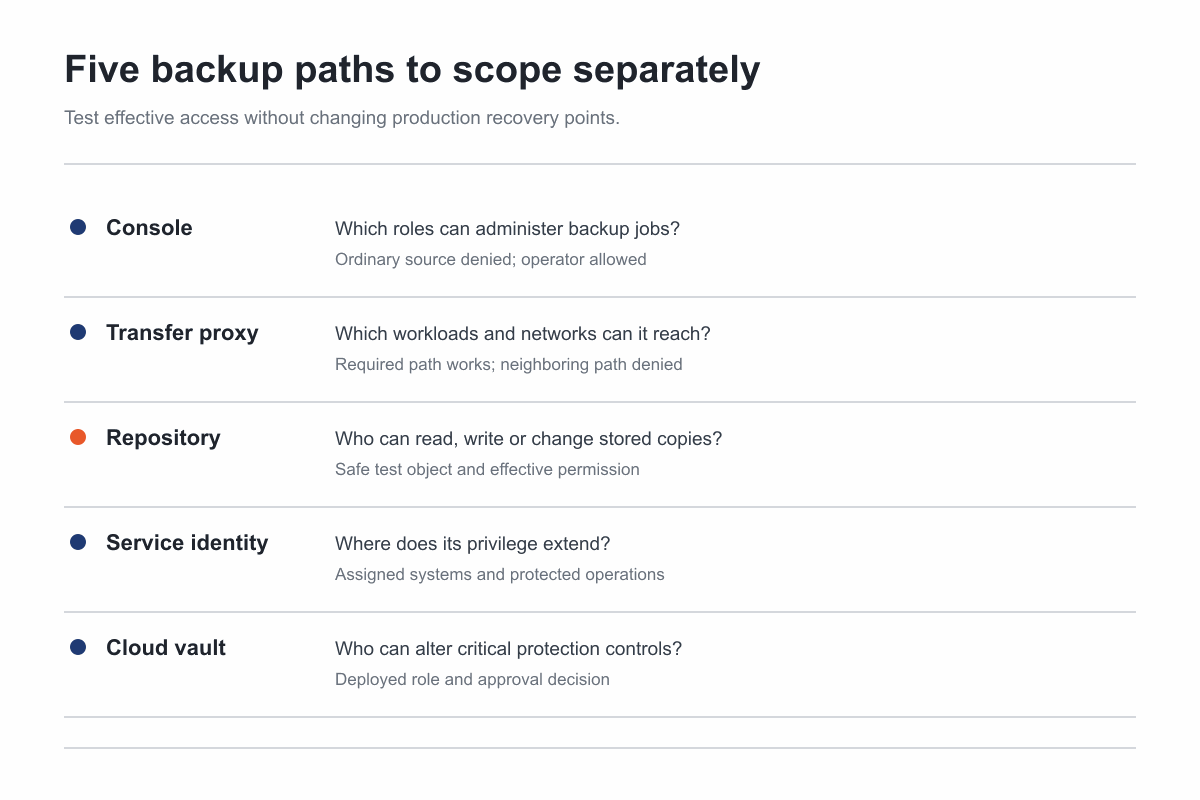
Figure 1: A buyer scope separates console, transfer, repository, service-identity and cloud-vault paths before asking what a low-trust principal can reach. Source: CISA, StopRansomware Guide, NIST SP 800-209, and Microsoft Azure Backup security overview.
Do not collapse all backup traffic into “the backup VLAN.” A service account may be allowed through an identity policy even if a workstation is blocked by a firewall. A proxy may have broad access to production networks because it must read protected workloads. A repository may accept traffic from proxies but not from ordinary server segments. A backup admin may reach a cloud vault through a management API rather than a private subnet. The test plan should state which control makes each decision and how the assessor will observe it safely.
The buyer's initial architecture packet can be redacted. It may identify roles, network zones, product families, cloud providers and the number of materially different sites without listing private addresses in a public document. After contracting, detailed diagrams and test credentials can be shared through a secure channel. The public article's examples are generic; no customer environment or live backup metadata belongs in marketing copy.
Console and management access
The console is an administrative decision point. The tester should identify which network sources can reach it, which accounts can sign in, and which roles can view status, change jobs or alter repository policy. The engagement need not attempt destructive action to show an overbroad role. A supervised read-only permission review and a safe test object can reveal whether a lower role has a capability it should not have. The report should name the approved role and expected result before classifying a finding.
Remote support paths deserve attention. A vendor may have legitimate access to troubleshoot backup jobs, but that route should have an owner, a purpose and a narrower privilege than full recovery administration where possible. If the same console is available from a standard user network, the buyer should ask whether that exposure was intended. A network reachability result is not the whole finding; the assessor should connect it to the actual authentication and role boundary.
Some consoles control multiple sites or business units. The proposal should identify whether a role can affect only its assigned jobs or broader infrastructure. A single central console may be a high-consequence point even if only one IP address is in scope. Conversely, several identical proxies may require a representative sample rather than full duplication. Price the decision paths and policy variation, not merely the host count.
Proxy, agent and workload access
Backup proxies and agents connect to systems that ordinary users may not reach. They may be located near protected workloads or have service permissions that span virtual machines, databases and file shares. The buyer should ask which direction each connection is initiated, what identity it uses, and whether a compromised low-trust host could use that route to reach protected systems or interfere with backup operations. These are architecture questions for the scope, not claims about a particular vendor product.
A safe test can verify that only approved proxies reach a representative protected workload service and that an ordinary source does not. It can also examine whether a proxy's management interface is exposed to unintended networks. The tester should avoid high-volume probing of a live backup window. Agree on a test host or service that represents the path and let the backup owner confirm the expected policy. If the proxy uses a different route at another site, sample that variation explicitly.
The underlying workload might itself be vulnerable, but a backup network test should not silently become a database or hypervisor pentest. If the buyer wants those layers assessed, add named workstreams. The backup scope is about the privileged route and its controls: who can use it, what it reaches and whether it can be constrained without breaking protection of the workload.
Repository and storage access
The repository is where the access question becomes most consequential. CISA warns that attackers try to find and delete or encrypt accessible backups. The assessment should establish which sources and identities can read, write, change or administer stored recovery points. A repository that is reachable only by an approved backup service has a different risk profile from one exposed to general user or server zones. The test should examine both network reachability and the effective storage permission.
The rules of engagement must prohibit deletion, encryption, retention change and production restore unless separately approved in a controlled environment. A synthetic test object can show whether a role has read or write capability. Where the risky operation cannot be safely exercised, use permission and configuration evidence and label the conclusion accordingly. A screenshot of a repository path is not proof that its contents are safe, and a blocked port is not proof if a different protocol or management path remains available.
Storage isolation may be physical, network, logical or operational depending on the architecture. NIST SP 800-209 discusses isolation and restoration assurance as storage-specific security concerns. The buyer should identify the isolation claim it relies on: an offline copy, an immutable copy, a separate identity boundary, a segmented repository, or a combination. The tester can validate the parts that are in scope while recording what a recovery owner must prove separately through restore testing.
Service accounts and privileged identities
CISA's guide says attackers seek stored credentials and use them to reach backup solutions. The buyer should therefore include backup service identities and administrative groups in the test scope. Ask for a map of who can administer jobs, repositories and cloud vaults; which service identities are assigned to proxies or agents; and which identities have rights outside the backup system. A service account with broad workload privileges may be necessary for its job, but the scope should test whether those privileges are constrained to the relevant systems and whether ordinary users can obtain or use that account through an unintended route.
The assessor can review credential handling and effective permissions without collecting real secrets into a report. Use redacted configuration, test identities and supervised access where possible. Do not publish account names or credential material. A finding should explain the starting privilege and resulting backup capability, with enough private evidence for remediation. If the test intentionally stops before using a powerful credential, say so. The report should not imply an action was performed when only a possible permission path was identified.
Identity can also control cloud backup resources. If the environment uses Microsoft Azure Backup, Microsoft's security overview describes immutable vault settings, soft delete and multi-user authorization as distinct protective controls. A buyer can ask whether the deployed vault's effective roles and critical-operation approvals match its policy. The assessor must check the customer's actual configuration and supported feature state; the existence of a Microsoft feature in documentation does not prove it is enabled.
Define safe allowed and denied cases
The following matrix is an original buyer tool, not a prescribed CISA or NIST test procedure. Replace each generic position with the organization's actual policy and approved test identities.
Starting position | Intended boundary | Safe evidence to request | Adjacent allowed case |
|---|---|---|---|
Ordinary employee network | No direct backup-console administration | Low-volume reachability and role result | Backup operator can reach console |
Restricted support account | Only assigned backup status or support action | Effective role on a synthetic job | Assigned operator completes safe task |
General server zone | No repository write or deletion capability | Representative network path and permission review | Approved proxy can write test object |
Backup proxy | Can reach named workloads only | Selected allowed and denied destination paths | Scheduled test job still functions |
Cloud backup reader | Cannot change vault protection controls | Resultant role and safe control-plane check | Approved owner can make a harmless change |
The matrix needs a destination that is available during the test. A failed connection to a powered-off repository host cannot establish that segmentation held. A denied login due to a bad password does not prove the lower role lacks the protected operation. Ask the tester to distinguish a network denial, authentication failure, authorization decision and unavailable target. The evidence should include the source identity or zone, target role, expected policy, observed result and limitation.
Pair the denied case with a permitted control. If the ordinary workstation is blocked from the console, confirm that a backup operator's approved management route still works. If the general server zone cannot write to a repository, confirm that the approved proxy can create a synthetic test object. This makes the finding actionable and the retest safe. A rule that blocks all backup traffic would satisfy a naive “deny” check while undermining recovery.
The assessor should also identify which logs can corroborate the path. Backup application audit events, identity sign-in records, firewall decisions and cloud control-plane logs may each describe a different part of the event. A penetration test need not turn into a full SOC exercise, but if the buyer wants detection evidence, specify which event and response should be measured. A missing audit source and an analyst who missed a collected event are different findings.
Compare the right services before asking for a quote
A backup infrastructure network penetration test examines reachable paths and privilege boundaries. A backup configuration review compares settings with a hardening baseline. A restoration exercise proves whether the organization can recover a service from its copies. A ransomware red-team exercise may test defender detection and response to a broader objective. These services can complement one another, but their conclusions should not be merged. A buyer should name which result it needs now.
NIST SP 800-34 Rev. 1 is a contingency-planning guide focused on recovery priorities and planning. CISA calls for regular tests of backup availability and integrity. Those sources support the need for owner-led restoration evidence, which is outside the narrow network pentest unless explicitly added. The penetration tester can show that a lower-trust account cannot reach a repository; the recovery team still needs to demonstrate that an approved restore works under its own plan.
A vulnerability scan is another input, not a substitute. It may identify an exposed service or software defect on a backup server. It cannot establish that service identities are appropriately limited, that a cloud vault's critical operation needs the right approval, or that a repository is unreachable from an ordinary workstation while the proxy path remains functional. The buyer should compare vendors on the effective decisions they will test and the evidence they will return.
The existing enterprise segmentation guide addresses many protected zones. This backup guide goes deeper on the console, proxy, repository, service-account and cloud-vault paths because those assets have special operational consequences. A broad internal test might identify backup systems as a critical target, but it should not claim full backup-path coverage unless those components and safe proof cases are written into the statement of work.
What to put in the request for proposal
Send vendors a redacted architecture showing backup product family, sites, protected workload classes, management and repository zones, cloud vaults, identity providers and operational windows. State which roles can be supplied as test accounts, whether a synthetic job or repository exists, and which production actions are prohibited. The provider should return a path matrix with inclusions, exclusions, sample rationale and evidence standards.
Ask which positions the tester will start from. An employee workstation, a backup operator account, a support identity, a proxy network position and a cloud reader role may all be useful, but the right set depends on the buyer's threat model. Ask how the provider will safely establish both allowed and denied access. If it cannot get a test identity or destination, the proposal should say whether it will infer a result from configuration and how that limitation will appear in the report.
Specify who owns each control. IAM may own group membership. Backup operations may own console roles and jobs. Storage administrators may own repository permissions. Network engineering may own segmentation. Cloud platform owners may own vault policies. A multi-team finding needs a clear primary fix owner and a retest window. A report that says “backup is exposed” without the effective route or owner leaves the buyer unable to act.
Compare quotes on the amount of policy variation. A small estate may have one console and one repository pattern. A large organization may have separate sites, backup products, cloud subscriptions, outsourced operations and exceptional privileged routes. The number of protected VMs is not enough to estimate the test. Ask for the selected path classes, role types, safe validation points and report artifacts. A lower fee for only a host scan is not comparable with a path-and-privilege assessment.
Production safety and evidence handling
Backup systems are sensitive to timing and load. The rules of engagement should identify backup and replication windows, test rate limits, maintenance freezes, stop contacts and any fragile appliance or repository. Avoid credential spraying, high-volume enumeration, destructive changes, deletion of recovery points, changes to immutability or retention, and unsolicited restores. If a control cannot be proven without one of those actions, use a disposable lab or document the limitation. A production network test can still provide substantial evidence through controlled accounts and low-impact paths.
Keep test data synthetic. A marked empty job, small harmless file, or purpose-built test vault can show a permission boundary without exposing employee or customer content. The report should not include private repository paths, secrets or actual backup data in a public-facing excerpt. Sensitive technical evidence belongs in the contracted secure portal with an agreed retention policy. Any temporary test account or object should be removed or handed back explicitly at closeout.
Do not overstate “air gap” or “immutable” from a single observation. CISA recommends offline backups, and Microsoft documents vault controls, but the deployed architecture determines whether a copy is truly out of reach of a particular attacker path. A network assessment can test selected reachability and authorization. It cannot prove that every recovery point survives all possible administrator or provider actions. The report should state precisely which copy, control and starting privilege it evaluated.
After a fix, repeat the failed path and a legitimate backup path. If the user zone is blocked from the console, check that the backup operator still manages the synthetic job. If a service identity is narrowed, check that its necessary backup operation still completes on the test workload. If a cloud-vault role is changed, check the forbidden critical operation remains denied and the approved control-plane action works. A retest that checks only the denial can leave an operational failure hidden.
What the final report should let you decide
The executive summary should answer whether an ordinary or lower-trust starting position could reach a backup capability that the organization meant to protect. It should name the tested component, path and consequence, with scope limits. The technical report should classify observed access, configuration-supported possibility and untested paths separately. A clean scan of backup hosts is not a conclusion about repository isolation, service-account rights or cloud-vault administration.
For every material finding, require the starting role or source zone, target console or repository, intended policy, observed action or path, evidence, likely owner, safe fix criterion and retest result. The report should also say which scheduled jobs or protected workload classes were represented and which were excluded. That lets security leadership understand whether the test covered the backup service that matters most to recovery planning.
If the organization needs broader ransomware assurance, combine this result with owner-led restoration evidence and, where justified, a controlled red-team exercise for detection and response. The backup network test is a strong input to that program because it identifies whether access to recovery infrastructure is restricted. It is not a substitute for proving that a critical service can actually be restored.
Cost and timing follow the trust decisions
There is no defensible universal price for a backup infrastructure penetration test. Effort changes with the number of distinct consoles, proxies, repositories, sites, identity domains, cloud vaults and policy exceptions. The need for synthetic jobs, supervised access, maintenance windows and a coordinated retest also affects the schedule. Ask the vendor to enumerate these assumptions rather than attach a flat fee to every backup client or protected VM.
A fixed fee can be useful when the path set is clear. The proposal should state which role and network starting positions it includes, how many component patterns it samples, which safe actions it will perform and which recovery operations remain outside scope. If a second product or cloud tenant appears during discovery, the provider should explain whether it is covered or needs a separate workstream. This prevents an ambiguous “all backups” promise from becoming a thin review.
Preparation is often the critical path. IAM may need to create low-privilege test accounts. Backup operations may need a synthetic job and a quiet window. Network teams may need a listener in a protected zone. Cloud owners may need a restricted test role. The schedule should separate that access preparation from fieldwork, preliminary findings, final reporting and retesting. An engagement started before the fixtures exist can spend its assessment time waiting rather than producing evidence.
Stingrai offers tailored network assessment quotes through Get a Quote. Its public fixed web application pricing covers one web application and associated APIs and is not a price for backup infrastructure. A path map and role matrix give a more accurate basis for this quote.
Where Stingrai fits
Stingrai is a CREST-accredited penetration testing company founded in Toronto. Its human-led internal and external network penetration testing can assess the backup management, repository and identity paths agreed in scope. The buyer and assigned testers can select representative starting positions, safe test objects and explicit prohibitions on production recovery actions before fieldwork begins.
Two named penetration testers from a team holding OSCE³, OSWE, OSEP, CREST CRT and CISSP certifications work on every human-led engagement, with team-lead and engagement-partner review. Confirmed findings are posted to Stingrai's PTaaS portal with remediation guidance during testing and can be discussed through live chat. Reports are redactable, and retesting is included. An organization can choose a one-time annual assessment or a continuous program where its backup infrastructure and access policies change frequently.
This is human-led infrastructure testing. Snipe, Stingrai's autonomous agent, tests web applications and associated APIs; it is not a backup console or repository tester. If an exposed backup management web interface has application logic that also needs a web application penetration test, name that separate layer. The report is more useful when network reachability, role permissions and application behavior each have a clear proof standard.
Frequently Asked Questions
What should backup infrastructure network penetration testing include?
It should include the backup management console, proxy or agent paths, repository access, service and administrator identities, and any cloud vault control plane relevant to the buyer's objective. Use defined low-trust and approved starting positions, synthetic proof objects, expected allow and deny results, production safety limits and retesting. The report should separate observed paths from configuration inference.
Is a backup server vulnerability scan enough?
No. A scan may identify exposed services or possible software weaknesses, but it does not prove who can administer jobs, write to repositories, use privileged service accounts or alter cloud backup controls. A path-and-privilege test connects the starting identity or network zone to the effective protected capability and its owner.
Does this test prove that our backups will restore?
No. A network penetration test evaluates selected access and isolation boundaries. An owner-led restoration exercise is needed to show whether copies are available, intact and capable of restoring a critical service under the recovery plan. CISA recommends regular tests of backup availability and integrity; the two activities answer different questions.
Must a tester delete a backup to prove risk?
No. Deleting recovery points or changing production retention is usually unnecessary and unsafe for a scoped network assessment. A disposable object, safe role check, read-only configuration review or supervised lab action can establish the permission path. The report should label capability that was inferred rather than actually exercised.
Should the test include backup service accounts?
Yes, if they are part of the protected path. CISA warns that attackers seek credentials to access backup solutions. The scope should identify which service identities can reach workloads, consoles and repositories, how their rights are granted, and whether a lower-trust principal could use or control them. The report should not include live secrets.
How should cloud backup vaults be scoped?
Name the provider, tenant or subscription, vaults, effective roles and critical operations the buyer wants tested. Microsoft Azure Backup, for example, documents immutability, soft delete and multi-user authorization as distinct controls. The tester should validate the deployed feature state and permissions safely; documentation alone does not show what a particular customer's vault enforces.
How much does backup infrastructure penetration testing cost?
There is no reliable universal price. A quote depends on distinct consoles, proxies, repositories, sites, identity domains, cloud vaults, exception routes, safe proof requirements and retest scope. Compare vendors on their path matrix and evidence, not just the number of protected VMs or IP addresses.
What should the retest demonstrate?
It should repeat the original unwanted route or privilege and a necessary authorized backup path after remediation. The low-trust source should remain denied while the approved operator or proxy can still complete its safe test operation. The report should record the new observed result, control change and any remaining limitation.
Related reading
References
CISA. StopRansomware Guide. October 2023 version. Read 15 November 2026.
NIST. SP 800-209: Security Guidelines for Storage Infrastructure. Final October 2020. Read 15 November 2026.
NIST. SP 800-34 Rev. 1: Contingency Planning Guide for Federal Information Systems. Final May 2010, updated November 2010. Read 15 November 2026.
NIST. SP 800-115: Technical Guide to Information Security Testing and Assessment. Final September 2008. Read 15 November 2026.
Microsoft. Overview of security features in Azure Backup. Read 15 November 2026.
Talk to Stingrai
Share the backup architecture, selected low-trust identities, protected console and repository paths, cloud vaults and safe proof limits through Get a Quote or book a free discovery call. Stingrai can scope a human-led backup infrastructure network assessment around the access decisions you need to prove.