





NIST's guide to full virtualization security treats the hypervisor, management system, guest operating systems, applications, storage, and virtual network as connected security components. A VMware vSphere penetration test should turn that architecture into testable boundaries: who can control vCenter, who can reach ESXi directly, what virtual machines can reach, and what a lower-privilege operator can do to workloads or data. A scan of host IP addresses answers only part of that question.
Quick answer. Scope a vSphere penetration test around vCenter roles and API access, direct ESXi management, virtual switch and segment behavior, VM or datastore privileges, and the operational interfaces used by backup or automation systems. Give the tester defined starting identities and safe success criteria. Stingrai can include vSphere in a human-led internal network penetration test, with explicit limits for production workloads and remediation retesting.
This guide is for security leaders, virtualization teams, and procurement owners buying an assessment of an enterprise vSphere estate. It does not assume that a customer is running a particular vSphere version, storage product, or network overlay. The proposal must identify the deployed version and architecture. A generic “VMware pentest” line item conceals too many material differences to compare fairly.
Decide which boundary the test must prove
The first decision is the consequence you need to understand. If a standard IT administrator can view inventory, can that account also operate sensitive VMs? If a contractor has access to a management jump host, can it reach ESXi interfaces that are supposed to be isolated? If two application tiers are placed in different virtual network segments, does the observed path match the intended rule? If the backup platform has vCenter rights, what operations are possible from its service identity? Each question points to a different starting position and a different evidence set.
Frame the requested outcome as a sentence the vendor can test. Examples:
A read-only vCenter user cannot change VM configuration, access a console, or expand privileges through inherited roles.
A user on an ordinary internal subnet cannot reach a host management interface that is reserved for platform administrators.
A backup integration account can perform its intended work without broad administrative control over unrelated workloads.
A VM in a less trusted segment cannot reach protected VM or storage management paths.
A change to an ESXi host's access mode is visible to the people responsible for detection and operations.
These are buyer objectives, not assertions about the target environment. The assessment should also record what is intentionally out of scope. “No VM escape observed” is not a meaningful conclusion if the test never attempted an authorized isolation evaluation. Equally, a buyer may have no reason to authorize disruptive hypervisor exploitation to answer a privilege or network path question. The safer and more useful scope proves the effective control that matters to the business decision.
Separate the four vSphere test planes
The architecture is easier to buy when the proposal names four planes. NIST's hypervisor guidance distinguishes resource isolation and the virtual network. Its virtual-network guide specifically addresses segmentation, traffic control, path redundancy, and monitoring. Broadcom's documentation adds the platform-specific differences between vCenter and direct ESXi access.
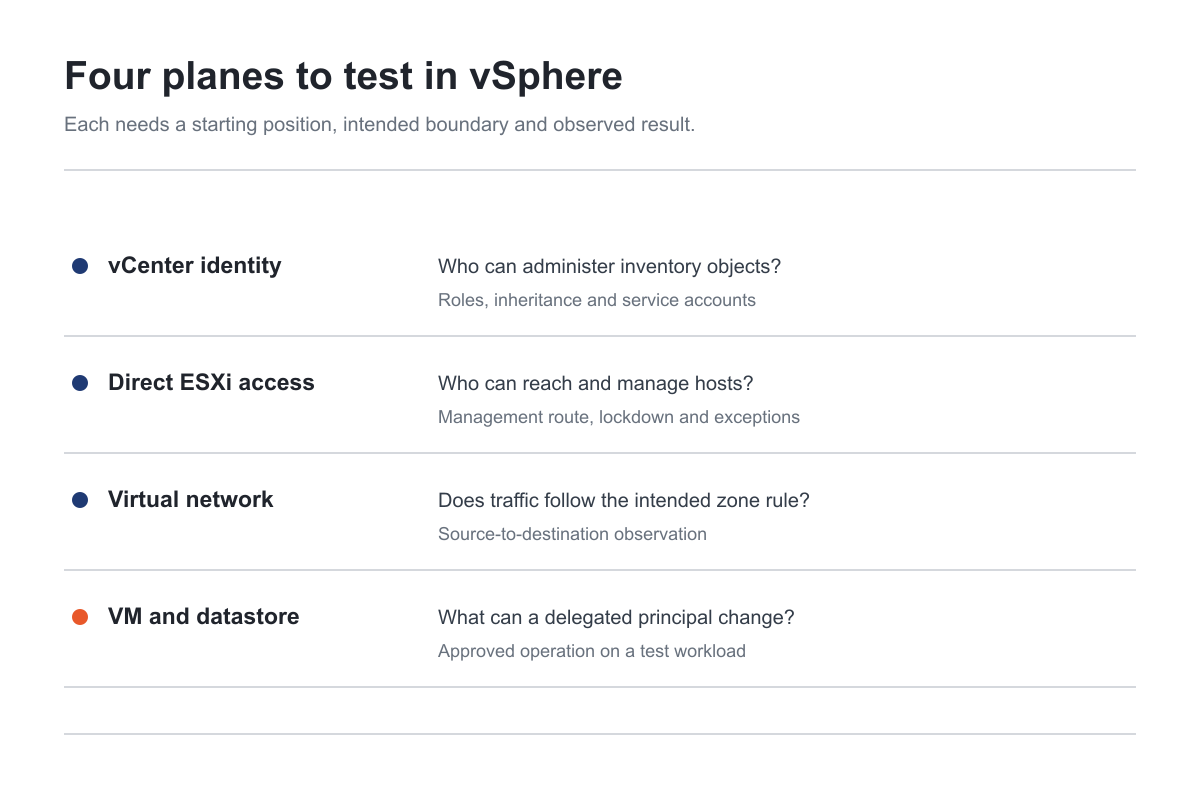
Figure 1: A vSphere scope separates management identity, direct host access, virtual network paths, and VM or datastore operations. Source: NIST SP 800-125, NIST SP 800-125B, and Broadcom vCenter and ESXi permission guidance.
vCenter identity and control
vCenter is the management point through which many VM operations are performed. NIST notes that the virtualization management system can start guests, create images, and administer the environment, so its access deserves particular care. A buyer should ask the tester to map identity sources, roles, object inheritance, service accounts, and API or automation routes. A single inventory export of named roles does not show the effective permission a person or integration receives on a particular object.
The test should start with several agreed roles, such as a read-only analyst, a delegated application owner, a virtualization operator, and a service identity. The vendor need not receive production administrator credentials to establish whether a lower-privilege role can cross a boundary. It may need a platform owner to confirm which operations are intended. Require evidence that connects a principal, its effective role on the relevant inventory object, the operation it could perform, and the business system that would be affected.
Broadcom explains that vCenter permissions and direct host permissions differ. This is a crucial scoping distinction. A report that reviews only vCenter can miss direct ESXi access. A report that scans ESXi services can miss excessive rights inside vCenter. Make the vendor list both control paths separately.
Direct ESXi host access
ESXi management is more than a list of open ports. The assessment should identify how administrators reach each host, what network locations are allowed, which local or directory accounts retain direct access, and how emergency access is handled. Broadcom's lockdown-mode guidance describes normal and strict modes with different recovery implications. Broadcom's exception-user guidance says explicitly listed accounts can retain direct access while lockdown mode is active.
This is an excellent example of why a pentest and a configuration review must meet. A configuration might show lockdown mode enabled, yet an exception account or separate management route may still provide the access a buyer intended to restrict. Conversely, aggressively enabling strict lockdown during a test can interfere with recovery. Ask the tester to evaluate the deployed mode and exception list without changing them unless a separately approved change window exists.
The evidence should name the host group, access source, permitted administrative path, effective direct-login rule, and any exception. A representative host sample is often practical, but the proposal must explain how it covers differences in cluster, site, version, operations team, and exception pattern. A host managed by a different vCenter or operated through a separate support channel may not be represented by the standard sample.
Virtual network and segmentation
Virtual networks create paths that may not be visible to a physical network review. NIST SP 800-125B addresses virtual segmentation, firewalls, traffic monitoring and path redundancy as distinct configuration areas. For a vSphere assessment, ask the vendor to compare the intended zone boundary with observed reachability from approved test VMs. Include both the virtual configuration and the upstream physical controls where the ownership crosses teams.
The test plan should specify representative source and destination pairs: user VLAN to management, application tier to database tier, tenant or business-unit segment to another, backup network to workload network, and guest VM to infrastructure service. These are examples to choose from, not a mandate to probe every VM. The buyer supplies the expected policy and the vendor observes whether the permitted traffic matches it. A good finding identifies the source, destination, allowed service, effective path and control owner.
Keep this distinct from a broad network segmentation test. The vSphere workstream adds the virtual switch, port group, distributed switch, host uplink, and management identity context that determines who can change the boundary. If the environment uses a separate software-defined networking platform, name it explicitly in the scope; do not assume it is included because the proposal says “vSphere.”
VM, datastore and integration operations
Permissions on VMs and their supporting storage determine whether a principal can inspect, change, copy, or interrupt a workload. The test should ask what the defined low-privilege roles can do with a sensitive VM, its configuration, its console, its virtual disks, and its snapshots, within safe limits. The purpose is to test the administrative boundary, not to extract confidential customer data or alter a production server.
Automation deserves a separate row in the scope. Backup, monitoring, orchestration and infrastructure-as-code systems may have service identities that call vCenter or manage hosts. Those integrations are often necessary, but they can acquire broad rights over time. Ask the tester to assess their granted role, credential handling and reachable management path. Where the backup system itself is in scope, state that explicitly. A vSphere test should not silently become a backup-platform pentest or, conversely, ignore an integration identity that has decisive vCenter rights.
NIST's full virtualization guide is useful here because it treats storage, guest operating systems and applications as part of the security picture. It does not mean one vSphere quote automatically includes a full pentest of every guest application. Draw the boundary in writing. A VM's internal web app belongs in a web application test if that is the desired outcome. The vSphere assessment asks whether the platform's controls protect that VM as an object and a network participant.
What to give vendors before asking for a quote
A vendor cannot price a serious vSphere assessment from a single host count. Provide an inventory that describes the management architecture, not a secret-bearing configuration dump. The initial packet can contain:
The vSphere and vCenter versions, management domains, sites and clusters in scope.
The number and type of ESXi hosts, including exceptions that differ from the baseline.
Which identity providers and privileged access paths administer vCenter and ESXi.
A role map for people, service accounts and support vendors, with intended permissions.
The virtual network zones and a short list of boundaries the test must prove.
Which VM and datastore operations can be demonstrated with disposable workloads.
The network locations from which the tester will start.
Planned maintenance, backup and recovery windows.
Third-party components that require separate testing permission.
A redacted diagram of management, storage and virtual network connectivity.
This is a scoping packet, not a public appendix. The vendor can receive sensitive details through the agreed secure channel after contracting. Avoid placing credentials, private IP inventories tied to sensitive systems, or customer data in a marketing document or a public article. The blog's matrix is generic; the engagement's actual map remains confidential.
The proposal should then state which controls are reviewed and which are validated. Reviewing a role definition is not the same as checking the effective action from a delegated account. Inspecting a distributed switch's settings is not the same as observing whether a VM can reach a protected service. A credible quote makes that difference visible, states how many representative paths it will test, and explains its sampling method.
A proposal comparison worksheet
Buyer question | Minimum answer from the vendor | What would make the answer weak |
|---|---|---|
Which management points are in scope? | Named vCenter instances, host groups, entry paths and exclusions | “All VMware” with no asset map |
Which identities are tested? | Defined human and service roles with starting permissions | Only a global administrator account |
Is direct ESXi access checked? | Host login routes, lockdown mode, exception users, source networks | A vCenter-only role export |
Are network boundaries observed? | Selected source and destination pairs with expected policy | A port scan without a zone model |
Are VM privileges exercised safely? | Disposable or approved test workloads and listed allowed operations | Production changes without a rollback plan |
Are integrations included? | Backup and automation identities explicitly included or excluded | Assuming every vCenter integration is covered |
What will the report prove? | Effective permission or observed traffic path with limitations | Generic severity labels without context |
How is a fix retested? | Repeat of the original boundary and intended access case | A scan-only retest of host versions |
The table gives procurement a way to compare real coverage. It does not impose a universal minimum on every organization. A small estate may have one vCenter and a straightforward access model. An enterprise estate may have several administrative domains and outsourced operations. The number of VMs alone is a poor proxy for the number of trust decisions.
Ask for a path-to-owner map in the final report. A finding on vCenter role inheritance may belong to the IAM and platform teams. A management network exposure may belong to network engineering. A guest-to-guest path may belong to the virtualization team, the firewall team, or both. A report that assigns every fix to “IT” can be technically accurate yet operationally useless.
Safe validation in a production virtualization estate
The rules of engagement should define production safety in concrete terms. Identify disposable VMs, test folders or datastores, permitted API actions, credential handling, network rate limits, allowed maintenance windows, and contacts who can stop an activity. Make snapshot, power-state, migration, storage and deletion operations opt-in. State whether the tester may create or alter objects, and how those objects will be removed. The safest evidence often comes from a test workload that represents a critical role without exposing the real system.
Avoid a blanket claim that “no-impact testing” is possible. Even read-only queries can be poorly timed or can touch a sensitive management service. A good tester coordinates with the virtualization operator and starts with low-volume observations. If a proposed check could interrupt a host, workload, storage path or backup job, the vendor should explain the expected effect and obtain separate approval. A production assessment can be valuable without triggering an outage or attempting a hypervisor escape.
There is a second safety issue: emergency administration. Broadcom's lockdown-mode article makes clear that normal and strict modes have different recovery consequences when vCenter connectivity is lost. Do not ask a tester to change the host mode merely to make a point. A read-only review plus a controlled login attempt from a test source may answer the buyer's direct-access question. Operational changes belong to the remediation owner and its change process.
The tester should document every artifact it creates, including test accounts, test VMs, temporary routes and logs. The closeout record should identify what was removed and what the buyer must retain for evidence. If the finding relies on a configuration-proven capability rather than an exercised action, label it as such. The report should never imply a production VM was accessed when the team intentionally stopped at the permission boundary.
Hardening guides and scans are inputs
Broadcom directs vSphere administrators to its security configuration guide, and VMware by Broadcom publishes vSphere 8 control files. Those are useful reference baselines. A configuration comparison can identify deviations that the platform team should investigate. It cannot, by itself, tell a buyer whether a particular identity can operate a critical VM or whether a network boundary holds from a real starting position.
Similarly, a vulnerability scan can identify possible version issues on exposed hosts. It does not prove the management path, effective vCenter object rights, direct host exceptions or virtual switch behavior. The strongest assessment reconciles configuration, scan output, and controlled path evidence. The report should separate a known software defect from an excessive role, and both from an observed segmentation gap. They often have different owners and different remediation windows.
Do not demand that the vendor “test every control in the guide” unless that is actually the purchase. A hardening benchmark review can be broad and largely read-only. A penetration test can be narrower and deeper, organized around a few important trust boundaries. If both are required, specify both, with coverage and evidence for each. The vendor should cite the applicable guide version and the customer's deployed vSphere version; a checklist for the wrong release is not a sound acceptance criterion.
What the report should let you decide
The executive summary should identify the tested business outcome. Was the sensitive management plane reachable from an unexpected network? Could an ordinary delegated role perform an unintended VM operation? Was a backup integration overprivileged relative to its stated job? Which finding can plausibly affect many workloads, and which is limited to one folder or host? This is more useful than a list sorted only by generic severity.
For each finding, require:
The starting identity or network position.
The object, host group or virtual network boundary.
The intended policy supplied or confirmed by the owner.
The observed permitted action or traffic path.
The scope of affected assets, with sampling limits.
A remediation owner and a change that preserves intended operations.
The evidence needed to retest both the prohibited and allowed case.
The retest matters because a fix can be incomplete in two directions. A narrowed role may still retain inherited rights through another group. A network block may stop legitimate backup or monitoring traffic. A good retest checks that the unwanted path is closed and the authorized path still works. Stingrai includes retesting of remediated findings in human-led engagements and posts confirmed findings to its PTaaS portal during the test so teams can begin remediation promptly.
The report should also contain a limitations statement. It should say whether the team tested vCenter API operations, direct host access, virtual network paths, and VM or datastore actions, and whether the evidence was observed or inferred. This makes the output useful for a board, an internal audit program, or a later assessor without overstating what the test proved. Stingrai's penetration testing produces evidence that supports compliance programs and audit preparation.
Cost and timing: ask for the drivers, not a universal number
There is no defensible single price for a vSphere penetration test across all enterprises. The cost drivers are the number of distinct vCenter and ESXi administrative domains, identity roles, sites and clusters, version differences, virtual network zones, integration identities, and selected proof paths. Safety constraints and the need for on-site access can also change the work. A quote should enumerate these assumptions rather than attach a generic rate to each VM.
Timing depends on the same scope and on platform-owner availability. The team may need a separate window for network path checks, a controlled test workload, and a review of service accounts with the backup or operations owner. A proposal should state when test access, preliminary findings, the final report and retesting are expected. Do not infer a delivery schedule from the size of the inventory alone.
If a vendor offers a fixed fee, ask what happens when the estate has an unexpected vCenter instance, a different ESXi lockdown policy at one site, or an integration requiring third-party permission. Those are normal scoping questions. They are not reasons to reject a fixed fee; they are reasons to define its boundary.
Stingrai quotes network and vSphere work through Get a Quote. Its fixed public web application pricing is for one web application and associated APIs, which is a different engagement. A buyer should not use that web price as an estimate for hypervisor or internal network testing.
Where Stingrai fits
Stingrai is a CREST-accredited penetration testing company founded in Toronto. Its human-led internal and external network penetration testing covers infrastructure exposure, internal lateral movement and segmentation testing. A vSphere workstream can be scoped around the management and virtual-network boundaries above, with the assigned team and the platform owner agreeing on production-safe proof before testing begins.
Two named penetration testers from a team holding OSCE³, OSWE, OSEP, CREST CRT and CISSP certifications work on every human-led engagement, with team-lead and engagement-partner review. Every confirmed finding is posted to Stingrai's PTaaS portal with remediation guidance, and the team can discuss it through live chat. Reports are redactable, and retesting is included. An organization can choose a one-time annual test or a continuous program when platform changes make repeated validation useful.
This is human-led network and infrastructure work. Snipe, Stingrai's autonomous agent, tests web applications and associated APIs; it is not a VMware hypervisor tester. If the estate also hosts a customer-facing application, scope that separately or as a clearly named parallel workstream. The buyer receives stronger evidence when each layer has its own starting position, success criterion and limitations.
Frequently Asked Questions
What should VMware vSphere penetration testing include?
A vSphere penetration test should identify the vCenter instances and roles, direct ESXi management paths, representative virtual network boundaries, VM or datastore permissions, and integration identities that matter to the buyer's objective. It should state which paths are actively validated, which are reviewed only, and what is excluded. The report should preserve a safe, reproducible boundary test.
Is a vCenter configuration review the same as a penetration test?
No. A configuration review compares settings and permissions with a baseline. A penetration test starts from agreed identities or network positions and checks what those principals can actually do or reach. The two methods complement each other, but they support different conclusions. Broadcom's security configuration guide is a useful input to a test, not a substitute for observed access evidence.
Does a host vulnerability scan cover direct ESXi access?
No. A scan may identify exposed services or possible software issues. It does not show every permitted direct-login identity, how lockdown mode and exception users operate, or whether a management route is reachable from an unintended internal segment. Those questions need configuration context and controlled access validation.
Should the test include virtual machine escape attempts?
Only if that outcome is explicitly required, authorized and safe for the environment. Many buyers need answers about vCenter privileges, host access, and virtual network separation rather than disruptive hypervisor exploitation. The statement of work should say whether VM isolation is assessed through configuration and safe proof, whether a dedicated lab is used, and what production techniques are prohibited.
How do we choose representative hosts and VMs?
Group hosts and workloads by site, cluster, software version, management policy, network role and exception pattern. Select samples from materially different groups and name the population each sample represents. Unique management servers, privileged workloads, and sites with local overrides may need direct review. The report must disclose the sampling limits.
Can a vSphere test support an audit or customer security review?
Yes. A scoped test can produce evidence about management access, role boundaries, virtual network separation and remediation status that supports a compliance or customer assurance program. The report should state what was tested and observed, so reviewers do not mistake a narrow host scan for an estate-wide conclusion.
How much does VMware vSphere penetration testing cost?
There is no reliable universal price. Quote the deployed management domains, host and cluster differences, role types, network boundaries, integrations, and required live proof. Compare the test paths, production safety provisions, report evidence and retest terms before comparing fees. Stingrai provides a tailored quote for vSphere and network testing.
What should we ask a vendor before the engagement starts?
Ask which vCenter instances and ESXi groups are included, what test roles are needed, which VM actions are permitted, how virtual network paths will be observed, whether backup or automation identities are included, how production changes are controlled, and what the report will prove. Confirm the cleanup and retest process in the same conversation.
Related reading
References
NIST. SP 800-125: Guide to Security for Full Virtualization Technologies. Final January 2011. Read 15 November 2026.
NIST. SP 800-125A Revision 1: Security Recommendations for Server-based Hypervisor Platforms. Final June 2018. Read 15 November 2026.
NIST. SP 800-125B: Secure Virtual Network Configuration for VM Protection. Final March 2016. Read 15 November 2026.
Broadcom. vCenter and ESXi permission behavior. Read 15 November 2026.
Broadcom. Enabling or disabling lockdown mode on an ESXi host. Read 15 November 2026.
Broadcom. Managing exception users in ESXi lockdown mode. Read 15 November 2026.
Broadcom. Security hardening for ESXi and vCenter Server. Read 15 November 2026.
VMware by Broadcom. vSphere 8 Security Configuration Guide repository. Read 15 November 2026.
Talk to Stingrai
Send the management architecture, intended privilege and network boundaries, and production safety limits to Get a Quote or book a free discovery call. Stingrai can scope vSphere testing within a human-led internal network assessment.



