





PCI DSS Requirement 11.4.5 makes a specific demand when an organization relies on segmentation to keep networks outside its cardholder data environment, or CDE: the segmentation controls must be penetration tested, and the test must confirm that they isolate the CDE from out-of-scope systems (PCI Security Standards Council, SAQ C). The purchase decision is therefore about a boundary claim. A scan of the CDE, a diagram showing a firewall, and an internal penetration test that never starts outside the CDE answer other questions. None alone demonstrates that every claimed exclusion holds.
Quick answer. Buy a segmentation test when your PCI DSS scope depends on separating the CDE from other networks. Define each source zone, protected destination, permitted exception and expected result before the vendor quotes. Ask for a report that records the tested paths and whether the control held, plus a retest of any failed boundary. Stingrai's human-led network testing can include this work where it is agreed in scope.
This guide is for a payment security lead, network owner, QSA liaison or procurement team preparing an engagement. It focuses on how to buy and review the work. The broader PCI DSS penetration testing guide covers the rest of Requirement 11.4, including internal and external tests. The internal network penetration testing guide explains what an assumed-breach test finds once the tester is already inside a network.
The decision the test has to support
Segmentation can reduce the set of systems an organization treats as part of the CDE. That reduction is a serious operational decision: fewer systems fall under the CDE's protection and assessment process because the organization says those systems cannot reach it in a way that would affect payment data. The test examines that assertion from the other side of the boundary.
The relevant PCI SSC language begins, “If segmentation is used to isolate the CDE from other networks,” and requires testing that confirms the controls “isolate the CDE from all out-of-scope systems” (PCI SSC, Requirement 11.4.5). Those phrases matter more than the name of a firewall product. A boundary implemented through cloud security groups, software-defined policy, a jump host, routing, VLAN access controls or a combination still has to produce the claimed isolation. PCI SSC's modern architecture guidance explicitly addresses hybrid CDEs, multicloud deployments, microsegmentation and zero trust designs.
The output should let the payment security owner answer four practical questions. Which systems did we claim were out of scope? Which paths from those systems toward the CDE were tested? Which paths were allowed by design, and which were unexpected? What changed, and did a retest prove the boundary now holds? If the report cannot answer those questions, it may document network activity without validating the scoping decision.
What Requirements 11.4.5 and 11.4.6 say
The current PCI DSS edition is v4.0.1. PCI SSC describes it as a limited revision with no new or deleted requirements (PCI SSC, June 2024). The clause wording below is from PCI SSC's publicly retrievable v4.0 SAQs; check the current v4.0.1 copy used for your assessment when you finalize the engagement.
Requirement 11.4.5: the boundary test
Requirement 11.4.5 applies if segmentation is used to isolate the CDE. The PCI SSC merchant SAQ C says testing must occur at least once every 12 months and after changes to segmentation controls or methods; cover all segmentation controls and methods in use; confirm they are operational and effective; and confirm that they isolate the CDE from all out-of-scope systems. It also calls for testing by a qualified internal resource or a qualified external third party with organizational independence. The tester need not be a QSA or ASV.
The requirement also calls for confirming the effectiveness of any isolation used to separate systems with differing security levels under Requirement 2.2.3. Include those isolation claims in the boundary worksheet if they are part of the environment. Otherwise a proposal can appear to cover 11.4.5 while leaving out a class of controls the clause explicitly names (PCI SSC, SAQ C).
The trigger is use of segmentation for CDE isolation. A flat environment in which everything is in scope does not acquire a segmentation test merely because a firewall is present. Conversely, a network cannot be declared out of scope solely because someone drew a line around it. The organization's scoping claim and the effective controls are what have to be reconciled. The qualified tester can be internal, but the person testing must be organizationally independent from what is being tested under the standard's language.
Requirement 11.4.6: the service provider cadence
Requirement 11.4.6 is an additional requirement for service providers. The PCI SSC SAQ D for Service Providers states that, when segmentation isolates the CDE, controls are tested at least every six months and after changes to segmentation controls or methods. It repeats the need to cover all methods in use, prove they are operational and effective, and use a qualified, organizationally independent tester. A service provider should therefore state its status and testing cadence in the request for proposal. A merchant-style annual quote may leave the service provider short of the required schedule.
Do not confuse this cadence with the schedule for the internal and external penetration tests. Requirements 11.4.2 and 11.4.3 address those tests separately. A single engagement can perform several workstreams, but the statement of work and report should identify the segmentation work, its source positions, its boundary cases and its evidence rather than burying it in a generic “internal pentest” line item (PCI SSC, SAQ D).
Changes that should trigger a fresh decision
The clause says “after any changes to segmentation controls/methods.” That does not mean only a replacement perimeter firewall. A newly connected cloud account, a routing change, a new private endpoint, a changed access policy, an acquisition network connected to a shared service, or a revised jump-host route can alter the boundary. The buyer's change process should identify who decides whether the segmentation claim changed and how testing is scheduled. Write that decision down before a project finishes, when the engineers and architecture diagram are still available.
Build a testable boundary inventory before asking for quotes
Vendors can only estimate meaningful field time if they know how many independent boundary claims must be checked. The address count alone is a poor proxy. A small CDE with many source networks, peering relationships and exception paths may require more work than a large but simple single-site estate.
Start with a current CDE diagram and asset inventory. Name the payment systems, the networks containing them, and the services that can connect to them. Then list every network treated as out of scope. For each one, record the control that should prevent access and the legitimate exception, if any. A corporate workstation VLAN may be prohibited from the database yet allowed to reach a payment web tier. A monitoring server may have a narrow management route. The test must distinguish that documented exception from a path that simply works.
Next, add the starting positions. A tester placed inside the CDE can test whether CDE hosts are vulnerable, but cannot demonstrate whether a workstation network outside the CDE can reach them. The starting position for a boundary validation belongs on the untrusted or out-of-scope side, using a network drop, an approved virtual test host, a controlled remote connection that terminates in the intended segment, or another agreed method. Multiple sites or cloud projects may need multiple starting points. If the vendor proposes one foothold for an estate with many isolated source zones, ask how that position covers every boundary claim.
Finally, identify the owners of rules, routes and identity policy. The tester may need read-only diagrams, firewall policies or cloud configuration to map the intended boundary. That does not make the work a configuration audit. Configuration review explains intent and helps find hidden paths; controlled reachability testing determines what the deployed environment actually allows. PCI SSC's requirement uses the words “operational and effective,” so a design review alone cannot close the question (PCI SSC, Requirement 11.4.5).
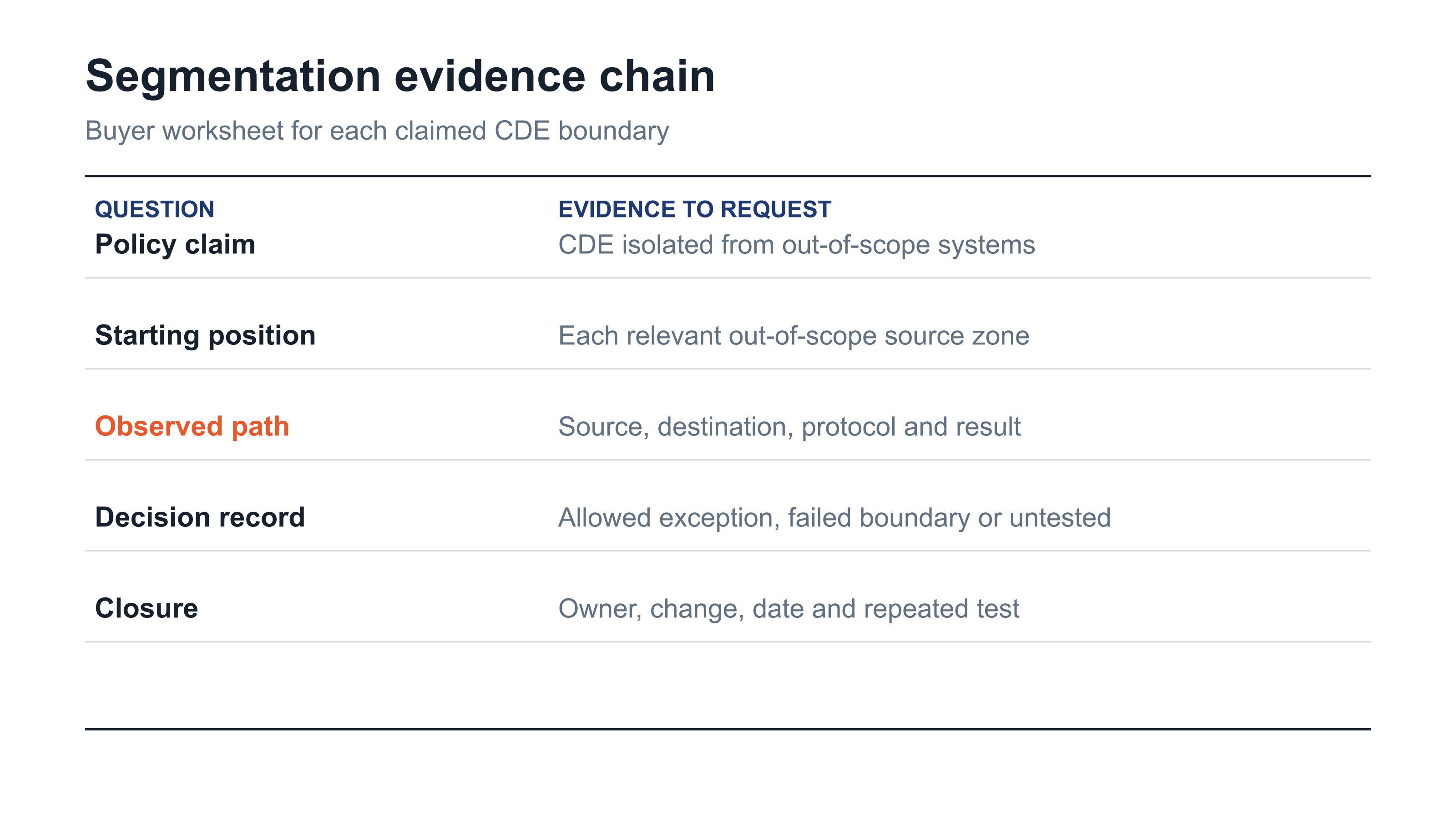
Figure 1: The evidence chain a buyer should ask a tester to produce for each claimed CDE boundary. Source: PCI Security Standards Council, Requirement 11.4.5.
A scope matrix a vendor can price
The matrix below is an illustrative procurement worksheet, not a PCI SSC template. Replace its examples with your own architecture. Keep the source and destination specific enough that the result can be repeated after a fix.
Source position | Protected destination | Intended policy | Control to validate | Evidence requested |
|---|---|---|---|---|
Standard corporate workstation network | CDE application and database tiers | Only named payment application routes allowed | VLAN policy, firewall rule and identity rule | Tested source, destination, protocol, observed result and approved exception |
Guest or visitor network | Every CDE segment | No route to the CDE | Wireless segmentation, routing and egress policy | Result from an actual guest position, not only a corporate test host |
Third-party support connection | Payment management interface | Named support workflow only | VPN or access broker, jump host and privileged access policy | Role used, route reached, denied paths and logged exception |
Cloud application subnet outside the CDE | Cloud payment workload | Only documented service calls allowed | Security groups, routes, peering and service identity | Configuration evidence paired with observed connectivity |
Backup or monitoring network | CDE infrastructure | Restricted operational access | Management ACL, service account and firewall path | Exact allowed path and proof that broader access fails |
The word “all” in 11.4.5 is why the worksheet must be an inventory, not a convenient sample of two VLANs. That does not require an indiscriminate packet flood against every address. It means the testing plan needs to account for every control and method used for the scope boundary, and the report must say what was covered and what was not. A buyer should ask the tester how representative endpoints are selected inside each zone and what happens when a zone contains multiple policy variants.
Include the paths people forget
The obvious packet path is only one of several ways into a protected environment. A jump host may have privileged access into the CDE. A shared DNS or identity service may be reachable from both sides. A management interface may sit on a network that an out-of-scope user can reach. Cloud peering or transit routing may introduce a path that bypasses the on-premises firewall entirely. The question is not whether every shared service is automatically in scope; that is for the entity and its assessor to determine. The test should make the real path visible so the scope decision rests on evidence.
This is especially important in a hybrid architecture. PCI SSC's 2024 guidance announcement says modern CDEs may span multicloud and traditional infrastructure and names microsegmentation and zero trust boundaries as explicit scoping questions. Ask how the tester will represent each cloud account, project, subscription, private endpoint and service mesh policy that the organization relies on to exclude a system. A cloud diagram may be helpful, but effective network paths and identity-dependent access still need validation.
What a useful report looks like
The report should begin with the boundary claim it tested. The reader needs a named CDE, an inventory or diagram version, source zones, destinations, the date and starting position of each test, the expected policy and the observed result. This context lets an assessor see why a blocked connection matters and lets an engineer repeat it. A bare scan result, especially one that lists only open ports on CDE hosts, has no way to show whether the source was genuinely outside the CDE.
For each tested route, ask for an evidence row: source, destination, relevant protocol, the control expected to apply, observed reachability, any legitimate exception, and a reference to the finding if the path crossed an intended boundary. The row should distinguish a network block from a service that simply was not listening. Those outcomes support different conclusions. If a test could not be completed because of unavailable access or unstable connectivity, the report should mark it untested, not silently turn it into a pass.
When a boundary fails, the finding should identify the rule or route owner, the likely scope consequence, a practical fix and a safe retest method. The result of the retest belongs beside the original evidence, with the date and the path rechecked. PCI DSS separately calls for penetration testing to be repeated to verify corrections to exploitable weaknesses under 11.4.4 (PCI SSC, SAQ D). A clean status without dated retest evidence is difficult for an engineering team or assessor to use.
An executive summary can reduce this detail to a decision: which scope boundaries held, which failed, what remains untested, and what action changes PCI scope or access. Keep the technical matrix attached or included. Senior leaders need the consequence; network engineers and the QSA need the path.
How to compare proposals without buying the wrong test
The lowest quote can be the narrowest scope. Put the same boundary worksheet in front of every bidder and require each to mark inclusions, exclusions and assumptions against it. A useful proposal specifies tester start positions, the networks and controls to validate, cloud and third-party dependencies, the approach to safe testing, evidence format, the retest and how scope changes are priced. If a proposal describes only internal host scanning, it may be a worthwhile vulnerability service, but it does not answer the segmentation claim in 11.4.5.
Ask who will perform the work and how organizational independence is established. PCI SSC permits a qualified internal resource or qualified external third party and says independence must exist, without requiring the tester to be a QSA or ASV (PCI SSC, SAQ C). A vendor's brand, certification list or tool inventory is not a substitute for the names, qualifications and actual allocation of the people who will test your boundary. Request a redacted sample finding showing an expected policy, a tested path and a retest result. It is easier to compare that than a method slide.
The buyer should also settle access logistics. A contractor-controlled device on the wrong VLAN cannot test the claim about the guest VLAN. A remote VPN that routes through a trusted management subnet may bypass the exact boundary in question. Write down who provides a test host, where it lands, what credentials it has and who confirms its placement before testing begins. For cloud scope, obtain the resource owner's authorization and the provider's rules of engagement before an active test. Budget time for these dependencies in the same way you budget tester days.
No fixed market price can be inferred from the standard or from the size of a subnet. Stingrai quotes network work to scope, based on factors such as live hosts, subnets, sites, Active Directory footprint and segmentation testing. A vendor should explain its quote in terms of boundary count, access positions, cloud and site complexity, evidence depth, reporting and retesting. This makes two proposals comparable without pretending that a single per-IP rate describes the work.
Questions for the short list
Which exact out-of-scope networks and cloud environments are included, and which are excluded?
Where will your test host or account start for each claimed isolation boundary?
How will you validate firewall, routing, identity and cloud policy together when they jointly enforce the boundary?
What evidence will distinguish a denied path from a service that was unavailable?
How do you show legitimate exception paths without treating all access as a failed test?
How will you handle a boundary failure that could expand the assessed CDE?
Who are the named testers, and how is their independence established?
What retest is included, and will the retest repeat the original path from the original source position?
How will the result map to the entity's defined penetration testing methodology and the assessor's evidence request?
These are procurement questions, not instructions to a tester to run unsupervised techniques. NIST's technical testing guide describes planning the assessment, analyzing findings and developing mitigations as part of one process. The proposal should show that connection from scope through a decision-ready result.
Decide what happens when the boundary fails
Agree on an escalation path before testing begins. A reachable CDE path from a network everyone treated as out of scope can affect the organization's scope decision and remediation schedule. The tester should know whom to contact during the engagement, what evidence can be collected safely, and when to pause rather than continue through a sensitive payment system. The security owner should know who can validate whether the path is an intended exception, a configuration defect or an unrecognized dependency. This avoids asking a tester to make a unilateral compliance decision during a live test.
Keep the result connected to change management. Record the rule, route or identity policy that changed; the owner; the source and destination; and the result of repeating the original test after the fix. If an allowed path is necessary for the business, document why it exists and whether it moves the connected system into PCI scope. A passing retest of one route should not be described as proof about all other boundaries. Scope is the complete set of isolation claims, and each exception is its own decision. The report's value is that it makes these claims reviewable by the people who own the environment.
Where Stingrai fits
Stingrai is a CREST-accredited penetration testing company founded in Toronto in 2021. Its internal and external network service is human-led and explicitly includes reachability between zones, VLANs and sites; isolation of a PCI CDE; and firewall-rule and access-control validation when those areas are scoped. Two named penetration testers conduct a human-led network engagement, and the work is reviewed by a team lead and engagement partner. It is available as a one-time annual test or as part of a recurring program.
The value for this buyer is a negotiated, written scope. Your team identifies the CDE and all out-of-scope positions; Stingrai confirms which boundaries, start positions and exception paths the engagement will test. Findings reach the PTaaS portal as they are confirmed, and the full technical report states the methodology, scope, evidence and segmentation results where tested. Retesting of fixed findings is included. The engagement is quoted individually rather than assigned a web-application package price. Share the boundary matrix through Get a Quote so the quote describes the actual environment.
Frequently Asked Questions
Is PCI DSS network segmentation testing required?
Yes, when segmentation is used to isolate the cardholder data environment from other networks. Requirement 11.4.5 calls for penetration tests that show the controls are operational and effective and isolate the CDE from all out-of-scope systems. If the organization does not rely on segmentation for that isolation, the conditional requirement does not apply in the same way.
How often must segmentation controls be tested?
Requirement 11.4.5 says at least once every 12 months and after changes to segmentation controls or methods. Requirement 11.4.6 adds a six-month cadence for service providers that use segmentation to isolate the CDE, also after changes to those controls or methods.
Can the internal penetration test include the segmentation test?
Yes, one engagement can contain both workstreams, provided the segmentation scope, tester start positions, boundary tests and evidence are explicit. An internal test that inventories hosts inside the CDE without testing access from out-of-scope networks does not establish that the boundary holds.
Does a firewall rule review satisfy Requirement 11.4.5?
A rule review helps define expected policy, but it does not by itself show that deployed controls are operational and effective. The buyer should ask for testing from the relevant out-of-scope positions and a report comparing observed access with the written policy.
Who may perform a PCI segmentation test?
PCI SSC's published requirement permits a qualified internal resource or a qualified external third party. The tester must be organizationally independent of the work being tested; the requirement does not say the tester must be a QSA or an ASV.
What should a segmentation testing report contain?
It should state the CDE boundary, each source position, tested destination and control, expected policy, observed result, exceptions, failures, limitations and dated retest results. That record lets network owners correct a path and lets the assessor understand what was actually tested.
How does cloud segmentation change the scope?
The same boundary claim must account for cloud routes, security groups, private endpoints, peering and identity-dependent access when those controls affect CDE isolation. PCI SSC's modern architecture guidance specifically discusses hybrid CDEs, multicloud environments and microsegmentation. The scope should list those paths rather than assume an on-premises firewall covers them.
Related reading
References
PCI Security Standards Council. PCI DSS v4.0 SAQ C. April 2022. Official questionnaire. Requirement 11.4.5 language and expected testing.
PCI Security Standards Council. PCI DSS v4.0 SAQ D for Service Providers. April 2022. Official questionnaire. Requirements 11.4.1 through 11.4.6.
PCI Security Standards Council. Just Published: PCI DSS v4.0.1. June 2024. Release note. Explains the limited revision and points to the current edition.
PCI Security Standards Council. PCI DSS Scoping and Segmentation Guidance for Modern Network Architectures. September 2024. Publication announcement. Identifies cloud, hybrid and microsegmentation scoping questions.
National Institute of Standards and Technology. SP 800-115: Technical Guide to Information Security Testing and Assessment. September 2008. Publication page. Test planning and findings guidance.
Talk to Stingrai
Send the CDE diagram, out-of-scope zone list and any known exception paths through Get a Quote, or book a free discovery call to review the testing positions and evidence you need.



