





CISA's microsegmentation guidance defines the control as limiting connections to a zone or segment and says enterprise architectures often combine several enforcement capabilities. An enterprise network segmentation penetration test should therefore evaluate the resulting path, not just the presence of a firewall or an agent. The purchase question is whether a user, server, branch or cloud workload can reach what the business says it must not reach, while approved work still functions.
Quick answer. Scope an enterprise network segmentation test as a set of named source-to-destination boundaries. Supply the intended allow and deny rules, representative starting positions, exception owners and safe test destinations. Require the tester to observe both blocked and permitted paths, identify the control that made each decision where possible, and retest fixes. Stingrai can include this work in human-led internal and external network penetration testing.
This guide serves security leaders, infrastructure owners and procurement teams responsible for a mixed enterprise network in Canada or the United States. It addresses east-west separation across business zones, remote or branch access, server tiers and cloud workloads. It is not a PCI DSS scoping brief. Stingrai's PCI DSS network segmentation guide addresses the cardholder data environment and specific requirements. Its firewall rule-path guide focuses on a control and its paths. This guide buys evidence for a portfolio of enterprise trust boundaries, regardless of how many controls implement them.
Start with the boundary claim the business relies on
Every useful segmentation test begins with a sentence about access. “Contractor endpoints cannot administer production directly.” “A marketing workstation cannot reach the backup repository.” “A web tier can reach its own database service but not neighboring business-unit databases.” “A branch site can use central identity services but cannot see another branch's protected operations network.” These are illustrative claims. The organization must choose its real ones and identify who approved them.
An asset list alone cannot express those claims. Ten network ranges may represent one repeated policy, while one shared subnet may contain several very different trust relationships. Ask the network, cloud and application owners to identify the protected resource, the source populations, authorized exceptions and the consequence of a failed boundary. The vendor can price path classes rather than simply count addresses. The final report can then tell leadership whether the controls enforced the business decision that justified segmentation.
NIST SP 800-207 cautions against granting implicit trust solely from network location and emphasizes protection of resources. Segmentation remains useful, but a blocked subnet does not replace user and device authorization. A good buyer scope asks where the network path and the identity decision meet. For example, a jump host may be the only allowed route to an administrative service, yet the jump host's user authorization may be too broad. The segmentation test can validate the route and identify the handoff to an identity assessment without claiming to have tested every access-control rule in the application.
Write the intended outcome before testing. A failed connection could be a firewall denial, a routing error, a down target or a service-level rejection. Only one of those may prove the segmentation control held. The assessor should have a safe listening target or another way to distinguish the result, plus enough read-only policy and log context to attribute it. Conversely, a successful connection may be an approved exception. The report needs the policy owner and business justification before labelling it a finding.
Make the source positions representative
The same destination can behave differently from a user workstation, remote VPN session, branch site, cloud workload or service subnet. A test from one privileged network position cannot establish that all lower-trust positions are separated. The statement of work should name representative sources that exercise materially different routes. Include the identity and device context when policy depends on them. A generic “inside the network” starting point is too vague for an enterprise.
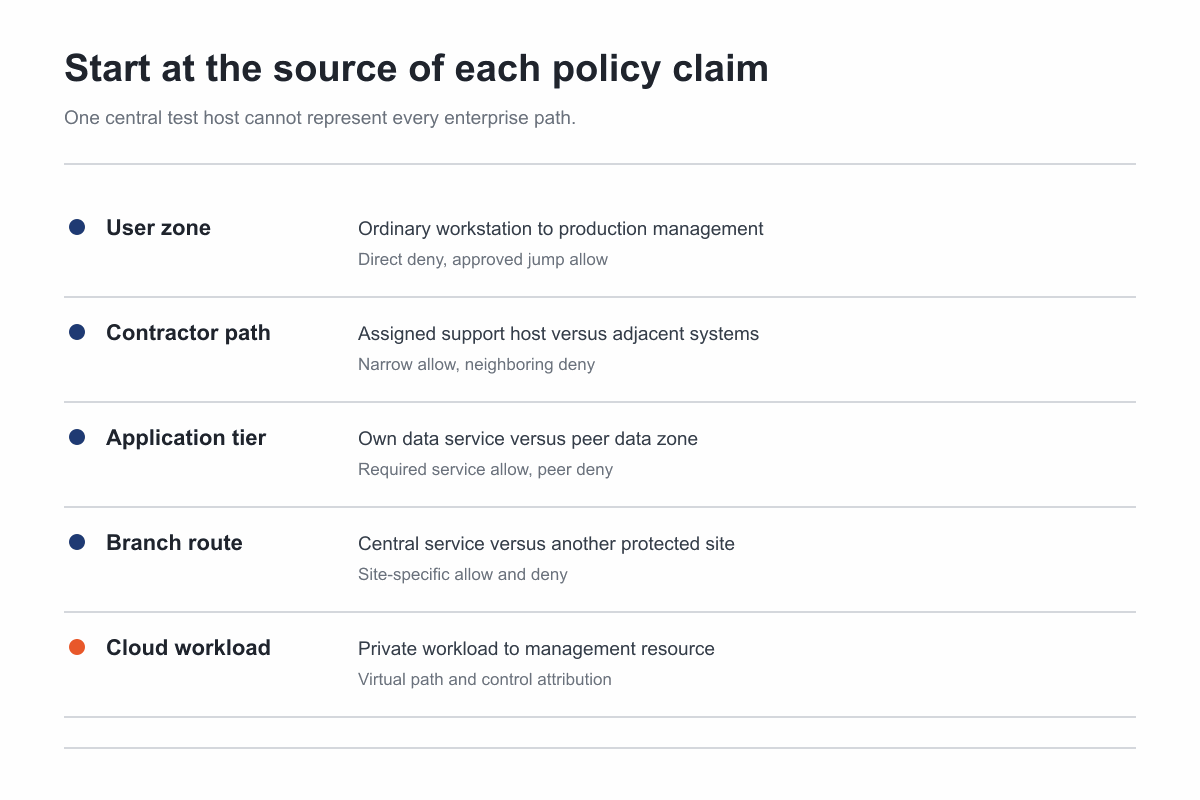
Figure 1: Enterprise segmentation evidence follows each selected source position to its protected destination and observed result. Source: CISA, Microsegmentation in Zero Trust and NIST SP 800-207.
Choose sources by policy class, not by convenience. A user-zone test host may represent ordinary employee access. A contractor route may depend on an identity-aware gateway. A branch can follow a distinct SD-WAN path. A cloud workload can use a security group and private endpoint that do not traverse the central firewall. A backup proxy may have broad operational reach. The proposal should explain which source was chosen for each class and what would make another source materially different.
Target selection matters just as much. A protected destination must be available for a meaningful test. A synthetic listener in the right zone may be safer than probing a production controller. Where only a production service demonstrates the policy, agree on a low-impact check and record its limitations. Include an adjacent approved destination so the vendor can show that a restrictive control has not simply broken connectivity for everyone.
Sampling should be transparent. CISA's guidance describes several segmentation types and notes that no one solution is necessarily suitable across a whole enterprise. That makes it risky to infer one site or workload represents all others. Group boundaries by enforcement pattern, owner, location and exception design. A headquarters user VLAN and a remote workforce route may look like the same role to an application but cross different controls. A cloud region may have a different template version. The report should map each tested sample to its population and list the untested variants.
Follow the path across enforcement layers
Segmentation is often implemented by more than a perimeter appliance. CISA's July 2025 guidance lists network-based and endpoint approaches and says enterprises may combine existing capabilities with vendor products. A route may cross an SD-WAN policy, a cloud security group, a host firewall and an identity-aware proxy. The assessor should follow the effective path and identify which layer allowed or denied the observed action. A configuration review of only the most visible firewall may miss the actual enforcement point.
The cloud path is especially easy to misattribute. A workload-to-workload connection in one virtual network may never touch an on-premises firewall. A private endpoint can change a path without adding a public address. The buyer should provide a redacted architecture that shows workload location, interconnects and intended policy ownership. NIST SP 800-125B treats virtual-network segmentation, path redundancy, firewall traffic control and VM traffic monitoring as related configuration areas. A network test should account for the virtual path where it participates in the business boundary.
Identity-aware controls need the right account. Testing from a privileged service identity may show an allowed path that should be denied to an employee. Testing without credentials may show a network denial but cannot prove that a contractor's assigned role is restricted after authentication. The proposal should say which role and device conditions are needed. If the buyer wants an Active Directory security assessment, scope that work explicitly; a segmentation test can use accounts and permissions as context without becoming a domain-wide privilege assessment.
Ask for control attribution without pretending it is always certain. A policy log may identify the rule, source and destination; a route trace may show the traffic crossed a particular device. But NAT, asymmetric routing or multiple denial points can limit certainty. The report should state the evidence and uncertainty. “Blocked by the firewall” is not defensible if the destination service was offline. “Segmentation failed” is not defensible if the destination was an approved exception. Precision is more valuable than an oversized list of green and red results.
Treat exceptions as first-class paths
Enterprise networks need exceptions for support, backup, monitoring, deployment and integrations. Those paths are often the most consequential because they cross boundaries by design. The buyer should name the exception owner, business reason, source identity, destination and expiry or review date where applicable. The tester then checks that the approved path works only under its approved conditions and that adjacent sources or destinations remain blocked.
A backup service is a useful example. It may need to reach many protected workloads, while ordinary users should not reach its management plane or repository. The segmentation test can validate the zone boundary; a separate backup infrastructure network test can examine the console, proxy, repository and service-account paths in greater depth. The same distinction applies to deployment systems and privileged jump hosts. A broad enterprise test identifies the high-risk exception and its effective network reach; specialist work follows if the buyer needs deeper control proof.
Temporary exceptions deserve a retest trigger. A migration link, acquisition interconnect or emergency support route can outlive its purpose. The assessment should record which exception was active at test time and whether the policy owner still accepts it. That is not a mandate for the tester to delete a rule. The network team should make operational changes through its own process. The tester's job is to show the effective access and the consequence of keeping it.
Use an allowed-and-denied path matrix
The following worksheet gives bidders a consistent way to estimate the work. It is an editorial example, not a prescribed architecture or a universal control requirement. Replace the generic labels with your actual zones and policy decisions through a secure scoping channel.
Business boundary | Representative test source | Protected destination | Allowed comparison | Evidence to request |
|---|---|---|---|---|
User to production management | Ordinary workstation or remote user | Synthetic management-zone host | Approved jump route | Direct denied result, jump allowed result, policy owner |
Contractor to internal systems | Restricted contractor session | Named support host and adjacent zone | Assigned support service | Narrow access and adjacent denial |
Application tier to data tier | Test workload in app zone | Own data service and peer data zone | Own service route | Protocol-level allow and peer-zone deny |
Branch to central and peer sites | Representative branch source | Central service and another branch zone | Approved central service | Branch-specific route and exception evidence |
Cloud workload to control plane | Test workload in cloud network | Selected management service | Required platform operation | Effective virtual path and control attribution |
Backup to protected workloads | Backup test identity or proxy | Approved source and unrelated network | Scheduled backup path | Necessary path plus non-target denial |
The matrix should have an expected outcome before fieldwork begins. The assessor should not discover a path and invent the policy afterward. An exception may be legitimate, so the buyer must identify who can confirm it. For each path, ask the vendor to preserve source identity, network location, destination role, protocol, time, observed result, relevant control evidence and test limitation. That allows engineering to reproduce the result and leadership to understand the business consequence.
Do not try every port on every host without a reason. A broad scan can produce volume and still miss a conditional exception or a path through a separate network overlay. Select representative protocols that establish the intended boundary safely. A test of one service does not prove every possible service is blocked, so the coverage statement should name the sample and any policy or configuration review used to extend the conclusion. This is an honest boundary assessment, not a claim of mathematical completeness.
Separate a segmentation test from adjacent purchases
A vulnerability scan identifies possible weaknesses on reachable hosts. It does not tell the buyer whether a lower-trust source can reach the protected host through an unintended path or whether the host's availability explains a failed check. A firewall ruleset review examines intended configuration and exceptions. It does not prove the path from each source position. A full internal penetration test may follow exploitation and lateral movement beyond the boundary. It can include segmentation, but only if the scope names the paths and proof required.
NIST SP 800-115 frames technical testing as a planned process of examination, findings analysis and mitigation. That is a useful procurement model: decide the claim, choose the test position, observe the control, analyze the result, and define the fix. A scanner output can be one input, but it should not be the final evidence for a segmentation decision. A buyer should ask what the vendor will do when an observed connection differs from the rule export.
Zero trust assessments answer another adjacent question. NIST SP 800-207 focuses on resource authorization rather than implicit trust from network location. A segmentation test can show where traffic is routed and constrained; a zero trust policy review can examine subject and device context, policy decision and session establishment. Many enterprises need both. The statement of work should say whether the identity decision is reviewed, actively exercised or out of scope. Avoid assuming a “microsegmentation” label means all user authorization is covered.
PCI work has a specific boundary claim and cadence under PCI DSS. This guide does not impose those requirements on non-payment networks. A business may still require strong segmentation for confidential intellectual property, operations, backup or regulated data, but the procurement driver is its own risk and assurance decision. If the cardholder data environment is included, use the PCI-specific segmentation brief for that workstream and distinguish its evidence in the final report.
Prepare the request for proposal
Give vendors a redacted zone map, a list of boundary claims and the desired source positions. The detailed private network map can be shared after contracting through a secure channel. The initial request can cover the number of sites and cloud environments, network technologies in use, test accounts available, representative destinations, special exceptions, operational windows and expected report format. It does not need credentials or a dump of every address in a public attachment.
Ask the provider to return the selected path classes, sampling method, policy review depth and active validation method. The proposal should say how it will distinguish a control denial from an offline target, whether it can correlate logs or route evidence, and how it will treat conditional identity policy. It should identify any third-party networks that require separate permission. A promise to “test all segmentation” without a path count, sample rationale or exclusion list is difficult to price or evaluate.
Safety belongs in the bid. Production segmentation supports live applications. Agree on test windows, rate limits, synthetic listeners, approved protocols, stop contacts and forbidden actions. A vendor should not change routing or firewall policy during a penetration test to prove a theory. If a suspected path cannot be safely exercised, it can be documented as configuration-supported with a limitation. Operational changes and broad discovery against fragile systems require separate approval and planning.
The deliverable should show a coverage matrix even if no boundary fails. It should list each selected source, destination and expected policy, then the observed result and its evidence. A clean executive summary without that matrix leaves the buyer unable to tell whether the expensive boundary was ever exercised. A finding should name the owner: network, cloud, endpoint, IAM, application or a combination. Its retest should repeat the failed path and an adjacent approved path after the owner changes the control.
Cost, timing and changes in scope
No universal enterprise segmentation pentest price is credible. The effort depends on distinct trust boundaries, source locations, destination classes, enforcement technologies, identity conditions, exceptions, site variation and the proof needed. Two enterprises with the same number of IP addresses can require very different work. The quote should state how many representative paths and policy variants it covers, what access the buyer must provide, and what happens if a new route or site appears during the assessment.
Timing is also driven by owner availability. Network and cloud teams may need to provide read-only policy context, deploy safe test hosts, verify destination availability and correlate logs. Application owners may need to confirm whether a path is legitimate. Retesting requires a change window and a repeatable fixture. The proposal should distinguish preparation, active validation, preliminary findings, final report and retest rather than promise a schedule based only on scan duration.
Continuous validation may be appropriate where cloud deployments, branch additions or identity policy changes frequently alter paths. A one-time assessment may be enough for a stable architecture or a specific transformation milestone. The buyer should define which changes trigger targeted retest and which require a new cross-zone sample. Stingrai offers one-time annual and continuous human-led programs; the choice follows the rate of change and the importance of the boundary.
What the report should let you decide
The executive summary should identify the most consequential failed boundaries and the business systems they protect. It should distinguish an unexpected open route from an approved exception, a broken business route from a security improvement, and a policy concern from a tested behavior. The technical appendix should preserve enough evidence for the control owner to reproduce the result without publishing a map of confidential infrastructure.
For every material path, ask for the source identity or host class, destination role, approved policy, observed protocol result, relevant enforcement layer, timestamp, limitation and fix owner. If the assessor used a sample, the report should say which population it represents. If a destination was offline or a log was unavailable, the conclusion should be inconclusive rather than silently counted as a successful deny. These qualifications make the report more trustworthy to the buyer and any later assurance reviewer.
Retest both directions of the operational decision. If an unintended user-to-management path is closed, confirm the direct path is denied and the approved administrator route remains available. If an application-tier rule is tightened, verify the peer data zone is blocked and the application's own database transaction still works. A fix that blocks every path may meet a simplistic deny metric while breaking production. The report should record the new observed behavior and the control change that caused it.
Stingrai's testing can produce evidence for a compliance or customer assurance program when the scope and observations are clearly described. It should not be treated as a blanket conclusion about every untested zone or application. The coverage map and limitations are part of the deliverable, not small print.
Where Stingrai fits
Stingrai is a CREST-accredited penetration testing company founded in Toronto. Its human-led internal and external network penetration testing can validate internal reachability and segmentation from agreed starting positions. For an enterprise boundary program, the buyer and assigned testers can select the user, branch, server and cloud paths that matter most, then agree on safe proof and access before testing begins.
Two named penetration testers from a team holding OSCE³, OSWE, OSEP, CREST CRT and CISSP certifications work on every human-led engagement, with team-lead and engagement-partner review. Confirmed findings are posted to Stingrai's PTaaS portal with remediation guidance during the test and can be discussed through live chat. Reports are redactable, and retesting is included. An organization can choose a one-time annual test or a continuous program as its network changes.
This is human-led network work. Snipe, Stingrai's autonomous agent, tests web applications and associated APIs; it does not validate enterprise network segmentation. If an application behind a segment also needs business-logic testing, scope that separately through web application penetration testing. The path evidence is clearer when each layer has its own starting position, authorized proof and report limitation.
Frequently Asked Questions
What should an enterprise network segmentation penetration test include?
It should include named business boundaries, representative source positions, protected destinations, permitted exceptions, expected allow and deny results, and safe observation of the effective paths. The report should identify the enforcement layer where evidence allows, explain sampling limits and retest both an unwanted route and adjacent legitimate access after remediation.
Is network segmentation testing the same as a firewall ruleset review?
No. A ruleset review examines configured policies and exceptions. A segmentation test checks whether traffic from an agreed source actually reaches or fails to reach a protected destination under the expected conditions. The two methods complement each other, and the report should reconcile a surprising result with the route and policy context.
Does a vulnerability scan prove a network boundary is effective?
No. A scan can identify reachable services or possible software weaknesses, but a failed scan result may also reflect an offline host or an untested route. Boundary evidence needs a meaningful source, an available target, the expected policy, the observed connection result and enough context to identify which control made the decision.
How should cloud and branch networks be sampled?
Group paths by materially different enforcement, location, identity and exception patterns. Select representative cloud workloads and branch sources for each policy class, then name which environments they represent and which variants remain untested. One central office source should not be assumed to represent a branch, remote user or cloud workload with a different route.
Does microsegmentation replace identity authorization?
No. NIST's zero trust architecture says network location alone should not grant implicit trust and focuses on access to resources. Segmentation constrains paths, while user and device authorization may make another decision at the resource. A buyer should specify which identity conditions the network test exercises and which need a separate assessment.
Must every IP address and port be tested?
No universal address or port count establishes coverage. Choose representative source-to-destination paths based on protected resources, policy classes, exceptions and architectural variation. The report should disclose the sample and any configuration review used to extend a conclusion. A blanket claim about all routes from one test host is not defensible.
How much does enterprise network segmentation testing cost?
There is no reliable universal price. The quote depends on the number of distinct trust boundaries, source locations, protected destination classes, enforcement layers, identity conditions, site exceptions, operational constraints and retest needs. Compare vendors on their path matrix and evidence, not only on an IP or device count.
What should a segmentation retest prove?
It should repeat the original unwanted path and a legitimate neighboring path after the fix. The protected destination should be unreachable from the disallowed source while an approved user or service can still perform its required work. The report should record the new observation, effective control and any remaining limitations.
Related reading
References
CISA. The Journey to Zero Trust: Microsegmentation in Zero Trust, Part One. Version 1.0, 29 July 2025. Read 15 November 2026.
NIST. SP 800-207: Zero Trust Architecture. Final August 2020. Read 15 November 2026.
NIST. SP 800-125B: Secure Virtual Network Configuration for VM Protection. Final March 2016. Read 15 November 2026.
NIST. SP 800-115: Technical Guide to Information Security Testing and Assessment. Final September 2008. Read 15 November 2026.
Talk to Stingrai
Send the boundary claims, representative source positions, exceptions and safe test limits to Get a Quote or book a free discovery call. Stingrai can scope human-led enterprise network segmentation testing around the paths your business depends on.



