





Enterprise remote access includes the client device and connection technology used by staff, contractors and vendors, while access to a resource also depends on the user's and device's authorization (NIST SP 800-46; NIST SP 800-207). A hardened VPN appliance can still give an ordinary remote user a route to a management network that was meant to be restricted. An enterprise can enforce multifactor authentication for employees and overlook a contractor path with a different policy. The relevant purchase question is broader than whether the gateway has a known vulnerability: which remote users and devices can establish a session, and what does that session actually permit?
NIST's remote access guide treats the connection as a whole system, including client devices, employees, contractors, business partners and vendors. NIST's zero trust architecture adds a useful principle: access to a resource should not be trusted merely because the session came from a familiar network location. Those sources support a practical assessment brief for mid-market and enterprise buyers.
Quick answer. Ask a tester to assess the public remote access entry points, the authentication and device conditions for each user group, and the internal or cloud resources reached after login. Provide representative test accounts and expected access rules. Require a report that shows each tested role, policy decision, allowed path, denied path and limitation. Stingrai's human-led network testing includes VPN, remote access and edge appliances, with post-login network and segmentation testing when scoped.
This is a procurement guide for a security leader, infrastructure owner or sourcing team. It describes the questions to settle before seeking a quote and the evidence to demand after the test. It complements the broader external network penetration testing guide, which covers the public perimeter beyond remote access, and the internal network penetration testing guide, which covers the environment after a foothold. The remote access question joins those positions into one authorized user journey.
The assessment decision: follow an authorized session end to end
Buyers often receive proposals split by technology: a VPN appliance test, an identity configuration review, a firewall review or an internal penetration test. Each can be useful. The risk appears at their joins. An employee may authenticate correctly but inherit an overly broad route. A contractor may receive a narrow policy in the identity provider but a wide network path from the gateway. An administrator may have strong MFA while a fallback account has different conditions. The assessment has to reconcile the written access design with the decisions made in a live session.
The first question is who enters? Identify employees, contractors, vendors, support teams, administrators and emergency accounts that legitimately use remote access. NIST SP 800-46 explicitly includes employees, contractors, business partners and vendors in enterprise remote access. A test that covers a single standard employee account cannot establish whether every externally managed group follows the same policy. The aim is representative role coverage, with differences recorded, not a test of every person.
The second question is what establishes trust? Document the front door, identity provider, authentication method, device condition, group or attribute mapping, and any exception. Microsoft's Conditional Access authentication strengths show why the word MFA alone is insufficient: a policy can require specific method combinations, including phishing-resistant methods for sensitive resources. Microsoft says those strength policies apply to external users who authenticate with Entra ID. Its external-user guidance directs organizations to use the MFA grant control for email one-time passcode, SAML/WS-Fed, Google federation and Microsoft personal account users. For eligible external users, cross-tenant trust settings can affect where the challenge is satisfied. A buyer needs the effective decision for each included identity type, not merely a screenshot of the intended policy.
The third question is what happens after admission? A connected session may expose an internal subnet, an application proxy, a virtual desktop, a cloud management plane or a collection of private services. The tester should compare observed reachability with the access matrix. The test should distinguish a denied path from a host that was unavailable or a route that could not be tested. NIST SP 800-207 centers authorization on users, devices and resources, so a broad route should be assessed as an access decision even if the entry gateway itself is fully patched.
The fourth question is what was seen and acted on? Ask whether the test produces relevant sign-in, gateway, endpoint and network telemetry, and whether your defenders can correlate them. A short, agreed observation window can show whether an anomalous but safe test event reached the right team. This is an optional detection objective, not a substitute for the access test. A full red-team exercise has a different goal and rules of engagement.
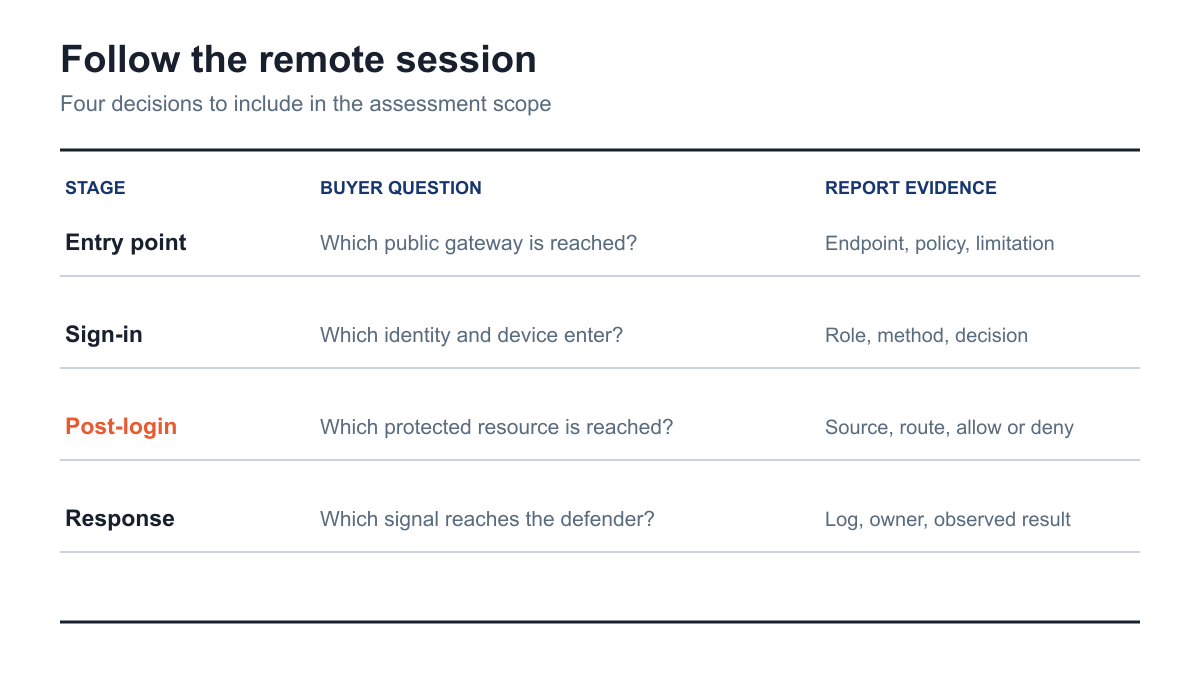
Figure 1: Buyer evidence chain for a remote access assessment. Sources: NIST SP 800-46 and NIST SP 800-207. The planning model follows full-solution scope and resource-level access.
Inventory the access paths before requesting proposals
Start with entry points, not an IP count. Include the VPN concentrators and portals, remote desktop gateways, zero trust network access brokers, virtual desktop front ends, privileged access gateways and any edge service that gives an external identity a path toward enterprise resources. Identify which are internet-facing, which are private behind an identity platform, and which are provided by a managed service. This inventory defines authorization and stops a vendor from spending the whole engagement on a gateway that is no longer the main employee route.
Next, map user populations. An employee, contractor, managed service provider and administrator may share a sign-in page but follow separate policies. For each group, document how an account is provisioned, who approves it, when it expires, how it is disabled, which authentication methods are allowed and which resources should appear after connection. Include an emergency path if it is an important part of the access design. Microsoft documents emergency access accounts as a special consideration in external-user Conditional Access policy design; that does not mean such accounts should be tried casually during a test. Agree on how they will be reviewed and whether a synthetic account or configuration evidence is safer.
Then map device classes. Company-managed laptops, contractor devices, browser-only devices and privileged administration workstations may receive different decisions. NIST SP 800-46 says all components of the remote access solution, including organization-issued and personally owned client devices, should be secured against expected threats. The engagement can therefore inspect device-based policy and test from agreed representative device states. It should not require the tester to enroll a real employee device or collect personal information. A dedicated test device and synthetic identities usually make the result clearer.
Finally, map destinations. For each role, name the business applications, server segments, administrative services, cloud consoles and sensitive networks that should be reachable. Mark explicit denials as carefully as allowed routes. An assessment of remote access is weak if it ends at “VPN connected successfully.” The destination matrix turns a connection into a set of testable authorization claims. Record where an access path changes security control, for example from the identity provider to the VPN group, from the gateway to a firewall rule, or from a virtual desktop to an internal application.
Starting role or state | Expected admission | Expected destination | Evidence to ask for |
|---|---|---|---|
Standard employee on managed device | Approved sign-in and device conditions | Employee applications only | Effective sign-in policy and tested reachability |
Contractor on approved access path | Contractor policy and expiration | Named project resources | Account attributes, policy decision and denied nonproject path |
Privileged administrator | Stronger controls agreed by owner | Named management plane | Authentication decision, route and privileged access boundary |
Unmanaged or unapproved device | Denied or restricted as policy states | No protected administrative route | Device decision and observed restriction |
Former or expired test identity | Denied | None | Revocation and session termination evidence |
These are planning examples, not claims about any organization's deployed policy. Replace them with your own role, device and resource pairs. Keep account names, private addresses and diagrams inside the authorized engagement. They do not belong in a public marketing brief.
Scope the exposed edge without stopping there
The public entry point still matters. An external assessment can inventory active remote access portals and services, verify that the approved gateway set matches the public footprint, and look for insecure configuration or exploitable vulnerabilities in authorized systems. Stingrai's network service explicitly covers VPN, remote access and edge appliances on the external perimeter. The proposal should name the relevant hostnames, IPs, providers and appliance families, or state the discovery process used to establish them. An “all public IPs” line can miss a hosted identity front end; a product name can miss a legacy gateway.
Ask the vendor how active testing will be made safe. Remote access infrastructure often carries production traffic. The agreed test window, rate limits, forbidden actions, escalation contact and stop conditions belong in the rules of engagement. There is a difference between validating that a weakness is reachable and attempting a disruptive exploit against the service that every remote worker needs. A buyer should accept a documented limitation when proving impact would violate availability constraints, provided the report does not describe the untested impact as confirmed.
Look for configuration drift between gateways. A primary gateway and disaster recovery gateway may have different software, policies or certificates. A regional point of presence may send users through a different identity flow. The tester should identify the paths actually in scope and report any excluded path rather than imply that a single endpoint represents the fleet. The same principle applies to edge management interfaces and administrative consoles: if a console is not intended to be public, the inventory should reveal that discrepancy.
An appliance vulnerability scan is an input, not the entire assessment. It tells the team about versions and known issues under the scanner's visibility. The buyer still needs to know whether the effective sign-in policy admits the right people, whether fallback routes differ and what a successful session reaches. NIST's technical testing guide joins planning, technical examination, findings analysis and mitigation rather than treating tool output as the final decision.
Test identity, MFA and exceptions as effective policy
Begin with the intended policy for each role and application. Name the primary authentication method, the resource that triggers it, the device or location conditions, the sign-in restrictions and the exception groups. Then arrange test identities that can exercise those branches safely. A tester should not request real credentials from a senior administrator or a customer account to prove a policy that can be checked with a synthetic account. An approval and audit trail for any temporary account are part of the engagement setup.
The report should say whether MFA was invoked and which method strength was required for the resource tested. Microsoft's authentication-strength documentation distinguishes MFA, passwordless MFA and phishing-resistant MFA strengths. The goal of this assessment is to verify your policy and its coverage, not to assert that every enterprise must deploy a particular Microsoft feature. A test may find that the strong policy applies to employee accounts but a guest or contractor reaches the same sensitive application by a different route. The finding is the policy difference and resulting access, with evidence of the identity and resource conditions.
External identities deserve their own row. For an external user authenticating with Entra ID, Microsoft says the authentication-strength policy and cross-tenant MFA trust configuration can affect the method accepted by the resource tenant. Other external identity types may use the MFA grant control instead. In a federation or managed service arrangement, the organization's written requirement can therefore differ from the method the resource tenant actually accepts. The tester should document which identity type and tenant made the decision, which trust setting applied, and what could and could not be observed. An assumption about another organization's controls is not evidence.
Review exceptions carefully. Emergency access, service identities, support channels and temporary accounts often have an operational reason to exist. The test should determine whether those reasons are written, who owns the exception, how it is monitored and whether its reach matches its purpose. Do not remove an emergency account or change production Conditional Access as part of a penetration test. Use configuration review and agreed synthetic paths where a live denial test might lock out the organization.
Session lifecycle matters as well. The buyer can request a check of termination when a test account is disabled or expires, whether a long-lived session continues to reach resources after a policy change, and which logs record the event. Those checks need a controlled account and agreed timing. A report should distinguish “policy configuration reviewed” from “effective session behavior tested,” because the two provide different assurance.
Validate post-login reachability against the access matrix
The connected session is a new starting position. The tester should identify the assigned address, routes, DNS view, application catalog or proxy permissions, then compare what is reachable to the role's approved destination list. A simple “connected” indicator says nothing about whether a contractor can see a management service or whether an employee's device can reach an administrative subnet. The assessment should record source identity and device state with each path, because the same destination can be appropriate for one role and a finding for another.
Define a boundary for each sensitive resource class that matters to the buyer. That might include Active Directory administration, backup infrastructure, a payment environment, cloud control planes, production deployment systems or acquisition networks. The request for proposal should name the classes and how they are represented in the test. A vendor may need one representative destination per policy group rather than every host. Explain that sampling rule before work starts so a result about one path is not later misread as proof that every route is correct.
Record both allowed and denied routes. An allowed route is useful evidence when it confirms the intended design. A denied route is useful only if the test could reach the control that issued the denial. If the destination was powered off, the test client lacked a route for an unrelated reason, or the service was not listening, the result may be inconclusive. The report needs to say so. The distinction matters to anyone who will rely on the result for segmentation, customer assurance or remediation planning.
Post-login testing can also reveal unexpected privilege combinations. A standard role may be placed in a group that grants access to a virtual desktop; that desktop may have wider network reach than the original device. A support account may enter through a narrow portal and then receive broad access through a jump host. Those are examples of possible paths, not findings about any real environment. The buyer can define an authorized, nondestructive validation goal: show the access chain and its policy owners without touching production data or attempting to control a critical system.
Where a remote route leads into a regulated environment, confirm what the scope of this engagement is meant to establish. A PCI segmentation test has a specific boundary and evidence question under Requirement 11.4.5; a general remote access assessment does not automatically cover every out-of-scope source position. Our PCI segmentation buyer brief explains how to specify that workstream. If the buyer wants both outcomes, the statement of work should list both the remote user journey and the CDE isolation positions.
VPN, zero trust access and virtual desktops: ask the same buyer questions
These architectures expose different surfaces, but the core authorization questions remain. A traditional VPN may give a client network routes after connection. A zero trust network access design may broker access to named resources. A virtual desktop may keep application traffic inside a managed environment while presenting a remote user with a desktop. NIST SP 800-207 cautions against granting implicit trust from network location and focuses on the resource and the subject requesting it. That principle helps buyers compare effective access even when the products use different terminology.
For a VPN, ask where the gateway terminates the session, which identity and device decisions precede network access, and what routes and name resolution the connected client receives. For a resource broker, ask how the identity and device condition maps to each resource and whether the connector can reach more than the published application. For a virtual desktop, ask what the desktop can access after login, which user privileges it inherits and what separation exists between user pools. These are scoping questions, not claims that one architecture is inherently safer.
Hybrid estates often use more than one of these routes. A contractor might use browser access to a single application, an engineer might use a VPN and a privileged administrator might use a managed desktop. One assessment can compare those routes if the proposal includes the right test positions and enough time. A single black-box internet test cannot make a strong claim about post-login reachability because it has no authenticated position. Likewise, a configuration review alone may miss the effective route that a connected client receives. State the evidence type for each architecture.
Define a safe test and a useful report
A remote access test has a higher operational impact than many isolated application tests because it touches the way staff reach work. The rules of engagement should identify the technical owner of each gateway, the identity team, the network owner and an on-call contact. Agree on test windows, test accounts, monitoring expectations, rate limits, prohibited actions and a stop condition. Identify which third-party platforms or managed services require their own authorization. NIST SP 800-115 treats planning and assessment as connected work; a credible proposal should show how its safety decisions affect the evidence it can produce.
The technical report should begin with a coverage map: endpoints assessed, roles and device states used, identity policies examined, destinations tested and the dates and starting positions. Its findings should show an expected rule, an observed decision or route, the impact of the difference, the evidence that supports it and a proposed owner for correction. If a path was excluded by the test window or third-party authorization, mark it excluded. If an identity branch could not be exercised, mark it untested. No summary should flatten these categories into “passed.”
Ask for a role-by-resource matrix as a deliverable. It should identify which representative sessions reached each destination, which attempts were blocked by policy, and which could not be concluded. A second table can capture identity decisions: user type, device state, resource, method strength, conditional policy and outcome. This is useful to both the IAM engineer and the network engineer. A narrative can then explain any chain in which a narrow sign-in was followed by broad network access, or a strong policy was absent on a separate route.
Retesting should repeat the original condition. If a contractor group was given an excessive route, a firewall change verified only from an employee VPN account is not a retest of the original finding. Agree on how synthetic accounts will remain available for remediation and retest without leaving dormant access behind. Stingrai's public network service includes retesting of fixed findings and updates their status in its portal and report.
A buyer's proposal comparison worksheet
Give every bidder the same scope and ask for an explicit answer to these questions:
Which public gateways, remote access applications and identity providers are included?
Which employee, contractor, vendor and administrator roles will have representative accounts?
Which managed and unmanaged device states will be tested, and who supplies the devices?
Which authentication branches and exception paths are in scope?
Which internal or cloud destinations represent each protected resource class?
How will the tester record allowed, denied, excluded and inconclusive paths separately?
Who will own test-account provisioning and third-party authorization?
What safe test window, stop condition and escalation path will be used?
Will the report include the effective identity decision and the post-login reachability matrix?
Which finding conditions are eligible for retest, and how will the original role and route be recreated?
A proposal that answers these questions can be compared on actual coverage. A lower quote based only on one gateway may be a good purchase if the buyer needs an appliance test, but it is not the same deliverable as an end-to-end remote access assessment. Ask bidders to price optional branches separately, such as a second identity provider, a privileged route or a detection exercise. That makes the scope choice transparent without pretending there is a universal per-user price.
Avoid applying a web application package price to this work. Stingrai's network service quotes network engagements to scope, with cost drivers such as live hosts, subnets, sites, start positions and segmentation testing. For this particular buyer, the more useful effort drivers are distinct remote access routes, representative role and device combinations, identity integrations, protected destinations, test-window constraints and the depth of reporting. Send those facts in the quote request so a vendor can explain its assumptions.
Where Stingrai fits
Stingrai is a CREST-accredited penetration testing company founded in Toronto in 2021. Its internal and external network penetration testing service is human-led and explicitly covers VPN, remote access and edge appliances at the external perimeter, with segmentation, internal network and Active Directory paths where those are scoped. Two named penetration testers conduct a network engagement, with a team-lead and engagement-partner review of the report. The service is quoted for the buyer's environment rather than offered as a fixed remote access package.
For a remote access buyer, the starting point is a scope conversation. Share the exposed gateways, user groups, identity providers, device conditions and the resource boundaries you want tested. Stingrai can then state which external and authenticated positions the engagement will cover. Confirm the expected evidence in writing: an attack path narrative, affected hosts, the access conditions for each finding and segmentation results where tested. Confirm any special IAM or detection objective before testing begins. Findings are posted to the PTaaS portal as they are confirmed, and fixed findings can be retested. Use Get a Quote with the role and resource matrix to receive a scoped proposal.
Frequently Asked Questions
What does an enterprise remote access security assessment include?
It should cover the internet-facing entry points, the identity and device policy for each representative user group, and the resources reached after an approved sign-in. A useful report records the role, device state, authentication decision, permitted and denied paths, exceptions and limitations.
Is VPN penetration testing enough to assess remote access risk?
VPN penetration testing can examine the gateway and its public exposure. It does not by itself establish whether contractor, employee and administrator identities receive the intended MFA policy or whether a connected session can reach sensitive systems. Add those authenticated positions if that is the decision the buyer needs.
How should contractors be included in the test?
Provide a representative contractor identity with the actual access policy, an approved test device or device state, the resources it should reach and the resources it must not reach. Include the identity provider and cross-tenant policy owner. Use a synthetic account and record expiration and removal after the test.
What should testers verify about MFA?
They should compare the intended method strength and policy coverage with the effective sign-in decision for each included role and sensitive resource. Microsoft Entra, for example, distinguishes general MFA, passwordless MFA and phishing-resistant MFA strengths. Its authentication-strength policy for external users applies only when those users authenticate with Entra ID; other identity types can require the MFA grant control. The assessment should note exceptions, external-user trust settings and branches that were reviewed but not exercised.
Does zero trust network access remove the need for testing?
No. A resource broker still makes identity, device and authorization decisions, and its connectors lead to applications or networks. The test should verify which resources each approved role reaches and whether the implemented policy matches the written design. NIST SP 800-207 frames zero trust around users, devices and resources rather than implicit trust from network location.
What evidence should a remote access assessment report provide?
Ask for a coverage map, a role-by-resource matrix, the effective sign-in conditions, tested routes, expected versus observed decisions, limitations, findings with owners and dated retest results. Distinguish a blocked path from a path that was not tested or a destination that was unavailable.
How much does an enterprise remote access assessment cost?
It is quoted to scope. Cost depends on the number of access routes, user and device conditions, identity integrations, protected destinations, test positions and reporting needs. Stingrai quotes network engagements individually and includes retesting of fixed findings; send a role and resource matrix to receive a comparable proposal.
Related reading
References
National Institute of Standards and Technology. SP 800-46 Rev. 2: Guide to Enterprise Telework, Remote Access, and BYOD Security. July 2016. Publication page. Whole-solution remote access scope and client-device considerations.
National Institute of Standards and Technology. SP 800-207: Zero Trust Architecture. August 2020. Publication page. Resource-level authorization and no implicit network-location trust.
National Institute of Standards and Technology. SP 800-115: Technical Guide to Information Security Testing and Assessment. September 2008. Publication page. Test planning, analysis and mitigation.
Microsoft Learn. Conditional Access authentication strengths. Product documentation. Method-strength policy for resource access.
Microsoft Learn. Require multifactor authentication strength for external users. Product documentation. External-user identity and cross-tenant considerations.
Talk to Stingrai
Share your remote access inventory, representative user groups and protected resource list through Get a Quote, or book a discovery call to settle the test positions and reporting evidence.



