





IEEE 802.1X-2020 defines port-based network access control that lets a network administrator restrict LAN service access to authenticated and authorized devices. A wired deployment can appear successful because a managed laptop connects and an unknown device does not. That observation is incomplete for a buyer whose risk sits in exceptions, assigned network roles, shared switch ports or the resources reachable after admission.
Quick answer. Scope a wired NAC security assessment around the full access decision: endpoint and switch port, authentication or fallback method, authorization result, assigned VLAN or access policy, and observed reachability to protected resources. Include representative managed, unmanaged, legacy and failure conditions, then ask for evidence of both permitted and denied paths. Stingrai's network service can provide internal network-drop and segmentation testing where scoped; state wired 802.1X and NAC objectives explicitly in the request.
This guide is for network architects, security leaders and procurement teams that need to validate an existing wired access-control deployment or plan a controlled review after a rollout. It is separate from Wi-Fi penetration testing, which covers radio networks, access points and wireless starting positions. A wired access-port test starts at an Ethernet connection and follows the switchport policy through admission and downstream access. The broader internal network penetration testing guide begins from an assumed internal foothold; here the admission decision itself is the subject.
Define what the NAC decision is supposed to do
NAC programs often have several goals: keep unknown devices off a corporate network, place managed devices in the right network, give printers and phones only the access they need, or make a branch resilient when the authentication service cannot be reached. An assessment should turn those goals into testable statements. “802.1X is enabled” is a configuration observation. “An unapproved device on a staff wall port receives only the intended restricted access, while a managed corporate device receives the approved role” is a policy claim that can be observed and reported.
The IEEE standard's public description identifies the purpose of port-based restriction. In a common wired design, a supplicant on the endpoint, an authenticator on the switch and an authentication server work together to decide access. Cisco's wired 802.1X deployment guide describes these components and shows how a successful authentication can result in a specific VLAN or access list. That Cisco guide is implementation documentation updated in 2011, not a statement that every vendor's defaults or failover modes are identical. Use the actual product documentation and deployment policy for the environment being tested.
The buyer needs to know which part of the chain is in scope. A configuration review can inspect authentication policy, switch settings and exception lists. A controlled port test can show the role assigned to a representative endpoint. A post-admission path test can show what resources that role can reach. A useful engagement connects these observations. A check that stops at “authentication accepted” may miss an overly broad assigned role. A check that starts from an already connected test host may miss the admission weakness that granted that position.
Avoid treating every endpoint as one class. A managed workstation can authenticate through a certificate-backed method, a printer may rely on a MAC-based exception, a visitor laptop may receive a guest role, and an IP phone may share a physical port with a workstation. The buyer should name the actual classes and expected outcomes. The article's examples are generic and hypothetical; they do not describe any Stingrai customer. The test plan should be based on the organization's approved NAC policy and the safe access positions it can provide.
Map the access-port and policy inventory
Start with locations and port classes rather than a switch count. Office desk ports, meeting rooms, shared spaces, branch locations, data-center ports and ports serving embedded devices may use different templates. A switch fleet can share a central policy but still have local overrides. Record the switch model and software family where they affect behavior, the port template, authentication method, RADIUS or other policy service, assigned VLAN or access list, and owner of any exception. That inventory helps the vendor choose representative ports and identify where one result cannot be generalized.
Ask the network team for the intended outcome of each endpoint class. A managed machine might need access to internal applications but not privileged infrastructure. A printer might need only print services and management from a restricted source. An IP phone may need voice services while the attached workstation receives a different data policy. A visitor endpoint may be denied or placed on an internet-only network. These examples are deliberately illustrative. The report should compare the organization's actual intended role with the role and downstream path observed by the tester.
Use a matrix that records both the admission decision and what follows:
Endpoint and port class | Intended method | Expected assigned access | Protected path to verify | Evidence requested |
|---|---|---|---|---|
Managed workstation on staff port | Organization-approved 802.1X method | Staff role | Staff application permitted; administration restricted | Method, policy result, assigned role and two path results |
Unmanaged device on staff port | Denial or approved restricted workflow | No corporate role | Sensitive resources denied | Port state, decision reason and observed reachability |
Printer or embedded device | Documented exception method | Narrow device role | Required service permitted; neighboring resources denied | Exception owner, role and path matrix |
Phone and workstation on a shared port | Separately defined voice and data policy | Intended role for each endpoint | Voice and data destinations | Both identities, both roles and downstream access |
Branch port during a controlled policy-service outage | Approved resilience behavior | Restricted or denied according to design | Critical and prohibited destinations | Actual failover role, timing and limitation |
Do not read this matrix as a mandatory configuration. A branch may choose a different availability tradeoff than a headquarters campus. The buyer's goal is to make that choice visible and testable. If a vendor proposes a single managed laptop at a single desk port for a global rollout, ask which other policy classes the result represents. If exception classes or branch templates are out of scope, record them as exclusions. A strong report does not imply coverage of a fleet from one convenient connection.
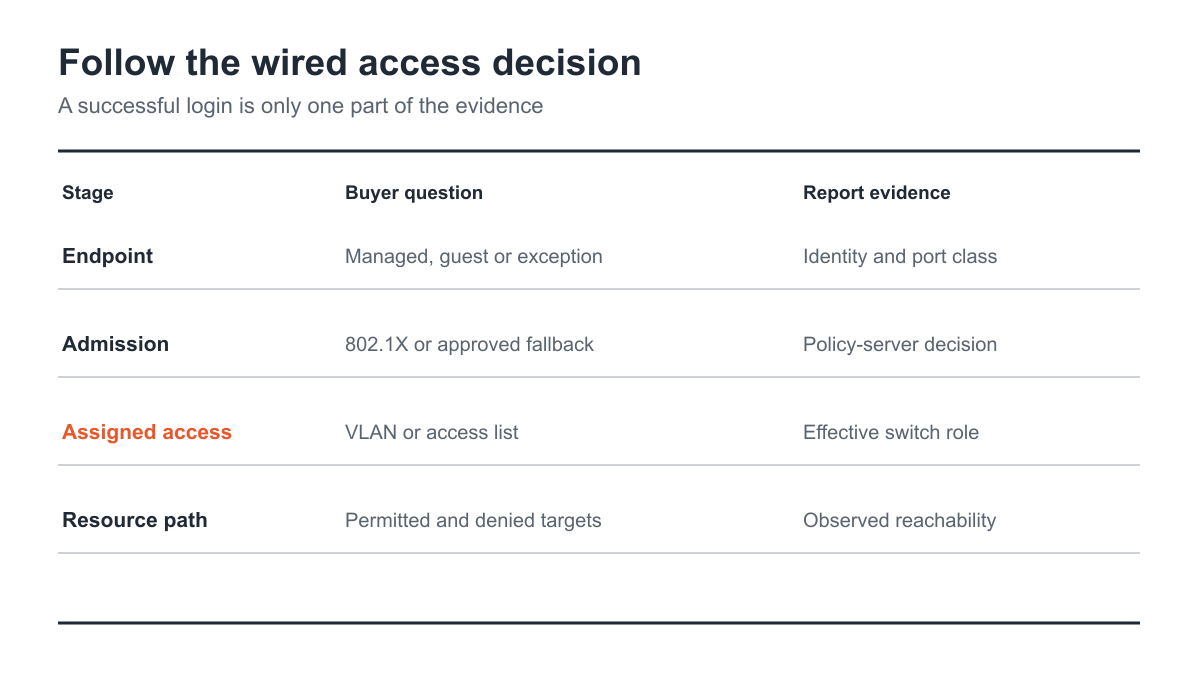
Figure 1: The admission and resource-access evidence a wired NAC buyer should request. Source: IEEE 802.1X-2020 and Cisco's wired 802.1X deployment guide.
Test the authentication and authorization branches
The core 802.1X path deserves more than one pass/fail result. Identify which managed endpoint identities are accepted, which authentication method is required, what the policy server returns, and which switchport authorization is applied. If the design uses EAP-TLS, review certificate-related conditions within the approved test scope. Cisco's guide describes EAP-TLS as mutual authentication using client and server certificates. A buyer should ask whether expired, revoked or otherwise nonconforming endpoint states are included, and how those states can be tested safely with synthetic certificates or controlled test devices. The vendor should report which conditions were observed rather than assuming that a configured method proves every lifecycle case.
Authorization is separate from authentication. A device can successfully authenticate and still receive too much access because of a broad VLAN, an access list, a mistaken group assignment or a policy-server response. Conversely, an endpoint can be placed in a restrictive role while a required business service is blocked. Ask for both outcomes. The test should record the switch port, identity class, policy decision, assigned role and relevant destinations. A security lead can then tell whether the problem is an identity rule, the switch's enforcement, a downstream route or an application-layer decision.
Include user and machine states if the deployment distinguishes them. A workstation before user sign-in may require a different network position from the same workstation after sign-in. A shared or kiosk device may have no individual user identity. The vendor should not treat a single successful logon as evidence for all those states. The Cisco implementation guide describes user, machine and combined authentication patterns; the actual scope should reflect the buyer's deployment rather than copy a vendor's sample configuration.
The policy server and switch logs should be correlated when possible. A RADIUS acceptance record may show what the server decided, while the switch session shows what it applied. A downstream connection shows what the endpoint could do with that assigned position. If the observations disagree, the report should preserve the difference rather than claim that the controller alone is the source of truth. The buyer may discover a stale switch policy, a local override or an unexpected route. Those are hypotheses until evidenced in the tested environment, not assumptions to put into a finding.
Make fallback access a named workstream
Legacy and embedded devices often cannot run the organization's 802.1X supplicant. Cisco's wired deployment guide discusses MAC Authentication Bypass, web authentication and guest VLANs as possible fallback mechanisms in its deployments. Its MAB guide says MAB authenticates devices rather than users and is weaker than 802.1X. That is why exceptions should be inventoried and tested as separate policy classes. A quote that says only “802.1X validated” can leave much of the real access estate unexamined.
The relevant buyer question is not whether MAB exists. It is which devices can use it, what access they receive, who approves the exception and whether the resulting network role is limited to the business need. Test the assigned role and downstream paths for an approved legacy device. Test what happens to a device that is not in the approved exception inventory, using safe, authorized test equipment. The report should name the control decision and exception owner. It should not provide instructions for impersonating a production device or contain sensitive identifiers that could be reused outside the engagement.
Voice and shared-port arrangements also matter. A phone may use a voice domain and carry a workstation connection through a second physical port. The network team should state which identities and roles are expected for each side. A vendor can then test those identities separately and describe whether one endpoint's state affects the other. An unqualified claim that “the port was secured” is too broad when the physical connection supports several policy decisions. Include these arrangements in the initial inventory so the test schedule and equipment are realistic.
Guest and remediation networks should be treated as real network positions. An endpoint denied corporate access may receive a restricted network for onboarding or certificate renewal. Validate the intended services and the prohibited destinations from that state. If the design intentionally permits pre-authentication traffic for bootstrap, ask the owner which traffic is allowed and why. The assessment can then test that boundary without turning a necessary operational exception into a false positive or assuming that every restricted role is safe simply because it has a different VLAN name.
Plan failure and recovery tests safely
Availability choices can change the authorization outcome. Cisco's wired 802.1X guide describes behavior when its authentication server is inaccessible, including configurable critical VLAN arrangements. Those are Cisco-specific deployment behaviors, not a universal default for every NAC product. The buyer should document the intended behavior in its own environment: deny new access, admit a restricted role, preserve existing sessions, or use another approved mode. The assessment should compare that decision with a controlled observation if an outage test is safe and authorized.
An outage simulation can affect many users. Do not ask a bidder to disconnect production authentication services as a casual check. Use a lab, a scoped test switch, a maintenance window or a vendor-approved simulation method where possible. Name the port, affected users, rollback plan, stop condition and escalation contact. If live failover cannot be tested, the report can review configuration and mark the behavior as unobserved. That is an honest limitation, not a failure of the project. NIST's technical testing guide emphasizes planning and conducting assessments, analyzing findings and developing mitigation; that discipline is especially important for a control that grants network access during service degradation.
Recovery matters as much as failure. A port may receive one role while the policy server is unreachable and another when it returns. A previously admitted endpoint may behave differently from a new endpoint. The buyer should state which transitions are in scope and which logs are needed to understand them. A report that checks only the steady state can miss a temporary broad access mode or an availability problem. Conversely, a test performed only during an outage says little about normal role assignment. Both states need their own evidence and limitations.
Keep operational ownership clear. The network team may own switch templates, the identity team the RADIUS policy, the endpoint team certificates and the security team the protected-resource matrix. A finding can cross these boundaries. A useful report identifies the control decision and the team that can change it, then asks for a retest that recreates the original endpoint and port state. The procurement brief should name these owners as participants before the test, reducing time lost during field work.
Validate what an admitted endpoint can reach
Admission is the beginning of the path, not the end. Cisco's guide notes that an authenticated identity can be assigned a VLAN or an access list. The buyer needs evidence that the assigned policy produces the intended resource access. From a representative device in each role, test a small set of approved and prohibited destinations: business application, device management, production server, printer service or internet egress, as appropriate to the environment. Record the source role and the observed result for each path.
This is a separate question from whether the endpoint's credentials were valid. A managed device may receive a staff VLAN that reaches a sensitive management interface. A printer exception may be allowed to reach an unrelated server because of a downstream route. Or an authenticated endpoint may be unable to reach the service it needs. These are hypothetical examples, not reports of actual customer conditions. The useful assessment distinguishes the admission control from the downstream network and application controls so the right owner can fix the issue.
NIST SP 800-207 says zero trust should not grant implicit trust solely because a user or device is on a local network, and it focuses on resources rather than network segments. In a wired NAC project, that guidance supports asking about access after admission. It does not imply that an 802.1X port is irrelevant. The port limits who receives a network position; later controls may protect individual resources. The assessment should show how these layers interact in the actual deployment rather than proclaim that one control replaces the other.
Be careful about evidence attribution. A failed connection could be blocked by the assigned ACL, a downstream firewall, a missing route, an unavailable service or an application login requirement. The report should identify which observation supports the claimed control. If the tester cannot isolate the cause, record the path as denied by an unknown layer and describe the limitation. That is better than falsely crediting NAC for a block it did not enforce. For a buyer making a budget decision, knowing which layer works and which remains unverified is essential.
Request a decision-level report and a realistic retest
The report should begin with the port classes and endpoint classes tested. For each case, list the site, switch and port class, endpoint identity type, authentication or fallback method, policy-server decision where available, applied role, expected access and observed downstream reachability. Include dates, test conditions and exclusions. A coverage table should distinguish passed, failed, inconclusive and untested cases. That makes it possible to compare the result with the enterprise's NAC rollout plan and to prioritize exceptions without overgeneralizing from a small sample.
Technical findings should preserve a safe reproduction path. A finding about an overly broad MAB role needs the exception class, the assigned network and the protected destination reached, while omitting reusable production secrets. A certificate-policy finding needs the test identity state and observed authorization result, not a dump of private keys. A failover finding needs the controlled failure condition and recovery behavior, with the safety limitations. These details let engineers act on the issue and allow an independent reviewer to understand the result. A dashboard tally alone is insufficient.
Retesting must recreate the original class and condition. If a printer exception received excessive access, a retest from a managed laptop does not prove that the exception was narrowed. If a branch switch behaved broadly during a policy-service outage, a test in normal operation does not close the finding. Ask the vendor to state which cases can be retested after a change and what access or window will be needed. Stingrai's public network service includes retesting fixed findings on request and updating their status in the portal and report, but the buyer should confirm the specific NAC cases in the scope.
The executive summary should answer whether the admission design is working across the representative classes, which exceptions carry the most access, what failure states remain uncertain and which teams own remediation. It should not imply that all switch ports in the estate were tested if the project sampled a subset. A clear sampling rationale and exception list make the conclusion more credible than an unqualified “NAC passed” statement. A regulatory or customer evidence package can then use the actual test scope, findings and retest, without treating the assessment as a certification.
Compare vendors on access decisions, not tool names
Give every bidder the same port and endpoint matrix. Ask which sites and switch families will be sampled, what test devices and identities are needed, whether configuration review is included, how the vendor will correlate RADIUS and switch decisions, which fallback modes are in scope, whether post-admission paths are tested, and what safe method is proposed for an outage scenario. Ask for a sample coverage table with expected and observed decisions. These answers make the scope comparable across vendors that use different tools or terminology.
Do not allow a wireless test to be substituted for this wired question. Wireless 802.1X can share identity infrastructure with wired NAC, but the physical starting position, authenticator, port policy and fallback behavior are different. Likewise, a standard internal penetration test that starts from an already authorized corporate host can be valuable but may not test whether an unknown device receives access at a wall port. The statement of work should say “wired access port,” identify the endpoint classes and include the post-admission path matrix. This avoids an ambiguous deliverable.
Cost depends on the number of policy classes, sites and unique switch templates, the availability of test identities and devices, the depth of configuration review, the number of downstream paths and whether failure behavior can be tested safely. A small pilot with a few well-defined classes is different from a multi-site rollout review with phones, printers, branches and several RADIUS policies. Ask for a scoped quote and list optional work separately. Do not infer a price from a general network penetration test or from a wireless engagement. Stingrai quotes network engagements to scope.
The team should be able to explain limitations. A vendor may have access to switch logs but not the policy server, or to a test port but not a production branch. That can still be useful if the report states which observations are available and which decisions cannot be confirmed. Ask how findings are reviewed by a senior tester and how remediation will be retested. A well-scoped NAC assessment is a map of effective access, not a blanket assurance that a product feature was switched on.
Where Stingrai fits
Stingrai is a CREST-accredited penetration testing company founded in Toronto in 2021. Its internal and external network penetration testing service includes internal starting positions such as a network drop and segmentation testing between zones, VLANs and sites where scoped. The public service page also lists switches, routers and their management planes. Every network engagement is human-led by two named penetration testers, with team-lead and engagement-partner review. The service is quoted for the buyer's environment, and fixed findings can be retested on request.
Wired 802.1X and NAC testing is a specific objective to put in the request, not a claim that every general network engagement automatically includes it. Send the port classes, endpoint types, authentication methods, RADIUS or policy-service ownership, fallback exceptions and protected destinations. Ask Stingrai to define the exact switches, access ports, identity states and post-admission paths it will cover, along with the safe outage-testing boundaries. The resulting proposal can then show whether the work answers the buyer's access-control decision.
Frequently Asked Questions
What should a wired network access control assessment include?
It should include representative switch ports and endpoint classes, 802.1X and approved fallback decisions, the applied network role, downstream allowed and denied paths, safe failure-state checks where feasible, and a report with limitations and retest cases. The statement of work should name wired access ports explicitly.
Is an 802.1X configuration review enough to prove NAC works?
No. Configuration shows the intended policy and device settings. A controlled port test shows the effective authentication and authorization decision, while a post-admission path test shows what the endpoint can reach. Request all three when the buyer needs assurance about deployed access.
Should MAB and legacy devices be included?
Yes, if the organization uses them. Cisco's deployment guidance describes MAB as a legacy-device fallback and notes that it authenticates a device rather than a user. Test the approved exception class and its assigned access, not just the managed laptop's 802.1X path.
How do wired NAC and Wi-Fi assessments differ?
A wired NAC assessment starts at an Ethernet switch port and validates its admission policy and downstream access. A Wi-Fi assessment starts with wireless infrastructure and radio conditions. They may share an identity provider, but one test does not automatically validate the other access path.
Should a RADIUS outage be tested in production?
Only with an explicit, safe plan and authorized window. The buyer should identify the intended failover behavior and use a lab, test switch or controlled simulation where possible. If production failure cannot be exercised safely, review the configuration and report the behavior as unobserved rather than claiming it passed.
What should a NAC report prove after an endpoint connects?
It should record the endpoint and port class, authentication or fallback method, applied role, and the protected resources that were actually reachable or denied. A successful authentication is not proof that the assigned VLAN or access policy is appropriately narrow.
How much does a wired NAC security assessment cost?
It is quoted to scope. The effort depends on policy classes, sites, switch templates, test identities and devices, fallback cases, downstream paths, safe outage testing and retest needs. Give each vendor the same matrix and ask for explicit exclusions and optional work.
Can a wired NAC assessment support customer or audit evidence?
Yes. A report with authorized scope, sampled ports and devices, expected versus observed decisions, access paths, findings and dated retest results can support a security or compliance program. State sampling and untested states clearly so readers do not infer whole-estate coverage.
Related reading
References
IEEE Standards Association. IEEE 802.1X-2020: Port-Based Network Access Control. February 2020. Standard page. Public purpose and status of the standard.
Cisco. Wired 802.1X Deployment Guide. Updated September 2011. Implementation guide. Cisco-specific examples of components, EAP, authorization and fallback.
Cisco. MAC Authentication Bypass Deployment Guide. Updated September 2011. Implementation guide. Cisco-specific MAB benefits and limitations.
National Institute of Standards and Technology. SP 800-207: Zero Trust Architecture. August 2020. Publication page. Resource-level access framing.
National Institute of Standards and Technology. SP 800-115: Technical Guide to Information Security Testing and Assessment. September 2008. Publication page. Test planning and mitigation.
Stingrai. Internal and External Network Penetration Testing. Service description. Public network scope and delivery terms, read 15 November 2026.
Talk to Stingrai
Share your wired port classes, endpoint and fallback policies, sites and protected-resource matrix through Get a Quote, or book a discovery call to define safe test positions and evidence.



