





The National Security Agency says network infrastructure risk depends in part on the design and configurations of existing networks. For an enterprise buyer, that makes a router or switch assessment more than a version check. The useful question is whether the device's actual management access, deployed configuration and forwarding behavior support the boundaries the organization believes it has.
Quick answer. Buy a network device security assessment when routers or switches are important to a management, site-to-site or segmentation decision. Give the tester a device inventory, intended administration paths, representative network starting positions and the traffic policies to validate; ask for findings tied to each device class and path. Stingrai's network penetration testing service includes switches, routers and their management planes where the engagement scope calls for them.
This guide is for a mid-market or enterprise security leader, network architect or procurement team defining an assessment that engineers can use. It is narrower than a general network penetration testing services guide. It also differs from a firewall rule and path validation brief: routers and switches carry management and transit functions whose assessment often depends on device roles, interface design and configuration state, not only a firewall policy. The management-plane scope article examines incident lessons; this guide is a vendor brief for a planned device assessment.
Start with the decision the device must support
An organization may be worried that a branch router exposes administration to a user network, that a core switch allows a sensitive VLAN to reach too much, that old configurations persist on newly inherited devices, or that a network team cannot tell when a privileged change was made. Each is a valid concern, but each requires a different test. A quote for a “network device penetration test” is meaningful only after the buyer states the device classes and the decisions that matter.
Separate three questions at the outset. First, can an unauthorized source or role reach and use a management interface? Second, is the configuration aligned with the owner's intended controls, including privileged access, permitted services, routing and access lists? Third, what do packets actually reach across the deployed topology? A configuration review can identify broad access, but observed reachability determines whether the implemented path behaves as expected. A path test can show an unexpected route, but it may not reveal how the device is administered or how a policy change is approved. The combined engagement should report each question separately.
The joint CISA, NSA, FBI and partner guidance for communications infrastructure recommends investigating device configuration changes outside change management, using protected management paths and retaining a centralized source of configuration truth. It explicitly notes that, while tailored to communications defenders, some recommendations may apply to organizations with on-premises enterprise equipment. This is useful context for a buyer, not a claim that every organization must adopt one prescribed topology. Ask the vendor to assess the controls the organization says it uses and to explain any comparison with external guidance.
For some buyers the narrowest useful purchase is a management-access assessment of a small set of critical routers. For others, the question is campus switch access and segmentation. A merger may create inconsistent device templates across sites, while a data-center migration changes traffic paths through new switches and virtual routing. An acquisition scenario or migration example in this guide is hypothetical; no client environment is being described. The statement of work should tie the selected device sample and test positions to the actual decision so that a finding can be acted on.
Create an inventory a vendor can actually scope
An address list alone hides differences that drive effort. Identify each device's role, site, operating system family and supported version, management method, owner, configuration source, relevant trust zones and criticality to service. Distinguish core routers, WAN edge devices, distribution switches, access switches, virtual network devices and management appliances. A physical count can be misleading when many identical switches share a template, while a small number of devices may have unique local exceptions. The buyer should disclose enough architecture to let bidders propose a defensible sampling method.
Record how each device is administered. Does management use a physically or logically separate network? Are there jump hosts or privileged access tools? Can a standard user subnet reach a web console, SSH service or vendor cloud manager? Does an emergency or local account exist, and who controls it? Which identity and logging services support administrative access? The question is not whether a particular vendor interface exists, but which sources and roles the organization intends to permit. The 2024 joint guidance recommends out-of-band management for its communications-infrastructure audience, and emphasizes separation from production traffic. A buyer can use that as a comparison point while keeping its own risk and operational design explicit (joint guidance).
Next, map each device to the traffic policy it helps enforce. A router may decide which site route is present; a switch may place endpoints in VLANs or apply access controls; several devices can combine to create a boundary. Include downstream firewalls, cloud connections and management networks where they affect the same path. The assessment does not need to test every feature of every device. It does need to name the network path and the expected decision. Without that, the report risks becoming a device settings inventory with no answer to the business concern.
Use this hypothetical request-for-proposal worksheet as a starting point:
Device class | Management question | Transit or policy question | Evidence to request |
|---|---|---|---|
Core router | Which approved roles can change routes? | Can a restricted zone use an unintended route? | Authorized source and role, route context, observed path |
Branch edge router | Is administration reachable from the branch user LAN? | Do branch and central routes follow the intended boundary? | Source positions at representative branches, configuration and path result |
Distribution switch | Which network manages interfaces and VLANs? | Do trunk and access policies match the segmentation design? | Configured state paired with observed segment reachability |
Access switch | Who can manage the device and change port policy? | Do selected access ports grant the intended network position? | Port class, identity or device condition, assigned network and path |
Virtual network appliance | Which cloud or platform identity administers it? | Does the effective route match the diagram? | Owner, policy layer, cloud path and tested limitation |
These are not benchmark requirements. They show how to define a testable question for each class. A vendor can then estimate whether a representative sample is appropriate, which unique devices need full review, and where a separate workstream is needed. Document devices excluded because of third-party ownership, unsupported access, maintenance windows or operational risk. A scope statement that lists exclusions is more useful than a broad promise to “assess the network” with unspoken gaps.
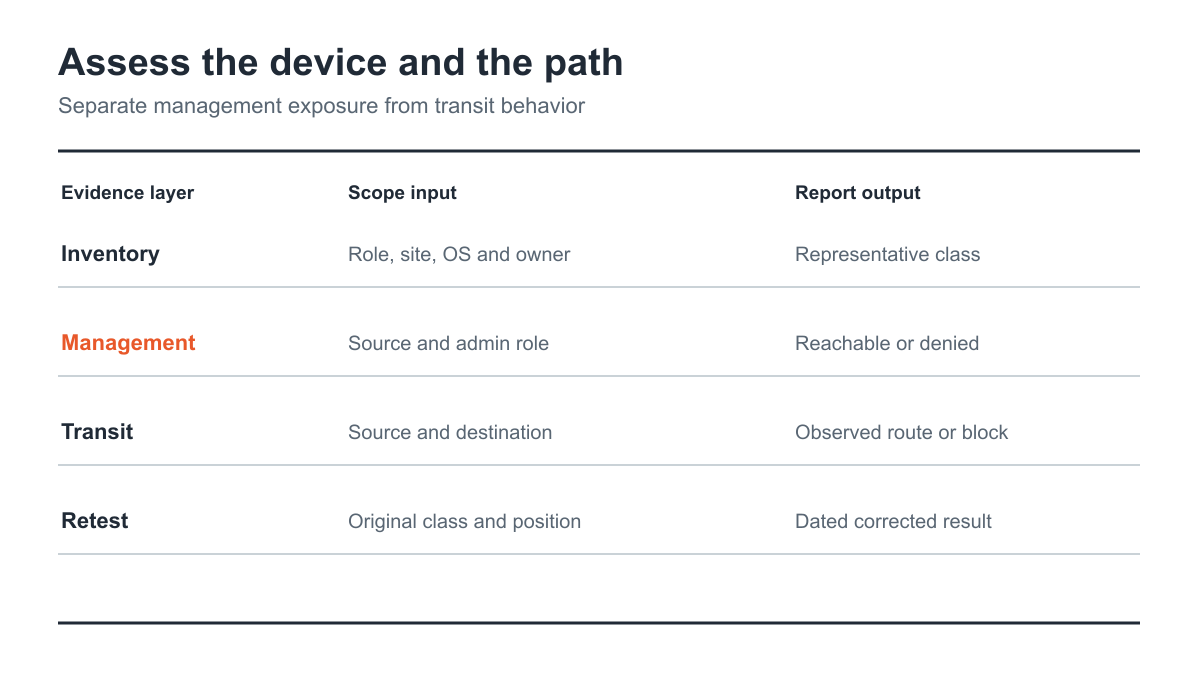
Figure 1: A buyer worksheet that separates management and transit questions in a device assessment. Source: CISA, NSA, FBI and partners, network-infrastructure guidance.
Examine management access as a separate path
The management plane needs its own source and destination matrix. A device may be well configured for ordinary traffic while its console is reachable from a standard workstation network. It may also be inaccessible from the internet but available through a broadly trusted internal jump host. Test from the positions that represent the real access decision: public internet if relevant, a standard user network, a vendor or branch position, and an approved administration network. Record whether the interface was reachable, whether authentication and authorization matched the intended role, and whether the event appeared in the available audit trail.
Configuration review can add context. An assessor may inspect read-only exports, local accounts, authentication method, role definitions, enabled management services and the source restrictions on administrative access. The goal is to connect a potentially risky setting with a plausible path or operational consequence. It is not to paste a generic hardening checklist into a report without knowing how the device is used. A buyer should provide approved baselines and exceptions so the tester can identify deviations that are actually meaningful. The joint guidance's call for centralized AAA and configuration management is particularly relevant as a question about who can make a change and how the organization detects one (joint guidance).
Emergency access is easy to omit from a standard role test. A break-glass account may be necessary to recover service when central identity fails, but its existence changes the access model. Ask the network owner which emergency routes and identities are authorized, how they are protected, and whether the assessment should verify their restrictions. Do not hand a tester an unrestricted credential without a controlled plan. The proposal should state the permissions used for review, the actions permitted, which devices are production-critical and who can halt testing. A good assessment proves a weakness without requiring an unsafe configuration change.
External exposure and internal reachability should not be conflated. A device that is protected from the public internet may still have an administrative service open to a large employee population. A device reachable through a management overlay may be governed by a separate identity provider or policy. If a vendor reports “no exposed management interface” after testing only public IPs, that statement is narrower than a full management-path conclusion. Ask for the tested source positions in every finding and in the coverage summary.
Test the deployed configuration and forwarding decision
Routers and switches also determine where traffic goes. A device's configuration can create a route or permit a VLAN connection that the high-level diagram does not show. Conversely, a broad-looking command may be constrained elsewhere in the topology. This is why a scoped assessment needs both a configuration view and a controlled traffic observation for important boundaries. The tester should compare expected paths with what the deployed network allows from representative sources, then identify which device or policy layer appears to control the result. Where evidence is incomplete, label the conclusion as limited.
Select traffic paths from the buyer's claims. Examples include a standard user VLAN to production administration, a branch network to a data-center service, a vendor link to only its named systems, or a management subnet to a device console. Write both allowed and denied cases. An allowed application flow proves the required business path still works; a denied adjacent flow helps establish that the permission is appropriately narrow. A denied attempt to a host that is down says little about the network rule. The report should distinguish a policy deny from a missing route, host state or service response.
Sampling must be explained. An enterprise with a hundred access switches may reasonably test policy templates and selected edge cases rather than every port. But a sample should represent different sites, operating systems, device roles, configurations and exception classes. If the organization recently consolidated networks after an acquisition, include the inherited template as a separate class. If two sites have divergent routing or management arrangements, one site cannot stand for both. Ask bidders to state their sampling assumptions and what would cause them to add a device or path.
Firmware and support status can be part of this work, but do not let a version list substitute for access testing. The presence of a published vulnerability is useful context; exposure and exploitability depend on the feature, configuration and reachability in the specific environment. The buyer should require the tester to separate “software version needs review,” “service is exposed from this position,” and “a controlled test demonstrated impact.” This separation improves prioritization and avoids claiming compromise where no path was shown. It also gives the owner a clearer fix, which may be patching, disabling a service, restricting a management route or changing a role.
The NIST technical testing guide frames assessments as planned tests followed by finding analysis and mitigation strategy. Use that structure in the statement of work. Ask the vendor to describe its safe test method for critical routing and switching equipment, the evidence it will collect, the stop condition and the person who will approve any deeper validation. Production network devices are not suitable for uncontrolled volume or destructive changes. The engagement should show whether the policy works without risking an outage to prove a point.
Account for changing architecture and control ownership
Device security drifts as routes, sites, identity providers and operating models change. A central template can be overridden locally. A temporary exception can become permanent. A new remote-management platform can expose a path that the original design never considered. The joint agencies' 2024 guidance recommends scrutinizing network-device changes outside change management, monitoring route and access-list updates, and storing configurations centrally. For an assessment, ask for a dated configuration snapshot and a named owner of each exception. That makes the resulting evidence useful after the test window ends.
Keep third-party ownership visible. Some devices sit inside a carrier, managed service or cloud platform, and the buyer may not have permission to authorize testing of them. The proposal should identify which side of the handoff can be tested, what the provider's responsibility is, and which claims remain unverified. If a route enters a managed network and exits into a protected environment, the test can still observe source-to-destination reachability within approved boundaries. It should not imply that the third party's internal control was reviewed when access was unavailable.
Network location is not a substitute for resource authorization. NIST SP 800-207 says zero trust grants no implicit trust solely because an asset is on a local network and emphasizes protection of resources rather than network segments. That does not make router or switch controls irrelevant. It means the report should explain their role in a layered design. A path that reaches an application may still be restricted by application identity, but the network path is real. If the buyer's claim was “the subnet is isolated,” an application login screen does not prove the isolation claim. State the specific control being validated.
Major changes are good triggers for a focused retest. A new site, route, privileged access tool or device template can alter management and transit paths. Rather than repeat every check after every change, define the affected claims and recreate the source positions that originally mattered. A dated comparison can show whether the new configuration closed a gap while preserving approved traffic. That discipline is useful for both security governance and change approval, even where no regulation specifies a fixed network-device test frequency.
Specify report evidence before the test starts
The report should begin with the inventory subset, device classes, versions where relevant, start positions, scope exclusions and test dates. Then separate findings into management access, configuration and transit behavior. This is a practical structure, not a formal standard. It prevents a vulnerable firmware observation from being mistaken for an open path, and it prevents a blocked path from masking an overprivileged administrator. The reader should be able to tell what was inspected, what was observed and what remains an assumption.
For a management finding, request the administrative interface and reachable source, the identity or role used, the expected restriction, the observed result, the configuration context where available and the remediation owner. For a transit finding, request the source zone, destination, intended route or policy, observed route, relevant devices and limitation. For configuration drift, include the approved baseline, observed departure, exception status and likely consequence. Do not put credentials, private keys or unrestricted exports into a broadly shared report. The useful evidence is the control decision and a safe way to reproduce it, not sensitive material copied wholesale.
A retest should repeat the original condition after a fix. If a branch user network could reach a router console, the retest must come from a representative branch user position. If a switch template assigned the wrong VLAN, the test should show the corrected assigned network and the downstream paths that changed. Record what was not retested, especially if a provider-owned device or a change freeze prevented access. This supports a precise risk decision rather than a vague “closed” status. Stingrai's public network service includes retesting of fixed findings on request and updates their status in the portal and report.
An executive summary should explain the business consequence. Which management paths are broader than intended? Which device classes have inconsistent control? Which sites or routes remain untested? What action belongs to the network team, identity team or provider? The technical appendix should preserve the evidence needed by engineers. This combination gives a mid-market security lead and an enterprise architecture board the same underlying facts without forcing either audience to infer the result from a raw configuration dump.
Compare proposals using a device-class matrix
Send every bidder the same inventory summary and ask for explicit coverage by device class. Ask which operating systems and versions the team can review, how many unique templates are assumed, whether site visits or remote test hosts are needed, what read-only access is required, which management paths are tested, how routing and VLAN policy will be observed, and which activities need a maintenance window. Have the vendor identify the smallest sample that supports the stated decision and the conditions under which the sample must expand. This creates a fair comparison between bids with different assumptions.
Ask where the engagement stops. An external network penetration test may encounter a router but not receive configuration access. A configuration review may never test whether a prohibited source can reach the device. A broad internal test may include some switches but not compare them to an approved baseline. Those services can all be useful; the proposal must call them by the decision they answer. Be wary of an appliance count used as a substitute for a coverage map, or a “full network” promise that names no sources, roles or routes.
Cost depends on the inventory's diversity, not just its size. A small number of unique core devices can require more coordination and deeper review than a large fleet of identical access switches. Site access, configuration availability, identity integration, vendor ownership, test windows and the need for a second observation after remediation all affect the estimate. There is no defensible universal price for this brief. Ask for a fixed quote against the agreed scope, optional work priced separately and a clear process for approving additions discovered during testing. Stingrai's service quotes network engagements to scope.
Request a redacted sample finding or a sample report structure that discloses no other customer's information. The sample should show scope, evidence, impact, remediation and retest rather than a long list of tool observations. Ask who performs the test and who reviews conclusions about complex paths. A reliable assessment lets the buyer hand a finding to an engineer and ask for a precise change; it also lets leadership understand which boundary or access decision is at risk.
Where Stingrai fits
Stingrai is a CREST-accredited penetration testing company founded in Toronto in 2021. Its human-led internal and external network service explicitly includes switches, routers, firewalls and their management planes, along with segmentation and internal path testing where scoped. Two named penetration testers perform each network engagement; a team lead and engagement partner review the report. Fixed findings can be retested on request. The company scopes and quotes network work for the environment rather than assigning a fixed router or switch package price.
For a device assessment, provide the device-class inventory, approved administration routes, policy owners, representative site positions and the traffic boundaries you want demonstrated. Ask Stingrai to distinguish device management, configuration and transit tests in the scope, and to state the planned evidence and safe testing limits. Findings are posted to the PTaaS portal as confirmed, with affected hosts and remediation guidance. The engagement can then focus on decisions that matter to the organization rather than a generic list of open ports.
Frequently Asked Questions
What should a network device security assessment include?
It should include a device-class inventory, intended management routes, representative user and site starting positions, configuration and access-control questions, observed network paths, scope limitations and retest evidence. The buyer should specify which routers and switches matter to the decision and how the vendor will sample repeated templates.
Is a router or switch vulnerability scan enough?
No. A scan can identify exposed services and possible version issues, but it does not by itself show who can manage the device, whether configuration matches approved policy, or how traffic crosses a protected boundary. Add read-only configuration context and controlled path observations where those are the questions the buyer needs answered.
Should the assessment include the management plane?
Yes, when administration of the device is part of the risk decision. Name the approved management sources and roles, then test representative unauthorized and authorized positions safely. A public-internet check alone cannot establish whether an internal user subnet or a vendor path can reach the console.
How should a large switch fleet be sampled?
Group devices by role, site, operating system, template and exception pattern, then select examples from each material class. State the exact population represented and the limits of that inference. Unique core devices, inherited configurations and sites with local overrides may need direct review rather than extrapolation from a standard access switch.
What is the difference between management and transit findings?
A management finding concerns who can view or change a router or switch. A transit finding concerns the traffic the device routes or permits between network locations. They can be related, but the report should give each its own starting position, expected policy, observed result and remediation owner.
Can this assessment support compliance evidence?
Yes. A report that states the authorized scope, tested devices and paths, expected versus observed decisions, findings and retest results can support a buyer's security and audit evidence. It should not imply that every device or route was assessed if the engagement used a sample or excluded provider-owned equipment.
How much does a router and switch security assessment cost?
It is quoted to scope. Cost depends on the number of unique device classes and templates, management paths, sites, starting positions, configuration access, safe test windows, provider dependencies and reporting depth. Give bidders the same matrix and ask for a fixed quote with exclusions and optional work stated.
When should router and switch controls be retested?
Retest a finding after its correction using the same relevant source and role. Also consider a focused retest after a material route, site, administration or template change that affects a protected boundary. The cadence should reflect the organization's architecture and change process rather than an assumed universal interval.
Related reading
References
National Security Agency. NSA Details Network Infrastructure Best Practices. March 2022. Press release. Design and configuration context.
CISA, NSA, FBI and partner agencies. Enhanced Visibility and Hardening Guidance for Communications Infrastructure. December 2024. Joint guidance. Device management, configuration and monitoring; written for communications infrastructure.
National Institute of Standards and Technology. SP 800-115: Technical Guide to Information Security Testing and Assessment. September 2008. Publication page. Test planning and mitigation.
National Institute of Standards and Technology. SP 800-207: Zero Trust Architecture. August 2020. Publication page. Resource-level trust framing.
Stingrai. Internal and External Network Penetration Testing. Service description. Public scope and delivery terms, read 15 November 2026.
Talk to Stingrai
Send the router and switch inventory, management routes, site sample and network decisions through Get a Quote, or book a discovery call to agree on safe test positions and report evidence.



