





The National Institute of Standards and Technology describes firewalls as controls over traffic between networks or hosts with different security postures, and its firewall guidance recommends periodic ruleset reviews or tests. That distinction explains the buyer's real problem: a rule can look correct in a console while the effective path differs because of routing, an overlapping policy, a translated address, an exception or a second enforcement point. A firewall assessment becomes useful when it connects the organization's written access decision to traffic observed from the source that matters.
Quick answer. Scope firewall penetration testing around named source and destination pairs, their intended allow or deny decision, and the firewall controls expected to enforce it. Ask the tester to reconcile policy and exception context with observed reachability, then report the exact path and retest any correction. Stingrai's network penetration testing service includes firewall rule and access control list validation where those boundaries are in scope.
This guide is for security leaders, network owners and procurement teams buying an assessment of firewall control effectiveness. It is narrower than a general network penetration testing services guide, and it is not a replacement for the separate PCI DSS segmentation testing brief when cardholder-data-environment isolation is the compliance claim. Its deliverable is an evidence-backed answer to a question the business can act on: does the configured control enforce the approved traffic policy on the paths we rely on?
Decide what the firewall test must prove
There are several legitimate purchases under the phrase “firewall testing.” A configuration review compares a rulebase with a standard and looks for broad, stale, duplicate or unexplained rules. A vulnerability assessment checks the firewall appliance, software and exposed services for known weaknesses. An external penetration test starts outside and examines what the perimeter presents to the internet. A path validation starts on one side of a control and tests whether a destination on the other side is actually reachable. These activities overlap, but their evidence differs. A buyer should select the work according to the decision that prompted the purchase.
For example, a business may believe that development workstations cannot reach production administration interfaces. The purchase decision is not settled by counting firewall rules. It needs a starting position on the development network, a protected destination, the intended access policy and a controlled observation of what happened. If there is an approved jump host, the test should distinguish that narrow exception from direct reachability. If the destination was unavailable during testing, an unanswered connection cannot be called a successful block. The report needs to preserve enough context to make those outcomes clear.
NIST's firewall policy guide expressly describes using generated traffic and monitoring how the firewall handles it against the expected response to verify ruleset behavior. Its publication is from 2009, so treat it as foundational testing guidance, not a current product configuration benchmark. The practical lesson is durable: rule intent, rule implementation and observed network behavior are three separate things. A buyer should ask the vendor how it will establish and compare all three.
Define success before the engagement begins. For a restricted administrative path, success might mean a named support role can use an approved jump route and an ordinary workstation cannot connect directly. For an application integration, success might mean only a named service and protocol is allowed, while neighboring subnets remain denied. For egress control, success might mean a controlled test host reaches its approved service and not an unrelated destination. Those examples are illustrative, not claims about any organization's environment. The real expected decisions must come from the buyer's own approved policy.
Build a path inventory instead of sending only an address list
A list of firewall IP addresses tells a bidder what devices exist but little about the coverage you expect. A useful path inventory names each trust boundary and why the business depends on it. Record the source zone, protected destination, traffic that should be allowed, traffic that should be denied, the control owner and any exception owner. The same firewall can enforce several boundaries, each with a different business purpose. Conversely, one boundary may pass through several devices and cloud controls. The assessment should follow the path rather than assume a single rulebase contains the entire answer.
Include every starting position needed to represent a policy class. An outside-in test from the public internet can validate perimeter exposure, but it cannot prove that a restricted employee VLAN is separated from a production network. An internal test host in headquarters may not represent a branch office whose traffic enters through a different route. A remote employee account may reach different networks from an office workstation. If the company has cloud workloads, determine whether the firewall is an appliance, a virtual control, a cloud policy or one layer of a longer route. The statement of work should identify which paths the tester will actually exercise.
Use the following as a procurement worksheet, not as a prescribed firewall design:
Business claim | Test source | Protected destination | Expected result | Evidence to request |
|---|---|---|---|---|
Public users can reach the application tier only | Approved internet test location | Application and administrative interfaces | Application allowed, administration denied | Observed traffic, relevant policy and exposed service |
Staff cannot administer production directly | Standard workstation zone | Production management subnet | Direct path denied, approved jump route allowed | Both route results and exception identity |
Vendors have limited support access | Representative vendor access position | Named support systems and adjacent systems | Named systems allowed, adjacent systems denied | Role, source, time window and effective route |
Branch sites are segregated | Representative branch network | Central services and restricted zones | Approved services allowed, restricted zones denied | Per-site path coverage and limitations |
Workloads have controlled egress | Approved test workload | External destinations | Documented egress allowed, unrelated paths denied | Source identity, destination and rule decision |
The table forces a useful conversation about what “covered” means. If two branches use the same template but different local exceptions, sampling only one branch may miss the difference. If a cloud route bypasses the on-premises firewall, the tester should mark the firewall as not on that path rather than claim that it validated the boundary. If only one destination in a broad subnet is used as a test case, the report should say why it represents the policy class and which destinations were not observed. Coverage should be explicit enough that the buyer can compare it with the architecture and authorize any change in scope.
Some controls are stateful and context-sensitive. A route may depend on user identity, time, device posture, destination name or application classification. The buyer does not need to disclose every operational detail in an initial sales conversation, but the final scope must include the conditions that decide access. A vendor quoting solely by number of firewall appliances can miss most of this effort. NIST's guidance says firewall policy should specify the traffic required by the organization and address changes to the ruleset; that is a reason to bring policy owners into scoping, not just asset owners (NIST SP 800-41 Rev. 1).
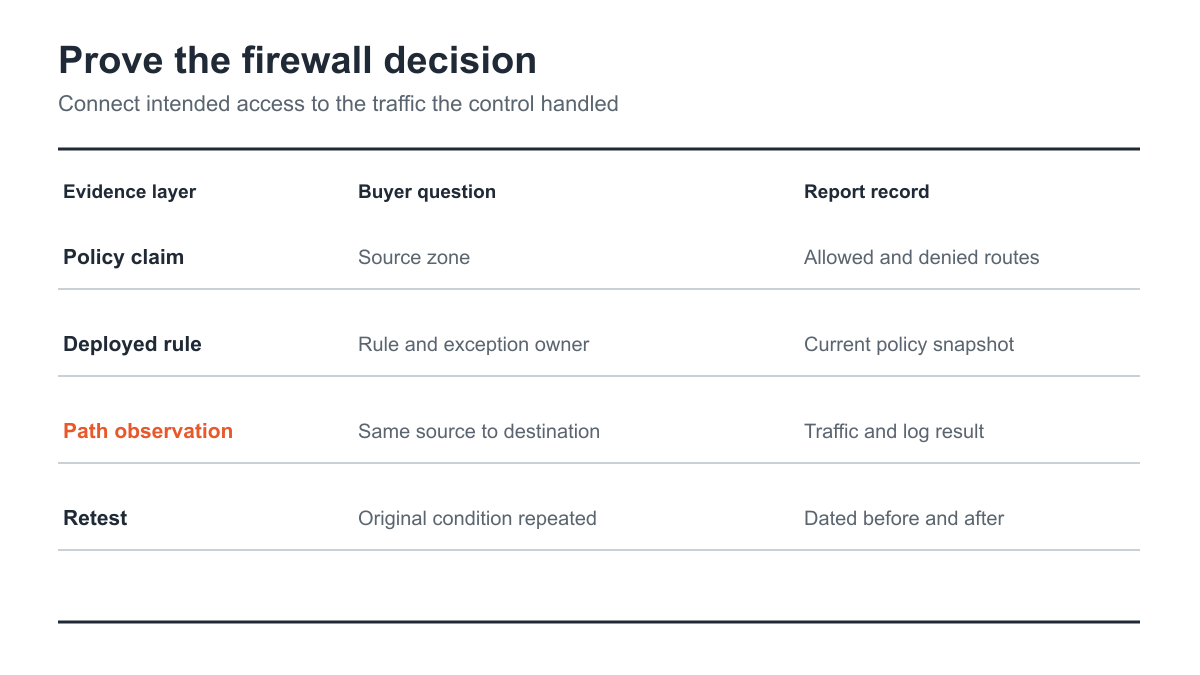
Figure 1: A buyer-oriented evidence chain for firewall control validation. Source: NIST, SP 800-41 Rev. 1.
Pair rule review with observed traffic
A ruleset review is valuable because it shows what the operator intended to deploy and which exceptions might explain an unexpected route. Ask the owner to provide a current, read-only policy export or a supervised view, the network diagram, the change record for high-risk exceptions and the control's logging plan. The tester can then identify rules that are broad relative to the stated policy, rules that are shadowed or redundant, and rules whose owners or expiration dates are unclear. That analysis should help select paths for controlled validation. It should not silently become an assertion that every production rule was exercised.
The live observation must be made from a meaningful source. If an internal firewall should block access from contractor laptops, testing from a privileged administrator host cannot validate that claim. The report should say whether the result was a firewall deny, a service-level rejection, a routing failure or an unresponsive target. Those are materially different findings. A host that happens to have no listening service does not prove that a policy would block the service if it appeared later. Firewall logs, packet observations and a controlled test connection can be correlated to make the distinction without providing a weaponized exploit in the report.
Translation and multiple hops deserve particular attention. Network address translation can change what the firewall sees as a source or destination. A path may traverse a load balancer, a cloud gateway, an internal firewall and a host-level control. An allow at one layer may be neutralized at another; an unexpected path may bypass the layer that the team thought was responsible. The deliverable should identify the control that actually made the decision where evidence permits, and describe uncertainty where it does not. Do not accept a report that attributes every failed connection to “the firewall” without checking the route.
Log evidence helps a buyer reconcile traffic with policy. NIST emphasizes firewall logs and alerts, formal change control and periodic testing in its firewall guidance. For a test, ask whether the relevant allow and deny events were captured, whether the source and destination can be identified after translation, and whether the rule or policy reference is available. A test does not need to turn into a monitoring implementation project, but it can expose a practical limitation: a team cannot readily explain why a protected connection was accepted. Record that as a visibility issue rather than assume a security incident occurred.
Give exceptions the same attention as the default rule
Many important enterprise routes are exceptions. A supplier needs a narrow management path. A backup service needs access to several networks. A temporary migration requires connectivity that normal policy forbids. Such paths are often justified, but they should be named, owned, time-bounded where appropriate and tested against the reason they were approved. A general rule that “administrators can reach production” is less useful than an explicit set of roles, source positions, target systems and maintenance windows.
Ask the tester to distinguish three outcomes for every exception. First, the approved path works under the approved conditions. Second, the same path is denied for an account or network that should not use it. Third, adjacent systems outside the exception remain unreachable. This positive-and-negative pair helps a network owner fix overbreadth without breaking the service. It also prevents a vendor from calling a control effective simply because one blocked destination was observed. The most useful report records the exception identifier and owner beside the observed result.
Temporary changes are a common reason to schedule a focused retest. A large enterprise may alter a firewall rule for a cutover, a new application or an acquisition link. The joint CISA, NSA and partner guidance for communications infrastructure recommends investigating configuration modifications outside change management and monitoring route and ACL changes. That document is tailored to communications infrastructure, though it notes potential relevance to enterprise on-premises equipment. For a buyer, the lesson is to include a current configuration snapshot and change window in the test evidence so that a later comparison does not confuse policy drift with tester error.
Don't make the test an indiscriminate check of every port against every host. That may create noise and still miss an identity-dependent exception. Prioritize boundaries protecting sensitive systems, broad permissions, externally accessible management, high-impact vendor paths and recently changed rules. Agree with the tester on representative hosts and protocols for each policy class, then state what those observations do and do not prove. The assessment's depth should follow the buyer's risk decision, while its limitations should remain visible in the report.
Include management exposure when the firewall is itself a target
The firewall's data-plane policy is only one part of the risk. Administrative interfaces, remote management access, software version, privileged accounts and logging controls can affect the same boundary. If the engagement includes the firewall device, identify the management interfaces and the authorized access path separately from ordinary transit traffic. The starting positions may include the public internet, a user subnet and a management network. The expected result may differ for each position. A test of external port exposure alone will not show whether a standard internal account can reach an administrative console.
The management work should be safe and proportionate. Ask what version and support status the owner will provide, whether credentials are available for a supervised configuration review, and which authenticated actions are out of bounds. Agree on a change freeze or safe testing window where needed, a stop condition and a person who can investigate unexpected behavior. A penetration test should prove an access or control issue without destabilizing a production firewall. NIST's SP 800-115 frames technical testing as a planned process that includes analysis and mitigation; that is the right model for a high-impact network control.
Keep the scope language precise. A buyer can purchase a transit-policy validation, a device security assessment, or a combined engagement. If the vendor's price covers only one, the proposal should not describe it as the other. A management-plane finding might explain why the policy can be changed by an unauthorized actor, but it does not automatically prove a transit path is open. Similarly, a blocked transit path does not prove the management interface is protected. Separate the evidence and the remediation owner for each.
Require a report an engineer can retest
The first page of the technical report should identify the policy decisions tested, not merely list devices. For each decision, request the source zone and test host, destination and service, expected allow or deny result, observed result, relevant control and rule context, date, exception reference, evidence and limitation. A compact coverage matrix lets a leader see how many important claims held, failed or remained untested. The technical appendix should provide enough detail for the control owner to reproduce the result safely and to know whether the fix is a rule, route, identity policy or service configuration.
Classify the outcome carefully. “Denied by policy” means the expected control actually handled the traffic as intended. “Unable to connect” may mean a network route is absent, the destination is down or another layer stopped it; it is an observation that needs interpretation. “Allowed by exception” should name the approved exception. “Unexpectedly allowed” should include the path and business impact. “Untested” should record why. These distinctions make the report suitable for change review, a customer security questionnaire or an audit evidence package without claiming the test itself grants compliance status.
After a fix, repeat the original condition. If a contractor path was too broad, a retest from an employee workstation is not equivalent. If the remediation narrowed a firewall rule but a backup route still reaches the protected subnet, a console screenshot alone will not prove closure. Ask for the original source and destination, the corrected policy reference, the observed new result and the date. Where a change closes one path but risks breaking an approved route, retest both the prohibited and permitted case. A dated before-and-after row is far more valuable than a generic statement that the issue is “resolved.”
The executive version should translate the technical findings into decisions: which trust boundaries are reliable, which exceptions need ownership, which paths remain open and who should change them. It should state the coverage limits, including unavailable sources, third-party networks or maintenance windows. The engineering version needs the path detail. Both are part of the same purchase; neither should force the other audience to guess. Stingrai's public network service description says its reports include scope and coverage, attack path narratives and segmentation results where tested, with fixed findings retested on request.
Compare vendor proposals on coverage, not appliance count
Give each bidder the same path inventory and ask for a line-by-line response. The proposal should say which firewalls and policy layers are in scope, which source positions will be available, which destinations represent the protected classes, whether configuration is reviewed, how expected decisions will be obtained from owners, how traffic will be observed, what management-plane work is included and what will remain outside the engagement. Ask whether cloud-native controls and host policies are included where they participate in the same path. A bidder can reasonably exclude them, but the exclusion should be explicit.
The scope should also identify who supplies test hosts, temporary access and read-only policy views. The vendor should explain how it avoids unsafe volume, production changes or disruptive checks. For a multi-site estate, ask how it selects representative branches or policy templates, and how it handles local exceptions. For a rulebase with many owners, ask whether exception discovery is part of the work or a buyer prerequisite. Those choices affect effort more than a single appliance count and help explain quote differences.
Cost is quoted to the actual test. Avoid transplanting a price from a web-application package or treating a generic network range as the price of this scope. A focused test of a small set of defined paths has a different effort profile from a multi-site policy review, internet-facing device assessment and post-fix retest. Give vendors the source/destination matrix, number of distinct policy contexts, available diagrams and access constraints. Ask them to price optional work separately, such as authenticated device configuration review, branch sampling or a second test window. That yields comparable proposals without inventing a universal rate.
A strong proposal describes the report. Request a sample finding or redacted coverage matrix, not client information from another customer. The sample should show expected and observed behavior, the affected path, business consequence, practical remediation and retest method. Ask who will perform the work and who reviews it. The answer is more meaningful than a list of scanning products. A firewall engagement is a decision-support service; the buyer needs a defensible account of what the control does in the deployed network.
Where Stingrai fits
Stingrai is a CREST-accredited penetration testing company founded in Toronto in 2021. Its internal and external network penetration testing service explicitly lists firewall rule and access control list validation, zone and VLAN reachability, firewalls and their management planes among areas that can be covered when scoped. Network engagements are human-led by two named penetration testers, with the report reviewed by a team lead and an engagement partner. The service is quoted to scope and includes retesting of fixed findings on request.
For a firewall buyer, send the path inventory, your current policy intent, the exceptions that must continue to work and the source positions you can provide. Ask Stingrai to state which boundaries and management interfaces are included, the authorized testing conditions, the evidence format and the retest cases in the proposal. Findings appear in the PTaaS portal as they are confirmed, with technical evidence and remediation guidance. This makes the engagement concrete without assuming that a particular rulebase, cloud control or device class is automatically included.
Frequently Asked Questions
What should firewall penetration testing include?
It should include the business access decisions to validate, representative source and destination paths, the relevant firewall policy and exceptions, controlled observation of allowed and denied traffic, a coverage matrix and retesting of corrected paths. Add device management checks if the firewall itself is in scope.
Is a firewall rule review the same as a penetration test?
No. A rule review examines configuration and policy intent. A penetration test can exercise the deployed path from an agreed source and observe how traffic is handled. NIST SP 800-41 Rev. 1 describes penetration testing as a way to verify that a ruleset performs as intended by generating traffic and comparing the response with expectations.
How is firewall testing different from PCI DSS segmentation testing?
Firewall testing can validate many enterprise access decisions. PCI DSS segmentation testing focuses specifically on whether segmentation controls isolate the cardholder data environment from out-of-scope systems under the applicable PCI DSS requirements. A firewall may be one control in that boundary, but a general firewall review does not establish the complete PCI scope claim.
Should internal firewalls be tested as well as perimeter firewalls?
Yes, when important trust boundaries depend on them. A public-internet starting position cannot demonstrate that an employee, vendor or branch network is separated from a sensitive internal destination. Scope representative starting positions for each policy class you need to validate.
What should the report say about a blocked connection?
It should say what produced the result. A firewall deny, missing route, unavailable destination and service rejection are different observations. Record the source, destination, protocol, expected decision, relevant control, logs where available and any limitation so the buyer can tell whether the intended firewall policy actually held.
How often should firewall paths be retested?
Retest after a finding is corrected and after a material policy, route or exception change that alters an important boundary. NIST's firewall guidance recommends periodic ruleset reviews or tests, but it does not prescribe one universal commercial schedule for every organization. Set the cadence according to the policy and change rate being protected.
How much does firewall penetration testing cost?
It is quoted to scope. The effort depends on the number of distinct boundaries, source positions, policy contexts, management interfaces, sites, cloud layers, evidence needs and retest conditions. Give every bidder the same path matrix and ask for explicit inclusions and exclusions; Stingrai quotes its network engagements individually.
Can a firewall assessment support customer or audit evidence?
Yes. A report showing the authorized scope, tested paths, expected and observed decisions, findings and dated retest results can support a security review or compliance program. The buyer and its assessor decide how that evidence fits a particular framework; the test should be described by what it actually covered.
Related reading
References
National Institute of Standards and Technology. SP 800-41 Rev. 1: Guidelines on Firewalls and Firewall Policy. September 2009. Publication page and report. Foundational policy, management and path validation guidance.
National Institute of Standards and Technology. SP 800-115: Technical Guide to Information Security Testing and Assessment. September 2008. Publication page. Technical test planning and mitigation.
CISA, NSA, FBI and partner agencies. Enhanced Visibility and Hardening Guidance for Communications Infrastructure. December 2024. Joint guidance. Device configuration change visibility; written for communications infrastructure.
Stingrai. Internal and External Network Penetration Testing. Service description. Public scope and delivery terms, read 15 November 2026.
Talk to Stingrai
Share the firewall policy decisions, source and destination matrix, exceptions and available test positions through Get a Quote, or book a discovery call to settle the paths, evidence and retest scope.



