





Cisco's Catalyst SD-WAN design guide separates SD-WAN Manager, Controller, Validator and WAN Edge into management, control, orchestration and data-plane roles. A useful enterprise penetration test follows those boundaries. It asks whether a branch edge is exposed, whether central authority can be reached or misused, and whether the resulting policy actually limits traffic between sites.
Quick answer. Scope SD-WAN penetration testing as a set of authorized tests against branch edges, central management and control, and selected cross-site traffic paths. Include both allowed and denied flows, plus the policy and log evidence that explains the result. Stingrai's human-led internal and external network penetration testing can validate the reachable path and segmentation without assuming that one edge scan represents every branch. The quote should name the estate, representative sites and stop conditions.
An SD-WAN estate can make a network test deceptively simple on paper. The branch router is visible, but central policy determines much of its overlay behavior. A branch may also have local routing, interface policy and direct internet access. A report that lists open ports on one WAN edge may miss the management authority that changes many branches. A configuration-only review of Manager may miss what packets actually do between sites. The buyer needs both perspectives, with a carefully selected set of branches rather than an undefined promise to test "the WAN."
Decide what the engagement must prove
The buying decision starts with business boundaries. Which branch should be unable to reach a protected data center segment? Which guest or contractor network should not reach another site? Which management interface should be reachable only from a jump path? Which direct internet exit should filter or log traffic as designed? A test objective should state the source, destination, expected result and reason. That gives the provider a safe proof and gives engineers a concrete remediation target.
For a mid-market organization, the scope may include a central Manager, a small set of physical or virtual WAN edges and a handful of representative branch pairs. For a larger enterprise, multiple regions, transports, policy domains and management teams may make the same "one SD-WAN" label misleading. The proposal should count distinct policy behaviors and site classes, not just appliance serial numbers. A test of a finance branch, remote warehouse and cloud transit site can reveal more than a superficial scan of dozens of identical branches, if those classes represent different trust boundaries.
The objective should also say whether the test is external, internal or both. An external workstream looks at internet-reachable edge and management surfaces owned by the customer. An internal workstream begins from an authorized branch network or test host and checks lateral reach, segmentation and management access. The test should not infer that an internet scan covers internal policy. Stingrai's network service covers both internal and external scope; the quote should specify the starting points and permitted paths.
Separate a patch question from a penetration-test question
Recent Cisco SD-WAN vulnerabilities make the estate worth inventorying, but this guide is about procurement and validation of security boundaries. The existing management-plane scope article covers the 2026 emergency-directive and exploitation context across several products. A new SD-WAN pentest should not simply replay a CVE checklist. It should test the organization's current exposed surface, access controls, policy effects and branch-to-branch reach after patches and compensating controls are accounted for.
The provider may review relevant advisories during planning, but the deliverable should not stop at a version list. A current build can still have an overly reachable management interface or a cross-site path the network team intended to deny. Conversely, an observed open port can be an authorized service with a narrow audience and robust access control. The finding needs a tested path and a business consequence.
Inventory the planes before choosing test sites
Ask the network team for a controlled asset map: Manager deployment, Controllers, Validators, WAN edges, branch classes, cloud edges, internet exits, transport links, management entry points, identity providers and logging destinations. The map should show which components are vendor hosted, customer hosted or managed by an MSP. A third-party managed component still needs explicit authorization. Do not assume that ownership of a branch LAN grants permission to test a vendor-hosted controller or another tenant.
Cisco's architecture distinguishes the Manager's network-management role from the Controller's control-plane role and the WAN Edge's forwarding role. This distinction changes the scope. An operator who can change centralized policy may influence network-wide routing, while a local edge interface policy may affect only a particular site or interface. The test should ask which authority is possible from each starting identity and where that authority is logged.
The inventory should include active and standby components, disaster-recovery instances, retired edges that remain connected, lab or staging Managers with production trust, and direct internet exit designs. This is a buyer's completeness check, not a claim that every estate has each of these. Ask the provider to reconcile the supplied inventory with observable assets inside the authorized ranges, then list any uncertainty. A test cannot confidently declare "management is inaccessible" if the old Manager was left out of the asset list.
Management access is a separate trust boundary
Cisco's SD-WAN hardening guide warns that direct access to management interfaces from user subnets or the internet increases attack surface and recommends secure administrative access. The pentest should check the actual reachability of Manager and related control components from approved external, branch-user and administrative starting points. It should validate identity, role and network restrictions without attempting disruptive changes to production policy.
The buyer should supply a normal operator account and, if appropriate, a read-only account so the provider can compare permissions. A black-box test can identify exposed surfaces, but authenticated testing can show whether lower-privilege roles are constrained as intended. The rules of engagement should prohibit changes to live templates or policies unless the organization creates a safe test object and explicitly authorizes the action. The report should identify what could be viewed or changed under each approved role, with redacted proof and exact scope.
Centralized management is also a detection question. Cisco's audit logging documentation describes logs of template and policy configuration changes. The test can ask whether a harmless approved configuration action appears in Manager audit records and, if it should, in the SOC's monitoring. A record generated in Manager but not collected by defenders is a logging gap. A record collected but not recognized is a detection gap. Those are different from a technical access-control finding.
Test control policy and data behavior separately
Cisco's policy overview distinguishes central control policy, which affects overlay routing, from central data policy, which affects traffic flow through VPN segments. It also distinguishes localized policies at edge devices. A pentest should not assume that the presence of a central rule proves the expected packet decision at a branch. The provider should map the intended policy to the selected source and destination, then verify actual traffic with safe probes.
For cross-site segmentation, choose representative pairs: branch user to data-center service, branch guest to another branch, branch to management network, and cloud transit to restricted branch resource where these paths exist. For each pair, record both a permitted control flow and a denied test flow. A denied TCP connection alone may have several explanations, including host firewall, routing or service state. The report should correlate the observed result with route advertisement, VPN membership, policy match and relevant logs before claiming SD-WAN policy enforcement.
The technical question becomes more useful when stated as a matrix. Source zone, branch, VPN or segment, destination, expected access, observed access and enforcing control should be separate fields. This avoids a common scope error: the network team asks for "segmentation testing" while the provider tests only a single branch's VLAN access. Cross-site policy may differ from local interface policy, and the result should tell the buyer which one held.
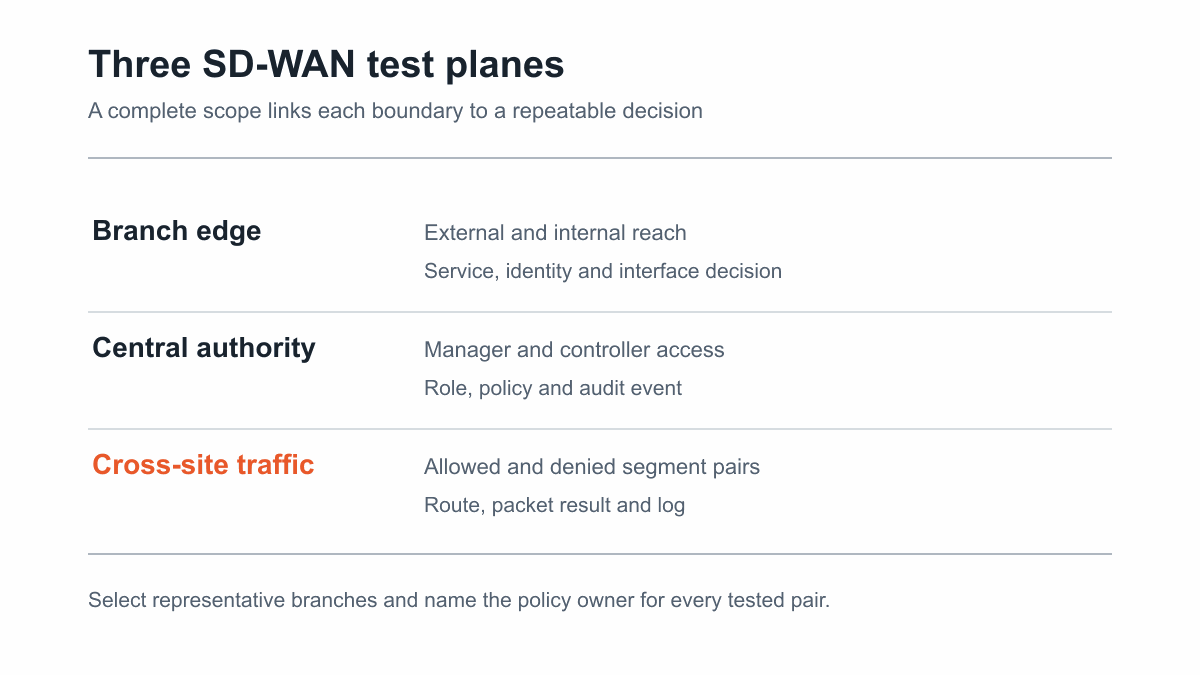
Figure 1: Three SD-WAN test planes and the evidence each should produce. Source: Cisco Catalyst SD-WAN Design Guide.
Include direct internet access where it changes risk
Some branches send internet traffic out locally rather than backhauling it. Cisco's public Catalyst SD-WAN design guide describes direct internet access at the remote site and the related security considerations. If a branch has this design, the external and internal test should name the local exit and the expected filtering or logging boundary. Otherwise the proposal might test the data-center egress path and miss the branch path employees actually use.
Do not turn the test into high-volume traffic generation. A safe check can verify reachability and policy decision for approved destinations with modest traffic. The rules should exclude denial of service, route flaps and changes that could interrupt branch operations. The point is to validate permitted and denied paths, not stress the transport. A separate resilience test requires different operational approval.
Write rules of engagement around branch operations
SD-WAN connects business sites, and a poorly timed change can affect more than the device under test. The authorization should name the legal asset owner, exact public ranges and appliances, Manager and Controller instances, test branches, source hosts, destination services, permitted credentials, traffic limits, maintenance windows, exclusions, emergency contacts and stop authority. It should name any MSP or carrier whose infrastructure is in scope. A test against a shared managed platform requires that platform owner's consent, not only the branch manager's approval.
Separate observation from change. Reading approved configuration and logs can be safe during business hours. Creating a test policy, changing an edge template or influencing routing may need a lab, maintenance window or a separate change ticket. The provider should propose a proof that establishes the permission without moving live traffic. If an actual policy update is needed to prove the path, it should be a harmless test object with owner approval and rollback. The buyer should reject a proposal that leaves these decisions to improvisation during the test.
The stop rules should be easy to apply. Unexpected link instability, route changes, user disruption, alarm floods, activity outside the authorized range or evidence of a real incident should pause the work. The white team should have an immediate communication channel to the network operations center and the test lead. A branch with a small on-site IT team may need a different contact plan from a staffed data center. A credible network pentest does not require making a remote site unavailable.
The scope should specify how provider-generated traffic will be identified after the fact without giving every defender the exact timing if the organization also wants to observe detection. Record test source addresses, accounts, timestamps and destination markers in a private control record. The network operations and SOC teams can compare their logs with that record at debrief. A blind detection exercise is a separate objective from a pure penetration test; do not present a notified test as a measure of routine SOC detection.
Use evidence that resolves ambiguous results
For each approved path, require the provider to preserve the source, destination, timestamp, expected outcome, actual packet or access result, policy reference, route context and relevant device log. For a central management test, preserve the actor, role, action attempted, Manager decision and audit event. For a branch segmentation test, preserve both allowed and denied flows, with enough context to distinguish SD-WAN policy from endpoint or host firewall behavior. A screenshot of a timeout is not enough to prove which control denied traffic.
The report should also say when it could not establish a result. An unavailable branch, missing log or unapproved cloud gateway may prevent verification. That limitation should be explicit rather than silently counted as protected. If a site class is represented by one branch, list the conditions under which the result might generalize and the differences that need another sample. A true estate-wide conclusion requires a representative sampling plan and evidence that the shared policy is actually applied consistently.
Compare SD-WAN pentest quotes on the same scope
Enterprise buyers often receive proposals that count devices but omit what the provider will test. Use a scope matrix to force a fair comparison. One quote may include only public WAN edge scanning; another may include Manager authentication, branch access, cross-site policy and direct internet exits. The second is a broader engagement, not merely a higher price for the same service. Ask every bidder to mark each line as included, optional or excluded and to show a sample redacted finding.
Workstream | Buyer input | Evidence to require |
|---|---|---|
External branch edge | Authorized public ranges and representative sites | Reachable services, access decisions and impact |
Internal branch foothold | Test host, branch LAN and permitted identity | Lateral reach and denied paths |
Central management | Manager URL or address and roles | Authentication, role boundary and audit trail |
Control-plane policy | Controllers, site classes and intended routes | Route or VPN policy decision for selected pair |
Data-plane policy | Source/destination pairs and expected access | Allowed and denied packet outcomes |
Direct internet access | Branch exit and expected security control | Local egress path and log evidence |
Reporting and retest | Fix owner and repeatable marker | Reproduction, remediation and retest outcome |
Ask the bidder how it will select branches. A useful answer explains why each selected branch represents a different policy, transport, exposure or business trust boundary. A weak answer promises to scan every IP but has no plan to validate central or cross-site decisions. Large-scale discovery may be part of the work, yet the buyer should know where manual verification is concentrated. The statement of work should identify the exact number and class of selected sites, plus what the provider will do when a branch is unreachable or a policy differs unexpectedly.
Ask who handles the central management test. The Manager's role and audit records differ from ordinary branch networking. The provider needs a plan for both authenticated administrative boundary testing and low-impact traffic validation. The quote should name the skills, evidence and review process for each, not simply list a common scanner. Ask whether the engagement includes consultation with the SD-WAN owner before and after testing; without it, the team may misinterpret a deliberate policy exception or an application-level denial as a network finding.
The final report should support both engineering and leadership decisions. The executive view says which branch classes and management boundaries were tested, which unauthorized paths were proven, whether business-critical separation held for the selected pairs and which risks need immediate action. The engineering view maps each finding to a device, policy, role, source, destination and retest. A provider that reports only a CVE list may be useful for patch management, but it has not answered the cross-site policy question.
What drives effort and cost?
Distinct site classes, Manager deployments, identity roles, network segments, cloud edges, external egress designs and third-party ownership all add work. A single policy domain with repeated branch templates can be sampled differently from several acquired networks with different management teams. The need to test after-hours, validate rollback or coordinate with a carrier also affects the engagement. Ask the provider to expose these assumptions in the quote. Do not compare an unauthenticated perimeter scan with a scoped internal and central policy validation as if they were identical products.
The buyer may choose a one-time assessment for a migration, a new SD-WAN rollout or an audit period. A continuous program can revisit selected paths as branches and policies change. Both can be useful, but recurring tests should identify what changes between rounds and repeat a stable baseline before claiming improvement. If a branch class is added later, the test plan should state whether it is a new sample or a retest of an old result. This preserves the value of the evidence over time.
Turn findings into network decisions
Run a joint debrief with network engineering, security operations, identity owners and the business owner of the protected destinations. Start with the intended policy, then show the observed route and traffic result. Ask whether the source identity or device should have had the access. Map the fix to the right layer. A Manager interface reachable from a user subnet needs a management-access fix. A route advertised to an unintended site may need a central control-policy fix. A packet permitted despite intended separation may need a data policy, local edge rule or downstream firewall fix. A missing alert for a management change needs logging or detection work.
Retest the same source and destination after remediation. A change that closes one path can create another routing or availability effect, so the network owner should validate approved traffic as well as denied traffic. The retest record should include the same site, segment, policy and observation method, plus the change identifier. If any of those differ, the report should say so. A new test path can be added after the baseline is closed.
The engagement may produce evidence for SOC 2, ISO 27001 or PCI DSS programs when those programs require independent security testing and remediation records. The valuable output is an authorized scope, repeatable evidence and prioritized remediation, not a generic compliance claim. Stingrai's network testing can be one part of that evidence. The buyer should align the test plan with the program's asset and timing requirements before work begins.
How Stingrai can scope the engagement
Stingrai is a global CREST-accredited penetration testing services company founded in Toronto, Canada in 2021, trusted by companies from startups to enterprises to meet audit requirements for SOC 2, ISO 27001, CMMC, PCI DSS and HIPAA. OSCE³, OSWE, OSEP, CREST CRT certified penetration testers, who are also world-class security researchers and bug bounty hunters. Choose from fully human-led or hybrid (AI agents plus human penetration testers) engagements across web, API, mobile, AI and LLM, cloud, network, Active Directory and social engineering penetration tests and red team engagements.
For SD-WAN, the internal and external network penetration test is human-led. Stingrai can scope the public edge, approved branch footholds, central management and segmentation checks as one coordinated engagement. The proposal should identify the branch classes, management components, allowed and denied traffic pairs, reporting evidence and retest condition. If the buyer also wants to measure SOC detection and response against a covert objective, red teaming should be separately scoped with its own rules of engagement.
Stingrai offers one-time assessments and continuous programs. A one-time test can establish a baseline after a rollout; a continuous program can revisit the selected paths as the estate changes. Both need a clear asset inventory and safe operational window. Bring the WAN edge list, Manager and Controller ownership, policy domains, representative branches and intended segmentation map to Get a Quote.
Frequently Asked Questions
What should an enterprise SD-WAN penetration test cover?
An enterprise SD-WAN penetration test should cover representative external and internal branch edges, centralized management access, relevant control and data policies, and selected cross-site allowed and denied traffic pairs. The scope should name the sites, roles and destinations, with evidence of the actual access or packet decision and a safe retest plan.
Is scanning WAN edge devices enough?
No. A WAN edge scan can identify reachable services and local weaknesses, but it does not prove what SD-WAN Manager permits or what centralized routing and data policies do between sites. A useful test includes the management and cross-site trust boundaries that affect the buyer's protected assets.
What is the difference between central control and data policy?
In Cisco Catalyst SD-WAN, central control policy influences overlay routing information and the routes advertised to WAN edges, while central data policy influences traffic flow through VPN segments. Localized policies apply at the edge. The test should map the intended rule to the observed route and packet outcome.
How can testers validate segmentation without disrupting branches?
Use approved source and destination pairs, modest non-destructive traffic, a known allowed control flow and a denied test flow. Correlate the result with the relevant route, VPN membership, policy match and logs. Avoid route changes, stress traffic and production policy edits unless separately authorized in a controlled window.
Should direct internet access be included?
Include direct internet access when branch users or workloads take a local exit that differs from the data-center path. Name the representative branch, permitted destination and expected security controls. A data-center egress test does not establish what happens at a local branch exit.
What evidence should the final report provide?
The report should include the tested source, destination, site, role, expected decision, actual access or traffic result, enforcing policy or device, relevant log and fix owner. For management tests, include the actor and audit event. For segmentation, include both permitted and denied paths so remediation can be retested safely.
Does SD-WAN testing require access to the central Manager?
That depends on the buyer's question. An external edge-only test can be scoped without Manager credentials, but it cannot validate administrative roles or central policy effects fully. An enterprise-wide boundary question generally benefits from authorized read-only or lower-privilege Manager access and a separate safe plan for any change test.
Does Stingrai use Snipe for SD-WAN testing?
No. Stingrai's SD-WAN and network penetration tests are human-led. Snipe is Stingrai's autonomous agent for web applications and associated APIs; its specialist sub-agent tests AI and LLM applications, including MCP servers, alongside named penetration testers. A network estate receives a human-led scope and report.
Related reading
Talk to Stingrai
Bring the WAN edge and control-component inventory, representative branches and intended cross-site policy to Get a Quote, or book a free discovery call to shape a human-led SD-WAN penetration test.



