





A completed cloud migration changes where an attacker can act and where defenders must look. MITRE ATT&CK's Cloud Accounts technique, T1078.004, describes how valid cloud identities can support initial access, persistence and privilege escalation. A cloud red-team exercise asks a narrower business question than a general configuration review: can an operator with an agreed starting identity or workload reach a named cloud objective, and can the security team reconstruct and contain the route?
Quick answer. Commission a cloud red-team exercise after migration when the concern is an end-to-end attack path through identity, cloud roles and management actions, with detection and response measured at every stage. Name the objective, starting access, AWS accounts or Azure subscriptions, protected data or service, provider-policy constraints and the SOC's expected response. Stingrai's human-led red team can test cloud and identity paths under an agreed scope, then deliver an attack narrative and detection timeline.
Migration projects often verify that applications run, users can authenticate and the new platform satisfies the deployment plan. Those checks do not automatically prove that a compromised account is constrained to its intended role or that a suspicious control-plane change creates an actionable case. The red-team buyer wants to measure a live chain and the defenders' handling of it. That purpose must be explicit, because an ordinary cloud penetration test may identify valuable misconfigurations without measuring whether the SOC notices a realistic sequence of actions.
Choose the buying question before the platform
The phrase "cloud red team" can describe a covert full-chain exercise, an assumed-breach scenario from a provided account, or a collaborative purple-team replay. Each mode answers something different. Full chain asks whether the operator can earn initial access and move to the objective. Assumed breach removes the initial-access phase and tests what a compromised account or workload can do. Purple teaming makes techniques visible to defenders so they can tune detections as they go. Stingrai's red teaming service offers assumed-breach, black-box full-chain and threat-led modes; purple teaming is the collaborative mode.
After a migration, an assumed-breach start often gives the buyer the cleanest answer to the new cloud trust question. The control group can provide a low-privilege cloud user, a test service principal or a sandbox workload with the same role pattern as a production class. The operator can then test where that access leads and what gets logged. This is a scoping recommendation, not a claim that one mode is always superior. If the enterprise has changed its internet edge, workforce identity and cloud estate together, the full chain may be the right question.
The destination should be a crown-jewel objective that matters to the business. Examples include reaching a protected configuration, reading a synthetic record in a sensitive data service, creating a harmless proof of control in a test environment or demonstrating whether a role can change a critical management setting. The proof must be agreed in advance. "Take over the cloud" is too vague, while a broad instruction to exploit everything creates safety and reporting problems. A defined objective gives the provider and buyer a common measure of whether the route was reached, blocked or never tested.
The objective also determines who needs to participate. An identity owner can authorize a test principal, a cloud platform owner can approve accounts and subscriptions, a data owner can provide synthetic material, and a SOC lead can define expected alerts and response. When any of those owners is absent, the report may show activity but not explain whether it violated policy or what should happen next. NIST SP 800-115 offers the general discipline of planning technical tests and analyzing findings; this ownership map makes that planning specific to a migration.
Distinguish a cloud red team from a cloud penetration test
A cloud penetration test starts with an agreed asset or configuration scope and looks for exploitable weaknesses. A red team starts with an adversary objective and measures a chain across whatever authorized assets are needed to reach it, including the defender's response. The two may touch the same IAM role, API, container or storage service. What differs is the question and evidence. A cloud penetration test can say a role policy is over-broad. A red team can say whether an operator could use that condition to reach a protected objective and whether the SOC detected and contained the path.
Buyer need | Cloud penetration test | Cloud red-team exercise |
|---|---|---|
Unit of scope | Workloads, accounts, APIs, identity settings and cloud controls | Named objective, starting position, allowed paths and defender expectations |
Main result | Findings with affected resources, impact and fix guidance | Objective outcome, attack narrative, prevention, detection and response timeline |
Defender awareness | Usually a planned technical assessment | Covert to defenders except the control group, unless a purple mode is agreed |
Best question | What is exploitable in this cloud scope? | Could an operator reach what matters, and would anyone stop it? |
Common next step | Repair and retest affected configuration or code | Replay the path with defenders, tune detection, repair and retest |
This distinction does not mean the red team should replace the penetration test. A recent cloud assessment can remove known weaknesses before the organization pays to measure detection. Conversely, a cloud assessment limited to individual findings may leave an identity-to-data chain and response process untested. The buyer should include both in a program when both questions matter, with the scope and deliverables kept separate.
The cloud migration itself can create an additional comparison: did the organization move an old permission model unchanged, or did it redesign trust? A red-team exercise should not assume the new platform has the same controls as the old one. Document the intended access boundaries after migration, then test whether the operator can cross them. If the migration team cannot provide that intended-state description, a targeted architecture and identity review may be needed first.
Build a scenario around identity and control-plane reach
Cloud attack paths often begin with an identity that is legitimate in the platform but used outside its expected purpose. MITRE T1078.004 includes user and service accounts, and it notes hybrid identities connected to on-premises directories. For a migration exercise, the buyer can define a representative start: a user account, service identity, workload role or federated administrator. The question is what that identity can do next, not how many cloud services the operator can enumerate.
For AWS, a scenario might ask whether a test principal can use an authorized role path to reach a protected resource or change a control-plane setting. For Azure, it might ask whether an Entra user or service principal can obtain an unexpected role in a subscription or access a sensitive workload. These are high-level examples for scoping, not instructions to perform a bypass. Each requires a client-approved identity, target and safety boundary. Where the business objective is data access, use a synthetic marker and a controlled read instead of taking real customer information.
The route may cross cloud and on-premises identity, or move between cloud accounts. A buyer should specify whether those boundaries are included. Leaving them implicit lets the provider stop at the first account even when the protected service sits behind a shared identity or management layer. It also risks an unauthorized test of a connected account that another business unit or supplier owns. Name each account, tenant, subscription and management group in the authorization. Mark anything connected but out of scope.
The objective can be reached without the operator needing to retain access. If a role assignment or sharing change is the proof, agree a harmless temporary change in a test resource, capture the event and reverse it. Avoid deleting logs, disabling controls or modifying production data to make the scenario look dramatic. A technically spectacular route is not worth a business outage. The outcome is more valuable when the security team can replay it and implement a precise fix.
Provider rules change the plan
Cloud-provider rules are part of the scope, not a document to check after the operator has begun. AWS's testing policy permits customer assessments of listed AWS resources without prior approval, but says all security testing that includes command-and-control requires prior approval. AWS also requires customers planning covert adversarial simulations or hosting command-and-control to submit a Simulated Events form for review. That distinction matters for a red team. A buyer who has run routine cloud penetration tests without approval should not assume the same treatment applies to a covert campaign or to testing with command-and-control infrastructure hosted elsewhere. Confirm the current AWS policy, the services in scope and the approval status before scheduling the exercise.
Microsoft's Azure penetration-testing guidance says customers do not need Microsoft's preapproval to test their Azure resources, but authorized third parties need the resource owner's explicit written permission and must follow the Microsoft Cloud Unified Penetration Testing Rules of Engagement. The Microsoft page also says that the unified rules are authoritative. Read the current rules when writing the SOW, especially where the scenario crosses tenants or uses a Microsoft-hosted source. A customer cannot use its own subscription as a reason to test another tenant or Microsoft's underlying services.
The rules of engagement should state who handles provider notifications, which environments are excluded, what command infrastructure is allowed, how test traffic is identified to the control group, and who can pause the test. Provider policies can change; the article's links are a starting point, not a substitute for checking them at launch. A provider who cannot explain the approval and ownership boundary should not be given a broad cloud scope.
For multi-cloud estates, do not assume one provider's permission applies to another. An AWS account and an Azure tenant have different policies, logs and identity models. The contract should name the provider for each route and state how the team will prove an objective without stepping into infrastructure the client cannot authorize. Any third-party SaaS integration or managed service needs the same ownership check.
Verify the telemetry before the exercise
A red team can only measure detection where the required events are collected and available to the defenders. A migration can leave gaps because a log source was not routed to the SIEM, a new account was omitted from a collection policy or a data-event setting was left at its default. The control group should perform a baseline check before the covert portion. That check should verify the presence and retention of the relevant identity, role, resource and data events, without teaching the SOC the test schedule.
AWS explains that CloudTrail management events record control-plane operations and that trails and event data stores log management events by default, but not data events by default. An AWS scope that expects evidence of object access must verify whether the required data events are enabled for the relevant service. A report that says "CloudTrail was on" without distinguishing those event types gives a false sense of observability.
Microsoft documents Entra sign-in logs for user, service principal and managed identity activity, with audit logs for tenant changes. Azure Activity Log records RBAC role-assignment changes. A buyer should map these sources to the planned path and check that the SOC can actually access them. A role change in a portal and a service-principal sign-in may reside in different places, with different retention and alerting. The test should record which source produced each observation rather than describing them all as "cloud logs."
The baseline need not be an exhaustive logging audit. Verify the exact events the scenario is expected to create, the identity that will appear, the account or subscription that owns the record and the route into the SOC. If an event source is deliberately absent, decide whether discovering that absence is part of the exercise or whether it must be fixed first. Either choice is valid when it is documented. What is not valid is reporting the absence as a test of the SOC's response when the SOC never had a signal to act on.
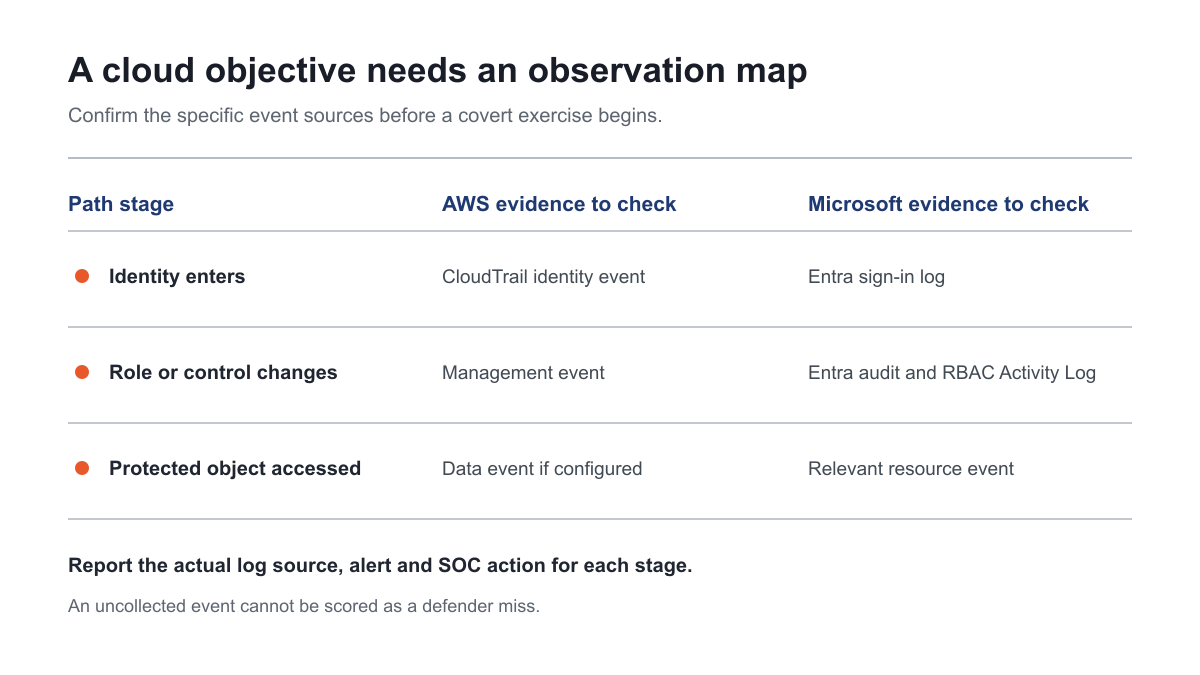
Figure 1: The evidence path from an authorized cloud identity to a protected objective. The mapping is an editorial test plan. Sources: MITRE ATT&CK, Cloud Accounts; AWS CloudTrail events; Microsoft Entra sign-in logs; Azure RBAC Activity Log.
Measure the objective and the defense separately
The report should say whether the operator reached the agreed cloud objective, which boundaries it crossed, and what each control did. A failed objective can still reveal a detection gap if the operator was stopped by a condition the SOC never noticed. A reached objective can coexist with useful alerts if defenders saw and investigated the activity but did not contain it in time. Those are different operational lessons.
For each stage, ask for a UTC timestamp, the test identity, the relevant cloud account or tenant, the action attempted, the access decision, the log event, the alert if any, and the analyst's next step. Include the control group's deconfliction notes and any actions that were intentionally omitted for safety. That record supports a replay with the SOC after testing. Stingrai's red-team service description names prevention, logging, alerting, misses and response timing as deliverables.
Avoid a single percentage called "cloud detection coverage" unless the report supplies its denominator and the tested behaviors. A route that was out of scope or prohibited by a provider is not covered. A log event without an alert is not the same as a case acted on. A suspicious role assignment that was detected only because the tester told the SOC about it belongs in the debrief, not the covert success column. The report should be explicit about these limits.
The post-migration decision is then concrete. If the operator reached a protected service through an over-broad role, the identity team owns a permission change. If a CloudTrail data event was absent, the platform team owns telemetry. If Entra recorded a sign-in but no detection fired, the SOC or detection engineering team owns the rule. If a case was created but no one contained the identity, incident response owns the playbook. A report that maps each gap to a different owner can drive a retest; a generic "cloud security needs improvement" finding cannot.
What the SOW and quote should contain
Begin with the post-migration business question. Identify the protected service or dataset, why it matters, the starting identity and its intended privilege, the providers and accounts in scope, and the safe proof of success. If the organization wants to test initial access as well, state that separately. The proposal should say whether the exercise is assumed-breach, full-chain or a collaborative purple session. Each choice changes operator time, control-group work and what a detection result proves.
The SOW needs a provider-policy section. It should name AWS prior approval for any testing that includes command-and-control, the AWS Simulated Events form for covert simulation or command-and-control hosting, the Microsoft unified rules for Azure, and the resource owner's authorization. It should state what will happen if an activity is prohibited or an approval is delayed. The vendor should not quietly substitute a different technique and then describe the original objective as tested.
Add an evidence plan before testing. Name the owner who will provide CloudTrail, Entra, Azure Activity Log, SIEM and case records; confirm that the tester can correlate timestamps without gaining unnecessary access to unrelated logs. Agree the format of the attack narrative and the stage-by-stage detection timeline. The executive summary should answer whether the objective was reached, how the defenders responded and what to fix first. The technical annex should contain enough cloud identifiers to support remediation without exposing secrets.
Finally, reserve a retest after changes. The original path, identity and objective should be repeated where safe, with any changed logging or policy state noted. If the organization has reorganized accounts or moved the protected service, the second test is a new scenario and should be labelled accordingly. A genuine improvement claim depends on comparable evidence, not merely a closed ticket.
Where Stingrai fits
Stingrai is a CREST-accredited penetration testing services company founded in Toronto in 2021. Its human-led red team engagements can span Active Directory, Entra ID, AWS, Azure and Google Cloud toward a named objective, with two named penetration testers from a team holding OSCE³, OSWE, OSEP, CREST CRT and CISSP certifications. The red teaming service includes an attack narrative, per-stage detection and response timeline, SOC replay and retesting of repaired paths.
An enterprise can buy this as a one-time exercise after migration or include the objective in a continuous program through the PTaaS platform. Cloud red teaming is quoted to the environment, scenario and operator work; Stingrai's published fixed prices apply to one web application and associated APIs, not this scope. A discovery call can settle the starting identity, authorized accounts, protected objective and provider-policy steps before pricing.
Frequently Asked Questions
What is a cloud red-team exercise after migration?
A cloud red-team exercise after migration tests whether an operator with agreed starting access can reach a named cloud objective and whether defenders prevent, detect and contain the path. The scope follows authorized identity, workload and control-plane boundaries. Its main deliverable is the objective outcome and detection timeline, not only a list of cloud misconfigurations.
How is cloud red teaming different from cloud penetration testing?
Cloud penetration testing identifies exploitable weaknesses within a defined set of cloud assets and configurations. Cloud red teaming follows an agreed adversary objective across authorized paths and measures the defenders' response at each stage. An organization may need both: repair known findings first, then test whether an operator can still reach what matters without being stopped.
Does AWS require approval for a cloud red team?
AWS allows assessments of listed customer resources without prior approval, but requires prior approval for all security testing that includes command-and-control, wherever that infrastructure is hosted. Customers planning covert adversarial simulations or hosting command-and-control must also submit a Simulated Events form for review. Check the current policy and the exact services and activities in scope before launch.
Does Azure require Microsoft preapproval for a red team?
Microsoft says Azure penetration tests do not require its preapproval, but the resource owner must explicitly authorize third-party testers and the exercise must comply with the Microsoft Cloud Unified Penetration Testing Rules of Engagement. The unified rules are the authoritative policy. The customer's permission does not extend to another tenant or Microsoft's own infrastructure.
What telemetry should be checked before testing?
Check the events that the planned path should create. In AWS, distinguish CloudTrail management events from data events because data events are not logged by default. In Microsoft environments, map Entra sign-in and audit logs and Azure RBAC Activity Log to the intended identity and role changes. Confirm the SOC can receive and interpret them.
Should a red team start with a compromised cloud account?
It can start with a client-provided test account or workload when the question is what an intruder could do after a foothold. That is an assumed-breach scenario. If the business also needs to know whether an outsider can gain the foothold, choose a separately scoped full-chain mode. Record the starting privileges so the result is not mistaken for proof about another identity class.
What should an enterprise buyer receive?
The buyer should receive the agreed objective and authorization map, attack narrative, per-stage timestamps, prevention and detection evidence, SOC actions, excluded routes, remediation owners and a retest plan. A report should mark activities that provider policy or business safety prevented from being tested, rather than calling them secure.
Related reading
References
MITRE ATT&CK. Valid Accounts: Cloud Accounts, T1078.004. Cloud identity paths.
AWS. Customer Support Policy for Penetration Testing. Permitted services and simulated events.
Microsoft Learn. Penetration testing. Azure authorization and rules of engagement.
AWS CloudTrail. Understanding CloudTrail events. Management and data events.
Microsoft Learn. What are Microsoft Entra sign-in logs?. Identity telemetry.
Microsoft Learn. View activity logs for Azure RBAC changes. Role change telemetry.
NIST. SP 800-115, Technical Guide to Information Security Testing and Assessment. Planning and test evidence.
Talk to Stingrai
To scope a post-migration cloud objective with authorized accounts and a measurable defender outcome, get a quote or book a free discovery call.



