





Kubernetes auditing can provide a chronological record of security-relevant cluster actions, including who initiated a request and what it affected. That makes a control-plane exercise measurable, but the audit policy and backend determine which events are retained. A buyer should test the attack path and the defender's ability to interpret it, not assume that a cluster log is already a SOC detection.
Quick answer. A Kubernetes red-team exercise starts from an authorized foothold, attempts a bounded path through identity, workload and control-plane decisions, and ends at a harmless synthetic objective. The buyer measures prevention, telemetry, analyst triage, escalation and containment separately. Stingrai's human-led red teaming can run the scenario while a white team compares cluster, cloud and SOC evidence. Put the exact cluster boundary and stop authority in writing before any activity begins.
This guide is for a security leader purchasing an adversary simulation across EKS, AKS, GKE or a self-managed cluster. It is not a configuration checklist. A configuration review may find broad RBAC, permissive egress or missing audit coverage. An end-to-end exercise asks whether those conditions let an approved test identity make a business-relevant move, and whether defenders recognize it in time to act. The result should tell the cluster owner what to change, the SOC what to watch, and leadership whether the present response path is credible.
Buy an objective, not a list of Kubernetes components
The first procurement question is what outcome the exercise should try to reach. A useful objective might be a marked nonproduction workload that represents a protected service, a synthetic Kubernetes Secret that contains no real credential, or an approved administrative decision on a disposable namespace. The white team should specify the expected boundary: the red team may begin as a developer identity with restricted access, but should not be able to reach the synthetic protected object or make an unapproved control-plane change. If the objective is reached, the report records the exact authorization and detection path. If it is blocked, the team records which control stopped it and what the SOC saw.
Choose one threat question at a time. Does a compromised application identity have a path to a more privileged service account? Could a developer credential alter a workload outside its intended namespace? Would an unexpected control-plane action generate an analyst case? These are different questions. They need different starting permissions, evidence and owners. A quote that promises to "test Kubernetes" without naming the question cannot establish whether the exercise succeeded.
MITRE ATT&CK's Containers matrix describes adversary behaviors against containers and orchestration systems. It is useful for naming behavior families and aligning detections, but it does not choose your business objective. The target should come from your environment: a customer-facing service, a release namespace, a data-processing workload or a cluster management function. Use a synthetic stand-in when the real asset contains personal data or could be disrupted.
Decide between a red-team exercise and a Kubernetes penetration test
A Kubernetes penetration test generally inventories and validates weaknesses across selected clusters, namespaces, identities, workloads, network policies and cloud integrations. Its main output is a finding with proof, impact and remediation. A red-team exercise can use the same surfaces, but it follows an objective and tests the defender's detection and response at each meaningful decision. The team may deliberately avoid broad vulnerability enumeration to preserve a realistic path and a fixed exercise window.
The distinction matters when comparing proposals. The buyer who wants coverage of every RBAC binding and admission policy should ask for cloud penetration testing, with a clear cluster inventory. The buyer who wants to know whether the SOC can investigate a plausible move from a workload identity to a protected control-plane action should ask for red teaming. Some organizations need both. Record which deliverable is being purchased so a narrow adversary simulation is not criticized for failing to be a complete configuration audit, or a broad pentest for not measuring analyst decisions.
The existing Kubernetes multi-tenant isolation matrix is a better fit when the core question is whether tenant boundaries hold across RBAC, tokens, admission and traffic. This exercise follows one selected path across those controls and into SOC response. It can use an isolation finding, but its acceptance criteria are different.
Define the starting condition and end marker
The starting condition controls what the result means. A low-privilege developer account tests whether legitimate access can be misused. A service-account identity tied to a test workload tests trust from workload to control plane. An assumed-breach node or container foothold tests a different sequence and may require a separate cloud-provider authorization review. Do not compare the results as if each began from the same risk. The statement of work should name the account type, namespace, cluster, permitted source and what access the red team receives at the start.
The end marker should be safe, unique and verifiable. A synthetic Secret can have a marker with no operational value; a nonproduction deployment can be configured to record an approved access decision; a protected test namespace can hold an object whose metadata confirms reachability without requiring real data access. The white team should know exactly what proves success and should exclude production customer content. An end marker that requires copying live secrets or changing production workloads introduces unnecessary risk and can delay approval.
Define both attacker and defender success. "Reached the marker" is an attacker outcome. "RBAC denied the request and the SOC recorded no incident because the policy worked" may be a good defender outcome if the policy decision is independently verified. "API request succeeded, the audit event was collected, but no case was created" is a different result. "Analyst created a case but could not identify the owning team" is a response gap. The report should keep these states apart rather than compressing them into a single pass or fail score.
Name the control-plane boundary precisely
Kubernetes authorization follows authentication at the API server. Kubernetes RBAC documentation distinguishes Roles and ClusterRoles, and a RoleBinding can grant a ClusterRole's permissions within one namespace. This is why the buyer must include both the identity and the binding context. A permission written in a role does not automatically mean cluster-wide access; a ClusterRoleBinding can change that reach.
The default edit role illustrates why generic role labels are insufficient. Kubernetes documents that the edit role can read Secrets and run Pods as service accounts in the namespace, potentially reaching the API permissions of those identities. An exercise might test whether the organization's intended developer boundary accounts for that behavior. The buyer should scope the exact identity and namespace and ask the provider to show the effective permission path. The article does not prescribe a payload or a bypass: the authorized test proves an access decision and captures its audit trail.
Control-plane reach may also depend on cloud IAM, workload identity, registry permissions and provider-managed logging. These are part of the buyer's cluster boundary. A managed cluster does not have only one owner. The statement of work should list the cloud accounts or projects, clusters, namespaces, identity provider, registry and logging destination that the provider may inspect. Any component outside the authorization stays out, even if the path appears technically reachable.
Build a bounded scenario around defender decisions
A practical scenario can be expressed as five evidence points: starting identity, control-plane request, protected-object decision, SOC interpretation and authorized response. The red team should record the path without placing exploit instructions in the buyer-facing report. The white team should independently retain the relevant cluster and cloud records. The SOC should preserve its alert, case, analyst notes and escalation. Comparing these records after the exercise reveals where a signal was lost.
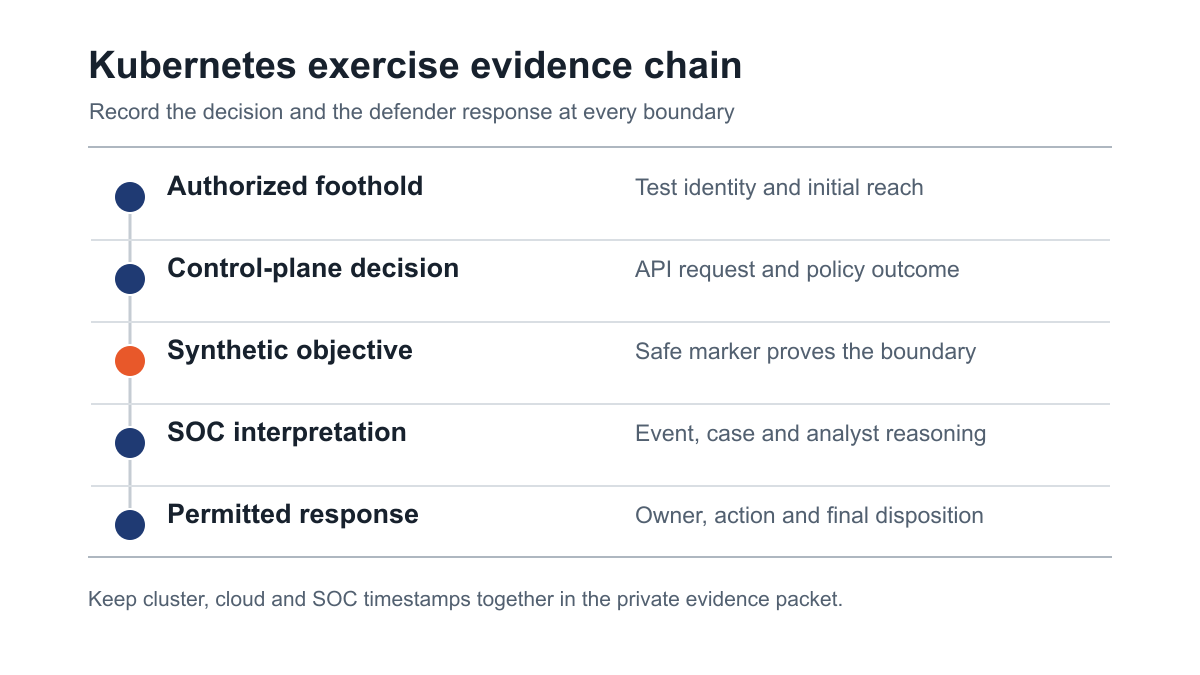
Figure 1: Evidence points for a bounded Kubernetes red-team exercise. Source: Kubernetes, Auditing.
The exercise should distinguish prevention from detection. Pod Security Admission has enforce, audit and warn modes with different effects: enforce rejects a violating Pod, audit annotates an audit event while allowing it, and warn returns a warning while allowing it. An analyst should not call an audit-only event a prevention. A red-team plan should state which policy decision is expected for the synthetic action and which evidence will prove it.
NetworkPolicy is another distinct boundary. The Kubernetes NetworkPolicy guide says that without policies in a namespace, ingress and egress are allowed by default. A policy object is not proof that all traffic is denied or that the cluster's network implementation enforces the policy. If traffic movement is relevant to the objective, the engagement should verify an allowed and a denied path with non-destructive probes, correlate them with the policy and record the source and destination. A control-plane test need not automatically become a full network segmentation assessment; the statement of work should say whether traffic is in scope.
MITRE's Deploy Container technique is one possible behavior family for defender validation. The buyer may ask whether an unexpected workload creation would be prevented, logged, alerted and investigated. That does not authorize arbitrary deployments or privileged workloads in production. A synthetic nonproduction namespace and explicit constraints can test the decision without risking customer services. A different scenario might focus on a denied role-binding action or an unusual administrative request. Select behaviors for relevance, not because they fill a matrix cell.
Include a SOC interpretation, not just an alert count
The SOC should have a question to answer: Was the action expected for this identity, namespace and change window? Did the analyst connect the control-plane event to the initiating identity and related cloud activity? Did the case reach the cluster owner with enough context for an action? A raw alert count does not answer these questions. The same event could produce several low-value notifications while the meaningful privilege change is overlooked. A single well-triaged case may be more useful than a dashboard full of detections.
Ask the provider to capture the source event, collector, enrichment, rule or hunt, case timestamp, analyst conclusion, escalation and final disposition. If the event did not reach the SIEM, that is a collection gap. If it reached the SIEM but no analytic matched, it is a detection-content gap. If the case existed but the analyst dismissed it without context, it is a triage gap. If the case reached the wrong owner, it is a handoff gap. The report should name the fix owner for each gap.
Kubernetes audit logging is especially important here because the audit policy determines what is recorded. A cluster may produce an event yet not send it to the SOC, or may record only metadata when the exercise requires a different level of detail. The buyer should confirm what signals are expected before testing and preserve the actual policy for post-exercise analysis. Do not infer SOC failure from a blank alert screen until the collection path has been checked.
Write rules of engagement that keep production safe
The authorization should name the legal asset owner, exact clusters and accounts, namespaces, IP or identity starting points, exercise windows, permitted behavior families, exclusions, safe end marker, data handling, stop authority and emergency contacts. It should state whether analysts are blind, partially informed or collaborating in a purple-team mode. These modes answer different questions. A blind exercise measures normal detection and escalation. A collaborative replay can improve rules and playbooks. The final report must identify which observations came from which mode.
Managed cluster service terms and customer authorization also matter. The team should confirm any cloud-provider testing conditions and third-party ownership before starting. Never assume that permission to test an application extends to every shared cluster, registry, tenant or managed service it touches. A production Kubernetes cluster can include workloads owned by multiple groups. The sponsor must resolve those boundaries, not leave them for the red team to infer while active.
The stop rules should be operational, not decorative. A real incident, unexpected workload instability, significant error increase, customer-data exposure or action outside the named authorization should trigger a pause and white-team decision. There should be a live contact route to the cluster owner and SOC. The red team should be able to identify its test identities immediately to the white team without spoiling analyst-blind conditions in ordinary operation. Containment tests should use approved actions against synthetic assets; deleting live pods or revoking real staff access is unnecessary.
Record the environment state before testing: cluster version, relevant namespaces, audit collection path, expected monitoring, role bindings for test identities and the synthetic object. These details are sensitive operational evidence and belong in the private engagement record, not a public blog or broad marketing case study. A buyer should require a secure evidence channel and a retention period in the proposal. The public proof is the method, not a client's topology.
Specify the evidence package before buying
The most useful red-team report is a trace that another team can verify. For each key step, require a timestamp, authorized identity, target object or service, expected decision, actual decision, independent log reference and business interpretation. The narrative should show the starting access, decision points and final synthetic objective. It should also identify where the control succeeded. A denied request with a timely, accurate SOC investigation is a positive result worth preserving.
Ask for two views. The executive view should state whether the objective was reached, whether it was detected, whether response occurred and what residual risk remains. The engineering view should map each decision to the specific control owner: cluster RBAC, admission policy, network policy, cloud identity, logging pipeline, SIEM rule, runbook or on-call process. A vague recommendation to "improve Kubernetes security" is not actionable. A finding should say which approved path existed and what change would remove or detect it, with enough evidence to retest.
The report should also identify the limits of proof. A single successful test does not mean every cluster is exposed. A single blocked action does not mean all paths are safe. A SOC detection in a notified replay does not establish blind operational detection. It is reasonable to use the exercise as a benchmark for a future scenario, provided the next scenario is not presented as identical when identities, namespaces, cluster controls or analyst knowledge changed.
Compare red-team proposals by scope and proof
The least expensive proposal may assume a narrow test identity, one cluster, no SOC participation and a brief narrative report. The more useful proposal may include a white-team planning session, cluster and cloud-log validation, a controlled objective, analyst observation and a defender debrief. These are different deliverables, so compare the line items before comparing price. Ask each bidder to identify which of the following is included, optional or excluded.
Proposal element | Buyer decision | Evidence to request |
|---|---|---|
Starting access | Developer identity, workload identity or assumed foothold | Authorized identity and initial permission snapshot |
Cluster reach | Named clusters, namespaces, cloud accounts and registries | Asset list and owner approval |
Objective | Synthetic protected object or nonproduction action | Exact success and stop criteria |
Control validation | RBAC, admission, network or cloud trust decisions relevant to the objective | Allowed and denied decisions with log references |
SOC participation | Blind, partially informed or collaborative | Case timeline and analyst notes |
Response | Observation only or approved containment | Decision owner, timestamp and safe action record |
Deliverables | Narrative, engineering findings, replay and retest | Evidence map and remediation owner |
Request a sample redacted finding and a sample response timeline. The sample should distinguish "no event generated," "event collected but not detected," "detected but not escalated" and "escalated but not contained." It should also show how a successful prevention is documented. This reveals more about the provider's method than a promise to map activity to ATT&CK.
The buyer should ask who will operate the engagement and who will review the report. A red-team engagement requires human judgment about the path, the authorization boundary and the defender response. An automated cluster scan can help inventory a surface, but it cannot by itself explain why an analyst made a decision or why a handoff stalled. Ask for the named roles, the white-team communication plan and the review point before finalizing the statement of work.
What should affect the quote?
The number of clusters is only one driver. Distinct identity providers, cloud accounts, workload types, observability pipelines and operating teams add coordination and evidence work. A single cluster with several namespaces and separate SOC ownership can require more planning than several similar nonproduction clusters. Blind testing adds control-group overhead. A full-chain scenario that begins outside the cluster needs a separate initial-access authorization and may include application, cloud or network scope beyond Kubernetes itself.
Do not buy a generic "unlimited Kubernetes red team" promise. Ask for a named objective and a defined time window. If the first exercise reveals a logging gap before any meaningful adversarial movement, the provider and sponsor should decide whether to repair collection and resume, or finish with a clearly bounded conclusion. This decision belongs in the change-control plan, not in an after-the-fact explanation of why the promised objective was never tested.
For a program that needs recurring evidence, separate the first baseline from later retests. A one-time exercise can answer a migration or board question. A continuous program may revisit selected paths as clusters, identities and detection rules change. The comparison should preserve the original scenario and record every change that affects the result. A retest that uses a different identity or an analyst who knows the exact marker is useful, but it is not the same test condition.
Turn the result into control and response changes
The debrief should be a joint engineering and SOC conversation. The cluster owner explains the intended RBAC, admission and network controls. The identity team explains how the starting principal obtained its access. The platform team explains the cloud and registry boundary. The SOC explains which events arrived, what the analyst saw and why the case did or did not escalate. The red team contributes the tested path and the independent timeline. Each team leaves with a named remediation, not a generalized action item.
Prioritize fixes by the tested path. Tighten an overbroad binding if that binding enabled the objective. Change an admission policy when audit-only behavior was mistaken for enforcement. Repair audit forwarding before writing a detection that depends on missing events. Update the SOC rule or runbook if a meaningful event was visible but lacked context. Practice the on-call handoff if a case was created but reached no cluster owner. Retest the same safe marker and record the new decision, then consider a second path to check for alternate routes.
NIST SP 800-190 treats container security as a layered problem and recommends runtime detection and response capabilities suited to containers. A Kubernetes red-team exercise can show how those layers interact in one business-relevant chain. The buyer should resist a report that makes a single setting carry the whole conclusion. Effective response depends on permissions, prevention, records, analysis and people acting on the result.
How Stingrai can scope the exercise
Stingrai is a global CREST-accredited penetration testing services company founded in Toronto, Canada in 2021, trusted by companies from startups to enterprises to meet audit requirements for SOC 2, ISO 27001, CMMC, PCI DSS and HIPAA. OSCE³, OSWE, OSEP, CREST CRT certified penetration testers, who are also world-class security researchers and bug bounty hunters. Choose from fully human-led or hybrid (AI agents plus human penetration testers) engagements across web, API, mobile, AI and LLM, cloud, network, Active Directory and social engineering penetration tests and red team engagements.
For this scenario, Stingrai's red team is human-led. The team can agree a cloud or cluster objective, run the authorized path, preserve the control-plane evidence and assess the client's detection and response. Cloud penetration testing is available when the buyer also needs broader coverage of cloud IAM, workloads, Kubernetes RBAC, network policies and secrets handling. The proposal should specify which service is in scope rather than blending a narrow red objective into an implied full-cluster audit.
The engagement can support a compliance program by producing a documented test narrative, prioritized findings and retest evidence. The report should be usable by security leadership and the engineers who own the controls. Stingrai offers one-time assessments and continuous programs; the right cadence depends on the change rate of the clusters and the decision the buyer needs to make. For a scoped quote, provide the cluster and cloud inventory, starting condition, synthetic objective, SOC participation and any production restrictions through Get a Quote.
Frequently Asked Questions
What should a Kubernetes red-team exercise include?
A Kubernetes red-team exercise should include a written objective, authorized starting identity, named cluster and namespace boundary, synthetic end marker, rules of engagement, control-plane and cloud evidence, SOC case timeline, response decision and a joint debrief. The deliverable should distinguish a blocked action from an undetected successful action and identify who owns each fix.
How is a Kubernetes red-team exercise different from a Kubernetes pentest?
A Kubernetes pentest validates weaknesses across a defined set of components and produces findings. A red-team exercise follows a bounded objective through selected controls and measures detection, investigation and response as well as the technical result. Buyers who need broad component coverage should scope that separately.
Does Kubernetes audit logging mean the SOC will detect the exercise?
No. Kubernetes can generate security-relevant audit records, but an audit policy decides what is recorded and a backend decides where records go. The SOC still needs collection, context, detection logic, analyst review and escalation. The exercise should verify each link with independent timestamps.
Can the exercise use production clusters safely?
Yes, if the owner authorizes the exact assets and the rules of engagement use a harmless marker, prohibit disruptive actions and name a live stop authority. A nonproduction namespace or synthetic object inside the production control environment can answer a relevant question without touching customer data. The sponsor should approve cloud-provider and third-party boundaries first.
Should the team test RBAC, Pod Security and NetworkPolicy in the same exercise?
Only when those controls are part of the chosen objective. RBAC governs API permissions, Pod Security Admission affects specified workload requests, and NetworkPolicy governs selected traffic flows where supported and configured. The red team should record each actual decision rather than treating the presence of a policy object as proof that it blocked a path.
What evidence should the SOC provide after the exercise?
The SOC should provide the received event or explain its absence, alert or hunt result, case timestamps, analyst reasoning, escalation recipient, containment decision and final disposition. Compare that record with Kubernetes and cloud logs. A missed event, a missed analytic, a mistaken triage decision and a failed handoff need different remediation.
Which clusters should a buyer prioritize?
Prioritize a cluster tied to a critical service or privileged management path where the objective can be represented safely. Pick a starting identity that matches a plausible business risk and make sure the relevant logs and responders are available. The first exercise should answer a decision the security leader can act on, not maximize the cluster count.
Does Stingrai use Snipe for Kubernetes red teaming?
No. Stingrai's Kubernetes and cloud red-team engagements are human-led. Snipe is Stingrai's autonomous agent for web applications and associated APIs; its specialist sub-agent tests AI and LLM applications, including MCP servers, alongside named penetration testers. The Kubernetes control-plane scenario is scoped for human operators.
Related reading
Talk to Stingrai
Bring the cluster boundary, starting condition, synthetic objective and SOC participation plan to Get a Quote, or book a free discovery call to shape a human-led Kubernetes red-team exercise.



