





Hybrid identity joins on-premises and cloud account lifecycles, but it does not make their access decisions identical. Microsoft's hybrid identity documentation describes provisioning and synchronization as the mechanisms that keep identities aligned. Its authentication guidance explicitly separates the choice of synchronization technology from how users sign in. That separation is the key to buying a useful red-team exercise: the provider must test the actual trust path, not assume that a synchronized user has the same permissions, controls or telemetry on both sides.
Quick answer. Commission a hybrid AD and Entra ID red-team exercise when leadership needs to know whether an authorized identity starting on premises can reach a protected cloud objective, and whether defenders can identify and contain the path across both systems. Supply a test identity, a named cloud resource, the real synchronization and authentication design, safe proof material and the expected SOC response. Stingrai's human-led red-team service can test that bounded objective and report the access, detection and response evidence.
This guide is for a CISO, identity director, SOC leader or procurement owner responsible for a hybrid estate. It is not a general Active Directory penetration test checklist or an Entra configuration baseline. Stingrai's Active Directory testing guide covers depth inside AD, while its Azure and Entra pentest scope guide covers the cloud component. The buyer question here is whether one authorized identity path crosses the AD-to-Entra boundary to a meaningful objective and whether the organization can reconstruct what happened from both sides.
Decide what the red team should prove
"Test hybrid identity" is not a decision-ready objective. The buyer should identify the starting position, the protected cloud action and the access assumption that makes the path concerning. An approved standard user account on a managed workstation might be the start. A sensitive enterprise application or a synthetic record in a cloud service might be the objective. The question is whether the identity's on-premises role and synchronized cloud state combine to permit more access than intended, and whether a suspicious sequence is noticed before the objective is reached.
The route can also begin with an approved cloud identity and ask whether it reaches an on-premises resource through an authorized application or remote access path. That is a different scenario and needs its own scope. Avoid treating an AD-to-cloud test as proof that cloud-to-AD movement is blocked. Identity, network and application controls can be asymmetric. A proposal should state the direction of travel in one sentence and say whether the opposite direction is excluded or separately tested.
The objective should be safe to demonstrate. A synthetic document in a restricted cloud library, a harmless role change in a test resource or access to a dummy administrative function can establish whether the boundary held. The buyer should approve the proof and the stopping point. The report can state that the operator reached a permission capable of a sensitive action without requiring the operator to read real customer data or disrupt a production identity service. A red team does not become more credible by causing an outage.
Buyer question | Starting position | Bounded objective | Main decision |
|---|---|---|---|
Does a standard AD user gain unexpected cloud access? | Approved synchronized test user | Reach a protected synthetic cloud record | Narrow group or application entitlement |
Do privileged identities cross tiers? | Approved local administrative test role | Reach a harmless cloud management action | Separate or constrain administration |
Does a cloud access policy catch the scenario? | Test identity and agreed device state | Attempt a protected application sign-in | Adjust policy targeting or grant conditions |
Can defenders connect both halves? | Any of the approved starts above | Complete or block a named proof | Improve correlation, triage and containment |
This table is an editorial test map. It is not a claim that every enterprise uses these roles or that Microsoft recommends a specific red-team scenario. Pick the row that relates to the current decision, then define the exact rights and resource owners in the rules of engagement. Several loosely related objectives make the result harder to interpret and harder to retest.
Map synchronization and authentication separately
An identity may be synchronized from AD to Entra without following the sign-in route a buyer imagines. Microsoft states that its sync technology choice does not determine the user authentication behavior. The provider should ask whether the relevant domain uses password hash synchronization, pass-through authentication or federation, and whether any backup or transitional configuration changes the actual route. The answer belongs in the scope and report, since it determines which system validates the user's first factor and where supporting evidence may be found.
Microsoft's hybrid authentication comparison says password hash synchronization validates credentials in the cloud, pass-through authentication uses an on-premises authentication agent for password verification, and federation with AD FS authenticates on premises. Do not collapse these into one "AD login." A red-team report that assumes every Entra sign-in went through a domain controller may attribute a missing on-premises event to a monitoring failure when the selected method did not use that route. Conversely, an exercise that never examines an on-premises dependency cannot evaluate a pass-through or federated path completely.
Actual sign-in design | Where the buyer should expect first-factor evidence | Scope implication |
|---|---|---|
Password hash synchronization | Entra cloud validation, plus identity sync context | Do not require a live domain-controller authentication for every cloud sign-in |
Pass-through authentication | Entra sign-in and the authorized on-premises agent path | Include the agent owner and relevant local evidence |
Federation | Entra and the federation service's authentication path | Include the federation owner and approved logs |
The table summarizes Microsoft's documented architecture, not an assertion about a particular customer's setup. The identity team should supply its own configuration and log locations before the exercise. Also distinguish directory synchronization from authorization. A synchronized account is not automatically entitled to every cloud application or role. The test must name the groups, app assignments, role grants and policies relevant to the chosen objective.
If the buyer has multiple forests, tenants or authentication methods, choose the route connected to the objective. A broad inventory can be useful before scoping, but the red team should not imply that one scenario covers every hybrid connection. Record the identities and systems actually used, and reserve separate tests for materially different sign-in paths. An exercise of a password-hash-synchronized user cannot stand in for a federated administrator merely because both appear in Entra.
Separate local privileges from cloud role outcomes
MITRE ATT&CK describes domain accounts as including users, administrators and services, and cloud accounts as potentially hybrid joined through sync or federation. Those categories provide a useful vocabulary for the buyer, but they do not say that a domain admin is automatically a cloud admin or that a cloud role grants local domain control. The exercise must measure the actual authorization chain rather than infer privilege from a title.
Ask the identity owner to identify the approved test account's on-premises groups and cloud application or role assignments. Then state which access should be allowed and denied. A successful cloud sign-in may be entirely expected while the protected resource remains inaccessible. A blocked cloud sign-in may answer the access question without testing the resource's own authorization. The report should distinguish authentication, Conditional Access, app entitlement and resource action instead of grouping them under "identity security."
The red team should use the least powerful starting identity that can answer the decision. Granting a tenant-wide administrator role to make the scenario run faster changes the question. If the buyer wants to test a privileged path, define why that privilege is representative and what harmless action proves the objective. The rules should prohibit changing live administrative policies, deleting logs or using real employee credentials. A test account and controlled resource can produce decisive evidence without exposing the estate to an avoidable operational risk.
This distinction also protects procurement comparisons. One proposal may include deep AD privilege-path testing, another may start with a granted AD account and spend its effort following the hybrid route. Both can be valuable, but they answer different questions. A buyer should ask how the operator will obtain the starting position and whether that phase is included in the quoted effort. If access is granted, the report must call it an assumed start rather than an earned initial compromise.
Treat Conditional Access as a cloud decision point
Microsoft says Conditional Access evaluates signals and enforces a policy after first-factor authentication. It does not govern every action by a hybrid user. Microsoft's sign-in log guidance specifically says Conditional Access does not apply to Windows sign-in; it protects sign-ins to cloud resources. A test that logs into an on-premises workstation and then declares a cloud Conditional Access policy ineffective has skipped the cloud decision point.
The buyer should define a safe allow case and a safe deny case for the protected cloud application. The identity, device state, app and policy conditions should be known to the control group, while the SOC visibility follows the selected red-team mode. The aim is to observe the actual decision for the agreed sign-in, not to try random conditions until one permits access. Where a policy is in report-only mode, the result should say what was enforced and what the report-only evaluation showed. Those are separate outcomes.
The summary status in a sign-in log can be misleading if read alone. Microsoft notes that a Conditional Access status of Success can appear when a policy was evaluated but did not itself apply. The report should identify the specific policy, its per-policy result and the protected resource. It should not equate a green status with proof that the required control was enforced. A policy that was disabled or did not match the identity belongs in a different finding from an applied policy whose grant condition failed.
This is distinct from a standalone Conditional Access validation matrix, which tests policy coverage systematically. A hybrid red team uses the relevant access decision as one stage of a wider objective and asks whether defenders noticed the whole path. If the policy itself is the buyer's main concern, commission the focused validation first and use its findings to select a red-team scenario.
Build a cross-boundary evidence plan before testing
The strongest report connects a local identity event, the sync or authentication context, the Entra sign-in and policy decision, the target-resource action and the defender's case. Not every scenario generates an event in every system. The plan should say which source is expected and why. A missing log is meaningful only after the team establishes that the scenario should have created it and that the log was configured, retained and accessible.
Microsoft's Entra sign-in documentation covers interactive, non-interactive, service principal and managed identity sign-ins, while Entra audit logs record tenant changes. The selected scenario should identify its sign-in type and cloud action. If the objective involves only a user reading a protected app, a tenant-change audit event may not be expected. If it includes an approved test role assignment, a relevant audit event may be. The report should not claim a detection gap because an unrelated event class was absent.
Microsoft Entra Connect Health can show sync server health, alerts, errors and data freshness when the required agent and configuration are in place. That may help the buyer interpret an unexpected identity state, but a healthy sync dashboard does not prove that the access decision was correct. Conversely, a synchronization error may explain why a test identity did not have the expected cloud state. The control group should establish the identity's actual state before calling an access result a vulnerability or a block.
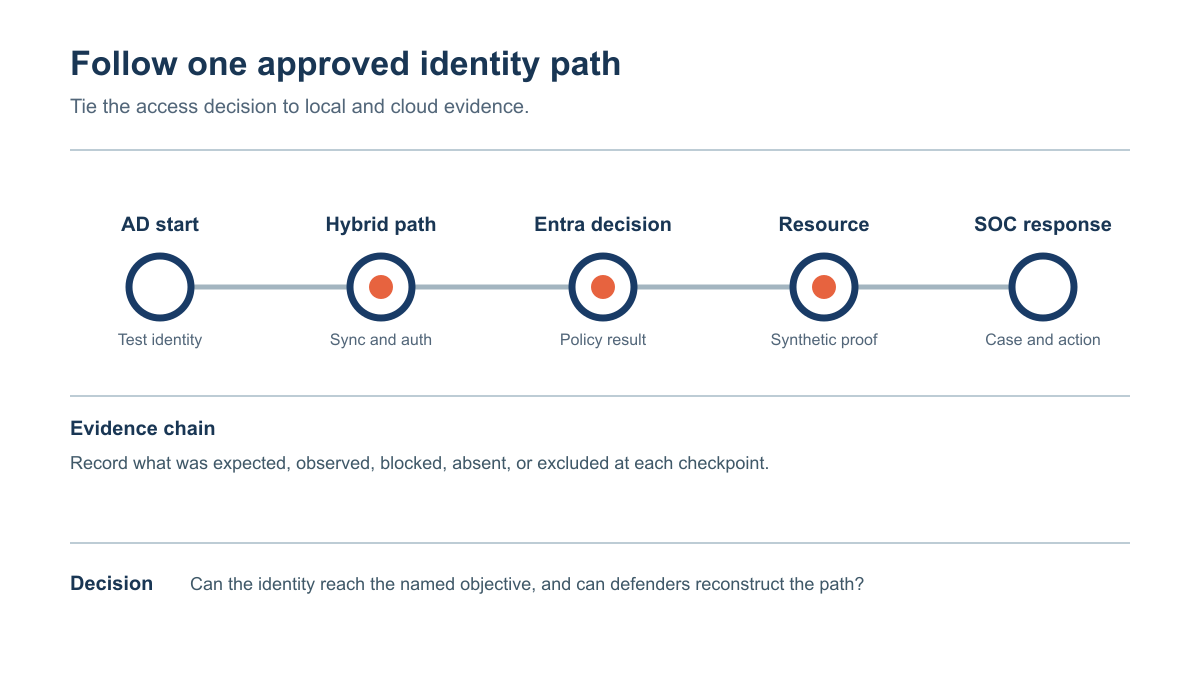
Figure 1: An editorial map of evidence across the approved local and cloud path. Sources: Microsoft hybrid identity; Microsoft authentication methods; Microsoft sign-in details; NIST SP 800-115.
Stage | Evidence question | Owner to involve |
|---|---|---|
AD starting point | Which test identity and local rights were actually used? | AD and endpoint owner |
Sync and authentication | Which identity state and sign-in method applied? | Hybrid identity owner |
Entra decision | Which sign-in and per-policy result occurred? | Entra and Conditional Access owner |
Protected resource | Was the intended action allowed, denied or unattempted? | Application or data owner |
SOC response | Who saw the sequence and when did they act? | Detection and incident response owner |
Ask the provider to preserve timestamps and correlation identifiers where available, but to keep raw credentials, tokens and sensitive user data out of the executive report. The SOC replay should compare what analysts knew during the exercise with what the control group learned afterward. An alert generated only after a tester disclosed the path belongs in the debrief, not in the covert detection result. A blocked objective with no analyst action and a reached objective with an alert that was not contained are different lessons.
Choose the exercise mode and safety controls
An assumed-breach start is efficient when the buyer's question begins with a compromised standard AD account or workstation. The organization grants that position and asks what the operator can reach through the hybrid boundary. A full-chain scenario would also include how the account or foothold is obtained; that expands scope, authorization and time. A purple-team mode makes the route visible to defenders so they can tune correlation and response. The proposal should name the mode, and the report should not describe granted access as an earned compromise.
The control group should approve the test identities, device state, application, data marker, permitted actions, excluded systems, timing, stop contacts and cleanup. If the objective is role change, use a harmless test resource with a reversible assignment. If the objective is data access, use a synthetic record. If the path touches a production dependency that cannot be safely exercised, stop at a proof point and record what remained untested. The provider should not quietly replace a blocked cloud path with a different on-premises target and call the original objective reached.
Protect the synchronization and authentication infrastructure itself. A live sync server, AD FS service or pass-through agent may be central to business sign-in. The scope should distinguish observing the effect of its configuration from testing that server directly. Direct testing of these components requires explicit authorization, operational contacts and a separate safety plan. The buyer can still test the identity path through normal approved sign-ins without allowing disruptive actions against a high-value shared service.
The rules should also address service providers and additional tenants. A company can authorize its own AD and Entra environment, but it cannot automatically authorize a partner's tenant or an unrelated SaaS control plane. List each owner and resource. If a relevant boundary cannot be authorized, exclude it and state the limit in the report. NIST SP 800-115 frames technical testing around planning, conduct, analysis and mitigation; an explicit boundary lets the buyer use the result responsibly.
Compare a hybrid red team with component assessments
An Active Directory security assessment can examine misconfigurations, excessive privileges, delegation and domain trust paths in depth. An Entra penetration test can examine cloud roles, app registrations, identity settings and policy decisions. A hybrid red team uses a selected part of both environments to answer a different question: can an operator follow an authorized starting position to a protected business objective, and can the SOC correlate and contain the path? It may reveal component findings, but its main deliverable is the objective and defender timeline.
The existing enterprise identity test matrix addresses SSO and SCIM in enterprise SaaS. The workload identity federation test plan addresses trust for application workloads. Neither is a substitute for a human identity path from AD through hybrid authentication to an Entra-protected objective. If the protected system is an application with its own roles, its authorization may need a separate test even after cloud sign-in succeeds.
The cloud red-team exercise after migration is broader: it can follow cloud account and control-plane routes in AWS or Azure. This post focuses on the AD-to-Entra identity boundary and the distinct evidence of synchronization, authentication and Conditional Access. A buyer whose cloud migration also changed identity can use both guides to specify which question comes first. Avoid paying twice for the same granted account and objective; use the earlier finding or report to narrow the second exercise.
The choice is a procurement decision, not a maturity label. Buy a component assessment for a known AD or Entra weakness class. Buy a hybrid red team when leadership needs an end-to-end path and response result. Buy a purple replay when the route is known and the immediate work is detection tuning. A program can sequence them, but the quote should state which phase produces which evidence and which retest verifies the fix.
What to require in the quote and final report
The SOW should identify the starting identity, on-premises environment, synchronization technology, user authentication method, Entra tenant, protected application or resource and objective proof. It should list the owners and written authorizations for each component. Ask the provider to distinguish the test of a normal user path from a privileged path, and to specify whether the operator receives the initial foothold. That prevents proposals with very different effort from appearing equivalent under the same "hybrid red team" title.
Request an evidence plan for each decision point. Which AD event or endpoint record is expected? Which sign-in or sync record matters? Which Conditional Access policy and resource should appear? Which target action proves the objective? What alert and case should the SOC create? A useful report can mark each item as observed, absent, not collected, not expected or excluded. Those categories keep a missing event from being misread as a failed detection and an untested path from being reported as secure.
The final report should include a concise executive outcome, an attack narrative within the authorized boundary, timestamps, policy and resource decisions, defender actions, exclusions, remediation owners and a retest plan. The technical annex should preserve enough context for identity and SOC teams to reproduce the fix, with sensitive identifiers redacted for broad distribution. A recommendation such as "improve hybrid security" is not actionable; the owner needs the exact group, role, policy target, event route or case handoff that should change.
Ask what the retest will repeat. If the issue was an unexpected cloud entitlement, use the same test account and objective after the group or app assignment is narrowed. If the issue was a Conditional Access policy that did not match, test the same sign-in conditions after the targeting changes. If the issue was a SOC correlation gap, run a comparable route and record whether the new alert reaches an analyst in time. A different authentication method or resource can invalidate the comparison, so any change should be called out.
Where Stingrai fits
Stingrai is a Toronto-founded CREST-accredited penetration testing company. Its red-team service explicitly includes Active Directory and Entra ID paths toward agreed objectives, with an attack narrative, detection and response timeline and SOC replay. Human-led engagements use two named penetration testers from a certified team. The company also offers a focused Active Directory assessment when the buyer needs component depth before or after the red team.
A useful request to Stingrai names the hybrid authentication model, start identity, protected objective, identity and SOC owners, safety boundary and intended decision. That gives the provider enough to quote the right exercise and to distinguish it from a general AD scan or cloud review. Get a Quote for a written scope that the identity, application and defender teams can all evaluate.
Frequently Asked Questions
What should a hybrid Active Directory and Entra red-team exercise include?
It should include an authorized starting identity, the actual synchronization and sign-in design, a named cloud objective, representative local and cloud rights, safe proof material, expected Conditional Access and resource decisions, local and cloud telemetry, SOC response and retest criteria. The report should separate what was allowed, blocked, detected, acted on and never tested.
Does a synchronized AD account automatically have Entra administrator rights?
No. Synchronization aligns identity information; cloud role and application entitlements are separate authorization decisions. The exercise should inspect the actual assignments relevant to the test account and objective, then demonstrate the observed result. It should not infer cloud privilege from an AD title or a successful sign-in.
Is password hash synchronization the same as pass-through authentication or federation?
No. Microsoft documents different authentication locations for password hash synchronization, pass-through authentication and federation. The buyer should identify the method used by the test identity and collect evidence from the systems that method actually uses. The synchronization technology choice alone does not establish the sign-in behavior.
Does Conditional Access protect Windows sign-in on an AD workstation?
No. Microsoft says Conditional Access protects sign-ins to cloud resources and does not apply to Windows sign-in. A red-team exercise should test the policy at the intended Entra-protected resource and examine the per-policy result, not treat a local workstation login as proof that the cloud policy worked or failed.
What is a safe objective for this exercise?
A safe objective is a specific cloud access or harmless management action that proves the hybrid identity boundary without exposing real data or disrupting authentication. Use a test identity, a synthetic record or test resource, an agreed stopping point and a cleanup plan. The control group should authorize any privileged or production dependency separately.
How should we read a Conditional Access Success status in a sign-in log?
Do not treat the summary status alone as proof that the required policy applied. Microsoft notes that Success can appear when a policy was evaluated but did not itself apply. Review the specific policy result, identity, application and conditions in the sign-in details, then compare that decision with the expected access rule.
How does this differ from an AD penetration test or cloud red team?
An AD penetration test examines weaknesses within a defined on-premises identity scope. A broad cloud red team can pursue cloud objectives through many entry points. This hybrid exercise follows one approved AD-to-Entra identity route to a named cloud objective and measures the defender's ability to connect the local and cloud evidence. A buyer can commission component depth separately where the chosen route reveals a need.
Related reading
Sources
Talk to Stingrai
Describe the AD-to-Entra path, test identity, protected objective and evidence owners in Get a Quote, or book a free discovery call to settle the scope.



