





Privileged access controls are only as strong as the decisions they make when an identity asks for elevation and then uses it. NIST SP 800-53 Rev. 5, AC-6 defines least privilege as access necessary for assigned organizational tasks. An enterprise that has deployed a privileged access management system still needs to know whether eligibility, approval, activation, session use, expiry and monitoring enforce that intent in its own environment.
Quick answer. A JIT and PAM red-team exercise begins with an authorized identity and a protected business objective, then follows the privilege decision from request through a safe administrative action and expiry. The buyer should test approved and denied paths, collect both access-control and SOC evidence, and define who may stop or contain the exercise. Stingrai's human-led red team can test the agreed identity and network path; the resulting report should distinguish a blocked privilege request from a permitted action that defenders failed to notice.
This is a different purchase from a platform configuration review. A settings export can show that approval is enabled for a role. It does not prove that the role cannot be reached through an alternate assignment, that the approver sees the right context, that the privileged session is bounded to the intended resource, or that the access disappears when the window ends. A red-team objective can connect those controls to an actual decision. It should do so without altering production data or granting persistent rights to the test identity.
Choose the privilege decision the business needs proved
"Test PAM" is not an objective. The buyer should name a protected action and the business owner who would care if it occurred without approval. The protected action might be viewing a synthetic secret in a test vault, changing a harmless configuration in a designated lab resource, or reaching a marked administrative function that returns a time-stamped allow or deny result. Choose something that represents a meaningful business boundary but can be verified without changing a live service or reading confidential data.
Next, state the starting condition. A lower-privilege employee account, an eligible but inactive administrator, a contractor identity, and a workstation assumed breached at the beginning of a test all ask different questions. If testers begin with an already elevated global administrator, the exercise cannot prove whether JIT approval blocks escalation. If they begin with an unrealistically powerless account that never uses the real workflow, a denial may say little about the exposure. Record why the test identity is representative and where it differs from a real person's access.
The scope should identify the privilege system and the resource it governs. A cloud role activated in Microsoft Entra PIM is not identical to a vaulted local account, a domain administrator credential or an emergency access account. Each has its own eligibility, approval, session and logging design. The exercise can use one representative workflow and state the limits of inference. It cannot declare "PAM effective" across every directory, server and application after testing one role.
The buyer also needs to choose the defender mode. A blind red-team phase measures whether normal monitoring recognizes abnormal privilege use. A collaborative replay measures whether the team can tune a rule and improve its response. Both are useful, but they should be reported separately. The SOC can be told that a general exercise window exists without knowing the precise action or target; the white team retains the exact identities and stop authority.
MITRE ATT&CK T1078 describes adversaries using valid accounts and detections that consider atypical logon and account behavior. T1098 describes account manipulation that can grant additional roles or permissions. These are threat-model references for an authorized exercise, not instructions to obtain someone else's credentials. The objective should be written in terms of access decisions and defender response, not a payload or a list of exploits.
Model the workflow before testing
A privileged identity moves through a sequence of distinct decisions. It may be eligible for a role without having that role active. It may request elevation and need verification, justification or approval. The role may activate for a limited scope and time. A target application or server then decides whether the privileged action is allowed. Finally, the grant expires or is revoked, and defenders must be able to reconstruct what occurred. A scope that checks only the role listing misses most of that chain.
Microsoft's Entra PIM documentation shows that activation can involve additional verification, reduced resource scope, a custom start time, a reason and an approval request when the role is configured to require one. Other PAM systems implement these decisions differently. The buyer's scope should use the organization's actual policy and product records, not assume that every platform behaves like Entra.
Decision point | Buyer question | Safe observation | Evidence to retain |
|---|---|---|---|
Eligibility | Who is allowed to request this privilege, and who can change eligibility? | Inspect authorized test identities and their assigned role paths | Eligibility export, owner approval and change history |
Request | Does the request state the task, target and duration that the owner expects? | Submit a test request for a designated target | Request record, justification and requested scope |
Approval | Does the right approver receive enough context and make the expected decision? | Compare a permitted request with a denied or expired one | Approver identity, decision, time and reason |
Activation | Does the grant begin only after the required checks? | Observe the role state and a safe target access decision | Activation audit event, role scope and target decision |
Privileged action | Is the identity limited to the task and resource approved? | Attempt a preapproved benign action and a prohibited negative case | Resource log, session record and allow or deny result |
Expiry or revocation | Does access end when expected, including an existing session? | Recheck the same benign action after the grant ends | Deactivation record and second target decision |
Detection | Did the SOC correlate unusual request, activation or use? | Review monitoring after the blind phase | Alert, case, analyst conclusion and escalation |
This is an original buyer matrix based on least-privilege, product-audit and detection guidance. It is not a NIST or Microsoft prescribed red-team test. The scope can be smaller than this table when the buyer has a single decision to answer, but any omitted stage should be labeled. For example, a test of approver behavior alone cannot prove resource-level restriction after approval.
Treat eligibility and approval as different controls
Eligibility determines who can request a role; approval determines whether a particular request may activate. A privileged administrator may be able to change either. The exercise should establish who owns the eligibility policy and who reviews changes to it. If a lower-trust identity can become eligible through an authorized test path, that is a distinct finding from an approver making a poor decision on a legitimate eligible request. The first is a privilege-assignment issue; the second is a workflow and context issue.
Use a test approver or an agreed real approver without deception that would violate the rules of engagement. The goal is to know whether the approval process supplies the required facts and records a decision. It is not a competition to trick an employee into approving an unexplained request. If social engineering is in scope, authorize it explicitly and specify the people, channel and safe exit. Otherwise, keep the request transparent to the control group and evaluate the technical and procedural checks around it.
An approval notification can also be present yet unusable. It may omit the target resource, fail to show the requested duration, or reach someone who has no knowledge of the task. Those are buyer issues even if the role activates only after a click. Record the content actually available to the approver and the criteria the organization says should be applied. Avoid a binary "approval works" label that ignores the quality of the decision.
Test the resource decision, not only the identity portal
A successful role activation in a portal proves that the identity system granted something. It does not prove that the protected resource accepted the right scope or denied adjacent resources. The red team should attempt a benign, preapproved action at the in-scope target and a negative case at a similar resource that should remain inaccessible. Both decisions need timestamps and resource-side records. A menu item or dashboard tile is weak proof of actual access.
The target may use cached authorization, a separate administrative account or a long-lived session. Those behaviors should be identified in the scope because they affect the expiry test. The buyer should ask what happens to a session opened during the grant after the grant ends. A portal showing "expired" while the session can still perform privileged actions is a different result from an immediate denial. If the platform intentionally allows an existing session to continue, report that design and its business consequence rather than claiming the expiry mechanism failed without context.
The white team should own cleanup of test grants, sessions and markers. A red-team engagement must not leave an emergency account enabled or a test role permanently assigned. The cleanup record belongs in the evidence pack, and the owner should verify that the protected resource has returned to its prior state.
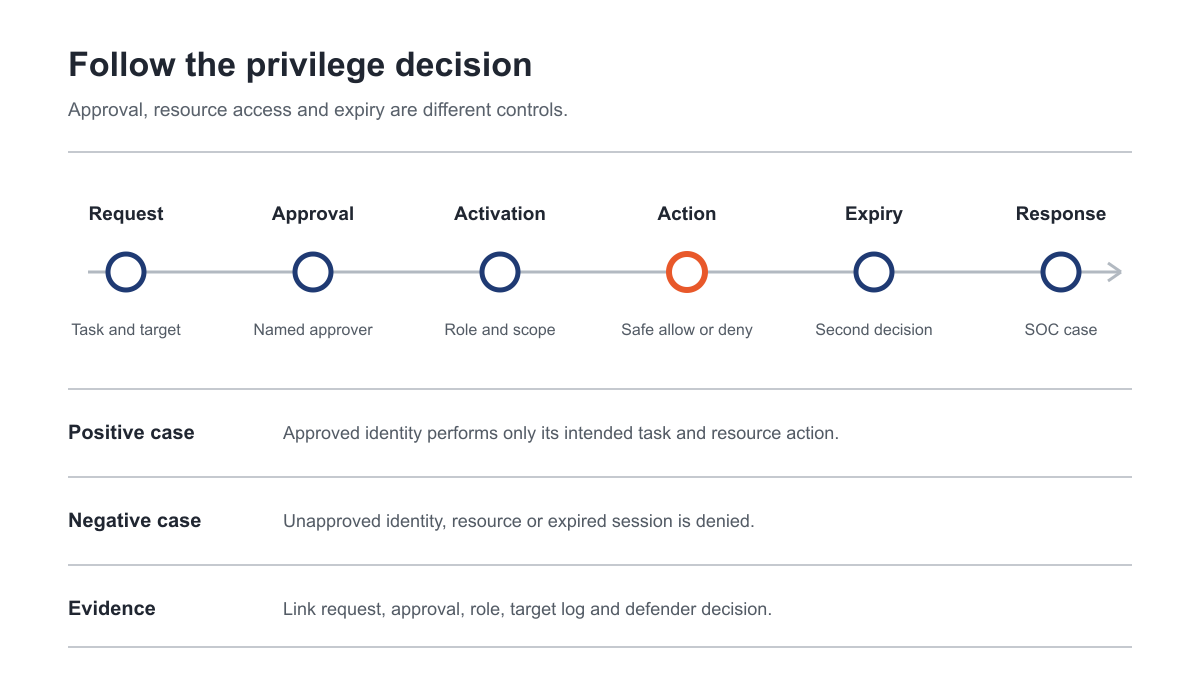
Figure 1: Editorial privilege-decision chain for a bounded red-team objective. Sources: NIST SP 800-53 Rev. 5, AC-6; Microsoft Entra PIM role activation; Microsoft PIM audit history.
Put detection into the objective
Privileged access can be perfectly legitimate and still deserve scrutiny when its timing, origin, scope or follow-on action is unusual. The SOC should be able to connect the identity's sign-in, request, approval, activation and target action. It should know whether the approval matches a change ticket or an emergency process. The red team does not need to supply a known malware signature to test that logic. A valid-account scenario is especially useful because it asks whether the defender understands behavior rather than merely blocking a suspicious file.
Microsoft's PIM security-operations guidance calls for monitoring privileged role-assignment changes, approval or denial of elevation, and changes to PIM settings. The relevant customer policy may prioritize some of those actions differently. The scope should identify expected alert conditions before the exercise, even if the analysts do not know the exact execution time. If no alert was expected for normal approved activation, the red team should not score the absence of such an alert as a miss. It should test the abnormal sequence the customer actually wants recognized.
Microsoft's PIM audit guidance notes that role request, approval, activation and deactivation can be asynchronous and may have different correlation IDs. It identifies a role-assignment request identifier that can connect stages of one activation. This is a useful warning for the evidence plan: a report that searches only one event identifier may falsely conclude that approval or expiry was never logged. For non-Microsoft PAM systems, ask the vendor which durable request or session identifier connects the records.
Score prevention and detection independently. A denied request may show that eligibility controls worked. It may also reveal that the SOC never sees repeated abnormal requests. A privileged action that succeeds under a properly approved grant may still produce a valuable analyst alert if the action is outside the user's usual task. A SOC case that accurately identifies the action but reaches the wrong administrator is a response-handoff issue. Each stage needs a finding owner and a retest path.
The buyer should require a defender timeline, not simply an alert count. MITRE T1098 describes detection that correlates account attribute changes with unusual timing or process context. The red team's report can compare that expected pattern with the actual identity and resource logs, the provider or internal SOC case, analyst notes, escalation and containment decision. It should also explain missing telemetry honestly. A test against an asset outside the monitoring contract cannot substantiate a claim that the SOC failed.
Set rules of engagement for a sensitive control
Privileged access testing touches a control that can affect the whole enterprise. Authorization must name the identity tenant, directory or PAM platform, the specific role, target resource, test accounts, approvers, testing window and permitted action. The white team should supply an immediate stop contact and a way to revoke access. It must also identify genuine emergency access paths that are out of scope unless the exercise explicitly covers them.
Prohibit changes to live users, real secrets, security logging, customer data and production service settings unless separately approved. The default safe proof is a synthetic marker or benign operation whose outcome is logged without altering business data. Do not rotate a live administrator password, disable an actual account, or create an enduring alternate path just to demonstrate impact. The test can show that such a path would exist using controlled evidence and then stop.
The test plan should also state whether the operator may use social engineering, phishing, credential theft or a simulated compromised workstation. These are separate methods with different permissions and risks. A test of JIT policy can begin from an approved lower-privilege account without any of them. If the buyer wants a full adversary campaign, broaden the objective and rules explicitly. Do not smuggle a larger red-team engagement into a "PAM review" line item.
Deconfliction is especially important when the SOC is expected to respond. The control group should know the test identity, source workstation and safe marker. If a real incident occurs or the monitoring team takes a containment action, the operator pauses until the control group resolves the situation. The control group may later reveal the exercise to analysts and conduct a collaborative replay. The report should preserve the blind outcome separately from the replay.
An emergency or break-glass account deserves its own decision. Many enterprises retain one for continuity if the normal approval service fails. The exercise can ask who can invoke it, who receives notice and what logs remain. But simulating a real outage or consuming a production recovery account can be disruptive. Keep that scenario to a controlled test account or documented tabletop unless the service owner expressly authorizes live use.
A fictional privilege path
Imagine a fictional enterprise with Entra PIM, a test subscription and a protected administrative function. A designated ordinary user is eligible for a limited role. The white team owns a synthetic object and has recorded the expected policy: approval is required, the role should apply only to the test subscription, and the SOC should investigate an attempt to use the role outside the approved window. No real customer asset or Stingrai client is involved.
The red team submits a request that the designated approver denies. The target action remains blocked. Later, the team submits a properly justified request for the test subscription, receives approval and performs the benign action there. An equivalent action against a separate, out-of-scope subscription is denied. After the grant expires, the team repeats the original benign check and observes whether the decision changes. The white team gathers request, approval, activation, target and deactivation records.
Suppose the permitted action succeeds, the out-of-scope action is denied, but the original session remains usable beyond the stated window. The technical finding is about session lifetime and target enforcement, not whether the approver did the right thing. Suppose separately the SOC receives a PIM-setting change alert but routes it to a stale contact. That is a defender handoff defect, not an access-control defect. A good report makes those distinctions so each owner can fix and retest its piece.
The scenario is deliberately ordinary. The value comes from proving that the system's privilege states and the resource's decision agree, and from showing whether defenders can reconstruct the sequence. It should not require a dramatic exploit or a real data exposure to justify the purchase.
Compare proposals by the decisions they will prove
Give bidders the same starting identity, privilege system, target, desired negative case and SOC participation. Ask them to specify which stage they will test and which they will inspect only as context. A quote for "PAM penetration testing" may cover configuration review, application testing of the PAM product, a privileged-account audit or an end-to-end red-team objective. Those are materially different services. The proposal should say which one it offers.
A strong proposal includes a safe target and proof, a rule-of-engagement plan, role and resource ownership, expected logs, a defender mode, report examples, cleanup and retest. It should explain whether cloud PIM, on-premises directory, vault, endpoints, network segments and target applications are all in scope or whether some are excluded. If the vendor lists them all without a business objective, ask it to name the exact allowed and denied decisions it will observe.
Use these questions in the buying process:
What lower-trust identity starts the exercise, and why does it represent our real risk?
Which role, resource and protected action form the success condition?
Will you test a denied path as well as an approved path?
What does the approver see, and who determines whether the approval was appropriate?
Will you verify target-side access before and after role expiry?
Which logs identify the request, approval, grant, session and protected action?
How will you distinguish an access-control failure from a SOC or notification failure?
Which actions are prohibited, and who can stop the test immediately?
What does the retest repeat after a role policy, session control or detection rule changes?
A low quote can be reasonable for one role and one target. It is not comparable with a multi-system red team that includes cloud, domain, vault, endpoints and a covert SOC phase. Ask for the scope assumptions and a price for any optional extension before signing. Stingrai's red-team work is quoted to the agreed objective and environments through Get a Quote, rather than applying a fixed web-application package price to identity testing.
Ask for a report that supports a decision and a retest
The executive report should state the initial privilege, protected objective, allowed and denied outcomes, defender response and residual risk. The technical annex should carry the exact test identity, role, resource, request and approval records, activation and expiry evidence, target-side decision, relevant SOC case and cleanup proof. Time stamps and identifiers must let the owner reconstruct the sequence without guessing. Do not paste live secrets or unrelated personal data into the report.
Assign each finding to the control it concerns. An overly broad eligibility grant is an identity-governance issue. A request approved without task context is an approval-process issue. A role that applies to an unintended resource is a scope issue. A session that outlives an expired grant may be a target enforcement issue. A missing alert is a telemetry or detection issue depending on whether the event was collected. A missed call or wrong contact is a response issue. This taxonomy helps procurement compare vendors and helps engineers retest the actual defect.
The retest should repeat the original safe decision under the changed policy. If the owner narrows a role, confirm that the legitimate task still works and the negative case remains denied. If the owner changes the expiry behavior, confirm both the portal state and resource action after the window. If the SOC tunes an alert, show a new case and its handoff. Label a collaborative replay as such; it proves the fix under known conditions, not a new blind-detection result.
Where Stingrai fits
Stingrai is a CREST-accredited penetration testing services company founded in Toronto. Its human-led red teaming works toward agreed objectives and tests whether detection and response work. A JIT/PAM exercise can combine identity, internal network and Active Directory boundaries when those are in the authorized scope. The proposal should name the starting privilege, target, approver and defender mode.
Stingrai offers one-time (annual) engagements and continuous programs through its PTaaS platform, with confirmed findings and retesting. A JIT/PAM red-team scope is quoted for the environment and objective. It is not covered by the fixed price for one web application and associated APIs.
Frequently Asked Questions
What should a privileged access red-team exercise test?
It should test a named privilege workflow from an authorized starting identity to a safe protected action, then verify what happened when the grant ended. The scope should include eligibility, request, approval, activation, target-side authorization and defender evidence where relevant. A platform settings review alone cannot prove the full path.
Is JIT or PAM deployment enough to prove privileged access is secure?
No. A deployed control can have overly broad eligibility, weak approval context, unexpected resource reach, sessions that outlive a grant or missing detection. NIST AC-6 describes the least-privilege objective; the exercise tests whether the organization's implementation produces that outcome for a defined task and resource.
Does an approved activation count as a red-team failure?
Not by itself. The question is whether the request met the organization's policy, whether the role was limited to the approved scope, whether the target action matched the task and whether unusual use was recognized. A legitimate approved task may be a control success. An out-of-scope action permitted under the same grant is a separate finding.
How can a red team test PIM without changing real data?
Use a designated test identity, approver, role, resource and synthetic marker. Record allowed and denied decisions at the target, then clean up the grant and marker under a named owner. The rules should prohibit live secret access, production configuration changes and disruptive actions unless separately authorized.
What evidence connects a PIM request to activation and expiry?
Microsoft's PIM audit guidance says asynchronous request, approval, activation and deactivation events may have different correlation IDs. It describes a role-assignment request identifier that links events from the same activation. Other PAM systems need their own durable request or session identifier plus target-side logs.
Should the SOC alert on every privileged role activation?
That depends on the organization's policy and the role's risk. Microsoft's security-operations guidance recommends monitoring elevations and changes to privileged role assignments and PIM settings. The exercise should define which behavior is abnormal before testing and assess whether analysts connected that behavior to a case and action.
How is this different from an Active Directory penetration test?
An Active Directory test can assess domain attack paths and privileges. A JIT/PAM red-team exercise follows a selected privilege request through approval, active use, expiry and SOC response, potentially across cloud or on-premises systems. The purchases can complement each other, but their objectives and evidence should be stated separately.
What should I ask a vendor to include in the quote?
Ask for the starting identity, privileged role, target resource, safe positive and negative cases, approver and SOC participation, rules of engagement, evidence timeline, cleanup and retest. Require the bidder to say whether it is reviewing configuration, testing the PAM product, or running an end-to-end red-team exercise. Those scopes are not interchangeable.
Related reading
References
NIST. SP 800-53 Rev. 5, Security and Privacy Controls for Information Systems and Organizations. AC-6 defines least privilege.
MITRE ATT&CK. Valid Accounts, T1078 and Account Manipulation, T1098. Read 15 November 2026. Threat and detection framing.
Microsoft Learn. Activate Microsoft Entra roles in PIM. Read 15 November 2026. Product activation workflow.
Microsoft Learn. View audit log report for Microsoft Entra roles in PIM. Read 15 November 2026. Request and activation correlation.
Microsoft Learn. Microsoft Entra security operations for PIM. Read 15 November 2026. Privileged-role monitoring guidance.
Stingrai. Red Teaming Services and Internal and External Network Penetration Testing. Read 15 November 2026. Public service descriptions.
Talk to Stingrai
To scope a safe privilege objective, approval workflow and defender evidence, get a quote or book a free discovery call.



