





Fortinet's FortiOS 7.6.3 release notes state that SSL VPN tunnel mode is replaced with IPsec VPN and that its prior settings are not upgraded. That change creates a practical security question after a migration: do the new identities, groups, policies and reachable networks express the access the organization intended? A successful connection test cannot answer that question on its own.
Quick answer. A FortiGate post-migration penetration test should validate who can establish the new remote-access session, which internal destinations each authorized group can reach, which paths a denied or lower-trust group cannot reach, and whether Agentless VPN or management interfaces remain exposed as intended. Stingrai can scope this as a human-led internal and external network penetration test with production-safe proof and retesting.
This guide is for security owners and network teams buying an independent assessment after a FortiGate remote-access change. It focuses on the result of a migration, not on instructions for performing one. The applicable FortiOS release, FortiClient release, identity design and network architecture belong in the engagement scope. Fortinet's version-specific behavior should never be applied indiscriminately to an estate running another release.
Buy a test of the outcome, not a migration review
Migration projects are usually judged first on availability: can staff connect, can a critical application load, and can support teams troubleshoot? Security acceptance needs a different set of observations. A connection may succeed for an intended employee and an unintended contractor. The employee may reach the expected application and also a protected management subnet. A retired web portal may remain reachable even though the tunnel mode has changed. None of those conclusions follows from a migration checklist alone; each requires an agreed starting position and an observed result.
The buyer's core question is access parity with a deliberate policy. “Parity” does not mean the new system must preserve every old permission. The organization may intentionally narrow access during the change. It means the resulting behavior matches the approved target, including explicit denials. For each population, specify the identity used, the method of authentication, the permitted destination set, the forbidden destination set, and any exception that has an owner. The tester can then validate the outcome without receiving production user data or making configuration changes.
The assessor also needs to distinguish what was reviewed from what was exercised. Reading a firewall policy is useful. Testing an approved route from a representative remote user gives stronger evidence of effective reachability. Comparing both exposes discrepancies caused by identity mapping, overlapping policies, route selection or a separate service path. The report should say exactly which conclusion rests on observation and which rests on configuration evidence.
A general firewall rule-path validation guide covers broad policy assessment. This FortiGate-specific engagement is narrower: it follows the remote-access identity and traffic paths after a platform change, while checking the residual edge and administrative surface created or preserved by that change. A generic port scan or configuration export does not prove those outcomes.
Draw the post-migration boundary map
Ask the network owner to supply a redacted before-and-after design, the intended access matrix, and a list of FortiGate services that should remain reachable from the internet and from internal management networks. The test does not need a public spreadsheet of private addresses. The actual addresses, identity groups and infrastructure names can be shared through the contracted secure channel. A generic map is enough to write the statement of work.
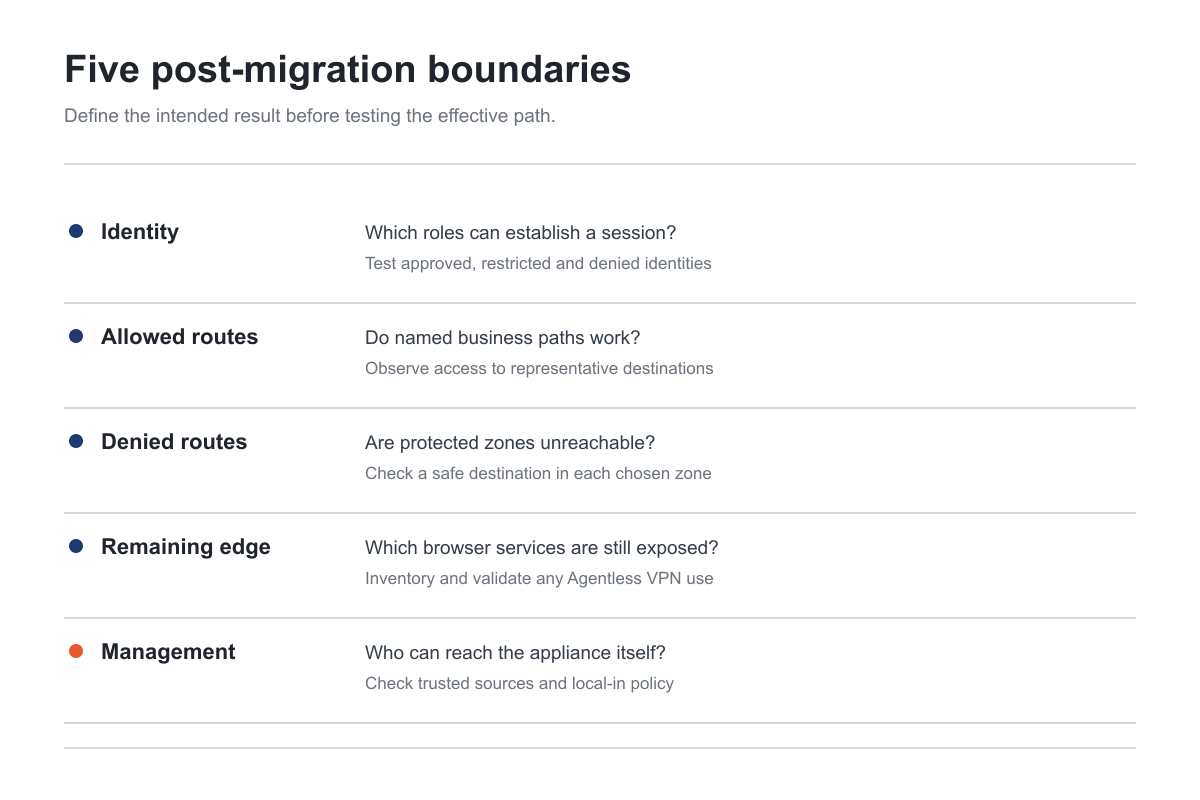
Figure 1: The assessment follows identity into IPsec reachability, denied routes, remaining edge services and management access. Source: Fortinet's FortiOS 7.6.3 release notes, user-group guidance, and local-in policy guidance.
The map has five questions. Who authenticates? What can that identity reach? What must it fail to reach? Which other edge services are still present? Who can administer the appliance? Each question has a different evidence source and often a different remediation owner. The identity team may own group membership; network engineering may own firewall policies; a separate operations team may own administrative access. A useful report connects the finding to the right owner instead of labelling every issue “VPN misconfiguration.”
The map should include variation. A company with multiple FortiGate sites, separate business-unit groups or emergency support access does not have a single “normal user.” A representative sample should cover materially different policy patterns. If one site uses a different release or a third-party access broker, the proposal must either include that path explicitly or exclude it. Do not assume that all gateways behave alike because they share a vendor logo.
Identity and authorization
Remote access is only as narrow as the principal that receives it. The tester should compare the intended user groups with effective access for ordinary staff, administrators, third parties and disabled or denied test identities. The organization supplies safe test accounts or supervises validation of real roles. Evidence should identify the starting group and the policy consequence, without placing actual credentials or private customer details in a public report excerpt.
Fortinet's FortiOS 7.6.5 guidance explains that dial-up or remote-access IPsec user groups may be specified in phase 1 or in an associated firewall policy, but not both. It also calls out manually assigned groups for additional policies created outside the VPN wizard. That matters to a post-migration assessment because an apparently correct tunnel definition does not establish the authorization of every policy reached through that tunnel. The assessor should identify where the deployed design applies group restrictions, then validate representative effective access. The article is not prescribing a particular configuration method.
Authentication should be part of the evidence, not a label on a diagram. Fortinet's remote-access best practices discuss certificates, multi-factor authentication and remote authentication servers as security options. A buyer should ask the vendor to verify which of those controls are actually required for the scoped population and whether an exception follows a documented business need. The team should avoid asserting that every environment must use one mechanism; the requirement depends on the organization's approved design, client compatibility and risk policy.
The negative cases are especially valuable. A valid but unauthorized test user should not receive the same network reachability as a privileged user. A former contractor account should not retain access once its group entitlement has been removed. A user who is intentionally allowed to connect for one application should not automatically reach the broader internal subnet. These cases can be tested with synthetic accounts and safe destination hosts. They reveal whether the system enforces who may reach what, which is the buyer's real requirement.
Allowed routes and denied routes
The approved matrix should name a manageable set of source and destination pairs. For example, an employee group might need a business application, a support group might need a management service during a change window, and a contractor group might need one jump host. The proposal should also name destinations each group must not reach. This gives the tester a success criterion that is more meaningful than “VPN worked.”
Test both the allowed and the denied cases. An overly permissive rule may be visible only in the denied case, while an overcorrection may break the allowed case. The latter matters because a remediation that closes an unwanted route but interrupts a business application is not complete. A report should state the source identity, connection type, destination role, intended rule, observed result and test limitation. A single ping response is not a full application-access conclusion; use a safe protocol-level check suited to the target service.
Network routes can be influenced by more than the policy line a reviewer expects to govern. Address objects, group mappings, routing, NAT, split tunneling and overlapping rules can alter the observed path. The buyer need not prescribe a vendor's testing technique, but the scope should require the vendor to reconcile the effective result with the policy and routing context. If the assessor identifies a possible unintended route without safely exercising it, the report should label the result as configuration-supported rather than observed.
For enterprises, sampling matters more than an oversized list of endpoints. Select destinations by trust boundary: ordinary application, sensitive application, identity infrastructure, management network, backup network and third-party interconnect. The selected hosts can be test systems that represent those zones. A good quote explains why that sample reflects the full set of policies and where it does not. A single success on one application does not prove segmentation across every site.
Remaining edge services
Fortinet's change to tunnel mode is easy to misread as removal of every SSL VPN-related surface. Its Agentless VPN documentation says SSL VPN web mode is renamed Agentless VPN from FortiOS 7.6.3. Fortinet's model notice also says that feature is unavailable on specified models. A buyer should therefore ask what browser-based access is supported and intentionally retained in the deployed release and model. The test should distinguish an approved Agentless VPN service from a forgotten exposure and identify who owns its user and application policy.
This does not mean the assessor should claim every FortiGate exposes Agentless VPN after an upgrade. The model, FortiOS release and deployed configuration determine whether the service is available and present. The point is to avoid equating “old tunnel removed” with “all old web access removed.” An external observation, a safe login-policy check and a configuration review can answer whether the service exists and whether its audience is deliberate. If another public-facing service shares the same appliance or address, list it separately so the conclusion is precise.
The external scope should identify every relevant public IP address and hostname, including alternate sites and disaster-recovery edges that are active. Those identifiers may be sensitive and need not appear in marketing copy. A tester should report whether the observed service inventory matches the approved design. If an appliance is reached through a load balancer or upstream firewall, identify that in the engagement plan; otherwise a scan of the FortiGate's nominal IP may miss the actual public path or misattribute a service.
Appliance management and local-in exposure
Administrative access deserves its own boundary. Fortinet distinguishes local-in policies, which govern inbound traffic destined for a FortiGate interface, from controls on traffic passing through the appliance. A transit policy review therefore cannot, by itself, answer which source networks can reach the management plane. Ask the assessor to verify permitted administrative sources, the interface and service used, and whether the effective exposure matches the operations team's documented access design.
Fortinet's hardening guidance advises against routine WAN access to administrative ports and describes using a trusted management interface or restrictions. A buyer should use that as a review reference, then test the actual environment. An emergency access path may be deliberate, but it should have a named owner, limited source and monitoring plan. An unknown public admin path is a materially different issue from an approved portal for remote users.
The test should not change management settings merely to demonstrate a finding. FortiGate policy changes can affect remote access, routing or operations. A low-volume, controlled reachability check from approved source positions, paired with a configuration review, can often answer the buyer's question. Where a more intrusive check is necessary, it belongs in a separately approved test window with an operations contact and rollback plan.
Turn the acceptance criteria into a test matrix
The table below is a procurement worksheet, not a claim that every FortiGate estate has these same roles or destinations. Replace generic labels with your own approved design in the statement of work.
Starting position | Intended result | Safe evidence to request | Remediation owner to identify |
|---|---|---|---|
Authorized employee test account | Connects and reaches named business applications | Authentication outcome and approved application reachability | IAM and application owner |
Restricted contractor test account | Reaches only its assigned support path | Allowed path plus denied sensitive-zone checks | IAM and network owner |
Removed or denied test account | Cannot establish an authorized session | Controlled negative authentication result | IAM and access operations |
Approved administrator source | Reaches only the required management service | Source-to-interface observation and policy context | Firewall operations |
Untrusted external source | Cannot reach administrative service | Low-volume external observation | Firewall operations |
Agentless VPN test identity, if service exists | Sees only approved web applications | Service inventory and role-specific access result | Remote-access owner |
Require the tester to record both the intended and observed outcomes. A statement such as “contractor segmentation was secure” is too broad if only one host was checked. The report should say which policy, identity, source network, destination and time window were used. It should document an unexpected success and a broken authorized path. That is enough detail to let engineers reproduce and retest the issue without exposing sensitive network data in the public article.
For a multi-site estate, the buyer may group gateways by common configuration. The vendor should say how it will detect exceptions: different FortiOS versions, local policy overrides, different identity providers, separate internet paths, or special-purpose support groups. Testing every site identically is expensive and may still miss the one meaningful deviation. The scope needs a reasoned sample, not a promise to “cover the whole environment” without a method.
What belongs in the request for proposal
A strong FortiGate post-migration proposal names the test targets and the business outcome. Give vendors a redacted architecture and ask them to return an explicit plan for the following:
Deployed FortiOS and client versions in scope, with sites and special cases separated.
Public and internal FortiGate access points, including Agentless VPN where relevant.
Identity providers, user groups and representative test roles.
The approved allowed and denied destination matrix.
How IPsec authentication and associated policy restrictions will be assessed.
Which management sources and local-in controls will be reviewed or observed.
The safe test accounts, test destinations and permitted traffic volume.
Which services are third-party owned and require separate authorization.
The difference between active validation, configuration review and inference.
Preliminary finding delivery, report evidence, cleanup and remediation retest.
The vendor should make exclusions visible. A remote-access test does not automatically cover every firewall rule, internal device, web application or cloud account. Conversely, if the buyer wants a broad network penetration test, the proposal should add explicit workstreams rather than stretching the VPN label. A web application reached over the VPN may warrant a separate web application penetration test if its business logic is part of the objective.
Ask how the vendor will use privileged credentials. A test from a global firewall administrator account may be useful for configuration review but cannot prove whether an ordinary remote user crosses an access boundary. Likewise, a black-box external scan cannot reliably characterize every internal group permission. A blended scope with a few controlled role accounts and limited external observation often answers more of the buyer's decision than either extreme by itself.
Procurement should compare proposals on their proof, not their tool lists. Two quotes that both mention “FortiGate pentest” may differ in whether they validate actual remote-user reachability, inspect retained Agentless VPN, check appliance management, or include retesting. A shorter but precise matrix can be worth more than a long scan report. Ask each bidder to show the sample boundaries and final evidence format before signing.
Production safety and evidence handling
Remote access supports active business work. A test plan should define rate limits, test hours, target accounts, help-desk notification, stop contacts, and whether authentication attempts could trigger lockouts or detection rules. It should keep credentials out of email and public tickets. The network team should prepare disposable or supervised identities whose access matches real role patterns without granting access to confidential business data.
Test destinations should be controlled. A listening test service in each representative zone can establish reachability without reading application data. For a production-only path, the owner can approve a low-impact check and remain present during it. The vendor should not run high-volume discovery or disruptive protocol tests against the FortiGate unless the statement of work explicitly requires and safely schedules them. The report can be specific without becoming an instruction manual for attackers.
Finding evidence should be sufficient for remediation while minimizing unnecessary exposure. Record the role, policy context, source zone, destination role and observed behavior. A redacted private address or system alias may be enough for executive material; engineers can receive the precise evidence through a secure portal. If a test account or temporary object is created, the closeout record should confirm its removal. Any exception used for testing should have an expiry and an owner.
The retest should repeat the same denied path and an adjacent legitimate path. For example, after a contractor rule is narrowed, verify that the contractor still reaches the approved support host while the protected network remains unreachable. After a local-in restriction is changed, verify the trusted administrative route still works. Retesting only the blocked case can leave an operational regression. These paired outcomes make the evidence valuable to the security and network teams.
What the report should let a buyer decide
The report should explain whether the post-migration design was achieved. It must name the tested release and sites, the role and destination samples, the observed allowed and denied outcomes, the residual edge services, and the management-plane result. Every finding should connect the unintended access to the business-relevant boundary, not just to a configuration line. The reader should understand what an attacker would need as a starting position without receiving a procedural exploitation guide.
Separate three conclusion levels: observed, configuration-supported, and not tested. An observed result comes from a permitted role or network source reaching a target. A configuration-supported result is a plausible exposure inferred from an effective rule or setting that the team did not safely exercise. “Not tested” may be due to production constraints, missing accounts or third-party permission. This language prevents a narrow validation from being mistaken for an estate-wide guarantee.
Include an owner and a retest condition for each finding. An identity-group defect may be fixed by IAM, while a route or local-in rule belongs to network operations. A retained Agentless VPN service may require a product owner to decide whether it should exist at all. A report that only says “tighten access” leaves the buyer without a decision. Precise findings tell the owner what outcome to restore and how to verify it without breaking authorized use.
Where a compliance or customer assurance program needs evidence, the report can support that program by documenting scope, method, observations and remediation. It should not overclaim. A test of selected remote-access paths does not establish the security of every application reached through the gateway. The scope and sampling statement are part of the value, because they let a reviewer understand what the evidence proves.
Cost and timing follow policy variation
There is no single defensible price for a FortiGate post-migration penetration test. The work changes with the number of distinct gateways and sites, deployed releases, identity providers, user groups, remote-access profiles, approved destinations, residual web access, and management paths. A simple design with one policy pattern is different from an estate with several business units, outsourced support and site-specific exceptions. The request for proposal should state those differences before vendors estimate effort.
The number of IP addresses alone is a weak proxy. A small address set can hide many identity decisions and network zones. A larger set of identical appliances may need a defined representative sample rather than a full repeat at every location. Ask the vendor which variations drive additional testing and what it will report if the real estate differs from the scoping packet. This makes a fixed quote comparable without claiming a universal price.
Timing also depends on access preparation. A tester needs representative accounts, approved test destinations, an operations contact, and a safe window for external and internal checks. A plan should say when preliminary findings are shared so remediation can begin, when the final report arrives, and how retesting is scheduled. A rushed test before role accounts or policy intent are available is likely to produce a scan result with limited business meaning.
Stingrai provides a tailored network assessment quote through Get a Quote. Its public fixed prices for one web application and associated APIs do not price a FortiGate engagement. The scope and proof matrix are the right inputs for a network quote.
Where Stingrai fits
Stingrai is a CREST-accredited penetration testing company founded in Toronto. Its human-led internal and external network penetration testing can test remote-access identity, effective policy boundaries, external exposure and management paths. For a FortiGate post-migration engagement, the buyer and assigned testers can select representative user roles, routes and edge services, then agree on safe proof before testing begins.
Two named penetration testers from a team holding OSCE³, OSWE, OSEP, CREST CRT and CISSP certifications work on every human-led engagement, with team-lead and engagement-partner review. Confirmed findings are posted to Stingrai's PTaaS portal with remediation guidance during the test, and the team is available through live chat. Reports are redactable, and retesting is included. A buyer can choose a one-time annual test or a continuous program if remote-access changes require repeated validation.
This work is human-led network testing. Snipe, Stingrai's autonomous agent, tests web applications and associated APIs; it is not a FortiGate configuration or VPN tester. If a remote application also needs security testing, the statement of work can name that as a separate application workstream with its own starting roles and success criteria. Clear boundaries make the final evidence more useful to both security and operations.
Frequently Asked Questions
What should a FortiGate post-migration penetration test include?
A FortiGate post-migration penetration test should validate representative user identities, IPsec group restrictions, allowed and denied internal reachability, remaining Agentless VPN exposure where configured, and appliance management access. The report should distinguish observed results from configuration review, identify its sample and exclusions, and include a retest of both prohibited and legitimate paths.
Why test after moving from SSL VPN tunnel mode to IPsec?
Fortinet says FortiOS 7.6.3 replaces SSL VPN tunnel mode with IPsec VPN and does not upgrade the old tunnel settings. A working connection therefore proves availability for that user, not that all group and network permissions match the approved new design. A post-migration test checks the effective authorization and reachable paths.
Does removing SSL VPN tunnel mode remove every web-access service?
No. Fortinet says SSL VPN web mode is renamed Agentless VPN from FortiOS 7.6.3, but its availability also depends on the appliance model. Whether the service exists in a particular environment depends on the model, release and deployed configuration. A tester should inventory the actual edge and validate any retained service against its approved audience and application scope.
Is a FortiGate configuration review enough?
A configuration review is a useful input, but it does not prove every effective user path. A penetration test uses approved identities and network positions to observe whether intended access works and denied access fails. The best report reconciles observed behavior with group mapping, firewall policies, routes and local-in controls, while labelling any inference it did not exercise.
Should the test include the FortiGate management interface?
Yes, if management-plane exposure is part of the buyer's risk decision. Fortinet distinguishes local-in policies for traffic destined for the FortiGate from controls on transit traffic. The scope should name trusted administrative sources, externally reachable services, safe validation limits and emergency exceptions. Management configuration changes should remain with the operations team's change process.
How many user groups and sites need testing?
Sample materially different policy patterns rather than choosing a group count without context. Include ordinary and privileged roles, third-party or restricted users, denied test identities, and sites with different FortiOS releases, identity providers or local policy exceptions. The proposal should explain which population each sample represents and what remains untested.
How much does FortiGate post-migration penetration testing cost?
There is no reliable universal price. A quote depends on the gateways and sites, release differences, user-group patterns, allowed and denied destinations, retained edge services, management paths and production safety constraints. Compare vendors on their test matrix, evidence, exclusions and retesting, not only the number of IP addresses scanned.
What evidence should we request in the final report?
Request the tested identity and source position, intended access rule, observed destination behavior, relevant policy context, limitation, owner and retest condition for each boundary. A good report also records which conclusions are observed, inferred from configuration or not tested. Retesting should confirm the unwanted route is closed while approved access still works.
Related reading
References
Fortinet. FortiOS 7.6.3 release notes: SSL VPN tunnel mode replaced with IPsec VPN. Read 15 November 2026.
Fortinet. Agentless VPN in FortiOS 7.6.3. Read 15 November 2026.
Fortinet. Using single or multiple user groups for user authentication. Read 15 November 2026.
Fortinet. Local-in policy. Read 15 November 2026.
Fortinet. FortiOS hardening best practices. Read 15 November 2026.
Fortinet. Remote access best practices. Read 15 November 2026.
Fortinet. Agentless VPN model availability notice. FortiOS 7.6.3 release notes. Read 15 November 2026.
Talk to Stingrai
Share the deployed release, remote-user groups, approved access matrix and production safety limits through Get a Quote or book a free discovery call. Stingrai can scope a human-led FortiGate post-migration penetration test around the effective boundaries you need to prove.



