





CISA, NSA and MS-ISAC warn that legitimate remote monitoring and management software can be abused, and that MSP and help-desk trust relationships can extend the consequences across customers. An enterprise or managed service provider buying an RMM assessment should therefore test the authority chain, not merely whether the management console responds to a scanner. The decision is who can sign in, which customer or device they can reach, what remote action they can cause, and whether the organization can reconstruct and stop an unexpected action.
Quick answer. Scope an RMM platform penetration test around technician identities, role permissions, customer and device access groups, remote-control and script authority, agent enrollment, API integrations and audit evidence. Use controlled accounts and harmless endpoint markers to prove allowed and denied paths across customer boundaries. Stingrai's human-led network penetration testing includes remote management services where scoped; the proposal should name the console, agents, integrations and managed-device sample being tested.
This guide is for an MSP security leader, an enterprise IT owner or a buyer comparing specialist quotes for the management system that reaches a fleet. It differs from a broad management-plane risk overview. The scope here is one approved RMM estate and the evidence needed to decide whether its technician and customer boundaries hold. It is also different from a generic remote-access assessment, which may cover VPN, VDI, jump hosts and support tools without tracing an RMM action from console to endpoint.
Define the managed estate before counting endpoints
An endpoint count alone is a poor measure of RMM scope. A platform may have one management organization, many customer or business-unit containers, several technician roles, API-only accounts, different agent versions, and policies that apply to groups of devices. A test of one administrator account against one workstation cannot establish that a technician is constrained to the intended customer, or that a script cannot run under a broader policy. The buyer should inventory control planes and authority boundaries before requesting a fixed quote.
List the RMM product and deployed release, hosting model, management URLs, identity-provider connections, administrative roles, customer or business-unit hierarchy, device groups, agent operating systems, scripting and remote-control features, API integrations, logging destinations and emergency access paths. Mark which are owned by the buyer, which by a provider, and which by the software vendor. If a company uses two RMM platforms during a transition, do not silently treat them as one scope; they may have different identities, agents and telemetry.
The estate should include a representative device sample chosen for the decision. A workstation, server and privileged management host may behave differently under the same console action. A newly enrolled agent may inherit policy differently from a long-managed device. A remote or intermittently connected endpoint may have delayed command delivery. The test need not touch every endpoint, but the proposal should explain why the sample represents the control being claimed and where it does not.
Distinguish an approved platform from unauthorized RMM software
CISA's advisory asks defenders to audit remote-access tools to identify authorized RMM and to review execution logs for unusual use. That is an inventory and detection task. The penetration test in this guide focuses on the approved platform's access and downstream authority. Both questions matter, but they yield different reports. A clean test of the approved console does not show that unauthorized portable remote-access tools are absent from the fleet. Conversely, a tool inventory does not show whether a support technician is overprivileged inside the approved RMM.
Ask the provider to separate those workstreams. An RMM platform test should identify the vendor instance, authorized portals and agents. An endpoint software inventory or threat-hunting exercise can look for unsanctioned tools using the organization's own endpoint telemetry. If both are purchased, state which team owns each result and how a finding about an unknown tool will be escalated without mistaking it for a vulnerability in the approved platform.
Test the effective technician authority
The key unit of testing is the combination of identity, role, scope and action. An RMM user may have a role that allows script execution but an access group limited to a subset of devices. Another may see all customer assets but have read-only rights. A third may be a service identity used by a ticketing integration. The report should show what each representative identity can actually do, not infer effective authority from a role name.
N-able's N-central documentation illustrates this model: every user has a Role and an Access Group. N-able also states that a user can have multiple roles and that an allow permission in one role takes precedence over another role lacking it (role assignment guide). This is a vendor-specific rule, not a universal RMM behavior. It demonstrates why the buyer should ask for effective-permission tests on its actual product, including inherited or combined rights.
Build a small role matrix from business policy. Include a standard support technician, a senior technician, a customer or business-unit viewer, an automation account, and an administrator if those identities exist. For each, name the customer, site or device groups they should reach and the actions they should be able to perform: view inventory, start remote control, transfer a file, run a script, create a scheduled task, deploy an agent, change a policy, manage users or read logs. The expected policy should be signed off by the RMM owner before the test; otherwise a surprising action may be impossible to classify.
Require both positive and negative cases. A positive case proves that the technician can complete authorized support work on a synthetic test device. A negative case asks whether the same identity is denied an out-of-scope customer, device or privileged function. The report should record the role and group snapshot, requested action, target, expected decision, observed result and any delayed endpoint effect. A UI that hides a button is insufficient if an associated API or scheduled task still accepts the action. A denial seen in the console is also incomplete until the endpoint confirms that no action was queued or executed.
Follow the customer and device boundary
For an MSP, the most consequential RMM boundary may be between customer estates. For an enterprise, it may separate subsidiaries, regulated business units or privileged device classes. N-able's Access Group documentation defines groups of customers or devices and explains how they combine with roles to determine what a user can do where. It also describes parent-level group inheritance. A buyer should verify the actual group memberships, inheritance and any “include new sites” behavior in the deployed environment rather than assume a narrow group name guarantees narrow reach.
Test representative peer boundaries with synthetic customers or device groups where the platform supports them. A technician assigned to one customer should not see or act on another customer's test device unless the policy explicitly grants shared support. A customer viewer should not see another customer's inventory, job results or audit history. A central administrator may intentionally span customers, but that broad reach should be documented and monitored rather than treated as an accidental exception. If production customer containers cannot be safely used, build a test hierarchy that faithfully represents the permission rules and state the limits of that simulation.
Scope the data boundary as well as remote execution. RMM consoles often surface hostnames, software inventory, alerts, notes and job output. A cross-customer read can disclose sensitive operational information even if the identity cannot launch a session. A negative case should therefore cover viewing, export and search where those functions exist. Ask the provider to show whether a denial happens at the server and whether an out-of-scope item appears in a report or API result. Keep customer names and real inventory out of public outputs and broad sample reports.
Separate agent reach from script and remote-control authority
The RMM agent is the bridge between a console decision and a managed device. The test should show how a device enters the management estate, which policy and customer group it receives, who may change that assignment, and whether an authorized console action reaches the intended endpoint. Agent enrollment and reassignment can change the effective scope even when technician roles stay constant. The buyer should include an enrollment test device if this boundary is a concern, with explicit permission to install and remove the agent.
Do not lump every downstream action into “remote access.” A remote-control session, a file transfer, a one-time script, a scheduled task, a policy deployment and an agent update may have different permissions, approvals and logs. N-able's scripting guide separates script repository management, script execution and task management; the same page notes that default technicians can run scripts available within their device scope in the documented Scripting view. The buyer should test the deployed role model and agent behavior, not assume that storing a script and executing it are the same privilege.
Use harmless markers to prove the boundary. A script test can create a temporary marker on a disposable device, return a known value and then remove it. A remote-control test can establish whether a controlled session starts and whether required user consent appears, without reading real files. A scheduling test can queue a benign action for a test device and verify whether it executes only under the expected role and customer policy. These tests should have pre-agreed cleanup and stop conditions. There is no need to deploy a real payload, collect credentials or interrupt production service.
The report should distinguish permission to create an action from permission to run it, and permission to run it on one device from permission to run it across a fleet. A role that can manage a script library may influence what another technician later executes even if it cannot execute directly. A scheduled task may outlive the session that created it. A device group may change after a task is queued. Ask how the platform handles these transitions and select safe cases that answer the organization's actual risk question.
Include API-only accounts and integrations in the same authority map
RMM platforms often connect to ticketing, inventory, identity, security and reporting systems. The buyer should list which integration identities can read customer data, create jobs, change device assignments or retrieve agent enrollment material. An API token used by a help-desk workflow may have different reach from the technician who initiated the ticket. A console-only test misses that path if the provider has not been told about the integration.
N-able's API-user documentation says API-only access is governed by assigned roles and access groups. It also illustrates that some integration tasks need specific permissions. The assessment should check the actual product's authorization model, token lifecycle, customer scope and logging for the integrations in use. A read-only API identity should not be assumed harmless if it can read another customer's inventory, and a ticketing integration should not inherit broad execution rights solely for convenience.
Ask for a positive and negative API case where the vendor supports them. A permitted test identity should retrieve or update a synthetic in-scope item as expected. A comparable request against an out-of-scope customer or privileged function should be denied. The result should include the identity, customer relationship, requested function, observed server decision and whether any delayed job was created. The method is the same as the console role matrix, but the application path is different. A hidden menu does not constrain a token that can call the API directly.
Include third-party ownership and permissions. An integration may be managed by an MSP, enterprise team or vendor. The buyer should authorize only systems it controls or has permission to test. Where a third-party service is outside scope, the provider can examine the RMM side of the connection and document the untested trust assumption. It should not probe the partner's service merely because an API key or webhook URL appears in the RMM configuration.
Require evidence that defenders can actually use
A secure RMM decision has two parts: whether the platform permits the action and whether defenders can understand what happened. Ask which logs show sign-in, role changes, customer group changes, remote sessions, script creation, script execution, scheduled tasks, agent enrollment and API activity in the deployed release. Ask where each record is stored, how long it is retained, whether it is exported to the SOC and which fields identify the technician, customer, device, action and result.
Version precision matters. N-able's Syslog Export event table lists when different event types were introduced, including remote-control sessions, scheduled tasks and user-created scripts. Its separate Common Audit Log page says event coverage differs by product and, at the time read, that the common log contains Ecoverse events only. A proposal should not promise “full RMM audit trail” from a feature name. The tester should verify the deployed product version and the exact event stream for the actions used in the exercise.
The evidence chain should link the console or API request to an endpoint result and a defender record. If a technician successfully queues a benign script, the report should capture the job identifier, targeted test device, observed execution result and corresponding log or case. If a forbidden action is denied, capture the denial and whether the SOC is expected to see it. A missing alert could mean the event was never generated, was generated but not exported, was exported without a detection rule, or reached an analyst who could not identify the owning customer. Those are different remediation owners.
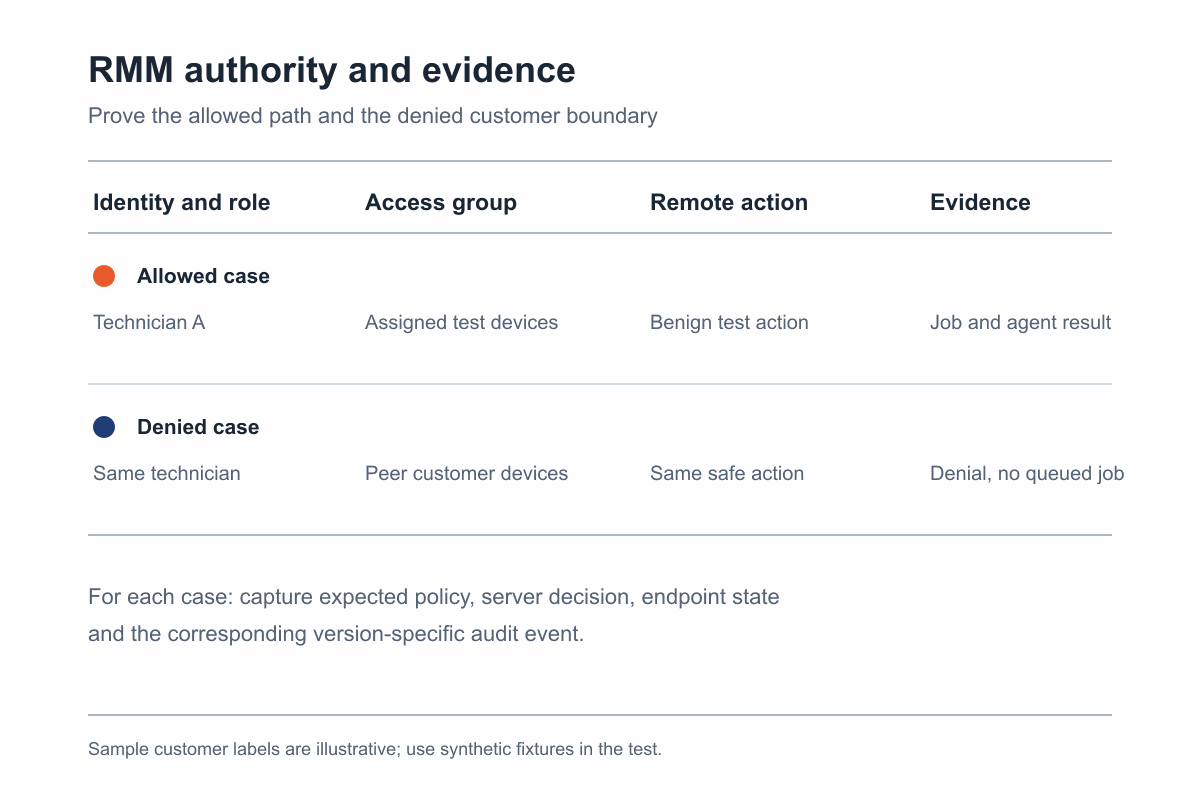
Figure 1: Editorial map of effective RMM authority and evidence, based on vendor role, access-group and audit concepts. Sources: N-able, Create an Access Group; N-able, Audit Events.
Ask the provider to exercise a safe containment decision where useful. Could the RMM owner disable a compromised technician identity, revoke a test token, stop a queued benign job, isolate a test device or remove an unauthorized agent registration? The scope should identify which actions are permissible and who executes them. A red-team style defender exercise may be purchased separately if the buyer wants blind detection and response. A platform pentest can still check whether the necessary records and control owners exist without pretending to be a full incident-response drill.
Set safe rules of engagement for a high-authority platform
RMM tests can have a wider operational blast radius than their target count suggests. The authorization should name the exact instance, customer or business-unit containers, test identities, device sample, agent actions, API accounts, allowed source networks, maintenance windows, prohibited changes and stop authority. The provider should be able to pause immediately if a test action appears on the wrong device or customer. A central test account should not be given unrestricted production authority simply to make the assessment easier.
Create a dedicated nonproduction customer or device group when possible. Its controls should resemble the relevant production role and policy structure, but the devices should be disposable and clearly marked. If the central platform cannot reproduce a production permission model safely, a carefully authorized production test with benign actions may be necessary. In that case, require preapproved target identifiers, short action windows and a real-time contact. The report should distinguish a tested production decision from one inferred from a test group.
Keep evidence free of real customer content. Use synthetic device names, marker files and harmless scripts. Avoid collecting arbitrary command output, screenshots of customer desktops, secret values or full agent tokens in a broadly distributed report. If the test reveals sensitive data unexpectedly, stop the path and use the agreed private incident channel. The public blog and any marketing sample should describe methods, not expose a customer's topology, tickets or device inventory.
The assessment should also have a rollback plan. A created test user, access group, API token, script, scheduled task or agent enrollment must be removed or returned to its prior state. Ask the provider to list artifacts created during the test and confirm their disposition. A retest should not reuse an untracked elevated account or stale task simply because it remains convenient.
Compare proposals by the authority boundaries they prove
Send bidders the same scope worksheet. Ask them to identify each assumption, sample and exclusion before comparing price. A quote for an “RMM pentest” that only scans the external login page is different from one that follows technician permissions through a managed endpoint and SOC evidence. The buyer should be able to tell which decision each line item answers.
Scope item | Buyer provides | Evidence to require |
|---|---|---|
Instance and deployment | Product, version, hosting and portal inventory | Exact authorized surfaces and exclusions |
Technician identity | Roles, group assignments and expected support tasks | Effective allowed and denied actions |
Customer and device boundary | Synthetic peer customers, sites or device groups | Cross-boundary negative cases and endpoint state |
Agent and script authority | Disposable devices and permitted benign actions | Enrollment, queue, execution and cleanup trace |
API integrations | API-only identities and owned integrations | Token scope and server-side authorization result |
Logs and response | Event destinations, SOC owner and retention | Event-to-case trace and gap owner |
Retest | Fix owner, target version and same test fixtures | Repeat decision and updated finding status |
Ask whether the quote includes authenticated console testing, configuration review, API authorization, agent enrollment, a sampled endpoint action, log validation and retesting. Some providers may be able to test one of these well but not all. Ask for a redacted sample finding that distinguishes a displayed button from a server decision and an endpoint effect. Ask which parts need a maintenance window and what happens if platform access or a test device is unavailable on the scheduled date. Price should reflect the distinct customer boundaries and permission models, not only the number of endpoint agents.
The buyer should also separate this service from product-vulnerability research. A vendor software flaw may be found during a platform assessment, but a bounded buyer engagement usually tests the deployed configuration, roles, reachable surfaces and authorized action paths. It does not promise exhaustive research of every component in the RMM vendor's code. Conversely, a current patch level does not prove that an overprivileged technician or integration cannot act across customers.
Turn results into a durable RMM control
Give each finding a specific owner: identity team for authentication or federation, RMM administrator for roles and groups, endpoint team for agent policy, integration owner for API tokens, SOC for collection and detection, or MSP governance for cross-customer rules. The report should show which boundary failed and what change would remove it. A generic instruction to “apply least privilege” is inadequate if the observed path came from a parent access group, a combined role, an integration token or a scheduled task that ignored the intended device limit.
Retest the same safe condition after remediation. If a technician reached the wrong customer group, use the same role and comparable synthetic target. If a script action was permitted on the wrong device, confirm both the denial on the forbidden target and the continuing authorized support action on the right target. If a log was missing, verify the event in the intended destination and, where in scope, a SOC case. Record the platform release, policy state and test date so the result is not confused with an earlier configuration.
CISA's call to inventory authorized RMM tools and review unusual execution remains relevant after the platform pentest. A strong result can become a recurring control: review technician and API identities, customer group inheritance, script permissions, agent enrollment, new integrations and event coverage after material changes. A repeat assessment should target changed boundaries and previously demonstrated paths, while a periodic broader baseline covers the estate that did not change visibly.
How Stingrai fits the RMM assessment
Stingrai's internal and external network penetration testing is human-led, includes remote management services where scoped, and provides confirmed findings with remediation and retesting. An RMM engagement can combine external reachability with authenticated, role-based tests of the management plane and controlled downstream action on approved devices. The proposal should state whether customer separation, API integrations, agent enrollment and SOC evidence are included, because none follows automatically from an external network test.
Stingrai's Snipe agent is for web applications and associated APIs. It is not the operator of an end-to-end RMM, network or endpoint assessment. If a buyer also wants the RMM portal assessed as a standalone web application, that scope can be identified separately, but the technician-to-agent authority chain and managed-device evidence remain human-led network work. The resulting report can support a security or compliance program by documenting the tested boundary, finding, fix owner and retest, while leaving the buyer's broader governance decision with its own team.
Frequently Asked Questions
What should an RMM platform penetration test include?
It should include the approved platform instance, technician and API identities, effective roles, customer and device groups, remote-control and scripting authority, agent enrollment where relevant, safe endpoint outcomes and audit evidence. Use both permitted and denied cases across the priority customer boundaries. The report should identify the deployed version, sampled devices, exclusions and retest conditions.
Is scanning the RMM login page enough?
No. An external scan can identify reachable services and some software weaknesses, but it cannot prove what an authenticated technician or API identity may do to a customer device. The assessment should include controlled role and scope tests with harmless downstream evidence when the buyer's concern is management authority.
How do we test cross-customer separation safely?
Use synthetic peer customers or device groups with test identities whose intended access is documented. Confirm that an authorized action succeeds in the assigned group and a comparable read or action is denied in the peer group, including any queued job and endpoint result. If production policy differs from the synthetic setup, state that limit explicitly.
Should script creation and script execution be tested separately?
Yes. Platforms can assign different permissions to managing a script library, executing a script and scheduling a task. Test each function that matters using benign markers on approved devices. Also check whether a created or queued action persists after the initiating user's access changes.
Do RMM API integrations need their own test identities?
Yes, when integrations are in scope. An API-only or service identity may have different role, customer and device reach from a human technician. Give the provider an authorized test identity and a synthetic target, then ask for an allowed and denied API decision with the corresponding platform record.
What log evidence should the provider return?
Ask for the console or API event, technician or service identity, customer and device identifier, job or session identifier, endpoint result and the event received by the SOC or audit destination. Verify that the deployed product version actually emits each expected event. A missing event and an untriaged event require different fixes.
Can the test run in production without disrupting support?
Yes, if the owner authorizes exact targets, identities, benign actions, time windows, cleanup and a live stop contact. A disposable device or test customer is preferable for state-changing paths. The report should mark which conclusions came from production and which came from a representative test group.
Does Snipe test the RMM agent and managed endpoints?
No. Snipe is Stingrai's autonomous agent for web applications and associated APIs. The RMM console-to-agent and endpoint authority chain is human-led network scope. A separate web application assessment can be quoted if the buyer also wants deep portal and associated API testing.



