





NetScaler Gateway documentation distinguishes authentication, which allows a user to sign in, from authorization, which defines the internal resources that user can reach. A penetration test that confirms only a successful login leaves the second decision unanswered. An enterprise buyer also needs to know whether the public Gateway path can reach the appliance's management interfaces.
Quick answer. A NetScaler Gateway penetration test should cover the public Gateway virtual server, the intended sign-in and session policies, post-login access to selected allowed and denied internal resources, and the separation of public and user networks from NSIP or other management addresses. Stingrai's human-led internal and external network penetration testing can validate these boundaries with approved identities and non-disruptive probes. The quote should name each virtual server, identity class and management path so the report can show what was actually tested.
This guide is for buyers of a scoped Gateway assessment after a deployment, identity change, network redesign or patch cycle. It is not a list of current CVEs. The existing NetScaler zero-day checklist covers a 2026 incident and the related patch and compromise response. A penetration test should consider current advisories, but its durable question is whether the organization's Gateway configuration and connected network enforce the intended access boundary today.
Define what the Gateway must protect
Start with a small set of business-relevant access statements. A contractor identity may be allowed to reach one published application but not a file share or management subnet. A staff identity may use a full VPN tunnel to reach a defined service set. An administrator may need a separate management path that is unavailable from the public Gateway VIP and ordinary VPN session. These statements identify the source, destination and expected decision. The provider can then validate them safely rather than reporting a list of generic settings.
The starting scope should include the Gateway virtual servers, public names and addresses, tenant or domain identity sources, user groups, session policies, authorization policies, internal application or network destinations, NSIP and any SNIP with management access, and relevant logging destinations. The buyer need not publish this topology. It belongs in the confidential statement of work and evidence packet. Any managed service, shared infrastructure or third-party backend needs its owner's authorization before it is tested.
The quote should specify external and authenticated phases. The external phase assesses what an unauthenticated internet user can reach on the authorized Gateway and management surfaces. The authenticated phase uses approved low-privilege and privileged test identities to validate session and resource boundaries. One does not replace the other. A black-box scan can identify an exposed login page or management interface, but it cannot show whether a contractor session can reach an internal service after sign-in.
Separate Gateway testing from adjacent assessments
The broader enterprise remote-access assessment compares multiple technologies and access paths. This guide narrows the question to NetScaler Gateway's own authentication, authorization and management boundary. The Citrix VDI breakout test begins after an authorized desktop session and evaluates that session's isolation. A Gateway assessment may verify that a published desktop is reachable only by the correct group, but it should not claim to have tested the desktop's internal breakout controls unless that is separately scoped.
The distinction also prevents a patch-driven false sense of completion. Applying a fixed NetScaler build is necessary when an advisory affects the estate, yet a patched appliance can still have a broad authorization policy, a user group with unexpected access or an exposed management address. Conversely, an internet-facing Gateway VIP is an intended service, not automatically a finding. The test must record an actual access decision and business impact.
Test authentication as an access decision
NetScaler Gateway supports policy-based authentication with several backends and factors. NetScaler's authentication overview says policies can be bound globally or to a virtual server and can be conditional on the user's source network. A buyer should ask the provider to identify the effective path for each test identity and virtual server. The test should show whether the intended factor and group assignment applied, not merely whether a generic sign-in page existed.
Use approved test accounts with known group membership. A normal employee, contractor and administrator are useful only if they represent different real policy decisions. The white team should define expected outcomes before the provider tests them. For example, an employee account might be allowed to authenticate under a defined factor path, while a contractor account without an assigned group should be denied or limited. The report should capture the policy decision and the relevant Gateway log, with sensitive identifiers redacted.
The provider should be careful about authentication test volume. Lockouts, rate limits and upstream identity-provider controls are operationally important, but deliberate password spraying or account lockout testing requires a specific approved window and test identities. A standard Gateway pentest can validate the intended authentication flow without high-volume attempts against staff accounts. If the buyer wants a separate identity resilience exercise, it should be written and priced separately.
Authentication policy precedence can matter when several policies are bound. NetScaler documents policy priority and multiple authentication servers. The buyer should request evidence of the effective policy for the tested user and VIP. A report that simply lists configured policies may miss which one actually handled the sign-in. A successful test login under the wrong policy can be more revealing than a missing policy in a configuration export.
Treat session policy as a post-login decision
NetScaler session policies are evaluated after authentication and can control connection settings such as client mode, split tunneling, clientless access and private network access. This makes the authenticated path more than a yes or no login. The provider should record which session policy the identity received and whether that mode matches the intended resource exposure.
A clientless user and a full VPN user may have very different reachable surfaces. NetScaler's clientless access documentation explains that clientless access can be enabled globally or through session policy for users, groups or virtual servers. The scope should name the modes that exist in the estate and test each relevant group. Do not infer that one successful browser session says anything about the VPN tunnel path, or vice versa.
The test should avoid altering live user experience merely to check a setting. The provider can use assigned test users, configuration review and safe target connections. A session-policy mismatch should be shown through the resulting access mode and a specific resource decision. If the intended mode cannot be exercised because the required client or test device is unavailable, mark that boundary untested rather than claiming it is protected.
Prove what an authenticated session can reach
NetScaler's authorization guide states that authorization defines the internal network resources a user can access and describes a default deny posture with explicit policies for allowed resources. The buyer should choose a small matrix of allowed and denied destinations for each relevant group. The provider should test both. A successful login with no target check cannot prove least privilege.
An authorization result should include the user or group, Gateway VIP, session mode, destination address or application, expected decision, observed result and the policy thought to enforce it. If the destination is unavailable for an unrelated reason, the provider should not count the timeout as a Gateway denial. A known allowed control destination helps distinguish an inaccessible backend from effective authorization. Where possible, confirm the corresponding Gateway or downstream log.
Group extraction can change the result. NetScaler documents that Gateway checks group information after authentication when applying authorization. A test account that belongs to multiple groups may inherit broader access than the buyer expected. The report should show the effective group and policy decision for the tested identity, with sensitive group names handled in the private appendix. The buyer should avoid equating a policy configured for one group with proof of the actual session's result.
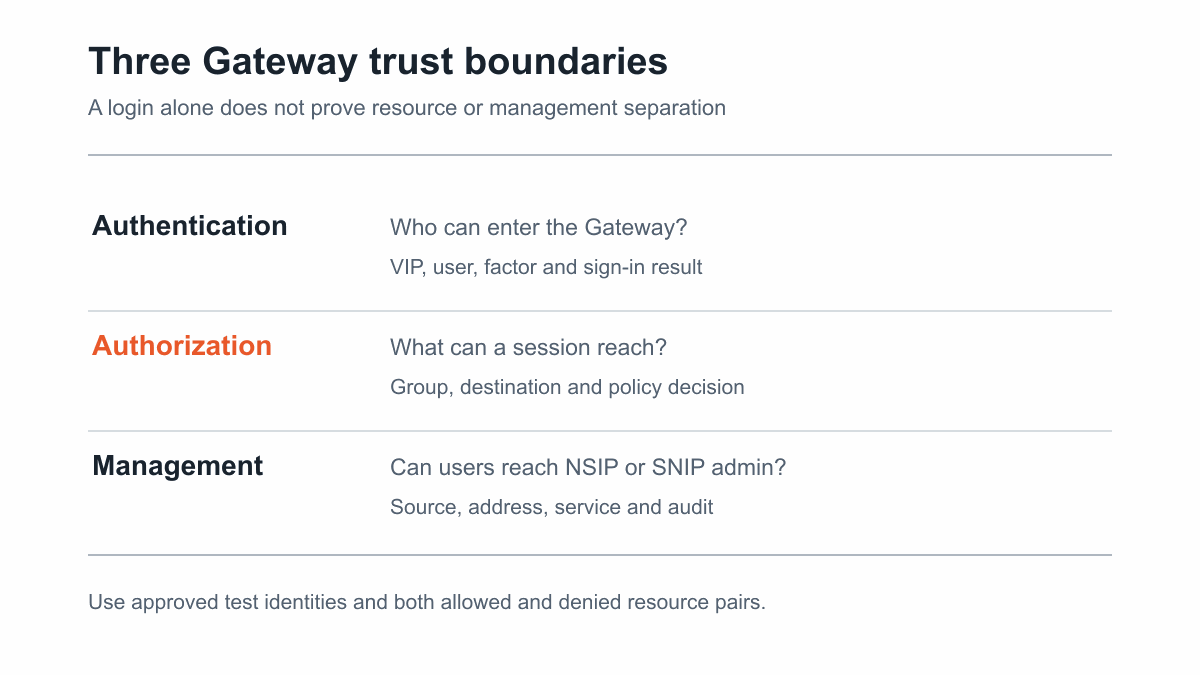
Figure 1: Three Gateway decisions to validate with separate evidence. Source: NetScaler, Authentication and Authorization.
The resource matrix should be risk-led. Choose an application that the group needs, a restricted service it must not reach, and a management destination that should be inaccessible from the user session. If the Gateway serves several groups or virtual servers, sample the combinations that represent different policies and business data. A test of one staff user does not establish the contractor path. A test of one internal service does not establish the whole network. The proposal should say how the sample was chosen and what remains out of scope.
Test management-plane separation explicitly
NetScaler's management and data-plane documentation identifies NSIP as a management address and VIP as the address that receives client traffic. An enterprise test should therefore inventory the NSIP and any SNIP configured for management access, not assume that checking the public Gateway VIP covers the administrative surface. The buyer should provide the expected management access path, such as a restricted network or jump host, and the provider should test reachability from approved internet, user-VPN and admin source points.
NetScaler's application access controls guide says management access on NSIP is enabled by default and can be controlled with ACLs. This does not mean every NSIP is publicly reachable. It means the test should verify the actual network restrictions. A management login prompt exposed to an ordinary VPN user is a distinct observation from a Gateway application being reachable. The provider should record the source, destination and service response, then validate the intended ACL or upstream firewall boundary with the network owner.
Management testing should be low impact. A read-only administrator account can show whether the expected role is enforced without changing a live Gateway configuration. An unauthorized role test can attempt a harmless view or safe action and record the denial. Changes to authentication, session or authorization policies on a production Gateway can disconnect users or expose resources; those changes should be excluded unless a dedicated test object, maintenance window and rollback plan are approved. A report that proves broad authority by making a risky live change is not better than a safe, defensible proof.
The management boundary may include high availability peers, disaster recovery appliances, virtual instances and a management console. The buyer should list the components actually owned and in use. If one peer is excluded, the report should not make an estate-wide claim. The test should also distinguish management access from backend communication and ordinary SNIP behavior. A SNIP can serve data-plane purposes; the question is whether administrative services were enabled and reachable there under the estate's configuration.
Keep patch and compromise review in the right workstream
For the 2026 NetScaler vulnerabilities, the incident checklist explains fixed builds and compromise checks. A Gateway pentest should confirm that the asset inventory and current advisory status are understood, but it should not represent a penetration test as a substitute for incident response when compromise is suspected. If the buyer has indicators of prior compromise, handle preservation and investigation separately before intrusive testing. A patched appliance can still have a permissive resource policy, and a secure resource policy does not erase evidence of a past intrusion.
The durable procurement question is whether the current boundary works. A finding should identify an unintended management reach, a wrong authentication path or an excess post-login resource reach. It should include the exact tested identity and destination, the policy decision and the business consequence. The provider can then retest after the team changes ACLs, policy bindings or resource authorization. Version status is supporting context, not the entire report.
Agree an evidence and logging plan before testing
NetScaler Gateway auditing documentation describes timestamped event history and local or syslog output. The buyer should ask where Gateway authentication, session, authorization and administrative events are collected in its particular deployment. Not every event will appear in the same record or at the same detail level. The provider and white team should agree which Gateway, identity-provider, firewall and SOC records will be preserved for the selected test cases.
For an authentication case, preserve the test account, VIP, factor outcome, identity-provider record and Gateway log reference. For a resource case, preserve the authenticated session, effective group, destination, allowed or denied result and relevant policy or firewall evidence. For a management case, preserve the source, NSIP or SNIP, service reachability, administrator role and audit event if an approved action is performed. A raw screenshot of a login page or timeout cannot answer all these questions.
The report should distinguish control failures from visibility failures. If a restricted user reaches a protected internal service, the authorization or network boundary failed for that path. If the service remained blocked but the SOC never saw a high-value management attempt, the access boundary may have held while monitoring needs work. If an event was generated but not forwarded, that is collection. If forwarded but dismissed, that is triage. The buyer can then assign the right fix owner rather than treating every observation as a Gateway software flaw.
The white team should retain a private timestamped test log and compare it with operations after the engagement. This is especially useful when identity, Gateway and backend logs use different time sources or retention policies. The provider should redact account names and internal addresses in any executive distribution. The full evidence should be restricted to owners who need it for remediation and retesting. A public case study should never disclose a client's remote-access topology.
Write rules of engagement for a live remote-access service
The authorization should name the legal owner, public Gateway names and VIPs, NSIP and management ranges, HA or DR instances, identity-provider test accounts, groups, user devices, resource destinations, testing window, permitted traffic, exclusions, stop authority and emergency contacts. It should state whether the provider may use full VPN, clientless access, published applications and management login, or only a subset. The buyer should obtain separate authorization for third-party managed infrastructure and backend applications.
Stop rules should protect users. Unexpected authentication outages, widespread lockouts, failover, service degradation, access to real restricted content or evidence of a real intrusion should pause the test. The provider should have a live contact route to the Gateway owner and network operations team. Test accounts should be recognizable to a small white team even if broader defenders are not told the exact timing. A production remote-access service cannot be treated like a disposable lab.
Prohibit unapproved password spraying, denial of service, configuration changes, broad internal scanning and access to customer records. Safe tests can use a small set of test identities and synthetic or designated internal destinations. The provider can prove an authorization boundary with non-destructive connections and logs. If a deeper exploit demonstration would materially increase risk, require a separate written change and rollback decision. The purpose is to produce usable evidence, not to maximize impact during the test.
If the buyer also wants to assess SOC detection or simulate an assumed breach after Gateway access, that should be a named red-team workstream. A standard penetration test can record whether relevant logs appeared, but a covert response exercise needs its own objectives, rules and defender-awareness mode. Do not combine the two without saying which conclusion each phase supports.
Compare quotes with a Gateway-specific matrix
Two quotes both labeled "NetScaler pentest" may have very different coverage. One may scan a public VIP and check versions. Another may test several authenticated roles, resource pairs, management addresses and logging. Compare the decision each proposal can support and the evidence it will deliver. Use the matrix below in the request for proposal.
Workstream | Buyer input | Proof to require |
|---|---|---|
External Gateway | Public VIPs, hostnames and authorized ranges | Exposed services and pre-login access result |
Authentication | Test identities, expected factors and groups | Effective policy and sign-in decision |
Session mode | Clientless, full VPN or published app groups | Actual mode and inherited session policy |
Internal resources | Allowed and denied destination pairs | Reachability, policy and backend correlation |
Management separation | NSIP, management SNIPs and source networks | Reachability, role and administrative audit |
Logging | Gateway, identity provider and SOC destinations | Timestamped source and forwarded evidence |
Retest | Changed policy or access boundary | Same identity and destination outcome |
Ask the bidder to show a redacted sample finding where an authenticated user reached a resource outside its intended set, or where the management interface was reachable from an unauthorized source. It should identify the policy or network rule that allowed the path and a safe way to verify the fix. A scanner report with a CVE table may supplement this evidence but cannot replace it. Ask whether a named tester will coordinate with the Gateway administrator when policy precedence is ambiguous.
The number of virtual servers is only one effort driver. Distinct identity providers, authentication factors, user groups, session modes, internal network destinations, HA peers and management networks all affect the scope. An appliance serving one clientless application is different from a Gateway providing full VPN to several groups. The provider should state what is included, what is sampled and what requires another test. If an MSP controls the configuration, the quote should include coordination and access assumptions.
One-time testing can answer a deployment, migration or audit question. A continuous program can repeat selected authentication and resource paths as policies and users change. Both models need a stable baseline: the same identity class, VIP, destination and expected decision. A later test using a different group is useful, but it is a new sample rather than proof that the original finding was fixed.
Use the report to change the right boundary
The debrief should bring together the Gateway administrator, identity owner, network owner, application owner and SOC. Review the expected access decision first. Then show the actual sign-in, session, resource or management result and the logs that explain it. Ask whether a broad group membership, policy priority, missing authorization rule, exposed management interface or downstream firewall caused the observation. Assign each fix to the owner of that control.
Retest with the same approved identity and destination after remediation. Confirm that permitted access still works while the denied path is now blocked. If the change affects management access, verify that administrators still have an approved route. Record the effective policy and log evidence. A fix that closes the test path but strands legitimate users or administrators is not complete.
Stingrai's testing can produce documented evidence for SOC 2, ISO 27001 and PCI DSS programs when the organization's compliance plan calls for independent testing and remediation. The report should give the asset boundary, tested roles, findings and retest evidence. It should not imply that a single Gateway assessment covers every internal application or all remote-access products.
How Stingrai can scope the engagement
Stingrai is a global CREST-accredited penetration testing services company founded in Toronto, Canada in 2021, trusted by companies from startups to enterprises to meet audit requirements for SOC 2, ISO 27001, CMMC, PCI DSS and HIPAA. OSCE³, OSWE, OSEP, CREST CRT certified penetration testers, who are also world-class security researchers and bug bounty hunters. Choose from fully human-led or hybrid (AI agents plus human penetration testers) engagements across web, API, mobile, AI and LLM, cloud, network, Active Directory and social engineering penetration tests and red team engagements.
For NetScaler Gateway, Stingrai's network penetration testing is human-led. The scope can include the external Gateway, approved authenticated roles, post-login resource reachability and management-plane separation. The proposal should list the VIPs, NSIP and management SNIPs, identity classes, allowed and denied resource pairs, evidence plan and retest. Stingrai offers one-time assessments and continuous programs; choose the cadence that matches policy changes and the decision you need to make. Bring the Gateway and identity inventory to Get a Quote.
Frequently Asked Questions
What should a NetScaler Gateway penetration test cover?
A NetScaler Gateway penetration test should cover the public virtual server, effective authentication and session policies, post-login authorization to selected allowed and denied resources, and management access to NSIP or management-enabled SNIPs. The report should show the actual decision for approved test identities and a repeatable remediation path.
Is a successful Gateway login proof that internal access is properly restricted?
No. Authentication determines whether a user signs in; authorization determines which internal resources that session can reach. The test should use approved identities and a matrix of permitted and denied destinations, then record the effective group, policy and connection result.
Why test NSIP and SNIP separately from the Gateway VIP?
NetScaler identifies NSIP as a management address, while the Gateway VIP receives client traffic. A SNIP may also have management access enabled. Testing only the public VIP can miss an administrative interface reachable from an unintended internet or user-network source. The scope should name the management addresses and permitted admin path.
Does patching the 2026 NetScaler CVEs replace a pentest?
No. Patching addresses affected software versions, while a pentest validates the current authentication, authorization, reachable-resource and management boundaries. If compromise is suspected, investigate and preserve evidence separately. A patched appliance may still have an access policy that permits too much.
Can testers safely check internal resource authorization?
Yes. Use approved test identities, designated internal destinations and modest non-destructive connection attempts. Include one allowed control destination and one or more denied destinations for each relevant group. Correlate timeouts or denials with Gateway and backend evidence before assigning the cause.
What logs should a buyer request?
Request Gateway authentication, session, authorization and administrative events where available, plus identity-provider, firewall and SOC records for the selected test cases. The report should show synchronized timestamps and distinguish an access-control failure from an event that was not collected, alerted or escalated.
Is VDI breakout included in a Gateway assessment?
Only if the statement of work explicitly includes post-login desktop or application-session isolation. A Gateway test can verify that the right user reaches the published resource. Breaking out of the VDI session is a different objective with different authorization and evidence.
Does Stingrai use Snipe for NetScaler Gateway testing?
No. Stingrai's NetScaler Gateway and network penetration tests are human-led. Snipe is Stingrai's autonomous agent for web applications and associated APIs; its specialist sub-agent tests AI and LLM applications, including MCP servers, alongside named penetration testers. The Gateway test is scoped and operated by human testers.
Related reading
Talk to Stingrai
Bring the Gateway virtual servers, test groups, internal resource matrix and management access map to Get a Quote, or book a free discovery call to shape a human-led NetScaler Gateway penetration test.



