Ransomware readiness is a set of testable business and security outcomes. NIST IR 8374 Rev. 1, finalized in June 2026, organizes those outcomes around protection, detection, response and recovery. A buyer can use that structure to commission an offensive test that produces evidence instead of a generic declaration that the organization is ready.
Quick answer. A ransomware readiness assessment should define the critical service, the authorized starting point, the boundary the tester may approach, the defender signal expected, and the proof required to close a finding. Commission a penetration test to validate reachable paths, a red team or purple team exercise to measure detection and response, and a separate owner-led restoration exercise to prove that backups and recovery plans work. Stingrai can deliver the human-led penetration testing and adversary simulation portions within a written scope and rules of engagement.
A ransomware-focused engagement is useful when a security leader needs to answer a concrete question: can an exposed service or an assumed-breach account reach privileged identity, a protected data store, a backup control plane, or another critical business dependency? The answer has to show the route tested and where it stopped. It should also show what the security team observed. A report that lists unpatched systems but never examines a path to a business objective answers a different question.
This guide provides a buyer-authored evidence matrix. It maps the NIST ransomware profile and CISA's StopRansomware Guide to proposed acceptance tests. The test cases and pass criteria here are editorial examples for contracting. They are not mandated test procedures in either publication, and the owner must adapt them to its environment and risk tolerance.
What the assessment should answer
The phrase ransomware readiness assessment describes several different services. A control review asks whether policies, asset inventories, recovery plans and configurations exist. A vulnerability scan identifies known exposures. A penetration test validates whether weaknesses can be combined within an approved boundary. A red team exercise tests whether the organization detects and responds to a realistic objective. A restoration exercise tests whether systems and data can be brought back into service. No single one proves all the others.
NIST SP 800-115 describes penetration testing as technical security testing that can examine defender detection and response, but it also stresses planning and operational risk. In a ransomware-focused scope, the tester should demonstrate a bounded precursor path, such as an unauthorized route from a low-privilege identity toward a protected system. The engagement need not encrypt files or interrupt a live service to establish that a control failed.
Buyer question | Best evidence-producing activity | What it can establish | What it cannot establish alone |
|---|---|---|---|
Is the internet-facing entry route exposed? | External network and application penetration test | Reachable weakness, validated impact and exact affected asset | Whether internal responders would contain a later event |
Can an ordinary account cross a privilege boundary? | Internal or assumed-breach penetration test | Authorized path, identity permissions and control result | Every possible route across the estate |
Will the SOC see and investigate a bounded action? | Purple team or red team exercise | Timestamped alert, analyst decision and containment action | How a backup will restore a service |
Can a critical service be restored? | Owner-led backup and recovery exercise | Restoration result, integrity checks and elapsed time under that plan | Whether a separate initial access path exists |
Is the full program ready? | Combined evidence review | Gaps and ownership across prevention, detection, response and recovery | A universal guarantee against future ransomware |
CISA's guide calls for offline encrypted backups and regular tests of their availability and integrity. It also calls for incident response plans, monitoring, MFA and segmentation. Those are distinct control families. The buyer should assign each to the activity that can prove it, rather than ask a pentest vendor to attest to a restore it never operated. CISA's response checklist also prioritizes impact assessment, isolation, restore triage and review of detection logs during an incident.
Start with a critical business service, not an asset count
A host count is a price input. A business service is the reason to test. Define one service whose loss would force a significant operational decision, then map its identities, applications, network paths, data stores, administrators and recovery dependencies. This map turns a broad wish to be ransomware-ready into a testable objective.
For a synthetic payment operations example, the service might depend on a customer portal, an identity tenant, a database, a file exchange, an administrator workstation and a backup platform. The names are fictional. The buyer would identify which production components may be touched, which should be represented in a lab, and which are excluded. A supplier should not infer that all assets sharing a network range are authorized targets.
The first scoping document should name the service owner, technical owner, incident commander, SOC contact and emergency stop authority. It should define the testing window and the maximum acceptable effect on production. NIST SP 800-115's rules of engagement template includes boundaries, expected outcomes, assumptions, risks, named personnel and scheduling. That is the right level of precision for this work.
A good objective is written as a statement that can be rejected with evidence: "An ordinary support account cannot obtain backup-administration capability through the approved identity path." A weak objective is "test ransomware readiness." The former defines a starting privilege, a protected capability and a proof point. The latter leaves the vendor to choose a convenient demo.
Choose the starting condition deliberately
An external test starts without privileged access and examines exposed routes. An assumed-breach test starts with an approved low-privilege identity or workstation position, allowing more time on internal boundaries. A red team may pursue a business objective with limited defender awareness; a purple team can expose the scenario to defenders in stages and tune detections. These modes answer different questions and need separate commercial line items if the buyer wants each.
For a first ransomware readiness commission, an assumed-breach starting condition is often productive because it can test identity, segmentation and detection while avoiding an uncertain initial-access phase. That is a scoping judgment, not a claim that external routes are unimportant. If internet exposure is a concern, add a bounded external phase. If social engineering is included, specify audience, channels, deconfliction and what happens when a user interacts. A phishing simulation should never be quietly inserted into a network pentest.
State protected boundaries
The protected boundaries may include privileged identity, backup administration, hypervisor management, cloud organization administration, sensitive data, and access between user and server segments. The buyer should decide which boundary is in scope and what observation is sufficient. A tester may prove access to a harmless canary or a read-only view while the true production action remains prohibited. This gives a defensible finding without changing backups, deleting snapshots, moving real data or interrupting a service.
CISA recommends segmentation as a way to contain an intrusion and limit lateral movement, while warning that inconsistent practice can defeat it. The test therefore needs a specific allowed path and denied path, plus the firewall, identity or service telemetry that confirms the result. A network diagram alone is not proof that a boundary works. See Stingrai's network penetration testing service for the scope of internal and external testing, and the separate red teaming service for objective-led exercises.
Source-mapped ransomware readiness evidence matrix
The table below is an original contract worksheet. Replace each bracketed buyer field before requesting quotes. The source column points to the control outcome that motivates the question; the test, telemetry and pass criteria are proposed buyer acceptance terms. They are not instructions to deploy malware or run a disruptive production simulation.
Buyer objective and source | Authorized safe test mode | Defender telemetry to preserve | Pass or fail proof | Retest evidence |
|---|---|---|---|---|
External entry: Can an approved internet-facing route reach the service? NIST IR 8374, Identify and Protect | Bounded validation against named public hosts or application roles; stop before persistence or data access | Perimeter logs, application access logs, identity events and alert timeline | Exact asset, authorized account or request class, reachability result, and why the boundary held or failed | Same path retested after fix, with new configuration and event IDs |
Identity and privilege: Can a low-privilege identity obtain a protected capability? PR.AA-03 and PR.AA-05 | Use buyer-issued test accounts and harmless proof of permission; no real credential theft | Sign-in logs, privilege-change records, identity alerts and analyst notes | Starting role, effective permission, target capability and control decision | Retest with same role and target, showing denied access and logs |
Lateral boundary: Can the approved user or server segment reach a protected segment? CISA segmentation guidance | Test only agreed protocols and targets; do not enumerate operational technology or safety systems without separate authority | Firewall flow records, endpoint telemetry, network alert and rule-change record | Allowed and denied path evidence tied to named source and destination | Repeat the approved path after rule correction, record policy version |
Endpoint visibility: Does the SOC notice the approved suspicious activity before the target objective? DE.CM-09 and DE.AE-02 | Benign simulation agreed with the EDR owner; no encryption or destructive payload | Endpoint event, alert, triage ticket and analyst decision | Observed action, sensor status, alert time and disposition | Repeat same benign signal and show improved handling |
Directory monitoring: Are unusual identity actions investigated? DE.CM-03 | Authorized identity path using test accounts; stop at approved proof point | Directory audit, identity provider event, SOC query and escalation record | Evidence that the event was logged, reviewed and escalated as agreed | Re-run same event and compare detection, triage and escalation |
Backup control plane: Can a low-privilege route administer or impair backups? PR.DS-11 | Permission and path review with canary object or read-only proof; no deletion, encryption or restore operation | Backup admin audit, IAM decision, protected-object log | Reachable management capability or explicit denial; owner confirms data was untouched | Retest the exact permission path after separation or policy change |
Response handoff: Can responders decide whether to isolate the synthetic affected asset? RS.MA-01; CISA response checklist | Tabletop or controlled purple-team inject; production isolation only by owner approval | Incident ticket, decision log, contact sequence and communications channel | Named decision maker, decision timestamp and rationale against the agreed playbook | Repeat tabletop inject and record revised decision path |
Recovery: Can the owner restore a clean service and verify backup integrity? PR.DS-11 and RC.RP-03 | Owner-led restore in an isolated environment; offensive tester may review evidence but does not operate production restoration | Backup job record, integrity check, restore log and service-owner sign-off | Successful or failed restore against buyer-defined service criteria | New restore exercise with the corrected backup or dependency |
The matrix deliberately separates tester proof from defender proof. A screenshot of a reachable administrative console may be sufficient to show a privilege boundary failed. It does not show the SOC detected the attempt. Conversely, an alert may fire even though the boundary held. A buyer who wants both results should require both event streams and a correlation key in the final report.
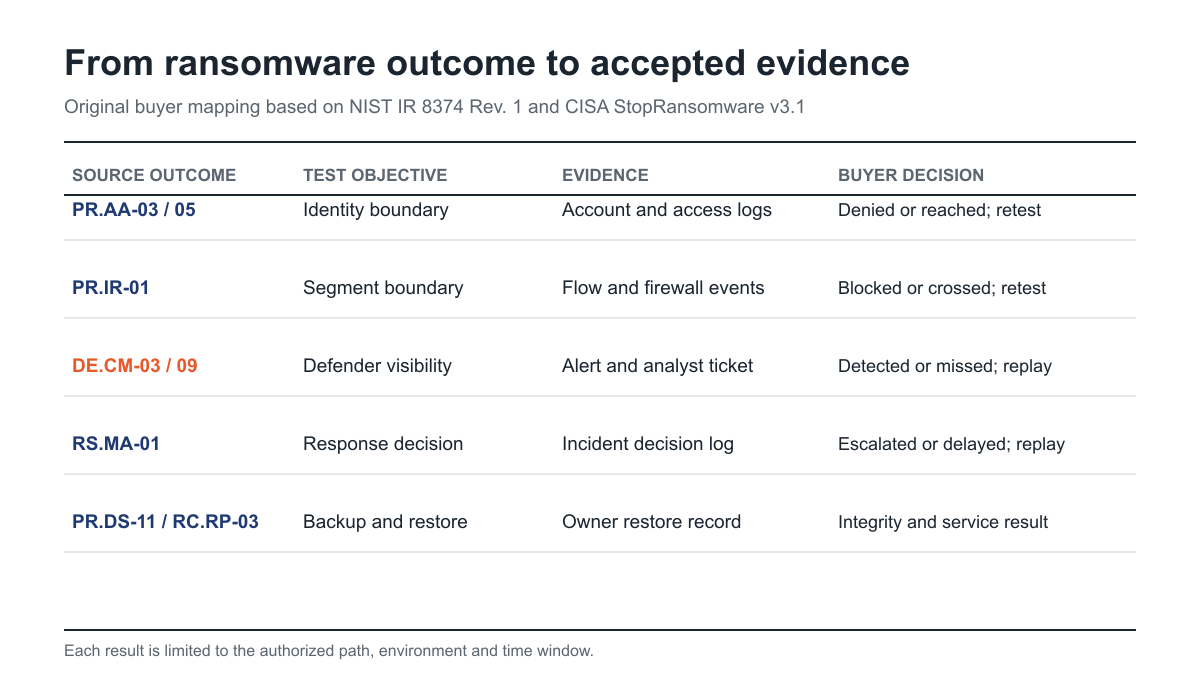
Figure 1: A buyer-designed evidence chain from protected access and monitoring outcomes to authorized tests, logs and retests. Sources: NIST IR 8374 Rev. 1 and CISA, October 2023 StopRansomware Guide.
Decide what may happen in production
The rules of engagement should state the furthest allowed effect, not merely say "non-destructive testing." That phrase can mean different things to a tester and an operations team. Set explicit boundaries for authentication, privilege proof, data access, file creation, outbound traffic, rate, persistence, social engineering and service change. Define which actions need a second approval at the moment of execution. If a boundary is too sensitive for a live demonstration, use a lab or tabletop and label the evidence accordingly.
The safe objective is to find and validate a path before it becomes an incident. In production, a tester can often show that a permission permits a dangerous operation without performing the operation. A canary file or synthetic record can show access control behavior without exposing customer data. A permission audit and narrow read-only query can show backup administrative reachability without touching recovery points. The report must say which evidence is direct observation and which is an inference from configuration, because the confidence is different.
CISA's response checklist describes isolation and restoration as incident actions. In an exercise, actual production isolation should remain with the service owner and incident commander. An offensive vendor can present a decision inject and observe the handoff; it should not disable a production network segment merely to make the scenario dramatic. NIST SP 800-115 warns that pentesting can affect targeted systems even with experienced testers, which is why written limits and stop controls matter.
Separate test evidence by confidence level
Use three labels in the report. Observed means the approved action produced a recorded outcome. Inferred means a configuration or permission strongly indicates a possible outcome, but the team stopped before demonstrating it. Untested means the path was outside scope, inaccessible, or deferred. This is an editorial acceptance convention for the buyer. It prevents a report from turning an inferred path into a claimed compromise or turning an untested control into a pass.
The same rule applies to backup resilience. An offensive tester may validate a path to backup administration, but only the recovery team can verify that a particular restore meets the organization's service criteria. NIST's current ransomware profile places backup protection and tested restoration in the recovery chain. The contract should name a separate owner for that evidence and a date for joining it to the penetration test findings.
Turn detection into a measurable result
"The SOC was notified" is too weak to accept. The buyer should specify the event that ought to be seen, the expected source of telemetry, who reviews it, how a true positive is classified, and what containment decision is expected. Use the actual alert and ticket identifiers in the final evidence packet. If a detection did not fire, record whether the sensor was absent, the log arrived late, the rule did not match, or the analyst did not escalate. Those are different corrective actions.
A red team can keep defenders blind to the precise timing and route, while an exercise controller still knows enough to prevent operational surprise. A purple team can replay the same bounded action with defenders and refine the signal. Neither mode needs to use real ransomware. The testing team can simulate precursor behavior with a benign, approved event and stop at the agreed proof point. This preserves the useful question: could defenders see and act on the path before the protected objective?
NIST IR 8374 Rev. 1 recommends monitoring directory services and other primary identity stores for compromise indicators. It also describes endpoint monitoring and adverse-event analysis. The buyer should use those outcomes to select telemetry, not to claim that one product or one alert guarantees protection. Detection quality depends on the monitored boundary, event coverage, triage process and timing the buyer sets.
Define pass criteria in the contract
For each objective, define what a pass would look like before testing starts. A prevention pass means the protected action was denied through the tested path and the denial is recorded. A detection pass means the agreed benign action generated the expected signal, was reviewed by the designated team, and led to the specified disposition within the buyer's own target window. A response pass means the designated authority made the documented isolation or escalation decision in the exercise. A recovery pass means an owner-led restore met a business service criterion. None of these implies that all untested paths pass.
Do not adopt a vendor's generic "detected in minutes" claim as the threshold. The buyer's target must fit its operating model and should be written in the statement of work. An overnight SOC with a different escalation design may need a different criterion from a continuously staffed operations center. The point is to record a target and compare evidence to it, not to import a universal stopwatch number.
A synthetic buyer example
Consider a fictional organization with an employee portal, an identity service, a records application and a separate backup administration tenant. The security leader asks whether an assumed-breach employee account could reach the records application or backup controls, and whether the SOC would identify the attempt. The engagement starts with a buyer-issued test account and a designated workstation. The records data is represented by synthetic objects. The backup platform is inspected through approved read-only permissions.
The scope allows testers to check identity role boundaries and a named network path, but prohibits changing backup jobs, moving real records, disabling accounts or interrupting systems. The SOC is not told the exact minute of the approved action; an exercise controller has the timetable and stop authority. A tester finds that one service account has a broader permission than intended. The tester records the policy, demonstrates access to a synthetic object and stops. The SOC ticket shows no corresponding identity alert. That is two findings: an authorization weakness and a detection gap. It is not a finding that backups were destroyed or that ransomware would certainly succeed.
The remediation owner narrows the service-account permission and adds monitoring for the permission path. During retest, the original low-privilege route is denied and the identity event reaches the SOC queue. The backup owner separately performs an isolated restore and records integrity checks. The final packet now contains a tested boundary, a tested detection and a tested recovery exercise, each with its own owner and limitations. The fictional example demonstrates how to write a result without claiming evidence the engagement never produced.
What to request in a quote and statement of work
Send every bidder the same service map and matrix. Require the proposal to identify each authorized start condition, target boundary, environment, test window, exclusions and named deliverable. Ask which objectives are a penetration test, which are red or purple team work, and which require the owner's own recovery team. Request effort and price by work package so a low bid cannot silently omit detection validation or retesting.
A useful statement of work should include a formal rules of engagement, technical contacts, an emergency stop procedure, log preservation and a method for correlating offensive actions with defender events. It should state whether the final report contains a route narrative, affected assets, severity rationale, observed versus inferred labels, remediation ownership and a retest result for each finding. The contract should also name who may approve a test beyond the original safe boundary. That approval belongs to the buyer; a general permission to test should not be stretched in the field.
Ask the bidder to explain how it will manage sensitive evidence. A screenshot may capture credentials, personal information or internal topology. The buyer should require redaction, an access-controlled delivery method, retention period and deletion process. Confirm whether a subcontractor will see the material and where the test team operates. These are procurement questions, not substitutes for the technical acceptance criteria.
Finally, ask how the bidder prices a repeat test after remediation. A retest is most useful when it reruns the original path with the same starting privilege and target boundary, then reports the new result. A generic scanner rerun may show a version change but not prove that an identity or segmentation path was closed. Stingrai's PTaaS delivery model posts confirmed findings during a one-time or continuous engagement and includes retesting, while the exact ransomware-focused network or red team scope is quoted for the engagement.
Evidence packet to accept at closeout
The buyer should be able to hand the following packet to its incident commander, technical owners and audit team without asking the tester to reconstruct events from memory:
An approved scope and rules of engagement with objective, environment, starting point, protected boundaries, exclusions, schedule and stop authority.
A route map for each objective, identifying observed, inferred and untested steps.
A finding record with affected asset, proof, business-service consequence, remediation owner and priority.
Defender event identifiers and timestamps where detection or response was in scope, with the analyst's disposition.
A record of deviations and stopped tests, including why the team stopped and whether a lab or tabletop substituted for production.
A retest record tied to each original finding and a clear status of fixed, still reachable or not retested.
A separate owner-led recovery result for backup availability, integrity and business-service restoration when recovery was included in the wider readiness program.
This packet is more useful than a single readiness score. A score collapses materially different outcomes: a working backup, an unmonitored privilege path, and an untested critical application could all hide behind the same average. The objective-level packet lets an executive see what has been demonstrated and what still needs a decision.
Where Stingrai fits
Stingrai Inc. is listed by CREST as accredited for penetration testing. For a ransomware-focused engagement, Stingrai can scope human-led internal and external network testing, Active Directory paths, social engineering where authorized, and red or purple team exercises against named business objectives. The company supports one-time annual tests and continuous programs through its PTaaS platform, which delivers findings as they are confirmed, provides direct tester collaboration and includes retests of fixed findings.
A buyer should ask Stingrai to price the chosen work packages against its own matrix and to identify the named testers, test boundary and evidence format in the proposal. Stingrai's offensive testing can produce evidence for a compliance program and an audit. The buyer's recovery and incident teams remain responsible for any production containment decision and for proving that a restore works. For a quote, provide the critical service map and your selected objectives, then use Get a Quote.
Frequently Asked Questions
What should a ransomware readiness assessment include?
It should include a named critical service, an approved attacker starting condition, protected boundaries, prevention and detection objectives, rules of engagement, evidence requirements, remediation owners and retests. Recovery evidence should come from an owner-led restoration exercise. NIST IR 8374 Rev. 1 provides the protection, detection, response and recovery outcome framework; the specific test matrix is set by the buyer.
Is a penetration test enough to prove ransomware readiness?
No. A penetration test can validate reachable weaknesses and bounded paths, while a red or purple team exercise can measure defender response and an owner-led restore can prove recovery. The final conclusion should identify which of those activities occurred and which objectives were untested.
Should a ransomware red team deploy real ransomware in production?
No. A buyer can validate precursor paths and detection using benign, authorized actions and can move disruptive behavior into a lab or tabletop. The rules of engagement should explicitly prohibit encryption, destruction and service interruption unless a separately approved environment and safety plan exist.
How do we measure whether the SOC detected the exercise?
Define the expected event, log source, analyst owner, disposition and buyer-set target window before the exercise. Accept timestamped alert and ticket evidence linked to the tester's action. Record whether a miss came from absent telemetry, a rule gap, delayed ingestion or an analyst decision.
What is the difference between a ransomware pentest and a red team exercise?
A ransomware-focused pentest asks whether named technical boundaries can be crossed within an approved scope. A red team exercise pursues an objective while measuring detection and response across people and process as well as technology. Both need written limits and an evidence plan.
Can a pentest vendor verify that backups will restore our service?
The vendor can test authorized access paths to backup administration and review evidence, but a restore result requires the backup and service owners to run an exercise in a suitable environment. The packet should preserve both results with separate owners and test dates.
What should appear in the final report?
The report should show the approved objective, starting privilege, tested route, exact proof, defender telemetry when in scope, business consequence, remediation recommendation, limits and retest result. It should distinguish observed outcomes from inferred and untested paths.
How should we compare ransomware readiness quotes?
Send bidders the same critical-service map and source-mapped objective matrix. Compare work packages for external testing, assumed-breach testing, red or purple team measurement, reporting and retesting. Reject a blended price that leaves the test boundary or deliverables unclear.
Related reading
References
NIST, Technical Guide to Information Security Testing and Assessment, SP 800-115, September 2008.
CISA, MS-ISAC, NSA and FBI, October 2023 StopRansomware Guide.
Talk to Stingrai
Share the critical service, authorized starting condition and evidence objectives with Stingrai. Get a Quote or book a free discovery call to scope a human-led penetration test or red team exercise.