Insider risk is an access problem and an organizational response problem at the same time. Carnegie Mellon University's Software Engineering Institute guide maps insider threat practices across HR, legal, physical security, data owners, IT and software engineering. A useful simulation therefore cannot end with a screenshot of a file that a test account could open. The buyer needs to know whether the access was appropriate, what signals appeared, who made the decision to investigate and whether a proportionate response followed.
Quick answer. An insider threat simulation is an authorized exercise that gives testers a defined employee, contractor or privileged starting position and a safe objective, then measures prevention, detection and response. Use test identities, synthetic records, documented consent and a small control group. Stingrai's human-led red teaming can examine the path through identity, network and data controls, then replay the evidence with the defenders.
This guide is for an enterprise CISO, insider risk lead or procurement owner who is buying a controlled exercise. It covers what to ask for, what to keep out of scope and how to decide whether the result justifies a control change. It is distinct from a prevalence article such as Insider Threat Statistics 2026, and from a generic assumed breach engagement. The former reports data; the latter starts from an internal foothold. This exercise specifically tests the authorization and organizational handling of activity by an apparently legitimate insider.
Decide which insider question the exercise will answer
"Test our insider threat program" is too broad to quote or evaluate. The organization should identify the protected thing, the kind of authorized access a person already has and the decision it wants to make after the exercise. A data owner might ask whether a contractor can reach a restricted project repository after a role change. An identity team might ask whether a privileged operator's unusual access is noticed and reviewed. A SOC might ask whether a suspicious but policy-permitted sequence receives human investigation rather than an automatic accusation.
The scenario should not assume that every insider is malicious. The same technical event can reflect a mistake, an unusual but legitimate project or deliberate misuse. A test can establish whether the control detects the event and whether the investigative workflow gathers context. It cannot infer intent from a log entry. This distinction matters because a poorly run simulation can produce a false sense of certainty about people. The report should state what occurred in the test and how the organization handled it, without asserting what a real employee would think or do.
There are several useful starting positions. An approved standard employee account can examine whether normal job access reaches a protected asset. A contractor identity can test time-bound access and offboarding assumptions. A privileged administrator account can test sensitive actions under explicit supervision. A departing-user scenario can examine whether a permitted account retains access at a pre-agreed transition point, but should use a synthetic test identity rather than a real employee's status. Each position requires a different control owner and different safety rules.
Buyer decision | Safe starting condition | Objective to prove | Main evidence |
|---|---|---|---|
Should project data access be narrowed? | Approved employee test account with a defined role | Reach a synthetic protected record | Entitlement decision, access log, alert and owner review |
Does contractor offboarding work? | Test contractor identity with an agreed end state | Attempt an agreed read after access should expire | Revocation timestamp, blocked action, exception handling |
Is privileged activity governed? | Approved administrative test role | Make a harmless change in a test resource | Approval, privileged session, change log and investigation |
Can defenders distinguish misuse from normal work? | Test identity with routine access | Perform a bounded unusual action using synthetic data | Context gathering, case notes and proportionate response |
This is an editorial scoping table, not a claim that a product or standard mandates these scenarios. Choose one objective that corresponds to a real business decision. An engagement that attempts every possible insider story without an owner for each result becomes difficult to interpret and difficult to keep safe.
Establish the privacy and authority boundary first
An insider exercise touches systems associated with real people. The authorization must identify who can approve the identity, asset, monitoring and response components. The employer's permission to test a platform does not automatically settle how personnel records or employee communications should be handled. HR, legal, privacy, the affected data owner and security operations should agree a test identity and the extent of observation before an operator begins. SEI's multidisciplinary model is useful because it stops the security team from treating a people process as solely a technical test.
Use a synthetic persona whose account has a documented role and whose actions can be identified after the exercise. Do not use a named employee as an unwitting target or ask a tester to access a real personnel file. If a workflow cannot be tested with synthetic content, the buyer should narrow the objective or obtain the specific data owner's authorization and a documented handling plan. Production systems may still be in scope, but the proof material should be created for the exercise and removed according to the agreed retention rules.
The control group needs to define what the defenders will know. A covert exercise may be appropriate for measuring an existing SOC workflow, but the control group still knows the identity, objective, dates, safety limits and stop contacts. A collaborative purple-team session can be preferable when the immediate goal is tuning a detection or investigation playbook. Neither mode is inherently more mature. The buyer should choose the one that answers the question without creating avoidable concern for staff.
Agree who may see raw logs and who may see an anonymized summary. Microsoft describes pseudonymization, roles and audit trails in its Insider Risk Management product, and also notes limits to anonymization in some views and exports. A buyer should verify the actual configuration before relying on it. The red-team report can identify the synthetic account to the control group while giving a wider audience only the control failures and remediation. The goal is to preserve enough evidence to fix a gap without distributing unnecessary employee data.
Build a safe objective with synthetic records
The protected objective should be small enough to measure and important enough to matter. A synthetic customer record in a restricted repository can stand in for a real dataset. A marker document can prove that a controlled test account reached a sensitive share. A harmless change in a test cloud resource can show whether a privileged action is reviewed. Each proof should have a pre-agreed maximum action and an agreed rollback.
Data movement needs special care. MITRE ATT&CK T1537 describes transfer to another account on the same cloud service as an exfiltration path. The buyer may want to test whether sharing a synthetic record to an approved external test account is prevented or noticed. That is different from releasing real data. Name the sender, receiver, content marker, channel, maximum transfer and retention period in the rules of engagement. If an existing policy would route the data to an unapproved personal account, stop at a simulated boundary instead of creating an actual exposure.
The exercise should distinguish can access, can change, can share and can conceal. A read on a protected document is a different business risk from editing entitlements or exporting a copy. A vendor proposal that labels all of them "data exfiltration" obscures the real control. If the main question is channel blocking and DLP behavior rather than insider program governance, commission a focused data exfiltration and DLP validation test. The insider exercise adds decision-making and multidisciplinary response to that technical result.
Document the point at which the operator must stop. For example, the permitted result may be a blocked sharing attempt plus an alert, or a completed transfer of a synthetic marker to a company-controlled test account. It should not be an open-ended instruction to collect as much as possible. Safety limits are part of the result: a path deliberately excluded for privacy cannot be reported as secure, and a blocked test is not the same as an unattempted one.
Measure the path in stages rather than with a pass mark
A single "detected" label hides useful differences. The first question is whether access was permitted by policy and whether that permission was appropriate for the role. The next is whether a technical control blocked or constrained the action. Then ask whether telemetry arrived, whether an alert fired, whether an analyst correctly investigated the context and whether the organization took a proportionate step. An alert that nobody owns is not a complete defense. A case that escalates to HR without checking the account's test status is not a good response either.
Microsoft's Insider Risk Management documentation explains how policies, indicators, alerts and cases can form a workflow. Its indicator guidance also states that global indicators are disabled by default and must be selected to configure a policy. The buyer should not accept a product name as proof of coverage. Ask which indicator or log was expected for the exact test action, whether it was enabled and who would see the result. Other platforms can be evaluated with the same questions without assuming they behave like Microsoft's.
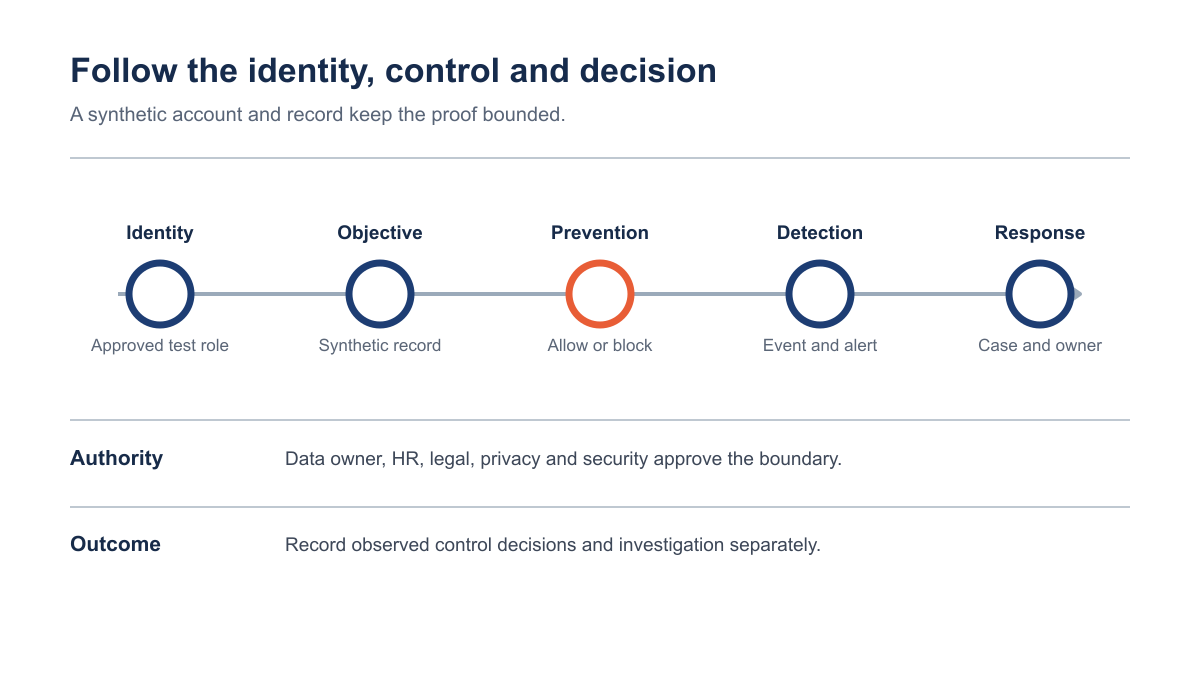
Figure 1: An editorial evidence map for a bounded insider exercise. Sources: CMU SEI insider threat guide; Microsoft Insider Risk Management; NIST SP 800-115.
Stage | Question to answer | Evidence to request |
|---|---|---|
Authorization | Was the test identity's access legitimate and limited to its role? | Role assignment, data-owner approval, relevant policy |
Prevention | Was the planned action blocked, limited or allowed? | Control decision, policy match, user-facing result |
Detection | Did the event reach the right team in time to matter? | Source event, alert, routing and timestamps |
Investigation | Did the analyst establish context before making a people decision? | Case notes, access review and consultation record |
Response | Did the owner contain the relevant access proportionately? | Decision, action, timing and rollback |
The scorecard should record observed facts and gaps. It should not assign a numeric grade unless the buyer has defined what the grade means in advance. A mature program may intentionally allow some benign activity while requiring a human review when multiple signals combine. That nuance is more useful than declaring that every unusual event should be blocked.
Separate the exercise from employee surveillance
The test should validate controls and process, not compile a dossier on staff. Keep the synthetic identity and test artifacts under the control group's management. Restrict operator access to the logs needed for the objective. Define who may unmask a test identity, who can see raw case evidence, how long exercise artifacts remain and who will remove them. If a real unrelated employee event appears during the window, route it through the organization's normal process rather than folding it into the red-team finding.
Avoid building the scenario around personal stress, grievance or presumed motive. Those narratives can distract from the access and response questions the organization can actually test. SEI's guide covers organizational functions because insider threat management involves prevention and fair handling as well as detection. A technical provider should not make employment judgments. The provider can demonstrate that a role was too broad, a control did not fire or a case failed to reach the right owner; HR and legal decide how real cases are handled.
This distinction also shapes communication. The control group should preapprove the deconfliction message for a defender who investigates the test, the stop signal for a business owner who sees unexpected activity and the post-exercise notice if staff could have been affected. A surprise event that causes an unnecessary personnel action is a design failure. The safest credible test is one whose conduct is controlled even when the defenders do not know it is a test.
Choose between a tabletop, a technical simulation and a purple replay
A tabletop can reveal whether HR, security, legal and a data owner know who should decide what. Participants discuss a hypothetical event and make choices. It is useful before a live exercise when authorization or escalation paths are unclear. It cannot prove that a data policy blocks a transfer or that a SOC sees an event.
A technical simulation uses approved identities and systems to produce actual control and telemetry evidence. Its value is the observable event chain. The provider should specify which actions are real and which are represented by a marker or staged event. The exercise can be covert to the SOC if the control group and safety plan allow it. It may be a poor first step when the organization lacks basic ownership of the protected asset or cannot create a safe test dataset.
A purple replay is a controlled follow-up in which the tester and defenders walk the same route together. The goal is to tune a rule, enrich a case with context, update an investigation decision or verify a fix. The replay should distinguish a newly working control from a result produced only because defenders knew the exact time and account. A final retest under the agreed visibility model can validate the improvement.
These modes can be combined in one program, but they should be separately named in the proposal. A quote for a tabletop with a slide deck is not equivalent to a human-led technical exercise with identity provisioning, live evidence capture and a SOC replay. The buyer should compare outcomes, scope and access, not just the word "simulation" on the cover.
Select representative roles without making employees the subject
The buyer may have many possible insider positions but should not turn a first exercise into an indiscriminate survey of staff. Select roles according to the protected asset and the business decision. A software engineer may legitimately read code and deployment material but have no reason to approve a finance export. A contractor may need access to a shared workspace for a project but not after the engagement ends. A privileged operator may have broad technical rights while being subject to a change approval and review trail. Those are three different hypotheses. The exercise should use a synthetic account for each selected role and explain why its entitlements are representative.
Ask the access owner to confirm the intended permissions before the test. If the role is already overprivileged on paper, the organization may choose to fix that known problem first and use the exercise to verify the change. If the team wants to see how a permitted action is monitored, the test can proceed even when the access itself is expected. That distinction helps the report avoid calling every successful read a vulnerability. The issue may instead be missing review, an unclear data classification or a case routed to the wrong owner.
Time matters for some roles. A contractor or temporary administrator may be allowed to perform an action during an approved window but should lose the right afterward. Use a test account with an agreed schedule and capture both the entitlement state and the action result at the relevant point. Do not use a real worker's resignation or disciplinary process as a test trigger. The exercise can prove that a technical offboarding control worked or failed without exposing a person's employment situation.
After the first route, change one condition at a time. A different role, a different protected asset or a different sharing channel can make a result incomparable. A buyer planning a series of exercises should record the common objective and evidence fields, then explain which condition changed between runs. That is more useful for improvement than a larger collection of unrelated scenarios with no shared decision standard.
What to put in the statement of work
The statement of work should begin with the decision, the protected asset and its business owner. It should identify the synthetic persona, starting rights, systems in scope, proof marker, permitted actions and stop conditions. If the test includes a contractor platform, a shared cloud tenant or another organization's service, get authorization from the relevant owner or exclude that boundary. NIST SP 800-115 frames technical testing around planning, conduct, analysis and mitigation; a clear SOW makes those phases reviewable.
Request a data-handling annex. It should specify how test records are generated, where they can be stored, whether any production identifiers may appear, who can see raw evidence, how artifacts are redacted and when they are deleted. An exercise that uses an actual sensitive record as a shortcut creates a privacy problem without proving a better control. If the data owner cannot supply a safe marker, the provider should adapt the objective before launch.
Name the defenders and control group separately. The control group owns the safety boundary and can stop the test. The SOC or insider risk analysts receive events under the chosen visibility model. HR, legal and privacy review the response design and escalation threshold. The provider should not quietly change the scenario when a prevention control works. A blocked objective is a valid result, provided the report shows what was attempted and which evidence supports the block.
Ask for a deliverable that supports remediation. It should include the authorized scope, timeline of actions, access and policy decisions, detections, analyst actions, business decisions, exclusions and retest criteria. For each gap, the report should name an owner and a testable fix. A recommendation to "improve monitoring" is too vague; the owner needs to know which event, correlation, case routing or access rule should change. The wider executive version can explain the business consequence without distributing raw identity or data details.
Where Stingrai fits
Stingrai is a CREST-accredited penetration testing company founded in Toronto in 2021. Its red-team service can follow an authorized identity and network path to a named objective, with detection and response timings as part of the engagement evidence. The purple-team service brings testers and defenders together to tune that path after it is observed. A buyer should ask for a specific insider objective, privacy boundary and report audience in the quote; a general red-team label is not sufficient.
Stingrai's human-led engagements use two named penetration testers from a certified team. The provider can test whether technical access and detection controls work, while the organization's own HR, legal, privacy and data owners govern the people decisions. Get a Quote with the protected asset class, identity type and desired visibility model to receive a scoped proposal.
Frequently Asked Questions
What should an enterprise insider threat simulation include?
It should include an approved starting identity, a specific protected objective, synthetic proof material, written authority, privacy limits, control-group contacts, expected prevention and detection signals, a defender response plan and a retest criterion. The report should separate access, blocking, alerting, investigation and containment rather than compressing them into a single pass or fail.
Is an insider threat simulation the same as an assumed-breach red team?
No. An assumed-breach test starts from an internal foothold and measures what an intruder could do. An insider simulation starts from an identity with legitimate duties and examines whether its access, unusual use and organizational handling are appropriate. The technical routes can overlap, but the insider exercise needs data-owner, HR, legal and privacy input that a generic internal foothold test may not require.
Do we need to use real employee accounts or data?
No. Create test identities with representative permissions and use synthetic records or markers wherever possible. A data owner should authorize the asset, and the rules should specify any unavoidable production access, evidence minimization and retention. A test should not gather a real employee's personal records merely to prove that a control can be exercised.
Does a DLP alert prove the insider risk program works?
No. A DLP alert may show that one rule matched one action. The buyer still needs to know whether the alert reached the right analyst, whether the analyst understood the context, whether the data owner was consulted and whether an appropriate response followed. Conversely, a well-governed exception may be allowed intentionally. Report the complete decision path.
Can the SOC be kept unaware of the exercise?
Yes, when the control group approves a covert visibility model and has stop and deconfliction procedures. HR, legal, privacy and data owners should still authorize the sensitive boundaries. A collaborative purple replay may be better when the immediate goal is improving a known detection rather than measuring blind response.
What should be excluded from the scope?
Exclude unapproved personal accounts, real personnel records, uncontrolled exports, unrelated employee activity, supplier systems without owner permission and any action that could interrupt business operations. List exclusions in the report so an untested path is not described as secure.
How should we compare proposals?
Compare the objective, access level, authorized systems, synthetic data plan, defender visibility, privacy controls, evidence format and retest commitment. Ask who will own the cross-functional response and what the provider will do if the first planned path is blocked. A low price for a discussion-only exercise should not be compared directly with a live technical simulation.
Related reading
Sources
Talk to Stingrai
Describe the identity, protected asset and decision you want to test in Get a Quote, or book a free discovery call to agree the safe scope.