





Data loss prevention has a narrow meaning when it is tested: a policy must recognize the material, act on its movement, and give defenders usable evidence of the event. MITRE ATT&CK defines data loss prevention as identifying, monitoring and controlling sensitive data across network, endpoint and cloud platforms. A configuration review can show that a rule exists. A controlled test shows what that rule does when a person or a compromised account moves a file, shares a cloud object or creates an export.
Quick answer. Data exfiltration testing is an authorized exercise that moves synthetic records through agreed channels to prove whether controls block, alert, merely log or miss the activity. Scope the test around a named data objective, the paths available to a realistic user or intruder, the exact evidence your SOC must receive, and a stop condition before any sensitive data leaves its owner. Stingrai's human-led red team can include simulated data access and exfiltration as a defined objective, with a detection and response timeline for the stages tested.
The reason to choose an objective instead of a generic "test DLP" request is that data movement has different owners. A blocked attachment may prove an endpoint or email policy works, but it says little about an application export, a cloud sharing permission or a backup copied across accounts. MITRE's Exfiltration tactic covers several ways data can leave a network. Its Transfer Data to Cloud Account technique calls out sharing, syncing and backup transfers within the same cloud provider. Those routes can bypass a test plan that only watches traffic leaving through a traditional internet gateway.
What the buyer is trying to learn
The central question is not "Can someone upload a file?" Most enterprise environments intentionally allow many uploads. The useful question is whether a particular identity, with particular access to a particular class of data, can move it through a route that should be controlled. A finance export, product source archive, research dataset and HR file may each have a different owner, classification, storage location and approved destination. That difference must appear in the scope before the tester chooses a route.
A complete engagement answers several linked questions. Could the test identity reach the data in the first place? Did the relevant policy classify a synthetic stand-in as intended? Did an endpoint, application, email, proxy or cloud control interrupt the movement? If movement was permitted, did a detector alert, or did a raw event sit in a log nobody watched? Did the SOC triage it, identify the affected account and data owner, and take the response step the organization expected? Each answer needs its own timestamp and evidence. Combining them into one pass or fail label hides the reason the test mattered.
This is also why a test can fail safely. The team can prove that an account reaches an export function and that a policy would allow a marked test file to be copied without sending a real customer record anywhere. The business impact is the reachability of the path and the behavior of the controls, not the volume of data taken. The source material should be fabricated or expressly created for the exercise. It must be recognizable by the deployed policy, yet clearly unusable as genuine personal, financial or health information. The destination should be controlled by the client or covered by its written authorization, with a documented retention and deletion plan.
The engagement should also separate preventive and detective success. An event blocked at the source may never require a SOC case. An event that is logged but silently discarded by a workflow is different from one that produces a timely alert. An alert that appears but is misclassified by a managed provider is different again. NIST's incident response guidance treats detection, response and recovery as connected activities; a buyer should ask for evidence across that chain rather than a screenshot of one DLP policy.
DLP validation, a penetration test or a red team?
These purchases answer different questions. DLP validation is appropriate when the organization knows its protected data classes and wants to prove policies across known movement channels. An application or cloud penetration test focuses on whether access controls, exports and sharing features can be abused within a defined product or environment. A red team starts with a named objective and asks whether an operator can reach it through a realistic chain while defenders attempt to notice and contain the activity. Stingrai's red teaming scope explicitly includes data access and simulated exfiltration; its web application penetration testing addresses application weaknesses that might provide access in the first place.
Buying question | Better starting scope | Evidence to demand |
|---|---|---|
Does our DLP rule recognize and stop a marked export through the channels we selected? | Controlled DLP validation | Policy version, test object, channel, action, log and alert evidence |
Can a low-privilege application user reach another customer's export? | Application and API penetration test | Authorization path, affected role, controlled proof and fix guidance |
Could a realistic intruder reach a named dataset and move a safe stand-in without the SOC reacting? | Objective-based red team | Attack narrative, data path, prevention and detection timeline, response decisions |
Do we know an alert exists but need the detection engineer to tune it live? | Purple team exercise | Per-technique telemetry, rule change, second run and handover |
The table is a buying framework, not a claim that one service substitutes for the other. A buyer may commission a scoped DLP exercise before a red team, or make DLP an explicit red-team objective. That sequencing prevents an expensive covert engagement from rediscovering a simple missing classification rule. It also makes remediation ownership clearer. The DLP owner can repair a policy; the application owner can repair a broken export boundary; the SOC can repair a missed escalation.
The scope should say which question has priority. Otherwise a supplier can deliver a technically sound policy demonstration while the security leader expected an end-to-end measure of whether data theft would be noticed. A contract that says "simulate exfiltration" without naming an identity, data class, route and expected response is too vague to evaluate later.
Build a synthetic test corpus before testing begins
Use fabricated records that resemble the structure relevant to the policy without containing information about any real person or customer. A buyer can seed an exercise with a document bearing a unique classification label, a harmless table of fictional entries, or a file whose marker is configured into the policy. The point is to test an observable decision. If the deployed rule recognizes labels, use the label. If it looks for structured fields, agree synthetic fields that the organization has approved. Do not assume any synthetic string will be recognized by every product.
Document the corpus as carefully as the target systems. Record who created it, its checksum or other stable identifier, the approved storage locations, the test identities allowed to open it, and the destinations where a copy may land. A unique marker lets the SOC correlate an alert to the exercise without exposing a real record in a report. The tester should not place genuine personal data into a ticket, chat, log attachment or sample report simply to prove access. A redacted screenshot of the policy decision and the marker can usually provide the necessary evidence.
The classification state matters. Testing a policy with a file that never received the required label says little about that policy's effectiveness. Conversely, manually labelling every file before the exercise can conceal the actual weakness: ordinary business workflows may fail to classify data. Keep those as separate test cases. One case asks whether the system labels or recognizes the material; another asks what happens once it has been recognized. If the organization wants to test automatic classification, include false positives and false negatives in the acceptance criteria, but only with records whose expected classifications are agreed in advance.
For a new or changed Microsoft Purview DLP policy, Microsoft recommends testing and tuning in simulation mode. The documentation says this mode shows policy matches without enforcement. That is useful for understanding what would match, but it should not be presented as proof that a live block or a human escalation took place. Put the policy state in the report next to the test result. A blocked action under an enforced policy, a simulated match and an alert generated during a simulation are separate observations.
Before launch, the control group should agree what happens to any test copy that reaches an approved destination. Preserve enough metadata to verify the event, then remove the content under the organization's retention rules. Do not leave synthetic files in public buckets or external services merely because they are fake. The path is being tested as a control failure, so it should be closed and cleaned up like any other controlled security exercise.
Choose channels from the data flow, not from a generic checklist
The first route is usually the one the business already uses. An authorized account exports a report, forwards a document, changes a sharing setting, calls an API or copies a file into a managed storage service. A useful test plan starts with that workflow and then asks where the next trust boundary sits. It should not automatically include every channel in MITRE ATT&CK's exfiltration tactic. Relevance, permission and visibility matter more than a long count of techniques.
Route to consider | Scope question | Evidence of a useful result |
|---|---|---|
Application export or API | Which role can request the export, and is the object bound to that role? | Authorization decision, export event, owner notification and tested control |
Corporate email and collaboration | Can a test file be shared to an unauthorized identity or domain? | Policy match, message or share decision, alert and user context |
Browser or endpoint upload | Does the endpoint or network policy act on a marked file leaving through an approved test destination? | Action at endpoint and network layers, including any conflict between them |
Cloud storage and cross-account sharing | Can the source account change sharing or copy data to another account under the same provider? | Cloud audit trail, policy decision and SOC triage of the target account |
Backup, snapshot or bulk export | Does a privileged identity create a new route to a protected dataset? | Control-plane change, destination, approval path and response evidence |
The cloud row is especially easy to overlook. MITRE T1537 describes transfer to another cloud account using sharing, syncing or backups. A firewall watching large internet uploads may have no view of the relevant cloud control-plane change. A buyer should ask whether the cloud team can produce the audit event, whether the event reaches the SIEM, and whether it is meaningful enough to trigger a case. This is a detection design question as well as a DLP question.
Do not treat the channel table as an attack recipe. The agreed test plan should name only client-owned or separately authorized destinations and should use the least intrusive action that proves a boundary. For example, a change to a test object's sharing configuration may be sufficient evidence; a bulk transfer is unnecessary. Where the source system cannot distinguish synthetic records from real ones, create a segregated test object or move to a non-production replica with equivalent policy. If a replica lacks production policy or telemetry, state that limit plainly.
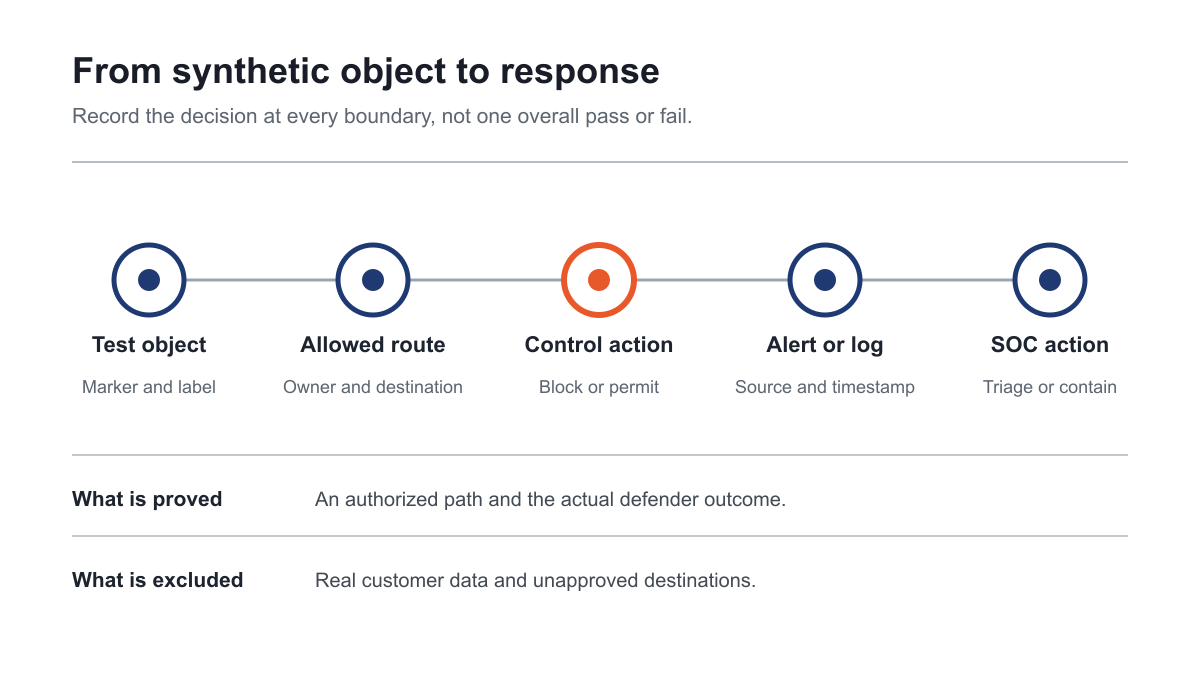
Figure 1: Evidence to collect from synthetic test material through prevention, telemetry, alert and response. This is an editorial test design based on the source frameworks. Sources: MITRE ATT&CK, Exfiltration; MITRE ATT&CK, Data Loss Prevention; NIST SP 800-61 Rev. 3.
Put safety and authorization into the rules of engagement
A data exfiltration exercise crosses more boundaries than an ordinary vulnerability scan. The rules of engagement should identify the source systems, the people who can authorize each dataset, the identities that may act, the receiving locations, the test window and the person empowered to stop the work. NIST SP 800-115 is a useful primary reference for planning technical tests and analyzing findings, while the contract should resolve the practical details for this environment.
The safest objective is not "take as much as possible." It is an agreed proof that a specified route can or cannot move a synthetic object and that the defenders react as intended. Make the maximum data quantity and destination explicit. State that production customer records, secrets and personal files are out of bounds unless a separately approved plan requires them. Avoid writing a test plan that depends on discovering such material and then deciding in the moment whether to copy it. The stop condition should apply before accidental exposure, not only after a complaint.
Where a managed SOC, email provider, cloud provider or outside DLP operator may see the exercise, decide who is informed and when. A covert red team still needs a small control group with authority to deconflict a real incident. A transparent DLP validation can include the policy owner and detection engineer from the start. Record the difference in the SOW; otherwise the exercise may be stopped by a well-meaning operations team before it proves anything, or a genuine incident may be confused with test activity.
Also decide how the testers will prove an outcome. A screenshot of an uploaded file can create another copy and broaden exposure. A time-stamped audit event, a test marker, the relevant policy version and a sanitized case record are more controlled. The deliverable can reconstruct the path without retaining the content itself. If evidence must be exported from a console, redact unrelated identities and store it under the client's own access controls.
Score prevention, visibility and human response separately
Use an outcome for each attempted path, not one score for the whole program. Prevented means the relevant action was stopped by a control. Alerted means an actionable signal reached a defender. Logged only means the record exists but no one was asked to act. Unseen means the agreed telemetry was absent or the event never reached the analysis point. These labels are an editorial reporting method; they are not an official MITRE score. An attempt can be blocked and alerted, so the report should retain both observations rather than force them into one cell.
For each route, attach the identity and synthetic object's marker, source and destination, action, policy state, observed result, timestamp, log source, alert identifier if any, and SOC action. Add the expected result agreed before testing. That comparison prevents a vendor from treating every block as success even if the business process should have allowed a legitimate transfer, or every unblocked transfer as failure when it was authorized.
The human response needs its own narrative. Did the analyst link the alert to a real identity and the protected data class? Did the case reach the right owner? Was the suspected account contained, or was it merely added to a queue? Could the team tell whether the data actually moved, or did the logs only show that a share was created? A red team engagement should reconstruct that sequence with the control group after testing. Stingrai's published red-team deliverables include a detection and response timeline that separates prevented, logged, alerted and missed actions.
No dashboard percentage can replace this record. A set of easy channels can produce an attractive score while a single privileged export path remains open. Show the denominator, the list of routes actually tested and the systems excluded. When a route is not tested because of provider rules, licensing, missing telemetry or business safety, mark it not tested, never covered. The next procurement decision should be based on the remaining route, not an average of unrelated controls.
What to put in the statement of work
Ask the provider to state the objective in plain language: a named data class, the authorized starting identity, the business workflow and what a successful safe proof would look like. Require a route matrix that includes source, destination, test material, control owner, telemetry owner and stop condition. Reserve the right to remove a route before testing if the business or data owner cannot authorize it. A vague commitment to "test exfiltration" leaves too much for the supplier to decide after the purchase.
The SOW should also distinguish preparation, execution, debrief and retest. Preparation covers classification and test-object checks, policy state, accounts and destinations. Execution records the actual attempted actions. Debrief reconciles tester timestamps with DLP, cloud and SOC evidence. Retest repeats only the affected paths after a fix, using the same object and expected result where possible. An altered policy and an altered dataset should not be compared as though nothing changed.
Demand an executive summary that says which objective was reachable and what the defenders did, followed by a technical annex that maps each route to a remediation owner. A policy that failed to match belongs with data protection engineering. A missing cloud audit event belongs with platform logging. An alert that reached the SIEM but was closed without investigation belongs with SOC process or a managed provider contract. A report that calls all of those "DLP gaps" cannot be used to assign work.
For vendor selection, ask to see a sanitized sample of an outcome record, not a promise of a heatmap. The sample should show the policy mode, a tested marker, actual event timestamps, alert and case identifiers, and a clear limit when a route was not tested. Ask how the provider avoids collecting real data and how it deletes its test objects and evidence. Those answers often reveal more about operational maturity than a list of supported channels.
Where Stingrai fits
Stingrai is a CREST-accredited penetration testing services company founded in Toronto in 2021. Its human-led red team engagements are scoped around a named objective, with two named penetration testers from a team holding OSCE³, OSWE, OSEP, CREST CRT and CISSP certifications. For a data-theft objective, the scope can combine a controlled starting point, synthetic material, authorized cloud or network routes, and a record of what the SOC saw at each stage. The red teaming service offers assumed-breach, full-chain and threat-led modes; the right mode depends on whether initial access is part of the question.
The team can run the engagement as a one-time exercise or part of a continuous program, with findings and retesting delivered through Stingrai's PTaaS workflow. Data exfiltration and DLP validation are quoted for the agreed scope rather than given a web-application package price. A discovery call should settle the data owner, safe test object, destinations, identity and detection owner before a quote is meaningful.
Frequently Asked Questions
What should a data exfiltration test include?
A data exfiltration test should include an authorized starting identity, a named data class represented by synthetic material, the source and destination for each route, the expected policy decision, the event and alert evidence, and the defender's actual response. Each route needs written authorization and a stop condition. The report should mark untested routes explicitly.
Can synthetic data prove a DLP policy works?
Synthetic data can prove how a policy behaves only when the test object matches the classification or detection conditions configured in that policy. It cannot establish that every real business file will be recognized. Test recognition and enforcement separately, and record whether the policy was in simulation mode or enforcing actions. Microsoft describes Purview simulation mode as reporting matches without enforcement.
Is a DLP test the same as a red team engagement?
No. A DLP test checks known policies and channels against agreed test material. A red team asks whether an operator can reach a named objective through a realistic chain and whether defenders detect and respond. A red team may include controlled exfiltration, but the purchase should say whether the priority is policy behavior, application access, or end-to-end detection and response.
Does a blocked transfer mean the SOC succeeded?
No. A blocked transfer proves a preventive control acted on that attempt. The SOC may never have received an alert, or it may have received one and taken no action. Score prevention, telemetry, alert and human response separately. An organization can reasonably decide that some blocked actions need no case, but that expectation must be agreed before testing.
Should the exercise use production customer records?
The normal starting point is synthetic records and client-controlled destinations. A report should prove the route and control behavior without copying a customer's information. If an organization believes real data is necessary for a narrow case, that choice requires separate authorization, data handling terms and a stricter stop plan. This guide's proposed scope does not rely on real customer records.
Can cloud sharing bypass a traditional outbound-data test?
Yes, a test plan limited to internet uploads can miss cloud-native sharing and cross-account transfer. MITRE T1537 describes movement to another account on the same provider through sharing, syncing and backups. Scope the cloud audit trail and the destination account as well as the file transfer itself.
What should an enterprise buyer receive at the end?
The buyer should receive a route-by-route outcome record, test-object identifiers, policy mode, timestamps, log and alert references, SOC actions, the objective reached or stopped, exclusions, remediation owners and retest results. A summary chart without those records is hard to validate or use for engineering work.
Related reading
References
MITRE ATT&CK. Exfiltration, TA0010. Defines the tactic and its technique families.
MITRE ATT&CK. Transfer Data to Cloud Account, T1537. Describes cloud-native movement.
MITRE ATT&CK. Data Loss Prevention, M1057. Defines the mitigation across platforms.
Microsoft Learn. Test your Data Loss Prevention policies. Explains simulation mode.
NIST. SP 800-115, Technical Guide to Information Security Testing and Assessment. Testing and assessment planning.
NIST. SP 800-61 Rev. 3, Incident Response Recommendations. Detection and response guidance.
Talk to Stingrai
To scope a controlled data exfiltration objective with synthetic records and a clear detection outcome, get a quote or book a free discovery call.



