





An MDR contract assigns part of incident detection and response to another organization, but it does not transfer the customer's need to know whether the handoff works. NIST SP 800-61 Rev. 3 says these shared responsibilities should be defined in the contract, including information flows, coordination and authority to act. An authorized red-team exercise can turn those written obligations into observable decisions.
Quick answer. To validate an MDR provider, scope a red-team objective that produces defined identity, endpoint or network evidence in assets the provider actually monitors. Measure collection, analyst triage, case creation, customer notification, escalation and any authorized containment separately. Stingrai's human-led red teaming can exercise the path while a control group compares provider records with customer-side logs. The test is useful only when both parties agree what the provider could see and what action it was permitted to take.
The most common bad conclusion is that an event was "missed" because no one showed the red team a ticket. A provider may have received the event but suppressed it; it may have investigated without notifying the customer; the customer may have received an escalation in the wrong mailbox; or the endpoint may never have forwarded the relevant telemetry. Each result implies a different fix. The exercise needs a chain of custody for the signal and a record of the decision at every handoff.
Buy an MDR exercise for a decision, not a detection score
MDR validation asks whether the organization and its provider can recognize and handle a specific adversarial path together. It is narrower than a general claim that the SOC will catch "an attacker." Choose a business objective, a plausible starting condition and a safe end marker. For an enterprise with a managed endpoint estate, a useful objective might be reaching a synthetic privileged file share from an authorized test workstation while avoiding any real customer data. For a cloud-heavy environment, it might be a controlled access decision in a test subscription. The white team chooses the objective for its business relevance, not because a particular tool will trigger an alert.
The distinction from a penetration test matters when reviewing quotes. A penetration test may show that a vulnerability or access path exists. An MDR red-team exercise also asks what the provider received, what an analyst inferred, when the customer was told and who could contain the activity. A purple-team session may replay a known behavior with defenders watching and tuning rules; that is valuable after a blind exercise, but it answers a different question. The initial exercise should state whether defenders know the technique, know only that an exercise is underway, or have no operational warning beyond the control group.
The CISA public red-team assessment illustrates why these distinctions matter. CISA reported that defenders discovered evidence of initial activity but did not act promptly, and that one endpoint alert was neither read nor answered. That assessment is one case, not a market benchmark. Its lesson for a buyer is methodological: an alert existing in a product is not the same as an analyst receiving, escalating and resolving it. CISA also noted that limited visibility into defender responses constrained interpretation of some measurable events. Build the evidence-sharing agreement before the exercise, rather than discovering afterward that only one team can see the case.
Establish what the MDR provider actually owns
"The MDR monitors our environment" is too broad for a statement of work. Create a coverage inventory with the customer and provider. Identify the endpoint groups, identity tenants, cloud accounts, network sensors and log sources that send data to the provider. For each, record who maintains the connector, who owns the detection rule, whether the provider can inspect raw telemetry, and what the customer retains in its own logging system. A test outside that inventory may still reveal a risk, but it cannot fairly measure the provider against a service it did not sell.
Define the provider's operational authority separately from its visibility. It may be allowed to isolate an endpoint automatically, recommend isolation for customer approval, disable a user only after a phone call, or merely open a ticket. NIST explicitly calls out that provider contracts should define authority to act and restrictions on operational decisions. The exercise should test the authorized path, not surprise the provider with a demand to perform an action outside its contract.
Boundary | Scope question | Evidence the buyer should retain |
|---|---|---|
Collection | Was the selected asset enrolled and forwarding the relevant events during the window? | Asset coverage record, connector health and customer-side event timestamps |
Detection content | What rule, analytic or human hunt was expected to notice the behavior? | Rule owner, detection version, alert record or documented absence |
Analyst decision | Did an analyst connect the event to a risk and open a case? | Case history, analyst notes, severity and rationale |
Provider-to-customer handoff | Did the right contact receive a usable notice through the agreed channel? | Notification timestamp, destination, message and acknowledgement |
Containment authority | What action could the provider take without approval, and what required a decision? | Contract authority, approval record, action log and outcome |
Closeout | Did the provider and customer agree what was contained and what remains exposed? | Final incident status, owner, next action and retest criterion |
This is an editorial buyer matrix derived from NIST's shared-responsibility and incident-management guidance. It is not a mandatory NIST test list. Its purpose is to make the contract and the actual delivery comparable. A provider may perform some stages exceptionally well and have no authority for others. The report should preserve that distinction.
Separate a telemetry gap from an analyst gap
Before selecting an adversarial behavior, verify that its evidence can plausibly enter the provider's workflow. A test workstation missing its endpoint agent is a collection finding. An agent that forwards the event while the provider has no analytic or hunt for it is a detection-content finding. An alert that an analyst closes without examining related identity activity is a triage finding. A credible case sent to an unmonitored contact is a handoff finding. Assigning all of these to "MDR failed" deprives the buyer of a fix owner.
The white team should preserve customer-side event logs and the provider's case record with synchronized timestamps. This need not expose the provider's proprietary detection logic to the red team. It only requires a post-exercise trace that says what signal was present, what decision was made and when. If a product suppresses a duplicate alert by design, the provider can explain that decision and show which parent case handled the behavior.
Include the customer's own response role
MDR is not automatically a full incident-response service. The customer may own legal notification, asset shutdown, identity revocation, business approval or communications to leadership. The scope should name the on-call customer role for each decision. A successful escalation to a mailbox that no one owns is not a successful joint response. Conversely, if the provider flags a credible event and the customer delays approval, the report should not describe that as an analyst detection failure.
NIST's incident-management guidance distinguishes triage, prioritization, escalation, elevation and assigned next actions. The exercise can test those transitions in a controlled way. The buyer should also ask who updates the case when the customer takes an action. A provider ticket closed at "notified customer" may be contractually correct but operationally insufficient if nobody confirms containment.
Design a bounded adversarial objective
Select an objective that matters to the business and can be proven safely. "Detect every ATT&CK technique" is not a useful acceptance criterion. A better objective is "from an approved test identity and workstation, determine whether a defined protected action is blocked, detected, escalated and contained." The target can be a synthetic document, a nonproduction account, a marked administrative action or a test server representing a crown jewel. Its value is in a measurable decision, not in the volume of activity generated.
Pick a starting condition that resembles the risk under discussion. A valid but lower-privilege account tests misuse of trusted access. An assumed-breach workstation tests lateral movement and endpoint coverage. An external foothold tests perimeter-to-internal handoff. The provider's current service may cover only some of these paths. State that limitation before soliciting quotes. MITRE ATT&CK T1078 describes valid-account abuse and associated detection based on unusual authentication and use patterns; it is a useful behavior family for a business-owned test identity, not a ready-made pass rate.
Avoid choosing a scenario simply because the provider has a known signature for it. The point is to test interpretation of activity relevant to the customer's environment. The white team may disclose the broad threat objective to the provider's exercise coordinator while withholding the exact timing and path from analysts. Alternatively, it may run a fully collaborative exercise. Both can be valuable, but the result must name the mode. A covert score cannot be compared with a replay where the analyst was told what to look for.
The plan needs a stop condition tied to business risk. Any real incident, unexpected production impact, safety concern or signs of access outside the authorization boundary should pause the exercise. The white team needs a working phone bridge and a way to identify the test account immediately. The provider should know who can authorize containment and what to do if its analysts believe a real intrusion is occurring. Tests of reaction time do not justify delaying a genuine response.
Write rules of engagement that preserve the result
The rules of engagement should define the monitored assets, start identities, permitted techniques at a high level, test window, source systems, synthetic targets, prohibited actions and white-team contacts. They should also define the evidence each party may share after the exercise. The red team should not need production personal data, real credentials or a disruptive proof to establish its objective. Use a safe marker that proves the relevant permission or reachability, and record the target's access decision.
Define how the MDR provider participates. If the provider has an exercise liaison, the liaison can preserve raw event and case records without tipping off analysts. If there is no liaison, the customer should confirm before starting that the contract permits later export of case timelines and relevant telemetry. A vendor that refuses any post-exercise evidence may still be able to provide a justified summary, but the buyer should know that limitation before purchasing the red team. The ability to verify a handoff affects the test's value.
Also settle alert suppression and allowlisting. Some organizations routinely allowlist known security-test sources, which can make a blind detection exercise meaningless. If the provider must suppress a specific action to avoid automatic customer disruption, record the suppression and exclude that step from the detection claim. The report should not quietly call a bypass a provider miss when a planned exclusion prevented the analytic from firing.
Agree a deconfliction process. The white team knows the operator's identities and source systems. It can distinguish the exercise from a real incident without telling front-line analysts the path. If the provider isolates the test workstation, the operator stops and the control group records the action. Repeatedly attempting to evade containment after success would change the objective and may produce confusion rather than useful evidence.
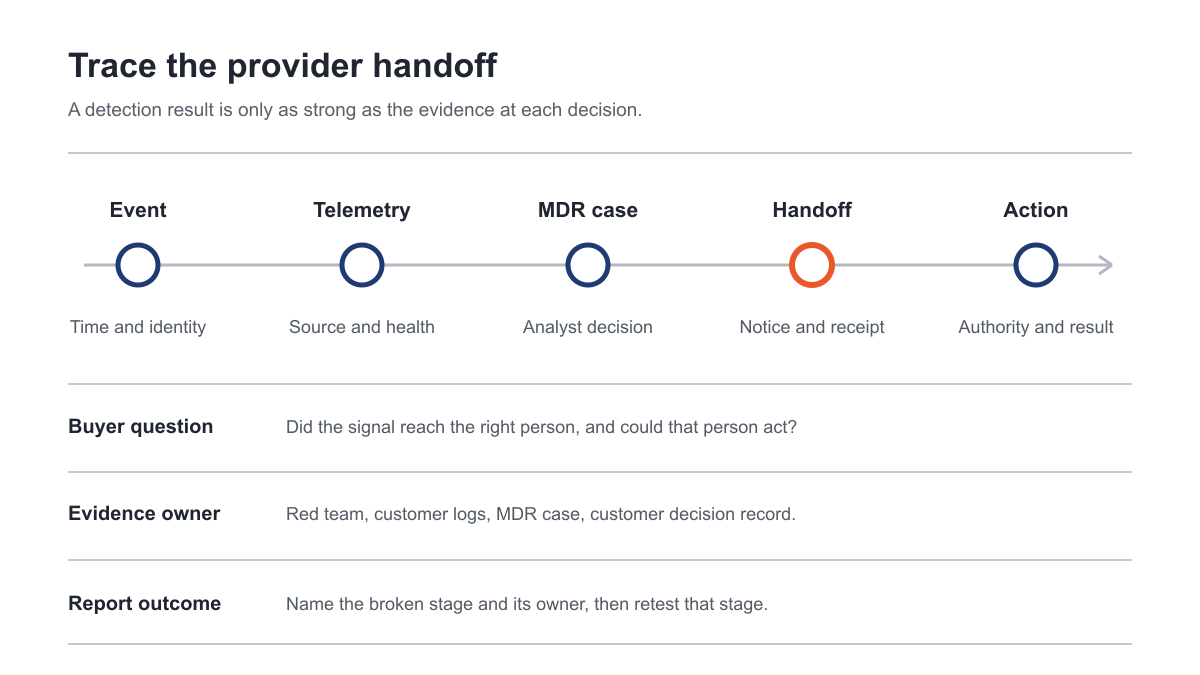
Figure 1: Editorial evidence chain from an authorized event to an MDR case, customer handoff and authorized response. Sources: NIST SP 800-61 Rev. 3; CISA's public red-team assessment.
Score each handoff with evidence
An end-to-end "detected" label hides important decisions. Score the path in stages, then provide a narrative. The first stage is prevention: did a control stop the protected action? The second is visibility: did the relevant event appear in customer and provider telemetry? The third is recognition: did a rule or analyst identify the behavior as noteworthy? The fourth is escalation: was the customer told through the agreed channel with enough context to act? The fifth is response: did an authorized person contain or investigate the activity? The sixth is closeout: was the outcome recorded and any remaining access removed or accepted by the right owner?
Each stage should have a time and an evidence reference. A prevented action may still generate no useful SOC event. A logged action may never become a case. A case may be labeled correctly but reach the customer after the designated decision window. A phone call may be timely but lack the affected asset and requested action. These are different findings. Ask the provider to report both the outcome and what data it had available when it made the decision.
The buyer can set its own thresholds in the SOW. For example, it can define that a case is actionable only if it identifies the affected asset, observed behavior, plausible impact, recommended next step and urgency. The exact time allowance depends on the contract, business process and event severity. This guide does not assign a universal minute target. A quote should identify whether the provider's existing service level applies to the exercise and what clock starts that level: raw event ingestion, alert creation, analyst confirmation or customer notification.
If the action is blocked by a security control, do not automatically score the MDR as a success. A red team may be unable to complete the objective because of identity policy, segmentation or endpoint prevention. That is a valid defensive outcome. Whether the MDR also recognized the attempt is a separate result. Likewise, the operator reaching the synthetic target does not automatically mean the provider failed; the provider may have escalated correctly while the customer made a conscious decision to observe before containment. The report must reflect what the parties agreed to test.
Use a replay to resolve ambiguous cases. After the blind phase, the provider can show its case timeline and the customer can show its own logs. The teams can identify a missing connector, a misclassified severity, a stale contact, or an unclear containment authorization. A purple-team follow-up can then test a changed analytic or escalation path in the open. Do not retroactively convert the improved replay into a pass for the blind phase; retain both results.
A fictional handoff example
Consider a made-up enterprise that contracts an MDR provider to monitor managed workstations, identity events and selected cloud logs. The white team provisions an ordinary test user and a marked file in a protected share. The red team begins on a managed workstation, attempts an unauthorized route to the marker and stops at the first approved proof. No real customer record is accessed. This is a scope illustration, not a description of a Stingrai engagement.
Suppose the workstation event reaches the provider, but the related sign-in is absent because the identity connector is unhealthy. The provider opens a low-severity case based on the workstation event alone and sends a portal notice to the customer. The customer's on-call contact sees it only after the exercise. That outcome should not be flattened into "MDR detected." The report would identify the collection defect, the analyst's decision with incomplete data, the notification channel and the customer's acknowledgement gap. It would also state whether the marker was reached and whether an existing control blocked it.
Now change only the notification route and repeat a harmless equivalent event in a visible replay. If the correct contact receives an actionable notice and records a containment decision, the buyer has evidence that the handoff improved. The retest does not claim that every future intrusion will be found. It confirms that the specific broken connection and escalation path worked under the tested conditions.
Compare quotes on operational evidence, not technique counts
Give each bidder the same objective, provider coverage inventory and information-sharing constraints. Ask for a proposal that names the entry condition, target, expected telemetry, defender mode, white-team role, safety rules, report format and retest. A list of ATT&CK IDs is useful for mapping after the exercise, but it does not say whether the provider will supply an analyst decision trace. A promise to "test the SOC" without provider participation is similarly thin.
The red-team vendor and MDR provider need distinct responsibilities. The red-team vendor designs and executes the authorized objective and records exact activity. The MDR provider handles normal monitoring and retains its case evidence. The customer owns approval, deconfliction, third-party contract coordination and business decisions. A quote should state whether a workshop with the provider is included. If not, the customer must budget its own time to reconstruct the timeline and request exports.
Ask bidders these questions:
What exact asset, account and business objective would you propose, and why does it test our MDR coverage?
Which logs must be present before the clock starts, and who verifies connector health?
Which actions are prohibited or require a separate approval?
How will the white team distinguish test activity from an actual incident without steering the analysts?
What will the report show if the event is logged but no case is opened?
How will you measure a case that exists but is sent to the wrong contact?
What evidence will the MDR provider need to release, and how will you protect it?
What retest confirms that a repaired connector, rule, contact or authority path works?
Beware of quotes that use a proprietary score with no event-level evidence or that promise a universal detection rate from one scenario. A single scoped exercise can identify weaknesses in a path and a contract handoff. It cannot establish the probability that the provider will catch all future intrusions. CISA's public assessment likewise shows specific observed activities and defender reactions, not a general performance grade for every environment.
Deliver a report the customer and provider can act on
The final packet should contain an executive decision summary and a technical timeline. The executive section states the objective, monitored boundary, outcome, response result and business owner for each gap. The technical section records UTC timestamps, source asset and identity, safe proof, customer-side events, provider alert and case identifiers, analyst decision, notification, acknowledgement, containment and cleanup. Any missing evidence should be marked as unavailable rather than inferred.
Separate findings by owner. A missing endpoint agent belongs to the customer or its endpoint operator. A connector that drops an event may belong to the customer, provider or platform team depending on the contract. A rule that fails to connect related behavior belongs to the detection owner. A stale phone tree belongs to the organization that maintains the contact list. An overbroad containment action may reflect the contract or an analyst decision. The report should name the evidence behind each assignment without revealing the provider's confidential detection logic unnecessarily.
Close with a specific retest plan. The owner fixes the defect; the red team repeats a comparable, safe signal; the provider and customer show the new timeline; and the report records what changed. If the first exercise was blind and the retest is collaborative, label that difference. Repeating a known path under coached conditions is good for validation, but it is not the same assurance as another blind exercise.
Where Stingrai fits
Stingrai is a CREST-accredited penetration testing services company founded in Toronto. Its human-led red teaming works toward agreed objectives and tests the defensive stack, including detection and response. For an MDR validation, the proposed scope can combine authorized identity, endpoint, network and cloud paths with a customer-provider evidence replay. The provider's participation and data-sharing rights should be settled by the customer before testing.
Stingrai offers one-time (annual) exercises and continuous programs, with confirmed findings, collaboration and retesting delivered through its PTaaS platform. Red teaming is quoted for the agreed objective and environments through Get a Quote. A meaningful proposal should state the monitored boundary, white-team arrangement, safe objective and evidence expected from the MDR provider.
Frequently Asked Questions
How do I test whether an MDR provider works?
Commission an authorized red-team exercise with a defined objective in assets the MDR provider actually monitors. Compare the red team's timeline, customer-side telemetry, provider alert and case record, customer notification and authorized response. A tool alert alone is insufficient evidence of an effective handoff.
Should the MDR provider know about the red-team exercise?
A small control group should coordinate authorization and deconfliction with the provider. Whether front-line analysts know the scenario depends on the agreed exercise mode. A blind exercise tests normal detection and escalation; a collaborative replay helps tune a gap. The report must identify which mode produced each result.
What if the provider says it never received the event?
Check asset enrollment, connector health and the customer's source log before calling it an analyst miss. If the event existed at the source but did not arrive, record a collection or integration gap and its owner. If it arrived and was suppressed, request the provider's documented disposition and evaluate that decision.
Is a detection alert the same as a successful MDR response?
No. CISA's public red-team assessment describes an endpoint alert that defenders did not read or answer. A successful joint response requires an analyst decision, a usable escalation to the right customer contact and an authorized next action, with evidence of each stage.
Who can authorize containment during the exercise?
The MDR contract and the exercise rules should specify which actions the provider may take independently and which require customer approval. NIST SP 800-61 Rev. 3 treats authority to act and restrictions on provider decisions as shared-responsibility terms. The white team should never assume that a provider can disable an account or isolate a system merely because it can see an alert.
What should appear in the final MDR validation report?
Request the authorized objective, coverage boundary, exact activity timeline, customer-side source events, provider alert and case decisions, notification and acknowledgement, containment action, missing evidence, owner and retest criterion. Distinguish prevention, logging, analyst recognition and customer response. The report should not reduce all of these to a single pass or fail score.
Can one exercise benchmark my MDR provider against others?
No. One exercise measures a defined path under stated coverage and rules. Different providers may monitor different sources or have different authority to contain, so a raw alert count is not a fair comparison. Use the result to test the contract you purchased and to improve the handoff for the risks that matter to your organization.
Is MDR validation the same as purple teaming?
No. A blind red-team phase tests how the provider and customer operate without analyst coaching. A purple-team phase is collaborative and useful for replaying the behavior, tuning detection and checking the revised escalation. A program can use both, but should report their outcomes separately.
Related reading
References
NIST. SP 800-61 Rev. 3, Incident Response Recommendations and Considerations for Cybersecurity Risk Management. April 2025. Shared responsibility, supplier participation and incident-management evidence.
CISA. Enhancing Cyber Resilience: Insights from the CISA Red Team Assessment. November 2024. Public red-team and defender-response observations from one assessment.
MITRE ATT&CK. Valid Accounts, T1078. Read 15 November 2026. Technique and detection framing for account misuse.
Stingrai. Red Teaming Services and PTaaS Platform. Read 15 November 2026. Public service descriptions.
Talk to Stingrai
To define an MDR validation objective, the provider handoff and evidence each party should retain, get a quote or book a free discovery call.



