





An endpoint security assessment should test whether the organization can see, interpret and respond to relevant activity on the devices it depends on. NIST Cybersecurity Framework 2.0 calls for monitoring computing hardware, software, runtime environments and their data, then correlating information from multiple sources. A deployed agent is an input to those outcomes, not proof that they are achieved.
Quick answer. Buy an endpoint security assessment when you need evidence that device coverage, telemetry, detection logic and SOC response work together on your actual estate. Scope representative Windows, macOS, Linux, server and remote-user groups; define safe simulated behaviors and an observation window; then require a report that separates prevented actions, recorded events, raised alerts and responder decisions. Stingrai's purple teaming pairs offensive testing with the defensive team to validate EDR and SIEM controls, while its red teaming can test detection and response against a wider objective.
This guide is for security leaders, SOC managers and procurement teams evaluating an independent assessment, not for teams shopping for a new EDR license. It addresses what to test, how to keep the exercise safe, what evidence to demand and how to compare bids. For a broader compromise objective that includes identity and network movement, the red team objectives guide may be the better starting point.
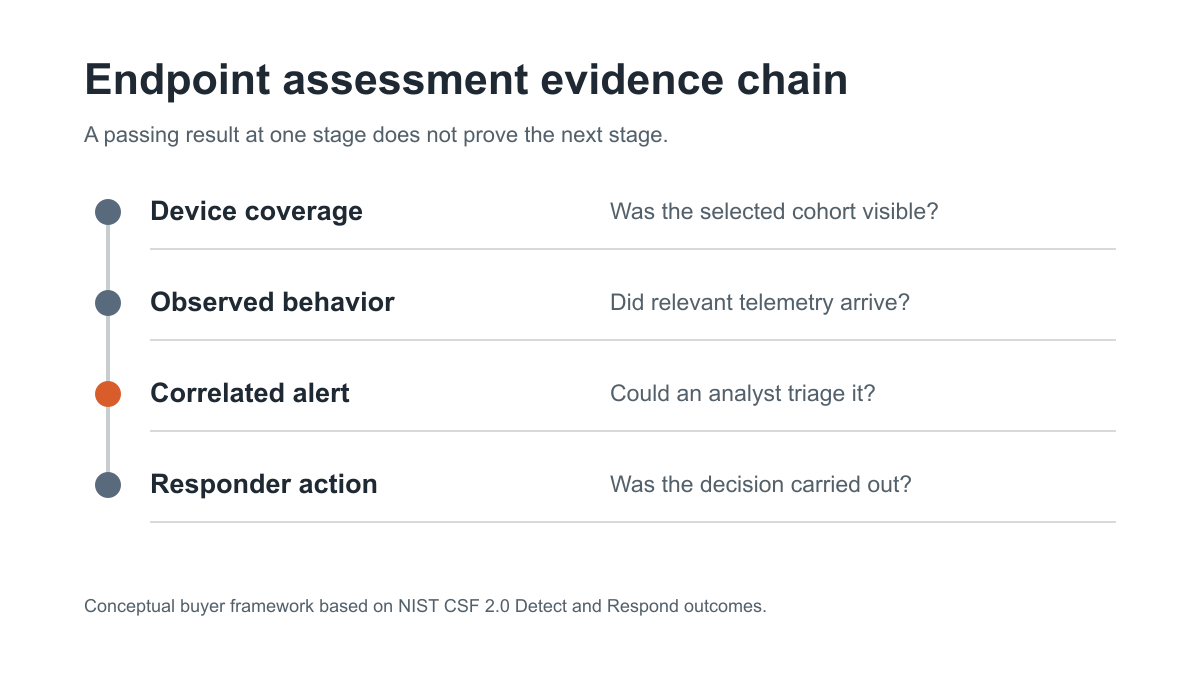
Figure 1: Four different questions define whether endpoint controls support a response. Sources: NIST CSF 2.0 and MITRE ATT&CK Detection Strategies.
Decide what the assessment must prove
"Endpoint security" can mean several purchases. A configuration review asks whether policies, exclusions, agent health and update settings match an approved baseline. A vulnerability assessment identifies weak software and operating-system configurations. An EDR validation exercise asks whether selected behavior produces telemetry, an alert, triage and an appropriate response. A red team exercise may use endpoints as part of a larger, goal-driven path. These are related but they are not equivalent deliverables.
Write the buying question before naming a tool or technique. A useful question might be: "Can our SOC detect and contain a simulated credential-access path on a managed laptop?" Another is: "Do Linux servers in our payment environment produce the same investigation evidence as Windows workstations?" The question determines which device classes, identities, telemetry sources and responders belong in scope. It also prevents a provider from calling an agent inventory export a complete security assessment.
NIST CSF 2.0 makes the separation concrete. Its Platform Security outcomes include configuration management and log records, while the Detect function includes monitoring and correlation (NIST CSF 2.0, PR.PS and DE.CM/DE.AE). An assessment can map evidence to those outcomes, but a framework mapping alone does not prove that a control worked in a real workflow. Require the observed result and the conditions under which it was produced.
The buyer should choose the response question as well. A blocked action may show prevention worked, but it may tell little about how the SOC would handle a permitted but suspicious action. A detailed alert may prove detection, but not triage or containment if it sits unassigned. A useful assessment reports each stage separately so owners can improve the control that actually failed.
Build the device and identity scope first
The scope should represent the devices that carry the business process, not merely the easiest pilot group. Start with the asset inventory, then select cohorts that differ in operating system, location, ownership, policy and exposure. The goal is a defensible sample that exposes material blind spots without making unsupported claims about every endpoint in the enterprise.
Scope dimension | Ask the owner to provide | Why it changes the assessment |
|---|---|---|
Device class | Workstations, privileged workstations, servers, virtual desktops and cloud-hosted workloads. | Agent packages, telemetry, isolation options and operational risk differ. |
Operating system | Supported Windows, macOS and Linux versions in the chosen cohorts. | A detection that works on one platform may have no equivalent signal on another. |
Ownership | Corporate-managed, contractor, third-party or BYOD devices. | Legal authority, access, enrollment and logging differ. |
Location | Office, remote, cloud and segmented environments. | Network path and telemetry delivery can change with connectivity. |
Identity | Standard user, privileged user, service account and break-glass roles. | The same device event can have very different significance by actor. |
Control policy | EDR tier, exclusions, prevention mode and response permissions. | A silent policy exception may explain an apparent detection gap. |
Business criticality | Systems tied to sensitive data, revenue or operational continuity. | It sets the allowed test window and acceptable response action. |
Ask for the denominators behind dashboard coverage. If a console shows many healthy devices but the estate inventory excludes newly provisioned laptops or certain server groups, a coverage percentage will be misleading. Reconcile the endpoint inventory, device management records and EDR inventory for the selected cohorts. Record excluded groups explicitly. The report can then say what was tested and what remains unknown.
Do not assume that production servers can be treated like disposable test laptops. Microsoft recommends piloting Defender for Endpoint on a suitably small subset before expanding deployment (Microsoft pilot guidance). That is product guidance, but the principle is useful for assessment safety: validate the method in a controlled cohort and expand only under the agreed rules of engagement. The provider should distinguish a product's built-in benign simulations from a broader adversary exercise.
Test the full evidence chain
An assessment should follow one scoped behavior from the endpoint to a decision. A single console screenshot is rarely enough. The buyer should ask the provider to capture the evidence chain in four layers and mark any layer that could not be observed.
Device coverage and sensor state
Before an action is simulated, establish whether the endpoint was enrolled, healthy, in the intended policy group and able to report. Record the device identifier and time window using a method that protects sensitive data. If the system is offline, excluded or running a different policy, that is a finding about coverage or governance, not a failed detection rule. A provider should not hide such cases as "test setup" if they occur in a representative cohort.
The assessment should identify controls outside the EDR agent when they matter: operating-system logging, identity events, network telemetry and SIEM ingestion. NIST CSF 2.0 DE.AE-03 calls for correlation from multiple sources. The relevant buyer question is whether those sources are available to the analyst making the decision, not whether they appear somewhere in an architecture diagram.
Behavior and telemetry
Define a small set of realistic, authorized behaviors that reflect the buyer's threat model. MITRE ATT&CK's detection strategies distinguish a high-level detection approach from platform-specific analytics; that distinction helps teams ask whether a planned behavior should be visible on each selected platform. The test record should say what was attempted at a high level, on which cohort, under which account, and what telemetry appeared. It should not expose a working attack recipe in a public-facing report.
Built-in product simulations can answer useful pilot questions. Microsoft says its Defender for Endpoint pilot includes benign "Do It Yourself" scenarios on onboarded pilot devices (Microsoft pilot guidance). They can confirm that a particular integration and investigation path is available. They do not by themselves establish that an enterprise SOC will detect an unfamiliar path on a different operating system, under a different policy, or across an identity boundary. Set the claim to match the test.
Detection and triage
For each test case, record whether the event was prevented, whether telemetry arrived, whether an analytic fired, how it was prioritized and where it appeared. An alert that arrives after the observation window, drops context or floods the queue may be functionally different from one an analyst can triage. The report should distinguish "no alert" from "alert in the wrong workspace" and "alert seen but not investigated" because each has a different owner.
The SOC may choose to know the exercise is happening, as in a purple team engagement, or may operate with limited prior notice, as in a red team exercise. Neither format is inherently stronger. In a collaborative exercise, analysts can tune a detection and retest it immediately. In a less disclosed exercise, leadership may learn how normal escalation works. The buying objective decides which evidence matters.
Response and containment
The final layer is the operational decision. Did the analyst establish what happened, connect the endpoint event to identity or network context, escalate according to the playbook and choose a safe containment action? NIST CSF 2.0 includes incident triage, escalation and containment outcomes under its Respond function (NIST CSF 2.0, RS.MA and RS.MI). An endpoint assessment does not need to execute a disruptive response to examine the workflow. The SOW can authorize a table-top decision, a simulated isolation action or a limited action on a dedicated test device.
Where response is deliberately not exercised, state that limitation. A report that says "EDR detected the scenario" should not be read as proof that the team can contain it. An executive summary should make that boundary plain enough for a risk owner who will not inspect the detailed evidence.
Choose the right exercise model
The provider should propose a method that matches the question and the environment. Ask what they will observe, what the defenders will know and how a failed detection will be handled during the engagement.
Model | Best buyer question | Defender involvement | Expected evidence |
|---|---|---|---|
Configuration and coverage review | Are agents, policies, logs and exclusions deployed as intended? | Endpoint and platform owners provide exports and context. | Inventory reconciliation, policy gaps and prioritized fixes. |
Benign product simulation | Does a known vendor scenario produce the expected local and portal signals? | Pilot owner and SOC monitor a documented case. | Device state, event, alert and investigation path for that case. |
Purple team validation | Can the SOC detect and improve a defined behavior across chosen cohorts? | Analysts work with testers during execution and tuning. | Before-and-after detection evidence and a retest record. |
Red team exercise | Can normal controls and responders identify a wider, objective-led path? | Disclosure and observation are set in the rules of engagement. | Attack narrative, observed detections, missed opportunities and response decisions. |
MITRE's adversary emulation guidance describes using threat behavior to test networks and defenses and develop behavior-based analytics. That supports a scenario-led design, but the provider should not pick a technique simply because it is available in a public test library. Choose behaviors relevant to your exposed systems, privileged access paths and recent control changes. If the business question is about a remote administrator's ability to reach sensitive servers, the exercise should cover that boundary rather than spend the entire budget on a workstation demonstration.
A conventional penetration test can uncover weaknesses on endpoints and in the surrounding network. An endpoint security assessment with detection goals requires the defender observation plan as well. The same activity can be useful in both engagements, but the acceptance criteria differ: the penetration test asks what access an authorized tester achieved; the validation exercise asks what the organization observed and did at each stage.
Write safe rules of engagement
Endpoint testing touches employee devices, production systems and incident workflows. The SOW should specify which devices are authorized, who owns them, which accounts can be used, what data may be viewed, which actions are prohibited and who can stop the exercise. It should also name the person who can resolve an unexpected policy or monitoring issue while the test is running.
Define a safety boundary by cohort. A dedicated pilot laptop can support more active simulations than a clinical workstation, payment system or production server. Where a sensitive system cannot support active behavior, the assessor can review coverage and configuration, observe telemetry from an approved adjacent test asset, or record the limitation. Never substitute an unsanctioned live test simply to complete a checklist.
Agree on evidence handling before the first action. Endpoint logs can contain usernames, file names, process arguments, customer data or other sensitive material. The provider should collect only what is necessary to demonstrate the finding, restrict access, define retention and deletion, and redact material in the report and screenshots. Anonymized examples are sufficient for a public methodology; the organization-specific traces stay in the private deliverables.
Specify what happens when a real incident overlaps the exercise. The SOC needs an exercise marker or a trusted contact path so it can distinguish the authorized activity when necessary, while still following its incident process for unrelated alerts. The stop rule should be usable by both sides and should describe who communicates with affected operations teams. These are contract terms, not details to improvise during an alert.
Compare proposals on evidence and fit
The strongest proposal identifies the test cohorts and observation questions. A proposal that promises to "test EDR" without a device sample, scenario logic, defender role or report format is too vague to price. Give each bidder the same asset and objective packet, then compare the work they actually include.
Proposal question | Strong answer | Weak answer |
|---|---|---|
Which endpoints are covered? | Names device cohorts, operating systems, policies and excluded groups. | Gives a device count with no sampling logic. |
What will be observed? | Separates sensor state, telemetry, alert, triage and response. | Says only that the tool will block a sample. |
How are scenarios chosen? | Ties behavior to a business path and relevant threat model. | Lists many techniques without explaining relevance. |
How is safety controlled? | Defines test assets, approved actions, stop authority and data handling. | Assumes any enrolled device is authorized. |
How is a missed alert reported? | Includes evidence, likely failure point, owner and a retest plan. | Produces a score without reproducible context. |
What is the defender role? | States whether the SOC is collaborative, observed or partially blinded. | Uses "red team" and "purple team" interchangeably. |
Ask who will run the exercise, who will observe the SOC, and who will review the final report. A skilled offensive operator alone cannot verify a detection outcome they did not observe. Conversely, a SOC analyst cannot infer a complete attack path from a product alert without the tester's timeline and objective. The engagement needs a shared timeline, synchronized enough to reconstruct what happened without leaking sensitive material into the executive copy.
Pricing should follow scope. The major effort drivers are the number of distinct device and policy cohorts, whether the SOC participates live, how many scenarios need retesting, the operational limits around production systems and the depth of report evidence. Ask bidders to state what a change in any driver does to the price and timeline. Do not compare a configuration export against a live, witnessed validation exercise as if the two were the same unit.
For buyers evaluating a wider penetration testing supplier, the quote comparison guide gives a method for normalizing proposals. This endpoint guide adds the EDR observation and SOC response fields that a generic pentest SOW often omits.
Define acceptance evidence before testing
The report should be usable by three audiences. Engineering needs an actionable control owner and a reproducible condition. SOC leadership needs the alert and investigation timeline. Risk or audit stakeholders need the scope, limitations, conclusion and remediation status. Do not force those audiences to infer the result from a raw event export.
Require each scenario to have a compact evidence record: authorized asset group, objective, approval boundary, time window, observed endpoint event, prevention state, alert state, analyst action, conclusion, limitation and remediation owner. Include links or references to private logs where appropriate. A finding about a policy exception should identify the policy path and affected cohort; a finding about alert routing should identify where the event went and who should have received it. That makes retesting possible without repeating the entire discovery exercise.
Distinguish outcome labels. "Prevented" means the control stopped the authorized behavior under the stated conditions. "Detected" means a signal was raised and available to a defender. "Investigated" means a person or automated workflow examined it. "Contained" means the response limited the simulated path within the agreed boundary. A scenario can meet one label and miss another. This vocabulary prevents a positive product result from hiding a process gap.
The assessment should also record untested territory. A test on a managed Windows pilot device says little about an unmanaged contractor laptop, a cloud-hosted Linux worker or a server in a different policy group. That limitation is not a defect in a well-scoped assessment; it is information the buyer needs for the next decision. Use it to decide whether to expand the sample, change policy deployment or run a broader exercise.
Plan remediation and retesting
A useful engagement produces a work queue, not only a score. For each gap, identify whether the owner is endpoint engineering, identity, SOC content, SIEM integration, incident response or the asset inventory. A single missed alert can have several causes; the report should point to the observed break in the chain and avoid guessing at a root cause that was not tested.
Retest the changed condition, not an easier substitute. If the original event was lost on a remote macOS cohort, a successful Windows lab test does not close that finding. If the alert reached the SIEM but not the responsible queue, retesting a local EDR rule alone is insufficient. Preserve the original test conditions and state any deliberate variation. A before-and-after timeline is especially useful when the SOC tunes a rule during a purple team session.
Choose future cadence from material change. New EDR policy groups, operating systems, identity integrations, SIEM migrations and incident workflows can invalidate old results. A one-time assessment gives a point-in-time baseline; continuous programs can validate recurring changes. Stingrai offers both one-time and continuous engagements, but the buyer should still specify the cohorts and scenarios for each cycle rather than assume a subscription automatically covers every endpoint.
Where Stingrai fits
Stingrai is a CREST-accredited penetration testing firm. Its purple teaming service defines scenarios with the Blue Team around SIEM, EDR and SOAR, then delivers gap analysis and tuning recommendations. Its red teaming service can evaluate detection and response against broader scoped objectives. Those are offensive security engagements, not an EDR product resale or managed SOC service.
For an endpoint-centered scope, ask Stingrai to define the relevant device cohorts, identity boundaries, permitted behaviors, observation approach and evidence format in the proposal. A one-time engagement can answer a specific procurement or control-change question; a continuous program can revisit chosen scenarios as the environment changes. The Get a Quote form is the right place to describe the estate and request a scope. No published fixed web-application package price should be assumed to cover endpoint work.
FAQ
What is an endpoint security assessment?
An endpoint security assessment is a scoped evaluation of how devices are protected, monitored and handled when suspicious activity occurs. For an EDR validation purchase, require evidence across device coverage, telemetry, alerting, triage and response on representative endpoint groups. A configuration review alone answers a narrower question.
Does an EDR assessment replace a penetration test?
No. An EDR assessment centered on detection and response asks what the organization observed and did during approved endpoint behavior. A penetration test asks what an authorized tester can access or change across the scoped environment. The two can share scenarios, but their objectives and acceptance evidence differ.
How much does an endpoint security assessment cost?
The price depends on the number of distinct device and policy cohorts, scenario depth, live SOC participation, production safety constraints, reporting and retesting. Ask bidders to price the same device sample and evidence requirements. Stingrai quotes endpoint-centered red or purple team work after scoping through its Get a Quote form.
What should an endpoint assessment report include?
It should state the authorized scope and exclusions, device and policy cohorts, each scenario's observed endpoint event, prevention result, alert path, analyst action, limitations, remediation owner and retest result. Executive conclusions should distinguish a missing sensor, a missing detection and an uncompleted response.
Can we test production endpoints safely?
Yes, when the organization authorizes specific devices and behaviors, defines prohibited actions and stop authority, and chooses a method appropriate to each cohort. A dedicated pilot device may support active benign simulations, while a sensitive production server may need a configuration review or a limited observation method.
Is a successful vendor simulation enough to validate EDR?
No. A vendor's benign simulation can confirm a documented control and investigation path on an onboarded pilot device. It does not establish coverage across other operating systems, policies, identity contexts or normal SOC workflows. Broader claims need corresponding tests and observation evidence.
Should the SOC know about the exercise?
That depends on the objective. A purple team exercise lets analysts collaborate, tune detections and retest during the session. A red team exercise can observe normal escalation with less disclosure under agreed rules. Record the disclosure model in the SOW so the result is interpreted correctly.
How often should endpoint controls be reassessed?
Reassess when material changes affect coverage or detection, such as a new operating system, policy group, SIEM route, identity integration or incident workflow. A baseline assessment is point-in-time evidence; a recurring program should name the cohorts and scenarios it will revisit.
Related reading
Talk to Stingrai
Describe the endpoint cohorts, detection objective and SOC participation you need in Get a Quote, or book a free discovery call to discuss a one-time or continuous red or purple team engagement.



