Business email compromise is a fraud path through a legitimate business workflow. The FBI's Internet Crime Complaint Center describes compromised business email accounts being used to induce unauthorized transfers of funds. For a financial institution, corporate treasury or large accounts payable team, the useful test is therefore not whether somebody opens an email. It is whether an apparently credible payment request can pass through identity, vendor change, independent verification and approval controls without an owner noticing the anomaly.
Quick answer. Commission a BEC payment-diversion exercise when the buyer needs proof that finance and security teams can stop a fraudulent payment-change path, not just record a phishing click. Use a fictional supplier, test mailboxes, a nonpayable transaction and a hard stop before money moves. Stingrai can combine its phishing campaign and red-team service under written rules, then report each technical and business control decision.
This is a scope guide for the person who owns the purchase: a CISO, head of fraud, treasury leader, controller or procurement sponsor. It is distinct from Business Email Compromise Statistics 2026, which reports threat data, and from a general social engineering campaign that stops at mail delivery, clicks or credential entry. The buyer question here is whether a payment-change request survives the real finance process and, if it does, at which control it should have stopped.
Name the payment decision before designing the email
The decisive action varies by organization. A company paying suppliers may change bank details in a vendor master and release an invoice. A broker or wealth manager may receive a customer request to move funds. A bank may process a corporate instruction under a different approval model. A test that treats these as the same workflow will misidentify the owner and the stopping point. The SOW should name the exact transaction class, its system of record and the team that can authorize a change.
The most useful starting condition may be a mock message from an approved test account, an assumed compromised mailbox in a sandbox, or a simulated request delivered to a designated finance cohort. The exercise can include actual mail security and identity telemetry without asking anyone to change a real beneficiary. Which path is chosen depends on what the buyer wants to know. A spoofed sender tests different controls from a genuine but compromised account. An attachment lure tests delivery and human suspicion, while a plausible reply in an existing thread tests whether a recipient confirms new payment details independently.
Do not confuse the stages. The test may show that an email reached an employee, that a request was considered, that a vendor record was proposed, that an approval was given or that a payment would have been released. These are different outcomes. The report should identify the latest stage reached before the hard stop. It should not call a message "successful BEC" merely because it was opened, or call the organization safe because one recipient reported a generic phishing message.
Finance workflow | Buyer question | Safe proof |
|---|---|---|
Supplier bank-detail change | Does the change require independent verification with a known supplier contact? | Fictional supplier record and rejected or approved mock change |
Corporate wire request | Can an email-only instruction reach a release queue? | Nonpayable instruction in a test queue with release disabled |
Customer funds transfer | Does the team verify a sensitive request through its approved customer channel? | Synthetic customer identity and blocked test instruction |
Invoice approval | Can urgency or executive pressure override maker-checker controls? | Test invoice that cannot settle, with approval trail |
This is an editorial exercise map, not a statement that all organizations use the same payment system. The buyer should choose the row that corresponds to the risk it actually owns and show the provider the real process diagram under confidentiality. No real customer, supplier, bank account or invoice belongs in the exercise artifact.
Agree a hard stop that prevents a real transfer
The control group should decide how the simulation ends before any message is sent. A realistic exercise can reach the decision point where an approver would release a payment and still stop safely. The transaction should be nonpayable, the beneficiary fictional, the test records labeled for the control group and the release function disabled or intercepted by an authorized owner. If the production workflow cannot guarantee that boundary, use a staging system or a structured tabletop for that portion. The report should distinguish a live control test from a discussed control.
The rules should name who can pause the exercise, what happens if a real customer or supplier responds, and whether the finance team may call the fictional contact. A deconfliction contact should be available to the fraud and SOC teams without spoiling the exercise for every participant. The provider must not imitate a real supplier in a way that could draw a legitimate payment into the test. Domain, mailbox and telephone choices should be approved by the organization and clearly excluded from actual payment master data.
The scope should also address data handling. The tester may see a message trace, security alert or case record, but that does not require bulk access to real invoices or account details. Use synthetic reference numbers and payment descriptions. If a real mailbox must be observed to test a control, restrict access to the minimum evidence and redact it in the executive report. NIST SP 800-115 frames technical testing as planned activity with findings and mitigation; the plan here must include the financial safety boundary.
Test the whole path, not a click rate
A BEC exercise can cross at least two distinct systems: the communication system where the request appears and the finance system where a change would be accepted. Between them sit people and procedures. The FBI IC3 guidance advises verifying payment and purchase requests outside email, including a direct call to a known verified number rather than a number included in the message. The exercise should observe whether that independent verification actually happens and whether the result is recorded.
Start by defining the mail route. Does a test message arrive from an external lookalike, from a legitimate test mailbox under an assumed compromise, or through an approved vendor portal? The choice changes what SPF, DKIM and DMARC can prove, and may change whether the mail gateway is relevant at all. Avoid calling a sender-authentication pass a finance-control pass. A real compromised mailbox can send an authenticated message. The verification process must be strong enough to handle that case.
Next map the vendor or customer master. Who can request a new beneficiary, who can edit the record, who checks it and what evidence they retain? A provider should test whether an emailed request bypasses the expected out-of-band verification or dual approval. They should not invent a weaker process for the exercise and then declare a finding. Obtain the documented workflow and compare the observed path with it. If the process is intentionally manual, the evidence may be a callback log or case note rather than an application event.
Finally follow the release decision. If a request survives earlier checks, determine whether a separate approver sees the change context and can challenge it. A simulated release is enough. The engagement should never transfer money to prove a point. The conclusion should say which control blocked the path, which control missed it, and whether a second person had enough context to make the right decision.
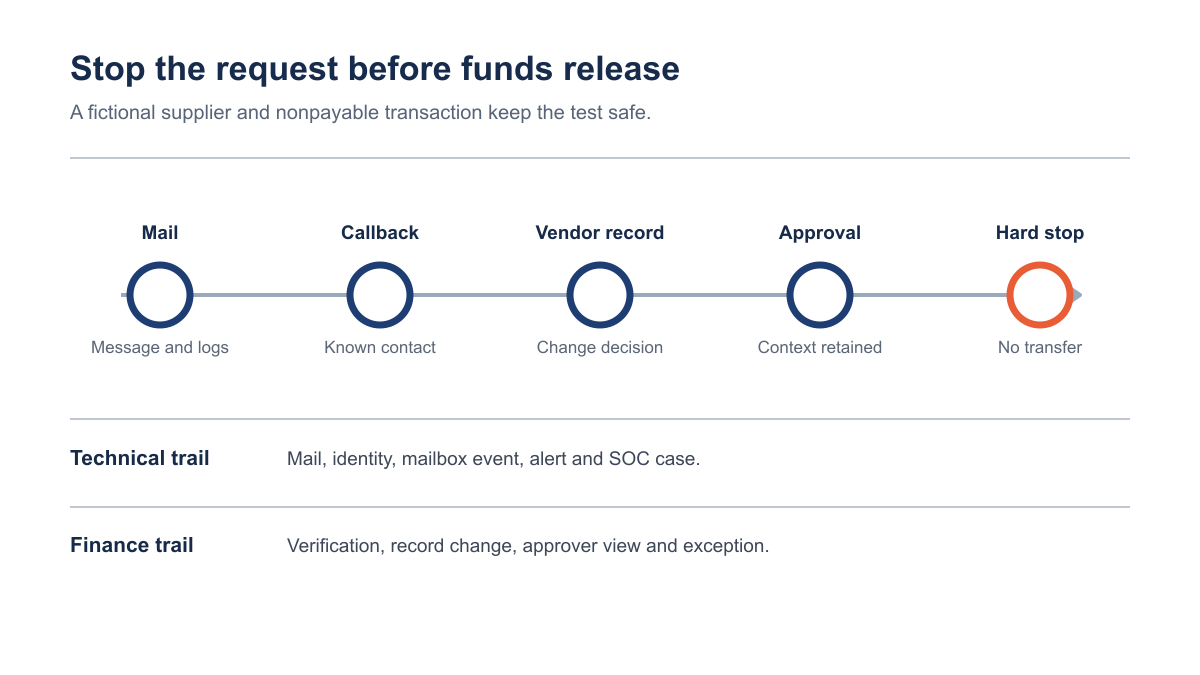
Figure 1: An editorial test path that stops before funds release. Sources: FBI IC3 BEC guidance; FBI IC3 2023 Internet Crime Report; Microsoft audit log activities; NIST SP 800-115.
Include mailbox and identity evidence where the scenario needs it
Payment diversion can follow an external impersonation or a genuine mailbox compromise. The latter may involve changes to forwarding or inbox rules. Microsoft's audit activity reference lists events for creating and updating inbox rules, while its Defender guidance describes suspicious forwarding rules as a BEC investigation signal. A Microsoft 365 buyer should ask whether the relevant logs are available in its configuration, whether alerts route to the SOC and whether investigators can link a mailbox event to the finance request. A buyer on another platform should identify equivalent evidence rather than assume a Microsoft event name applies.
The exercise does not need to create an actual malicious rule to ask this question. A controlled test account and a harmless destination can produce a record if the organization authorizes it. Alternatively, the provider can review the detection logic in a purple-team session with a pre-generated benign event. What matters is whether the tested event is linked to a real triage path. A demonstration in a vendor dashboard that nobody monitors is not the same as an operational alert.
Identity controls may matter as well. If the scenario begins with an assumed compromised mailbox, state that initial access is granted and do not claim that phishing defenses were tested. If the scenario begins with a permitted phishing campaign, name the cohort, landing behavior and what the tester is allowed to collect. Real credentials and live session tokens should not be needed to prove a payment-process weakness when a test identity can exercise the path. The Stingrai phishing service and a broader red-team scenario answer different questions; the SOW should make their boundary explicit.
Measure finance controls and security response separately
A useful report has two timelines. The technical timeline covers mail receipt, authentication result, sign-in or mailbox event, alert routing and SOC action. The finance timeline covers request receipt, callback attempt, vendor-master review, approval, exception and the hard stop. Align them by time. This reveals whether security knew about a suspicious mailbox while finance continued to process the request, or whether finance challenged the change before any technical alert appeared.
The result should include a decision for each control: present and effective, present but bypassed, not configured, not observed or excluded. An alert that appears after the finance decision may still help incident response, but it did not prevent the payment decision in this test. A callback to a telephone number supplied by the suspicious email does not satisfy the independent verification described by the FBI. A valid independent callback may stop the path even if mail detection missed it. Buyers need both facts.
Do not reduce this to a blame exercise for an accounts payable employee. The process might put a single person under time pressure without a reliable number of record, or an approver might see only a changed beneficiary with no reason for the change. Those are design defects. The after-action review should ask what the organization made easy or hard, then assign fixes to the relevant owner: treasury, procurement, identity, email security, fraud operations or the SOC.
An organization may need more than one scenario because its controls differ by request source. A supplier-bank change sent to accounts payable, a customer wire instruction and an executive request for an urgent exception can enter different queues and reach different approvers. Test one route at a time so the evidence remains attributable. If a callback blocks the first scenario, that is a strong result for that route, not a reason to infer that every other route is protected. The next test should be chosen from the remaining business decisions, using a separate fictional counterparty and a fresh control-group briefing. This approach also makes remediation more precise: the vendor-master owner can change one verification rule while the customer-transfer owner can address another without treating them as the same weakness.
Evidence question | Possible owner | What a useful finding says |
|---|---|---|
Was the sender's identity trustworthy? | Email and identity team | Which identity or message signal was observed and its limit |
Was a bank change independently verified? | Procurement or vendor-master owner | Which known contact channel was used and what was recorded |
Did approval preserve context? | Finance control owner | What the approver saw and whether the exception was visible |
Did the SOC connect the events? | Security operations | When the alert arrived and whether finance was warned before the stop |
Could the exercise stop safely? | Control group | Where the transaction was intercepted and how test artifacts were removed |
These are editorial evidence questions. They are not a substitute for the financial institution's own control framework or a regulator's rule. The report can support an audit or assurance discussion, but the organization and its auditors decide how to use the evidence.
Choose the right exercise mode
A tabletop is appropriate when teams have never rehearsed who owns a suspect payment instruction. It can expose missing contacts or uncertain escalation without sending a message. It cannot prove that the production mail path, vendor-master controls or alert routing work. A simulated message campaign can test delivery, reporting and verification behavior, but it should not claim a payment release result if it never reaches the finance workflow.
A human-led red-team exercise can be appropriate when the question is whether a permitted adversarial path crosses several controls before detection. The test may start with an assumed mailbox compromise, an approved external impersonation or a fictional vendor change. It should have a narrower objective than "steal money": reach a defined approval stage using nonpayable records, then stop. A purple-team replay can follow, with the SOC, fraud team and finance owner comparing their timelines and adjusting controls.
Prepare a shared evidence packet for the replay
Finance and security teams often record different parts of the same story. The mail team may have message identifiers and authentication results. The identity team may have sign-in events. Accounts payable may have a vendor-change ticket, and treasury may have an approval record. The control group should identify in advance how those records will be connected without copying entire mailboxes or payment ledgers into the red-team report. A synthetic reference number, test identity and agreed timestamps can provide a common thread. The provider should state which records it needs and who is permitted to supply them.
The replay should start with what each team knew at the time, not what the investigators learned after the test was revealed. Ask the mail analyst what signal was visible before finance received the request. Ask the finance approver what changed in the supplier record and what contact method they had available. Ask the fraud team when it would have intervened and whether a bank or payment processor notification would have been triggered. Then reconstruct the sequence together. This separates a control that worked in real time from one that looks obvious only in hindsight.
Record uncertainty explicitly. A missing mail log might mean the event was not captured, or it might mean retention or permissions prevented the review. A missing callback note might mean no call occurred, or that the process stores confirmation elsewhere. The provider should not choose the more dramatic interpretation without asking the record owner. The final report can still state that the organization could not produce evidence of a verification step, which is a useful governance finding even when the underlying action remains uncertain.
Set a retest that changes the failed condition and leaves the objective constant. If the issue was a callback to an untrusted number, test the revised known-number process. If the issue was an alert that never reached finance, test the handoff and its timing. A different template or different cohort is not, by itself, proof that the original weakness was fixed.
FINRA's 2025 oversight report identifies BEC schemes that target financial-firm email accounts and seek fraudulent wire transfers. The report is a risk source, not a requirement for a particular exercise design. A bank, broker and corporate treasury should each select the route that reflects its own product and transaction authority. A generic phishing template sent to all staff would be cheaper to run but would answer a different question.
What to require in the quote and statement of work
Ask the vendor to describe the test transaction class, starting condition, recipient cohort and fictional supplier or customer. The proposal should identify which mail, identity, vendor-master and payment systems are in scope, which are observed only, and which cannot be touched. A third-party payment processor or supplier portal is outside the organization's authority unless the owner permits testing. The provider should name the exact point at which the transaction cannot proceed to a live transfer.
The SOW should describe communications. Who in the control group knows the scenario? Who can stop it? How will an analyst verify that an unexpected message or account is part of the exercise? What happens if a real employee reports it to law enforcement or a bank fraud team? The team should not suppress a genuine incident during the exercise. Deconfliction is a safety function, not an excuse to ignore real alerts.
Request a two-timeline report, a list of controls attempted, evidence for each decision, a precise explanation of what was not tested and a retest plan. Ask whether the provider can facilitate a joint replay with finance and security. The remediation section should identify the owner of the known-number directory, the vendor change rule, the approver view and the SOC alert. A finding that merely says "train users" does not tell the buyer which structural weakness allowed the path to progress.
Do not compare proposals solely by the number of emails or recipients. One carefully scoped test of a payment change can produce more useful evidence than a broad campaign reporting only clicks. Price should be compared against the access, safety setup, analyst participation, reporting and retest that the proposal actually includes. Stingrai's Get a Quote route is appropriate for a custom finance workflow.
Where Stingrai fits
Stingrai is a Toronto-founded CREST-accredited penetration testing company. Its phishing campaigns can test an approved mail and reporting path; its red-team engagements can follow a named objective across authorized systems and measure defender timing. Human-led work uses two named penetration testers. The buyer should specify whether the goal is mail reporting, a safe finance decision test or a joint replay, since each requires different access and participants.
Stingrai can provide technical evidence and an attack narrative, while the finance owner defines the nonpayable transaction and approves the hard stop. The organization retains responsibility for real payment controls and fraud decisions. Ask for a scope that names the technical and business evidence on both sides of the handoff.
Frequently Asked Questions
What does a BEC payment-diversion red-team exercise test?
It tests whether a controlled fraudulent payment-change request can progress through mail, identity, vendor or customer verification, approval and security response. The exercise should use fictional records and stop before any real bank-detail change or transfer. Its report should show the last stage reached and the control that blocked or missed the path.
Is this the same as a phishing simulation?
No. A phishing simulation may measure delivery, clicks, credential-entry attempts and reports. A payment-diversion exercise follows a specific finance workflow and asks whether an unauthorized change could reach an approval or release decision. It may include a phishing component, but the finance controls are the purchase decision.
Should the provider send a real payment or change a live supplier account?
No. Use a fictional supplier, synthetic details and a nonpayable transaction or staging workflow. The SOW should identify the hard stop and the person who can enforce it. If a live system cannot safely stop a transaction, use a controlled discussion for that portion and label it as such in the report.
Does a successful callback end the exercise?
It can stop the payment-diversion path, which is a valid and valuable result. The team should record whether the callback used a trusted number of record rather than contact details in the suspect message, what the recipient learned and whether the outcome reached the approval system. The technical timeline may still reveal mail or identity gaps that need attention.
What if the email comes from a genuine compromised account?
The sender's authentication may look legitimate. The scenario should test the independent verification and payment controls as well as mailbox and identity telemetry. If the exercise assumes the mailbox is already compromised, the report must say that initial access was granted, not claim that the organization failed a phishing test.
What evidence should the SOC and finance team receive?
They should receive aligned timelines for message and mailbox events, alerts, request handling, verification, vendor-master decisions, approvals and the hard stop. The report should identify each untested or simulated step, control owner and retest condition. The wider executive version can omit raw mailbox and payment identifiers.
Can the exercise support an audit or insurance discussion?
The controlled test can produce evidence of what the organization attempted, observed and changed, which may support an assurance program. It is not a statement that a particular standard mandates this exercise or that a single successful test proves every payment route safe. The buyer should map the evidence to its own requirements and transaction classes.
Related reading
Sources
Talk to Stingrai
Describe the payment workflow, safe stopping point and desired defender visibility in Get a Quote, or book a free discovery call to scope the exercise.