Outsourcing penetration testing transfers execution to a supplier, while the buyer still owns portfolio priorities, permission to test, remediation and acceptance. CREST's penetration testing buyer guide discusses supplier appointment models and asks organizations to define requirements before selecting a provider. NIST SP 800-115 calls for an assessment plan whether testing is done internally or by a third party. The operating model determines whether those responsibilities stay clear after a contract is signed.
Quick answer. To outsource penetration testing, appoint an internal portfolio owner and choose whether one supplier or several specialists will cover the required surfaces. Define the handoffs for onboarding, written authorization, scope changes, live escalation, report acceptance and retesting, then pilot the model before expanding it. Stingrai is a CREST-accredited penetration testing firm that delivers one-time and continuous human-led engagements across web, API, mobile, cloud, network and Active Directory scopes.
This guide is for a security leader or procurement team building an external testing operating model for a mid-market or enterprise environment. It addresses the relationship with the supplier, the handoffs that commonly fail, and the evidence an internal owner should require. For a decision driven by the testing firm's impartiality or a program-specific assessor rule, use the third-party penetration testing guide. If the immediate problem is comparing two prices for a single app, use the narrower quote comparison worksheet.
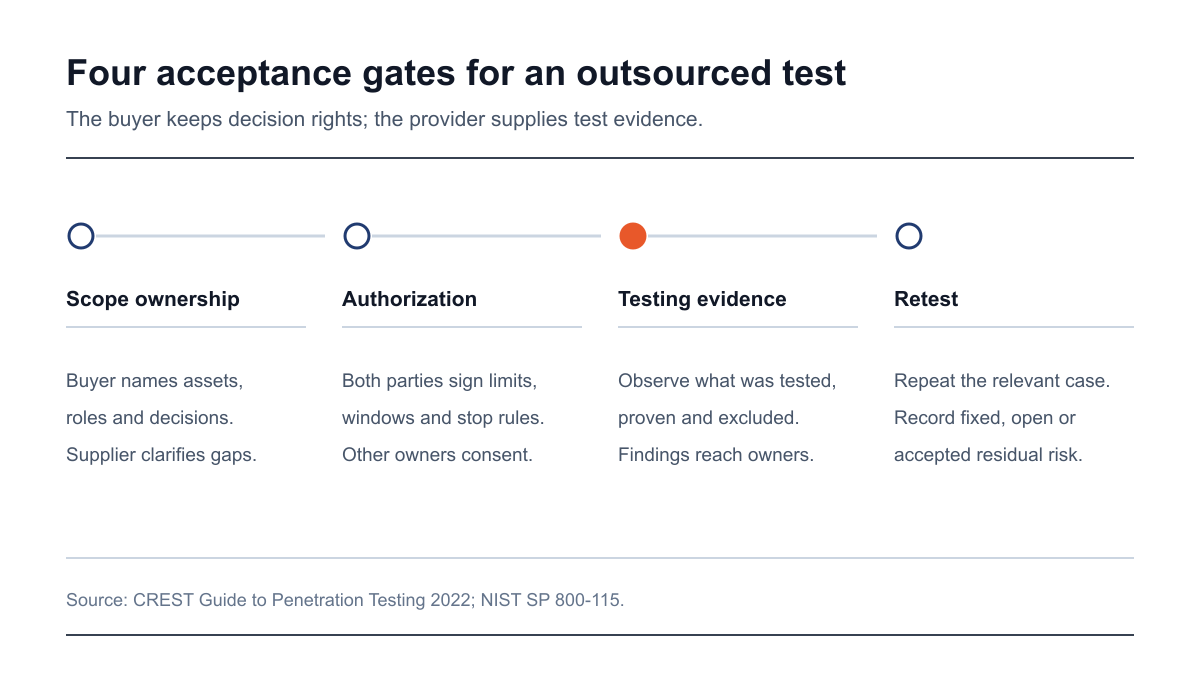
Figure 1: The buyer owns four gates even when testing is external. Sources: CREST, A Guide to Penetration Testing 2022 and NIST SP 800-115.
Start with the decision the test must support
"We need a pentest" is not yet a useful brief. The same words can describe a pre-launch web application test, a cloud identity attack-path assessment, an annual network test, or evidence for a customer security review. Each needs different access, tester experience and deliverables. Write a decision statement before drafting a scope: "We need to know whether a standard user can cross tenant boundaries in the new application before enterprise release" or "We need independent evidence that external access and internal segmentation controls work at these sites."
The decision statement identifies the risk owner, the assets that matter, the deadline and the audience for the result. A software engineering lead may need a reproducible API authorization finding; a board may need an attack-path summary; an auditor may need the exact scope, dates, method and retest status. A single report can serve all three, but only if the contract requires each output. CREST advises defining report format and content in the scope and contract, not leaving it to the provider's template (Guide to Penetration Testing 2022).
Create a one-page buying brief with five fields:
Field | Buyer decision to record | Why the provider needs it |
|---|---|---|
Business objective | The transaction, data boundary or critical function whose compromise would change a decision. | Directs manual work toward business impact rather than a generic scan. |
Authorized assets | Exact applications, APIs, cloud accounts, networks, environments and owners. | Determines access, test methods and permission to test. |
User and privilege model | Representative roles, tenants, service identities and administrator paths. | Makes authenticated and cross-role testing possible. |
Operational limits | Production windows, prohibited actions, third-party systems and stop authority. | Allows the team to test safely and to know when to halt. |
Evidence audience | Engineering, risk, customer, regulator or audit stakeholders, and their expected document format. | Defines the report, attestation and retest acceptance criteria. |
The brief is an input to discovery, not a substitute for it. A capable supplier should challenge an asset list that omits an administrative API, a connected identity system or a cloud account that grants the application its data access. A good challenge changes scope before the statement of work is signed. It does not silently expand live testing after authorization.
Choose an outsourcing model that fits the portfolio
CREST's buyer guide describes single-provider and dual-provider models, including their strengths and limits (CREST, supplier appointment models). The practical choice depends on the portfolio and the internal capacity to coordinate specialists.
Model | Fits when | Buyer responsibility | Watch for |
|---|---|---|---|
One provider across the portfolio | The same provider can demonstrably test the relevant application, cloud and infrastructure surfaces. | Maintain one scope register and compare results across systems. | A broad brochure hiding weak depth in one specialty. |
Specialist providers by surface | Mobile, OT, AI or a regulated test requires skills not present in the main provider. | Resolve boundaries between providers and normalize severity and evidence. | Gaps at the handoff, such as the mobile API or cloud identity path. |
Project-by-project procurement | Tests are infrequent, products have separate owners or the portfolio is changing rapidly. | Repeat onboarding, authorization and report review for each engagement. | Inconsistent methods and no shared view of recurring findings. |
Retained testing program | Applications release frequently or multiple teams need recurring assurance. | Own prioritization and accept scope changes for each release. | A subscription that promises coverage without named assets, cadence or tested roles. |
Do not buy a single provider merely to reduce procurement paperwork. Ask the proposed lead tester to explain one realistic attack path across two of your surfaces. For example, an application role may access a cloud resource through a service principal; a mobile app may call an API that shares authorization with the web app. If the provider treats each as an isolated checklist, a single contract has not bought integrated coverage. Conversely, a two-provider model is only stronger if the SOW states who tests the shared boundary and who consolidates the result.
For an enterprise program, define a portfolio owner inside the organization. That person approves the annual test map, records which systems are in scope this cycle, keeps architecture and role inventories current, and signs off on remediation evidence. Outsourcing the testing does not transfer the authority to choose which business risk is acceptable.
Give every bidder the same scope packet
The fastest way to create incomparable bids is to send each vendor a different explanation of "the application". Send a compact scope packet to all bidders, then answer clarifying questions in one shared addendum. This differs from issuing a long generic questionnaire: it makes the work itself comparable.
For a web or API test, supply the staging or production URL, API documentation, major workflows, expected user roles, whether source access is available, whether test accounts and sample data can be provisioned, and any rate limits or destructive actions to exclude. For cloud work, list the accounts or subscriptions, identity provider, relevant projects, permitted read and active tests, and any managed services whose rules require separate permission. For network work, specify ranges, sites, remote access method, operating windows and systems that must not be touched. For mobile, identify the IPA or APK, backend endpoints, supported operating systems and test devices.
The packet should mark customer-controlled systems, third-party services, and shared infrastructure separately. NIST SP 800-115 says that when an organization does not control the network being tested, the other owner usually must consent in writing to the plan. That rule matters for a hosted app, a colocation facility, a SaaS integration and a cloud platform boundary. The buyer should identify the owner and obtain approval before active testing, rather than ask testers to infer permission from a commercial contract (NIST SP 800-115, section 6.5).
Give bidders the same evidence requirement, too. A report for an authenticated SaaS app should tell engineering which role, object and workflow were tested, what was observed, what could not be tested, and how a fix will be verified. A request for "OWASP coverage" alone is vague. The OWASP Web Security Testing Guide is a technique reference for web applications and web services, not a rigid checklist or compliance certificate. Ask the bidder to map its proposed tests to your architecture and business objectives.
Evaluate the delivery team, not just the company name
The company credential and the people who conduct the test answer different questions. A firm-level accreditation can show that the organization has been assessed against a service standard. The SOW still needs the actual testers, their relevant experience, the method they will use and who reviews their report. Verify an asserted CREST accreditation on the CREST Marketplace, then ask who is assigned to this engagement and whether that team has delivered the specific scope you are buying.
Ask for a redacted report sample with a difficult authorization or business-logic finding, not only a list of known software versions. The sample should show an observed path, impact tied to a business action, actionable remediation, safe proof and retest evidence. A cloud or network sample should demonstrate an end-to-end path or a clearly bounded failed path, with enough detail for an owner to reproduce the configuration state. Redaction is expected; customer names, credentials and live targets are not needed to judge the work.
Use pass or fail gates before scoring price:
Method fits the surface. The provider can explain authenticated roles, manual authorization tests, cloud identity paths or internal network boundaries relevant to the actual scope.
Named delivery ownership. A lead tester and a manager are accountable for scope decisions, quality review and escalation.
Safety and authorization. The provider accepts written rules of engagement, prohibited actions, stop contacts and third-party permissions.
Evidence handling. The provider can describe access controls, encryption, report sharing, retention and deletion for material found during testing.
Remediation loop. Retesting is included or explicitly priced, with a defined request window and a report update.
Only then compare commercial terms. A low price on an external-only scan is not equivalent to authenticated web testing across roles, even when both proposals say "penetration test." The quote comparison guide provides the price-normalization method; this article focuses on whether the outsourced operating model will deliver and retain usable evidence.
Put authorization and data handling in the contract
NIST SP 800-115 says an assessment plan should identify scope, authorized testers, logistics, sensitive-data handling and incident response. It also advises explicit exclusions and the permitted level of testing. Turn those headings into contract attachments, signed by the parties with authority over the systems.
The rules of engagement should identify the precise targets and environments, source IPs or test access method, permitted hours, rate limits, prohibited actions, account creation and cleanup, emergency stop authority, and how to handle an incident discovered during the test. Production work needs an owner who can answer a scope question promptly. If the provider discovers a connected service that is not authorized, the team should document it and request a written scope change before testing it.
Data handling needs its own answer. Testers may see personal information, source code, secrets or customer records. Specify what may be copied, whether a synthetic proof is enough, where evidence is stored, who can access it, how it is transferred, the retention period, and when it is deleted. NIST identifies storage during and after the test, transmission and removal as assessment-plan topics. A generic confidentiality clause is useful but does not tell a tester what to do with a screenshot that contains a real customer record (NIST SP 800-115, section 6.5).
The provider's own sample reports should be redacted before procurement review. Internal evaluators need to judge format and detail without receiving another organization's data. Apply the same discipline to your finished report: keep the full technical version under restricted access and give a customer or auditor only the permitted summary and scope evidence.
Run the first engagement as a controlled pilot
For a new supplier, choose a bounded but meaningful system. It should have real authorization or infrastructure questions, a cooperative owner, representative test identities and a feasible remediation team. A toy app proves little; a critical payment system with no safe test window is a poor first exercise. The pilot's job is to demonstrate how the relationship works, not to certify the entire portfolio.
At kickoff, confirm the scope packet against the live architecture. Have the provider repeat the permitted and excluded assets, privileged accounts, data-handling rules and emergency contact. Set a brief communication cadence that makes a material finding visible while it can still be acted on. If findings will appear in a portal or ticket system, test that the right engineers can view them and that sensitive evidence is not pushed to an overly broad channel.
During testing, track coverage decisions separately from findings. A provider may report no issue in a role that was never provisioned; that is a coverage gap, not a clean result. Require a short running list of completed roles and workflows, blocked access, excluded targets and agreed changes. When a critical issue is found, the internal owner should decide whether to authorize continued testing, apply a fix, or suspend activity. The tester should not improvise that business decision.
At the close, compare the work against the signed SOW. A finished pilot has a scope record, method and dates, observations with evidence, limitations, an executive view, engineering fixes, and a retest path. CREST's guide says report format and content should be set in the scope and contract. A PDF delivered on time is only an accepted deliverable if it covers the promised work (CREST, reporting guidance).
Make the report an acceptance test
An outsourced report is an input to decisions. Require enough detail to distinguish a tested boundary from a configured control that was merely observed. A buyer can use the following acceptance matrix during the review meeting:
Acceptance question | Evidence to look for | What to do if missing |
|---|---|---|
What was actually tested? | Asset, environment, role, dates, method and material exclusions. | Ask for a coverage addendum before accepting the report. |
What was proven? | Reproducible observation, affected business action, safe proof and impact limits. | Ask the tester to separate observed impact from inference. |
Can an owner fix it? | Root cause, affected component, practical remediation and verification case. | Request an engineering walkthrough. |
Did the fix work? | Retest date, same test case, result and remaining exception. | Keep the item open until retest or a documented risk decision. |
Can the report be shared? | Executive summary and a redacted scope or attestation artifact where contracted. | Restrict the technical report and prepare an approved summary. |
For a multi-system program, preserve a portfolio register with the test date, provider, asset owner, scope, open findings and retest status. That register makes repeat testing deliberate. It also shows where an application changed after its last test or where a cloud identity path fell between two vendors. The provider can supply the evidence, but the buyer owns the register and the decision to accept residual risk.
Budget for the whole loop
Outsourcing cost depends on the asset count, user roles, testing depth, access preparation, cloud and network boundaries, reporting needs, retest terms and cadence. Do not compare a quote for one web application with a quote for a portfolio that includes mobile clients, connected APIs and cloud identity. Ask each supplier to state the units of scope and how changes affect price. Set aside internal time for account provisioning, architecture questions, finding triage and retest scheduling; those tasks are part of the program even if they are not on the vendor invoice.
The contract should clarify whether retesting covers all remediated findings, only selected severities, or a fixed period. Clarify whether a major release triggers a new test, a scope change or an included follow-up. For many products, one-time testing before a launch and a continuous program for rapidly changing surfaces are both valid. The choice follows release frequency and the evidence your buyers or auditors expect, not the provider's preferred billing model. For broader price context, see the penetration testing cost guide and the enterprise PTaaS portfolio quote worksheet.
Where Stingrai fits
Stingrai is a CREST-accredited penetration testing company headquartered in Toronto. Its human-led work covers web and API, mobile, AI and LLM, cloud, internal and external network, Active Directory and social engineering scopes. The PTaaS platform posts confirmed findings with proof and remediation guidance during testing, supports direct chat with the assigned testers, and includes retesting. Stingrai offers one-time engagements and continuous programs. Human-led and hybrid engagements include an attestation letter stating scope and dates, which can support a buyer's compliance and customer-assurance process.
For a web application and associated APIs, Stingrai also offers Snipe's autonomous testing and a Hybrid Pentest in which Snipe and named penetration testers work together throughout. Snipe is scoped to web applications and associated APIs; it is not the cloud, mobile or network test team. An enterprise scope across multiple assets or other surfaces is quoted to the agreed inventory and evidence requirements. The web and API service, cloud service and network service show the relevant test families.
An efficient first conversation starts with the buying brief: what decision the test supports, what assets are controlled, which roles and environments can be provided, and what report must be shared. That lets the proposal describe a real engagement rather than an undefined "pentest" line item.
Frequently Asked Questions
How do you outsource penetration testing for an enterprise?
Name an internal owner, define the business decision and controlled assets, send the same scope packet to bidders, verify the testing team and method, and sign the rules of engagement. Accept the work after reviewing coverage, usable findings and retest evidence. NIST SP 800-115 calls for an assessment plan for third-party tests as well as internal ones.
Should we use one penetration testing provider or several?
Use one when the same team can demonstrate depth across your actual surfaces and maintain a coherent portfolio view. Use specialists when a surface needs skills the lead provider cannot show, then assign ownership of shared boundaries and consolidate evidence. CREST's buyer guide describes both single- and dual-provider models.
What should be in an outsourced penetration testing statement of work?
Include exact assets and owners, environments, user roles, permitted techniques, excluded actions, test windows, third-party approvals, data handling, stop contacts, deliverables and retest terms. The SOW should state how a scope change is approved during testing.
Can a vendor test a cloud or SaaS system we use?
Only the customer-controlled parts you are authorized to test should be in the signed scope. NIST SP 800-115 says the owner of a third-party network usually must consent in writing when that network is part of the assessment. Confirm platform rules and the other owner's permission before active work.
How do we know an outsourced test was more than a scan?
Ask for the tested roles and workflows, observed authorization or attack-path evidence, limitations and reproducible findings. A scanner output without a safe proof, business impact and a retest case is not enough to accept a manual penetration test. The report should match the method and depth promised in the SOW.
Who owns remediation after the outside team leaves?
The buyer assigns an internal owner to each finding and keeps the portfolio register. The provider explains the observation, supports a fix discussion and retests within the contracted terms. The final decision about residual business risk stays with the buyer.
Does outsourced penetration testing support audit and customer evidence?
Yes, a scoped test can produce a report, test dates, limitations and retest status for a compliance program or customer review. Requirements vary by framework and contract, so the buyer should state the evidence audience before testing. Stingrai's human-led and hybrid engagements include an attestation letter stating scope and dates.
Related reading
References
NIST. SP 800-115, Technical Guide to Information Security Testing and Assessment. September 2008. Section 6.5 addresses the assessment plan, third-party authorization, data handling and incident coordination.
CREST. A Guide to Penetration Testing 2022. 2022. Buyer requirements, supplier models, contracting and reporting.
OWASP. Web Security Testing Guide, Introduction. Current online guide. Scope and limits of the web and API testing methodology.
CREST Marketplace. Stingrai Inc.. Current directory listing. Firm-level Penetration Testing accreditation.
Stingrai. Penetration Testing as a Service. Current service description. One-time and continuous delivery, live findings, report and retest.
Talk to Stingrai
To scope outsourced human-led testing across your applications, cloud or infrastructure, get a quote or book a free discovery call. Bring the asset inventory, evidence audience and intended testing window.