An API gateway is a policy enforcement point whose security depends on which policies it owns and what the backend still checks. NIST SP 800-228 update 1 describes centralized, hybrid and distributed gateway designs and warns that a shared perimeter gateway can be bypassed if an internal path reaches a service without the same checks. For an enterprise buyer, the procurement question is whether an assessment will follow the entire authorization decision from caller to route to backend object, rather than test only that a gateway rejects an invalid token.
Quick answer. Scope an API gateway security assessment across deployed routes and versions, caller authentication, policy matching, token or header translation, backend reachability, object and function authorization, and the logs that prove each decision. Test the same authorized and forbidden cases through every relevant gateway and a controlled backend path. Stingrai's API penetration testing service includes direct API testing across roles and tenants and can review gateway configuration when white-box access is granted; the statement of work must name those components.
This guide has a narrower buying question than the general API penetration testing checklist. That checklist maps common API risks. A gateway and backend assessment asks which team enforces each decision, whether deployed routes match the inventory, whether a backend trusts the correct identity and whether an alternate path defeats the intended policy. It complements protocol-specific work such as a gRPC API penetration test or an mTLS API assessment.
First identify the real enforcement pattern
“Behind a gateway” is not a complete architecture. NIST's API protection guidance describes three patterns. A centralized gateway holds shared protections in one component. A hybrid pattern puts cross-cutting functions such as authentication at a shared gateway while application-specific authorization can remain with the service team. A distributed pattern places policy enforcement closer to individual applications. An enterprise may use more than one pattern at the same time. Ask the platform owner to draw the actual path for each critical API, not choose a label from a product brochure.
The drawing should include the public hostname, load balancer or ingress, gateway instance, route or operation, backend integration, service identity, resource store and any internal caller path. Mark where the client token is validated, where it is translated or replaced, where a user or tenant is selected and where an object permission is decided. Include different environments only when they matter to the assessment. This is a procurement artifact: it lets the buyer ask a vendor exactly which policy layer and backend it will test.
Ownership is equally important. The gateway team may maintain authentication and rate-limit policies, while an application team owns authorization and a cloud team owns the network path to the backend. A finding at the boundary can otherwise be passed between teams. The statement of work should name the configuration and source artifacts the provider can review and the people who can explain expected behavior. A black-box test may discover a forbidden response; a source-assisted or configuration-assisted scope can identify the missing policy or trust assumption more efficiently.
Do not assume centralization is inherently safer. NIST describes tradeoffs in every pattern. A centralized gateway may be easier to govern consistently, but its protection can be bypassed through other network paths if backends rely solely on it. A hybrid model distributes responsibilities and requires the owners to show that the split is consistently enforced. The buyer's objective is a tested decision contract, not a preferred diagram style.
Turn the route inventory into a testable contract
Start with what is deployed, not only with the current OpenAPI file. Ask for gateway exports, API definitions, public DNS names, path and method tables, backend mappings, environment names and the list of supported API versions. OWASP API9:2023 calls out the risk of incomplete host and version inventories. NIST REC-API-8 recommends reconciling declared specifications with live traffic to find shadow, orphan and zombie endpoints.
For each important route, write the caller types and expected outcome. An ordinary user may read an owned object. A partner client may read a subset of objects. An administrator may change configuration. A workload identity may call an internal operation without representing a human user. These are examples; the actual product roles govern the test. A route without an owner or expected audience is a preparation problem that should be fixed before the provider labels an authorization result.
Include old routes and environment differences. An earlier API version may still serve clients, and a beta host may reach the same backend with different gateway policy. A route can be protected on one gateway deployment and left open on another. The provider should compare the declared inventory with the hosts and methods it can observe within the authorized scope. A useful report names the route, version, environment, policy and backend for every tested path, rather than saying only that “API security was assessed.”
Test cases should have a legitimate call and a forbidden counterpart. A missing token, a token for the wrong audience, a user in another tenant and a role lacking the function each answer a different question. The bidder should explain which pairs it will exercise and how much time is allocated to them. Testing every combination may be impractical; a risk-based selection should be explicit and tied to sensitive operations and data.
Follow caller identity through the gateway
The first decision is who the gateway believes the caller is. A buyer should supply the identity provider, accepted token types, expected issuer and audience, client certificates if used, and the route-level policy map. The test should check representative valid and invalid credentials under the approved rules. It should also observe whether a route receives a user identity, a client identity, a subscription identifier or no identity at all. Those are not interchangeable.
Microsoft's Azure API Management guidance gives a concrete example of two different OAuth arrangements. In one, the token is intended for the backend and the gateway can validate it before forwarding. In another, the token is intended for API Management, which then uses a separate mechanism to reach the backend. The buyer should document which arrangement their deployment uses. A provider should not infer the backend's user context simply because a gateway returned a successful response.
The same vendor's security guidance cautions that an API Management subscription key identifies a subscription, not a user or app. That is a useful question even outside Azure: what does each credential actually establish? A test should compare a user token, an application credential and a gateway key against the organization's intended policy. The report should avoid treating a shared routing or billing key as proof that a specific person may view a customer record.
Header transformation is another decision point. Some gateways add an identity header, remove a caller-supplied one, exchange a token or forward the original token. Ask the platform owner which fields the backend trusts and which component is allowed to set them. The tester can then verify, within the approved scope, that the backend sees the intended principal and that a client cannot substitute a different principal through an alternate ingress path. This is an authorization question, not a request for a generic header fuzzing exercise.
Separate gateway authentication from backend authorization
A valid token proves something about a caller. It does not answer whether that caller may read one invoice, change one account, view one field or invoke an administrative function. OWASP API1:2023 addresses permission for a specific object. API3:2023 addresses properties exposed or modified beyond the caller's rights. API5:2023 addresses access to functions intended for another role. A gateway may enforce some of these decisions, but the buyer needs to know exactly where.
Build a small role-and-object matrix. Use two controlled organizations or tenants if the service is multi-tenant, then provide objects owned by each. Add an administrator and a workload identity only where they exist. For each selected operation, record the expected result for an owner, a peer, a different role and a signed-out caller. The provider should exercise the same operation via the public route and any authorized internal route. A mismatch reveals which layer may have been relied upon incorrectly.
The report should show more than a response code. A denied update may return an error while still queuing a background job. A list endpoint may omit the main object but leak a sensitive field in a summary. A gateway may reject an invalid token while a backend accepts a token for an unintended audience. The tester should record the expected decision, the request identity, the observed response and any downstream state that can be checked safely. Synthetic data keeps that evidence useful without exposing live records.
Do not turn an editorial test matrix into a claim that every API needs field-level authorization at the gateway. NIST discusses endpoint and field annotations as design options, and the chosen implementation depends on the application. A buyer should ask whether the current design's intended object and property decisions are enforced consistently, wherever those decisions live.
Check backend reachability and alternate paths
NIST's centralized-gateway discussion warns that a shared perimeter gateway can be bypassed by an internal pivot, which bypasses policies enforced only there. The assessment should therefore check whether a backend is reachable through a direct public hostname, a second ingress, a legacy path or an authorized internal position. The buyer must provide written permission for each test source and target. An external-only pentest cannot prove an internal route is absent.
Reachability alone is not the entire finding. Some backends intentionally accept traffic from a private mesh and authenticate it with service identities. The provider should compare the observed path with the intended network and identity policy. If a route bypasses the shared gateway, what equivalent checks does the backend or service-level proxy perform? If it accepts traffic only from an approved gateway, what evidence supports that claim? A useful report explains the path and the control owner without overstating exposure from a benign internal connection.
Gateway configuration can change faster than backend code. A new route may inherit a broad policy, a version alias may map to an older integration, or a testing environment may become externally reachable. Include the deployed gateway configuration and the platform's release path when the buyer needs assurance after a migration or acquisition. The provider can compare configuration and observed behavior, then document the build or deployment tested. A stale diagram is not evidence of the active route.
The safety boundary matters here. Direct backend checks should use agreed targets, source networks and low-impact requests. They should not involve indiscriminate internal scanning or attempts to cross into services the buyer cannot authorize. If a third-party platform owns an ingress or backend, the report should list it as excluded or include a separate permission. Procurement can then decide whether the remaining evidence is enough.
Include machine identities and service-to-service calls where relevant
Enterprise APIs are often called by jobs, integrations and other services. A human login matrix alone will miss how a gateway authenticates a service and how the backend limits what that service can do. The buyer should list the workload identities that call in-scope routes, their intended audiences and the backend permissions they need. The test need not request production secrets; provide controlled credentials or a test environment that exercises the same policy.
A service-to-service path can be direct or can pass through a gateway or mesh. NIST's hybrid pattern explicitly divides shared and application-level policy responsibilities. The SOW should state whether internal calls, service-level proxies, mesh policy and backend service identities are included. Otherwise one bidder may test only the external HTTP entry point while another tests the trust path that actually moves customer data between services.
Check how the backend distinguishes a request made for a user from a request made by an application on its own behalf. These may have different allowed operations. A provider can test representative permitted and forbidden calls using synthetic objects, then document whether the identity and tenant context survived the gateway or token exchange. If a shared service identity performs all backend actions, the report should say how the application enforces the original caller's rights before handing work to that identity.
Rate limits, quotas and circuit breakers are also part of many gateways, but they need a safe test plan. NIST treats them as runtime controls. The provider should state whether it will validate policy configuration, perform low-volume functional checks or include a separately authorized load exercise. Do not let a “gateway security test” quietly become a denial-of-service test against production.
Make policy telemetry part of the evidence
A gateway and backend can disagree while returning the same visible status to a caller. Logs and traces can help determine which layer accepted or denied a request. NIST REC-API-18 recommends logs, metrics and distributed traces tagged with API context and calls for signals about policy enforcement outcomes. The buyer should ask which logs the provider may see, how test traffic will be marked and who will retrieve the backend decision record.
For a small set of controlled cases, the report can pair a request identifier with the gateway policy result, routed backend, principal or service identity, application authorization result and final response. It does not need to reproduce secrets or entire customer payloads. A denial can be treated as proven when the evidence shows both the expected response and the absence of an unauthorized state change. If the organization cannot correlate the layers, that is a visibility gap to report separately from an access-control defect.
Logs have their own scope and privacy rules. Agree on retention and redaction for test identities, tokens and synthetic objects. The provider should not ask for broad production log export merely to verify a few cases. A focused evidence bundle is easier for engineering and audit stakeholders to review.
Give every bidder the same decision matrix
The table below is an editorial procurement tool. Replace the examples with the actual routes, roles, backends and policies. It is especially useful when a platform team and several application teams share one gateway, because it shows who must supply each test fixture and who should own a finding.
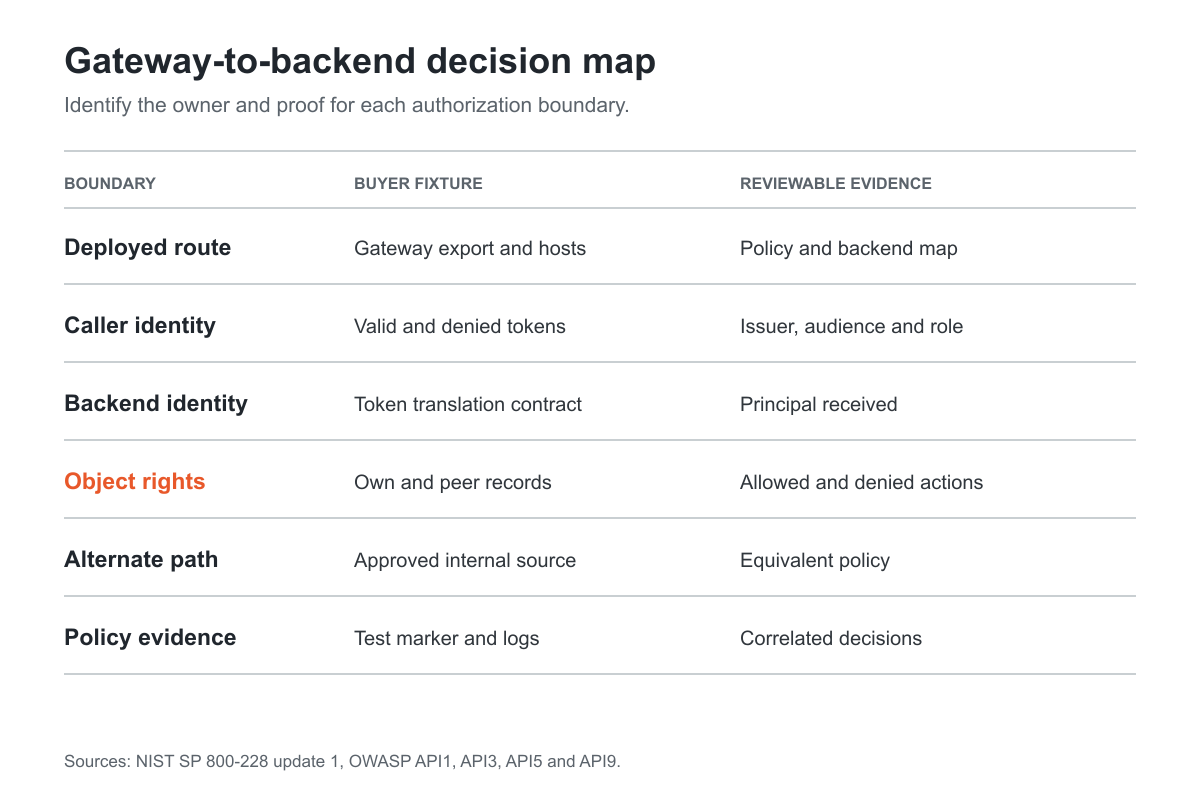
Figure 1: An editorial gateway-to-backend decision matrix for buyer fixtures and reviewable evidence. Sources: NIST SP 800-228 update 1, OWASP API1, API3, API5 and API9, and Microsoft API Management authorization guidance.
Boundary | Buyer supplies | Provider demonstrates |
|---|---|---|
Deployed route | Gateway export and live host list | Policy, version and backend mapping match the inventory |
Caller identity | Valid and denied controlled credentials | Route validates the intended issuer, audience and caller |
Backend identity | Token or header translation contract | Backend sees the principal and service identity intended |
Object permission | Separate owned and peer objects | Allowed and denied object, property and function decisions |
Alternate path | Approved internal or legacy source | Equivalent policy on any reachable backend path |
Policy evidence | Test marker and authorized logs | Correlated gateway and backend outcomes |
Require the provider to return an evidence record against these rows. “Gateway checked” should identify the specific route and policy, not only the product name. “Backend checked” should identify the application decision and test identity. A row that could not be tested should be marked excluded with the reason and an owner, so the security leader can decide whether an additional engagement is needed.
Compare the scope and quote, not the gateway logo
Give competing providers the same route inventory, representative credentials, object fixtures and policy diagram. Ask whether they include configuration review, direct API testing, source-assisted authorization review, internal-path validation, logs and a retest. A quote limited to gateway settings can be useful for a platform configuration question but cannot establish that backend object authorization works. A full API test without gateway access may miss the policy inheritance and routing problem the buyer is trying to resolve.
Cost depends on the number of routes, applications, roles, tenants, environments and policy owners, plus whether the provider has an approved internal source and configuration access. Avoid comparing a count of endpoints without the role and object matrix. One sensitive route with several caller types and a backend token exchange may need more work than many simple public read-only operations.
Ask for a clear stop rule. Testing should use controlled identities and data, approved hosts and low-impact calls. If a provider discovers an alternate backend path, it should validate the path only to the agreed proof threshold and notify the owner. No customer record or credential belongs in a public write-up. The signed scope should explain how the test will handle a shared gateway whose other tenants or applications are out of bounds.
Finally, set deliverables. The report should identify the tested deployment, route and version coverage, expected and observed authorization, redacted proof for confirmed findings, affected owners, remediation guidance, exclusions and retest outcome. A retest should repeat the original forbidden call through the relevant route after the policy or backend fix. An annual baseline or one-time assessment can be supplemented with a continuous program when routes and backends change frequently.
Where Stingrai fits
Stingrai is a proud CREST-accredited penetration testing service provider founded in Toronto in 2021. Its API penetration testing service tests APIs directly across roles and tenants, covers REST, GraphQL, gRPC and SOAP, and can use gateway configuration in a white-box engagement. Its web application service can include the application workflows that call those APIs. Two named penetration testers from a team holding OSCE³, OSWE, OSEP, CREST CRT and CISSP certifications perform human-led engagements, with team-lead and engagement-partner review.
For a gateway and backend assessment, give Stingrai the deployed route inventory, controlled callers, expected policy and relevant backend owners. The technical report, live confirmed findings, remediation guidance and included retest can support your SOC 2, ISO 27001 or other compliance program with evidence of the tested API boundaries. Stingrai offers one-time or annual tests and continuous programs; choose the cadence that matches route changes and procurement need. Book a discovery call to map the decision chain before a quote.
Frequently Asked Questions
What should an API gateway security assessment include?
It should include the deployed routes and versions, caller authentication, gateway policy matching, token or header handling, backend identity, object and function authorization, alternate backend paths and correlated evidence for allowed and denied calls. NIST SP 800-228 update 1 describes different gateway patterns, so the signed scope should follow the organization's actual enforcement design.
Is checking gateway configuration enough to prove API authorization?
No. Gateway configuration can show a policy exists, but a controlled request must show how the policy and backend behave together. An authenticated caller may still lack permission for a specific object, field or function. The assessment should compare expected and observed decisions at the relevant layers.
Should a backend be tested directly?
Yes, when the buyer owns the backend and can authorize a safe test path. A direct or alternate route can reveal whether gateway-only protections are bypassed or whether equivalent backend controls apply. The scope should name the source network, target and proof limit.
Does an API subscription key identify a user?
Not necessarily. Microsoft states that an Azure API Management subscription key identifies a subscription, not a user or application. The buyer should document what its gateway key establishes and test user or workload identity with the mechanism its own design actually uses.
Which test accounts are needed?
Supply controlled credentials for the caller types and roles that use the API, plus separate owned and peer objects when the service is multi-tenant. Add an administrator or workload identity only if the real application uses one. Each fixture needs an expected permission decision.
What evidence should the provider return?
Request the route and deployment tested, request identity, expected policy, gateway outcome, backend outcome, redacted response or state change, exclusions and retest result. A response code without context does not show where a decision was made or whether a downstream action occurred.
How should two gateway assessment quotes be compared?
Give both providers the same route inventory, backend map, policy owners, roles and synthetic objects. Compare configuration access, source-assisted review, direct API requests, internal-path checks, log correlation, safe proof limits and retest terms. The cheaper quote may have excluded the backend authorization boundary.
When should gateway and backend authorization be retested?
Retest confirmed findings after a fix and revisit sensitive paths when routes, identity providers, token exchanges, backend services or tenant models change. A one-time or annual baseline can be supplemented with a continuous program where deployments change frequently.
Related reading
References
NIST SP 800-228 update 1 publication page and full guidance. March 2026 update to API risk and control guidance.
Microsoft Learn: API authentication and authorization in API Management. Caller-to-gateway and gateway-to-backend patterns.
Microsoft Learn: Secure Azure API Management. Subscription-key and gateway hardening guidance.
OWASP API1:2023 Broken Object Level Authorization, API3:2023 Broken Object Property Level Authorization, API5:2023 Broken Function Level Authorization and API9:2023 Improper Inventory Management. Authorization and inventory categories.
Stingrai API penetration testing and web application penetration testing. Service scope.
Talk to Stingrai
Share your deployed routes, policy ownership, controlled callers and expected backend permissions so the team can scope the actual decision path. Get a Quote or book a free discovery call.