gRPC defines services and remote methods through an interface definition, usually Protocol Buffers, and supports distinct unary and streaming call patterns. The gRPC project's core documentation describes those method forms. A procurement brief that says “test the API” can miss material work if the provider prices only a REST gateway or only the simplest unary calls.
Quick answer. A gRPC API penetration test should enumerate the in-scope service methods from proto definitions and deployed behavior, then verify authentication, method and object authorization, metadata handling, business rules, and stream-specific state as controlled identities. The buyer should provide proto files, client roles, a safe test environment, and expected access decisions, and require a method-by-role coverage matrix with redacted evidence. Stingrai's API penetration testing service expressly names gRPC and scopes APIs using protobuf files; standalone or complex gRPC work should be defined in a custom quote.
This guide is for security and engineering buyers whose applications use gRPC for internal services, mobile backends, partner integration, or communication behind a web application. It is narrower than a general API penetration testing checklist. The buying decision here is whether the proposed assessment follows the actual method, identity, and streaming architecture rather than treating gRPC as an HTTP service with a different content type.
Inventory services and methods before counting endpoints
Start with the service definitions. A proto file declares services, methods, and message structures. It does not by itself prove that every declared method is deployed or that every deployed method appears in the file supplied to the tester. Ask the provider to reconcile the approved definitions with the environment in scope and state what could not be reached. gRPC's core concepts provide the service and method vocabulary, while the signed statement of work provides the authorization to test particular systems.
List each service and method, its business purpose, client type, environment, and owner. Add whether it is externally reachable, reached only through a gateway, or used between internal services. A public API and an internal service may share message types but make different trust assumptions. A buyer who wants the internal call path tested must include network access and the service identity needed to reach it. A quote for a public gateway does not automatically cover the backend method.
Do not equate one service with one uniform risk. A service can expose read-only queries, administration, bulk export, asynchronous processing, and state-changing commands. The method inventory should label which actions use customer objects, which use privileged roles, which create side effects, and which return sensitive fields. That lets the provider estimate role permutations and safe fixtures, rather than quoting on a raw count of proto methods alone.
Include methods that are reachable through multiple client paths. A mobile application may call the gRPC service directly while a browser reaches the same business operation through a REST translation layer. The test should say whether both paths are included. If the buyer needs to know whether gateway policy and backend policy agree, testing only one path will leave that question unanswered.
Distinguish the four RPC method forms
The gRPC documentation identifies four forms: unary, server streaming, client streaming, and bidirectional streaming. This is a service definition fact, not a claim that every deployment uses all four. The buyer should mark which forms appear in the product, then ask the provider how each form changes the test plan.
A unary call has one request and one response. It can still have serious authorization and business logic issues, but the test interaction is bounded. A server stream sends multiple responses after one client request. The buyer needs to know whether every emitted object is authorized for the caller and whether a role change affects a live stream. A client stream sends multiple request messages before the server's result. The test should consider whether validation and quota controls apply across the full stream, rather than only its first message. A bidirectional stream combines continuing input and output, making identity, message state, and termination behavior especially important.
The report should not mark a streaming method covered merely because a connection opened successfully. Ask for evidence that the provider exercised representative messages and observed permitted and forbidden outcomes. OWASP's gRPC Security Cheat Sheet notes that a unary interceptor does not protect streaming methods by itself. A vendor that says “interceptor checked” should explain which method forms it actually verified.
Streaming tests need controlled, non-sensitive data. For a document feed, use fixtures whose ownership is known. For a command stream, agree on harmless operations or a staging replica. The buyer should state whether stream duration, revocation, and message limits are part of the security objective. Those decisions affect effort and safety more than a line item saying “gRPC included.”
Map channel credentials, call credentials, and metadata
Identity in gRPC may be attached to a channel, to an individual call, or both. The gRPC authentication guide distinguishes channel credentials from call credentials. Its metadata guide explains that metadata can carry authentication information and other call context. The buyer should describe how its system uses these mechanisms, without placing live secrets in the procurement brief.
Give the provider controlled credentials or a safe way to obtain them for each client role. State whether mutual TLS, bearer tokens, API keys, workload identity, or another mechanism is in use. These are possible models, not a recommendation that every service use every option. The test should verify what identity the server believes it received and which operations that identity is allowed to perform. A valid transport credential does not, by itself, grant permission to a customer's object.
Metadata also carries context such as tenant identifiers, tracing information, and custom headers in some systems. Treat that context as untrusted unless the service has a documented mechanism to establish it. A buyer should ask whether the provider will check that one client cannot select another customer's context simply by changing a request field or metadata value. The exact control belongs to the application's architecture, so the expected result must come from the product owner.
If a gateway or service mesh adds identity, document where it is established and where it is enforced. The assessment may need configuration or source access to explain a trust decision, or it may be limited to externally observable behavior. Both can be useful, but the report must be clear about which one occurred. The buyer should not accept an unsupported assurance that “mTLS protects the service” as proof of object or function authorization.
Test method, object, property, and business authorization
Authentication answers who the caller is. Authorization answers whether that caller may invoke a method and act on the particular object or field. OWASP's gRPC guidance calls for method-level authorization, while OWASP API1:2023 addresses object ownership. These are related but distinct checks. A user may be allowed to invoke GetDocument and still be forbidden from retrieving another organization's document.
Include privileged methods such as administrative changes, approvals, exports, or user management where they exist. The provider should show whether a lower-privilege identity is denied, and whether the legitimate privileged call continues to work. OWASP API5:2023 frames this as function-level authorization. Where a response contains fields with different sensitivity, OWASP API3:2023 supplies the property-level distinction.
For a multi-tenant service, provide controlled identities and objects in separate tenants. Label each fixture with its owner and expected visibility. A request that returns no data might mean the authorization control worked, but it might also mean the test account had no valid baseline. Require an allowed call before the forbidden comparison. For state-changing methods, check the resulting record or event, not just the status of the RPC.
Business rules deserve separate test cases. OWASP's gRPC Cheat Sheet notes that Protocol Buffers provide type safety, not business validation. A well-typed request may still attempt an action outside the product's approval, ownership, limit, or sequencing rules. The buyer should identify the high-value workflows and their intended state transitions before the assessment starts.
This is why the API authorization test matrix remains useful even when the transport is gRPC. The matrix concept is the same: actor, object, operation, expected result, observed result. The gRPC-specific addition is method form, metadata identity, and stream state.
Make streaming state and resource controls explicit
Streams are more than long unary calls. A server may authenticate at admission, then send many messages over time. A client may send a sequence of messages before the service decides what to commit. A bidirectional method may receive and emit while roles or tenant membership change. The buyer should specify whether the assessment must evaluate authorization at stream start, on later messages, and after a controlled privilege change.
Resource controls are part of the scope but require safe rules of engagement. OWASP's gRPC guidance points out that per-message size limits do not bound the total work a stream can cause. A provider can review configured limits and use bounded checks in an authorized environment. Broad load generation or denial-of-service testing should be separately approved, with a defined stop condition and contact. Do not let an ordinary pentest quote imply permission to stress production systems.
Ask how the provider will distinguish a stream that is correctly closed from one that merely stops sending visible events while retaining a live privileged session. Retest evidence should include the business effect after a remediation, especially where an unauthorized stream previously read data or changed state. A result based only on a connection error is too narrow for an enterprise buyer to rely on.
Logging can help interpret a stream finding. A gRPC request may cross several services, and the relevant authorization decision may occur downstream from the first server. The buyer can ask whether the test will observe method identity, caller identity, denial events, and correlation across services, where logging access is in scope. The report should redact tokens and personal data. Logging evidence complements the security finding; it does not replace a direct test of authorization.
Define the gateway and internal-service boundary
Many enterprise gRPC deployments have an external gateway, an internal API service, and several downstream components. The provider must know which parts it may test. A gateway might translate protocols, verify a token, or impose a policy; a downstream service may decide object ownership and business rules. The buyer should not assume that testing the outer endpoint proves the inner authorization decision, especially if another client can call the inner service.
Provide a simple path diagram or a list of hops: client, gateway, service, downstream service, and data store. Mark which identity or authorization context each hop receives. The OWASP Microservices Security Cheat Sheet distinguishes edge checks from service-level authorization. A gRPC test can use that distinction to ask whether a backend operation is permitted by the business policy rather than merely reachable through an authenticated channel.
There may be a reason to limit the test to the externally exposed method. If so, write that exclusion down. If the concern is a partner or internal service calling gRPC directly, include the relevant network path, credentials, and legal authorization. A vendor can only test what it can reach and is allowed to touch. The report should state whether its conclusion covers the gateway, the backend, or both.
Give the testing team safe inputs
A useful gRPC assessment needs current proto definitions, service addresses, expected method behavior, controlled identities, synthetic objects, and an engineering contact. For streaming methods, provide a safe event source and a way to observe committed state. State whether reflection is enabled and whether the supplied definitions are authoritative. The provider can report undocumented or older methods discovered during testing, but the buyer should not expect complete inventory from a black-box view alone.
Agree on the environment and schedule. A production assessment can be valuable when identity and routing differ from staging, but state-changing tests need fixtures, limits, and cleanup. A staging replica can support more invasive checks, but the report should explain differences that matter to the conclusion. If a third-party service owns a downstream hop, distinguish testing your integration from testing the provider's infrastructure.
Never send live production credentials in a public RFP or blog response. Share them through the engagement's secure channel after authorization. In the procurement document, describe credential types and role count, not the secret values. This keeps the proposal comparable while protecting the systems the test is meant to assess.
Reconcile the definition with the deployed service
The proto files supplied at kickoff are a starting inventory, not a substitute for observing the deployed system. Ask the provider to record which declared methods were reachable in the chosen environment and which were absent. Ask whether service reflection was available, whether it was intended to be available, and whether an unexpected method or older service version was discovered. OWASP's gRPC guidance treats reflection as an exposure that deserves an explicit production decision.
This reconciliation matters to procurement because “all methods tested” can mean all methods in a file supplied by one team, not all methods reachable by the client population. A service owner may know that a mobile release still calls an older method while a web team considers it retired. The report should say which source of truth was used and where the deployed behavior differed. The buyer can then assign the inventory gap to the right engineering owner without mistaking it for a tested pass.
Do not turn an undocumented method into an automatic finding. Its risk depends on reachability, identity, business purpose, and the organization's intended lifecycle. The tester can record the method, the authorization context in which it appeared, and whether it was assessed within the agreed scope. If an additional method requires more work, the provider and buyer should agree on that change during the engagement rather than silently omit it.
Require method-level evidence
An enterprise buyer should be able to see what was tested without reading raw protocol traces. Ask for a matrix that lists service, method, method form, actor, object or tenant fixture, expected result, observed result, and any exclusion. Each confirmed finding should include a redacted call or state trace, business effect, remediation guidance, and the retest result. The report should distinguish a method that was tested and denied from one that could not be reached.
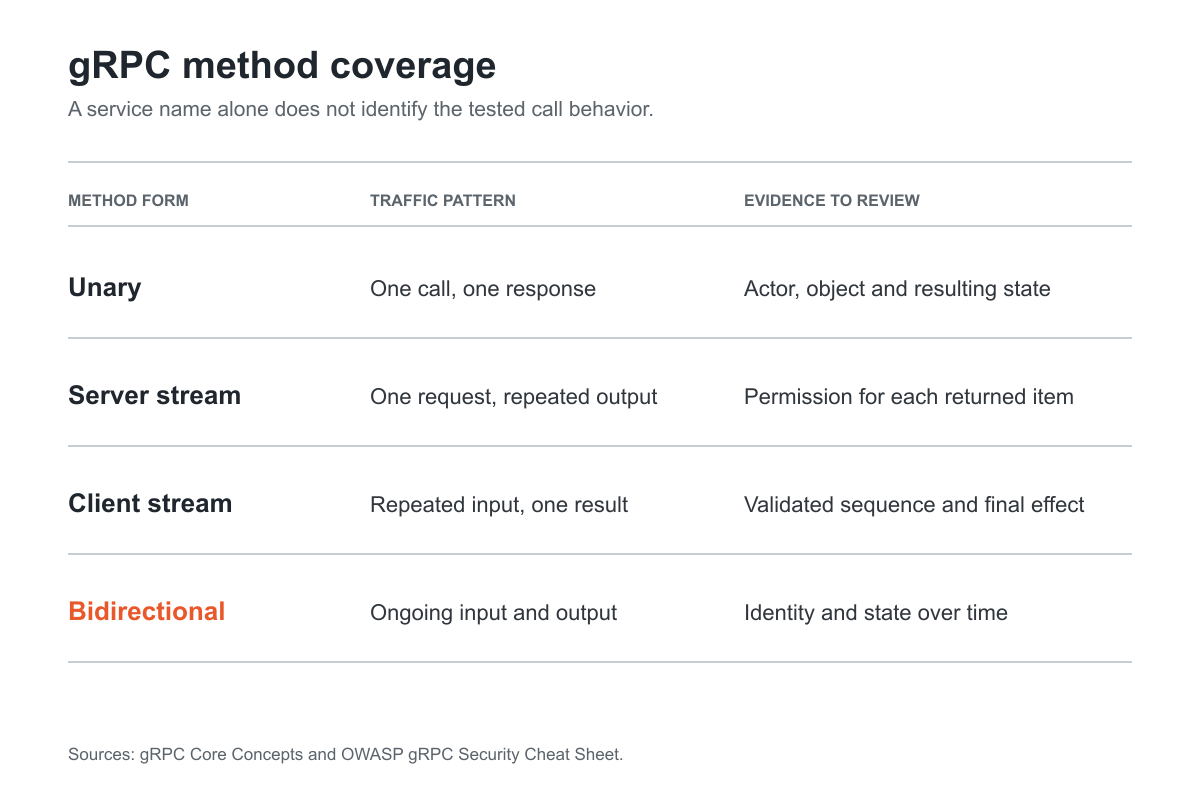
Figure 1: A proposed buyer matrix for the four gRPC method forms and their evidence needs. Sources: gRPC core concepts and the OWASP gRPC Security Cheat Sheet.
Method form | Scope question | Evidence to request |
|---|---|---|
Unary | Is this identity allowed to call the method on this object? | Allowed baseline, denied comparison, and resulting state |
Server streaming | May this caller receive each item over time? | Authorized and forbidden stream fixtures, including a privilege change if relevant |
Client streaming | Are messages validated and authorized throughout the input sequence? | Bounded message sequence and observed outcome |
Bidirectional streaming | Does the service preserve identity and permission rules while both sides communicate? | Controlled state transitions and redacted event trace |
This matrix is an editorial scope aid, not a claim that every method needs every scenario. It should reflect the service's actual behavior and the buyer's approved policy. A provider should mark a method as not applicable only when the method form or workflow does not exist. Missing credentials or network access should be reported as an exclusion.
Compare gRPC pentest quotes on what they actually cover
Send each bidder the same proto inventory, deployed service list, method forms, roles, tenant fixtures, environment, and gateway diagram. Ask how many methods and business workflows they will exercise, whether they will inspect metadata identity, whether streaming methods are included, and what source or configuration access they require. Ask for the deliverables and retest terms in writing.
One provider may quote the outer gateway only. Another may include the internal gRPC service and downstream object authorization. Those are different purchases. Likewise, a unary-method test and an assessment of long-lived streams are different scopes even if they share a service name. Compare the proposed evidence, not just the number of endpoints or the phrase “API Top 10.”
A useful clause reads: “Assess the named gRPC services and deployed methods using supplied proto definitions and controlled client identities. Test channel and call identity, metadata handling, method and object authorization, business rules, and the in-scope unary and streaming methods. Document the gateway boundary, safe operating limits, redacted findings, a method-by-role coverage matrix, exclusions, remediation guidance, and retest results.” Adapt it to the system's architecture and legal authorization.
Ask what the provider will do when the proto inventory does not match the deployed service. A strong proposal describes how that gap will be recorded and whether the extra method is covered under the quoted effort. The answer protects the buyer from receiving a neat report that omits a legacy or internal interface.
Where Stingrai fits
Stingrai's API penetration testing service names gRPC, REST, GraphQL, and SOAP. The service scopes APIs using protobuf definitions alongside roles, tenants, and environments, and it tests authorization and business logic directly. A gRPC buyer should provide the method inventory and gateway boundary during scoping so that the quote states which unary and streaming paths are included.
Stingrai offers human-led API assessments and one-time or continuous testing programs. The published fixed web application packages cover one web application and associated APIs; a standalone or larger gRPC service should receive a custom scope and quote. The penetration test can supply technical evidence for an enterprise security review and a compliance program.
Frequently Asked Questions
What should a gRPC API penetration test cover?
A gRPC API penetration test should cover the deployed services and methods, identities conveyed through channels and calls, metadata handling, method and object authorization, business rules, and any unary or streaming methods in scope. The buyer should provide proto definitions, controlled roles, expected access decisions, and safe fixtures. The report should include method-level coverage and redacted evidence.
Is a REST API penetration test enough for gRPC?
Only if the signed scope also includes the gRPC methods and their identity and streaming behavior. A REST gateway may expose some business operations without revealing every internal method or the way a stream behaves. The buyer should ask whether the assessment covers the gateway, the backend gRPC service, or both.
What does a buyer need to provide for a gRPC assessment?
Provide current proto files or equivalent definitions, service addresses, client roles, credential types, expected object and tenant permissions, an environment with synthetic data, and an engineering contact. List the deployed streaming methods and any gateway or service mesh path. Share actual credentials only through the engagement's secure channel.
Why do unary and streaming methods need separate scope lines?
Unary calls have one request and one response. Streaming methods can process or return multiple messages while a connection persists, so the assessment may need to check identity, authorization, state changes, and resource limits over time. OWASP notes that a unary authentication interceptor does not automatically protect streaming methods.
Does mutual TLS prove a gRPC method is authorized?
No. Mutual TLS can identify communicating peers and protect transport, but the service still has to decide whether the caller may invoke a method or act on a particular customer object. The buyer should ask for permitted and forbidden tests tied to its business policy rather than accepting a successful channel connection as proof of authorization.
Can a gRPC pentest test tenant isolation?
Yes, when the buyer supplies controlled identities and objects in separate tenants and includes the relevant methods in scope. The provider should compare an allowed baseline with forbidden object and field access across tenants. The final report should identify which tenant pairs and methods were tested and which were excluded.
Should gRPC reflection be enabled for testing?
The buyer can provide proto definitions whether or not production reflection is enabled. The provider should record the actual deployed discovery path and compare it with the approved inventory. Any recommendation about production reflection should follow the system's security design and the agreed test objective, not a blanket assumption about every environment.
Can a gRPC test safely include resource limits?
Bounded checks and configuration review can assess some limits under agreed rules of engagement. Broad load or denial-of-service testing needs separate authorization, a defined environment, stop conditions, and operational contacts. The report should state which resource behaviors were tested and which were excluded for safety.
What should the gRPC pentest report show?
It should name the tested services, methods, method forms, roles, tenant fixtures, gateway boundary, environment, exclusions, findings, and retest outcomes. Each finding should tie a redacted call or state trace to the expected rule and observed business effect. A method-by-role matrix helps an enterprise reviewer distinguish an observed denial from an untested path.
How is a gRPC API pentest priced?
The quote should reflect the deployed services and methods, roles, tenant fixtures, streaming behavior, gateway access, source or configuration review, reporting, and retesting. A raw method count alone cannot show how much authorization work is required. Stingrai's published pricing covers one web application and associated APIs; standalone or larger gRPC scope is quoted through Get a Quote.
Related reading
References
Talk to Stingrai
Use Get a Quote to share the service and method inventory, or book a free discovery call to define the gRPC gateway, identities, streams, and safe test environment.